Explore how sexuality and relationships shape emotional, psychological, and spiritual wellbeing, with practical insight rooted

September 17, 2026 (1mo ago)
Sexuality and Relationships: A Life-Path Guide
Explore how sexuality and relationships shape emotional, psychological, and spiritual wellbeing, with practical insight rooted
← Back to blog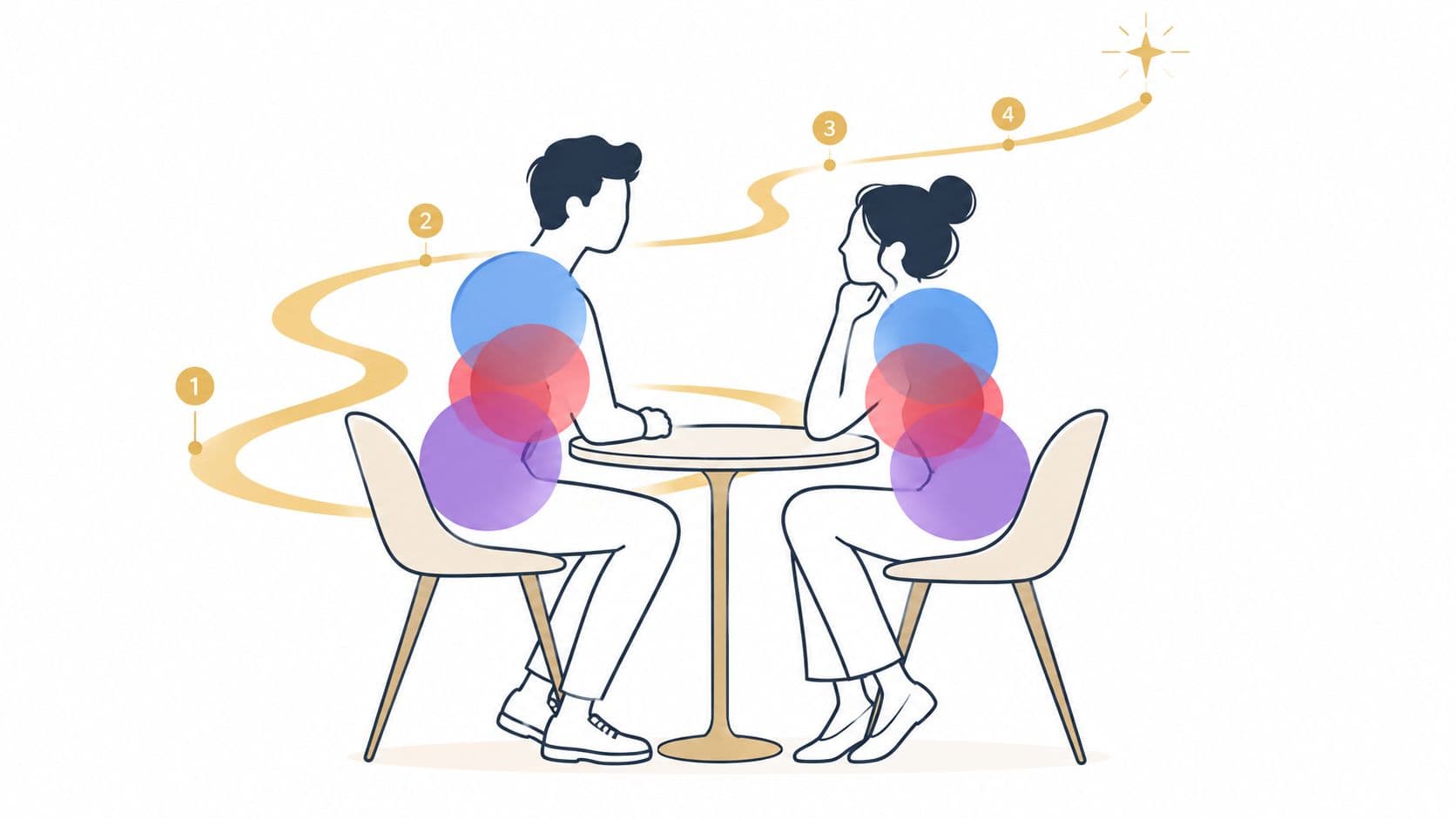
Explore how sexuality and relationships shape emotional, psychological, and spiritual wellbeing, with practical insight rooted
You're sitting across from someone you love, sharing the same room but not quite the same emotional world. Conversation has become practical, affection feels harder to initiate, and neither of you can identify one dramatic event that caused the distance. You may wonder whether the problem is sexual, emotional, relational, or simply the result of stress accumulating unnoticed.
Questions about sexuality and relationships rarely stay inside the bedroom. They involve trust, body image, attachment, communication, personal history, safety, and the meaning someone gives to closeness. The same search for connection can also shape friendships, family bonds, and work partnerships. People often want intimacy, but they don't always know which form of intimacy they need or how to explain it.
Dan Millman's The Life You Were Born to Live offers one symbolic way to examine those patterns through 45 life paths. Used carefully, the system can act like a personal map. It shouldn't replace honest conversation, health care, or professional support, but it can help you notice recurring needs without turning either partner into a fixed label.
When Intimacy Feels Off and Nobody Can Explain Why
The couple at the kitchen table has tried the obvious questions. “Are you tired?” “Is something wrong?” “Do you still want to be together?” Each question lands heavily because neither person has a clean answer. They care about each other, yet their usual rhythm of touch, humor, and emotional openness has thinned out.
This quiet drift is a common starting point for exploring relationship dynamics. One partner may want more physical affection, while the other longs for emotional reassurance before touch feels inviting. Stress, resentment, changing self-esteem, health concerns, family history, or fear of rejection may all be present, but the couple experiences them as one confusing distance.
Sexuality gives us a wider vocabulary for that experience. It includes how people relate to their bodies, how they experience desire, how they ask for closeness, and how they respond to vulnerability. It also includes moments that confuse or unsettle them after sex. Someone who feels sadness, emptiness, or agitation afterward may benefit from learning what is postcoital dysphoria, especially if the reaction keeps returning and feels difficult to explain.
The same pattern appears beyond sex
A person who withdraws during intimate conversations may also go quiet during conflict at work. Someone who overfunctions for a partner may take responsibility for every family problem. A person who needs admiration before feeling secure may experience criticism as rejection in several parts of life.
That doesn't mean one personality explanation solves every relationship difficulty. It means recurring reactions deserve curiosity rather than shame. A useful starting point is to ask, “What do I protect when I pull away?” or “What am I hoping my partner will understand without my having to say it?”
Understanding intimacy in a relationship becomes clearer when you look beyond sexual activity and examine the emotional message underneath it. A life-path framework can add another lens, helping you map familiar patterns while leaving room for choice, growth, and the actual history of the people involved.
What Sexuality Really Means in a Relationship Context
The World Health Organization defines sexual health as a state of physical, emotional, mental, and social well-being in relation to sexuality, not merely the absence of disease, dysfunction, or infirmity. Its global sexual and reproductive health portal covers sexual health, infertility, sexually transmitted infections, family planning, cervical cancer, and violence against women, with content last updated in August 2026. The WHO's 2025 estimate that 840 million women, nearly 1 in 3, have experienced partner or sexual violence during their lifetime, including 316 million affected in the previous 12 months, shows why sexuality must be understood alongside safety, public health, and social policy. WHO sexual and reproductive health data
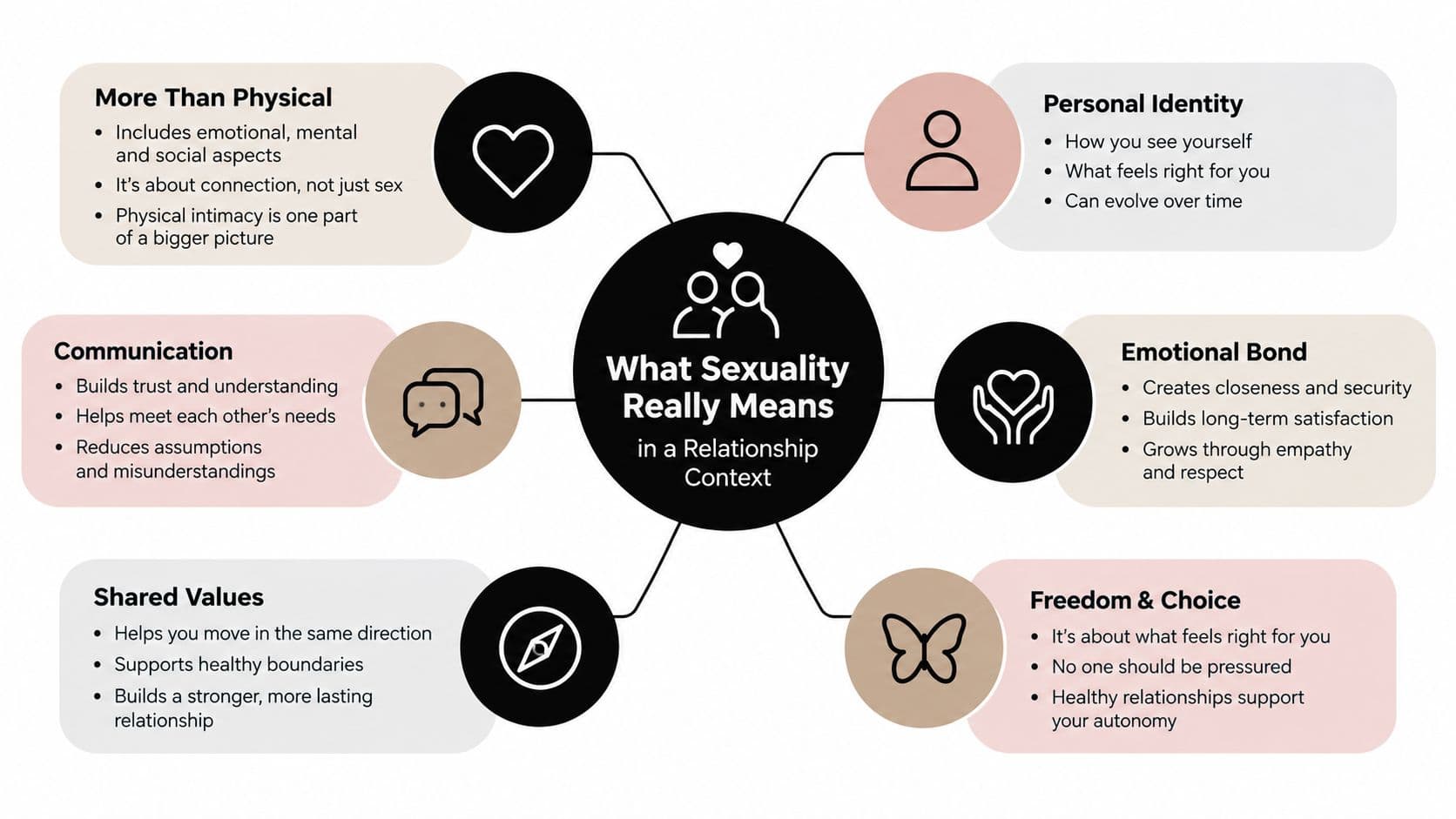
Think of sexuality as a language. People learn different accents from family messages, culture, religion, past relationships, media, and personal experience. Two partners may both want closeness but use different words, timing, gestures, and expectations to express it.
Three layers shape the language
The psychological layer includes attachment history, self-esteem, body image, and past experiences. A person who learned that affection could disappear without warning may seek frequent reassurance. Someone who has experienced criticism about their body may need patience and acceptance before desire can feel relaxed.
The emotional layer concerns vulnerability and trust. Can you say that you want more affection without demanding it? Can you name a boundary without fearing punishment? Can you hear “not tonight” without treating it as a verdict on your worth?
The spiritual layer asks what intimacy means. Some people experience sex as play, comfort, devotion, exploration, or a way to feel connected to something larger than individual identity. Others find meaning in a committed partnership without centering sex at all. Neither perspective becomes healthy just because it is spiritual. Meaning still needs consent, respect, and mutual care.
Inside a relationship, partners constantly translate between these inner worlds. That translation becomes visible in daily conversations, physical affection, conflict, and the ways each person defines a satisfying life together.
Where Sexuality and Relationships Intersect
Sexuality and relationships meet in several practical places. Separating those places helps you ask better questions instead of treating every difficulty as a problem of desire.
Communication comes first. A multilevel meta-analysis of 93 studies with 38,499 participants found positive associations between sexual communication and relationship satisfaction, r = .37, and between sexual communication and sexual satisfaction, r = .43. The strongest associations involved communication quality, which showed relationships of r = .43 with relationship satisfaction and r = .52 with sexual satisfaction, compared with frequency, which showed r = .31 for both outcomes. Meta-analysis of sexual communication
Satisfaction is related to, but not identical with, relationship happiness. In a longitudinal study of 2,104 mixed-gender newlywed couples, earlier sexual satisfaction predicted later relationship satisfaction, while earlier relationship satisfaction didn't significantly predict later sexual satisfaction. Longitudinal study of sexual and relationship satisfaction
Safety creates the baseline for vulnerability. Physical safety includes freedom from coercion and violence. Emotional safety means a person can express desire, uncertainty, or refusal without intimidation, ridicule, retaliation, or pressure. Without that baseline, communication techniques can become superficial.
Identity shapes what each person brings into the partnership. Gender, orientation, values, body experience, relationship history, faith, and personal goals all affect the meaning of intimacy. A partner's needs aren't automatically unreasonable because they differ from yours.
| Intersection | What It Covers | Key Evidence |
|---|---|---|
| Communication | Requests, boundaries, feedback, and emotional disclosure | Quality of sexual communication has stronger associations with satisfaction than frequency in a 93-study meta-analysis. |
| Satisfaction | Pleasure, fulfillment, affection, and relationship quality | Earlier sexual satisfaction predicted later relationship satisfaction in a longitudinal study of newlywed couples. |
| Safety | Consent, freedom from coercion, trust, and emotional security | The WHO frames sexual health within broad well-being and documents the connection between sexuality, violence, and public health. |
| Identity | Values, body image, orientation, history, and meaning | Individual differences shape how partners interpret desire, closeness, and commitment. |
These intersections describe patterns, not diagnoses. Dan Millman's life-path framework can add a personalized layer by asking why certain needs, defenses, and conflicts feel especially familiar to you.
Life Paths as a Map for Sexual Patterns and Needs
Dan Millman presents a 45-life-path system in The Life You Were Born to Live. The system connects a birth date with a path that describes recurring strengths, blind spots, and developmental lessons. Applied to sexuality and relationships, it can help you reflect on how you pursue closeness, protect yourself, handle desire, and respond when a partner's needs differ from your own.
A life path works better as a map than as a verdict. A map doesn't force you to take one road. It shows terrain that may require attention, such as a tendency to control, withdraw, rescue, perform, or seek constant approval.
Read patterns as invitations
A path oriented toward leadership might value respect, directness, and clear roles. In intimacy, that person may feel most open when they trust their partner's competence and honesty. The same strength can become a blind spot if leadership turns into control or if vulnerability feels like weakness.
A path centered on service might naturally express love through care, practical help, and emotional availability. That person may create deep warmth, but could also confuse being needed with being loved, giving more than they can sustain and then feeling resentful.
These examples aren't predictions about anyone's sexual behavior. They illustrate how a personal-development language can help someone ask useful questions:
- Notice the strength: What do I naturally contribute to closeness?
- Name the blind spot: When does that strength become pressure, avoidance, or self-neglect?
- Identify the lesson: What behavior would create more mutuality?
- Choose a practice: What can I say or do differently this week?
Use The Life You Were Born to Live and the Life Purpose App as references for the system itself. Then compare the description with lived experience rather than forcing your experience to match the description. Exploring your own life-path number may surface motivations behind attraction, conflict, emotional withdrawal, or the wish to be pursued.
Reading Compatibility Through the Life Purpose App
Compatibility becomes more useful when it moves beyond the question, “Are we a match?” People rarely need a simple yes or no. They need language for understanding why admiration appears in one area while friction keeps returning in another.
The Life Purpose App translates the life-path approach from The Life You Were Born to Live into an interactive format. By entering two life-path numbers, users can explore complementary qualities, shared developmental themes, and possible areas of tension within the system's logic. The result is a starting point for reflection, not a promise about what a relationship will become.
Consider a representative pairing between a visionary path and a grounding path. The visionary partner may bring imagination, possibility, and enthusiasm. The grounding partner may offer steadiness, follow-through, and attention to practical details. Each may admire what the other contributes, while also feeling misunderstood. One might experience the other as limiting; the other might experience the first as unreliable.
Turn interpretation into conversation
A compatibility reading can help partners ask:
- “Where do we naturally support each other?”
- “Which difference keeps becoming a misunderstanding?”
- “What does respect look like for each of us?”
- “Where do we need clearer language about affection, sex, time, or commitment?”
The app's general tendencies shouldn't replace direct observation. If a partner says they feel pressured, that information matters more than a symbolic description. If someone names a boundary, the ethical response is to respect it, regardless of any compatibility pattern.
The relationship compatibility by birthdate approach works best before a difficult conversation, not instead of one. Read the pairing, underline the parts that feel recognizable, and bring only those observations that can support curiosity. Compatibility isn't the absence of difference. It is the ability to work with difference without erasing either person.
Healthy Practices That Strengthen Sexual Connection
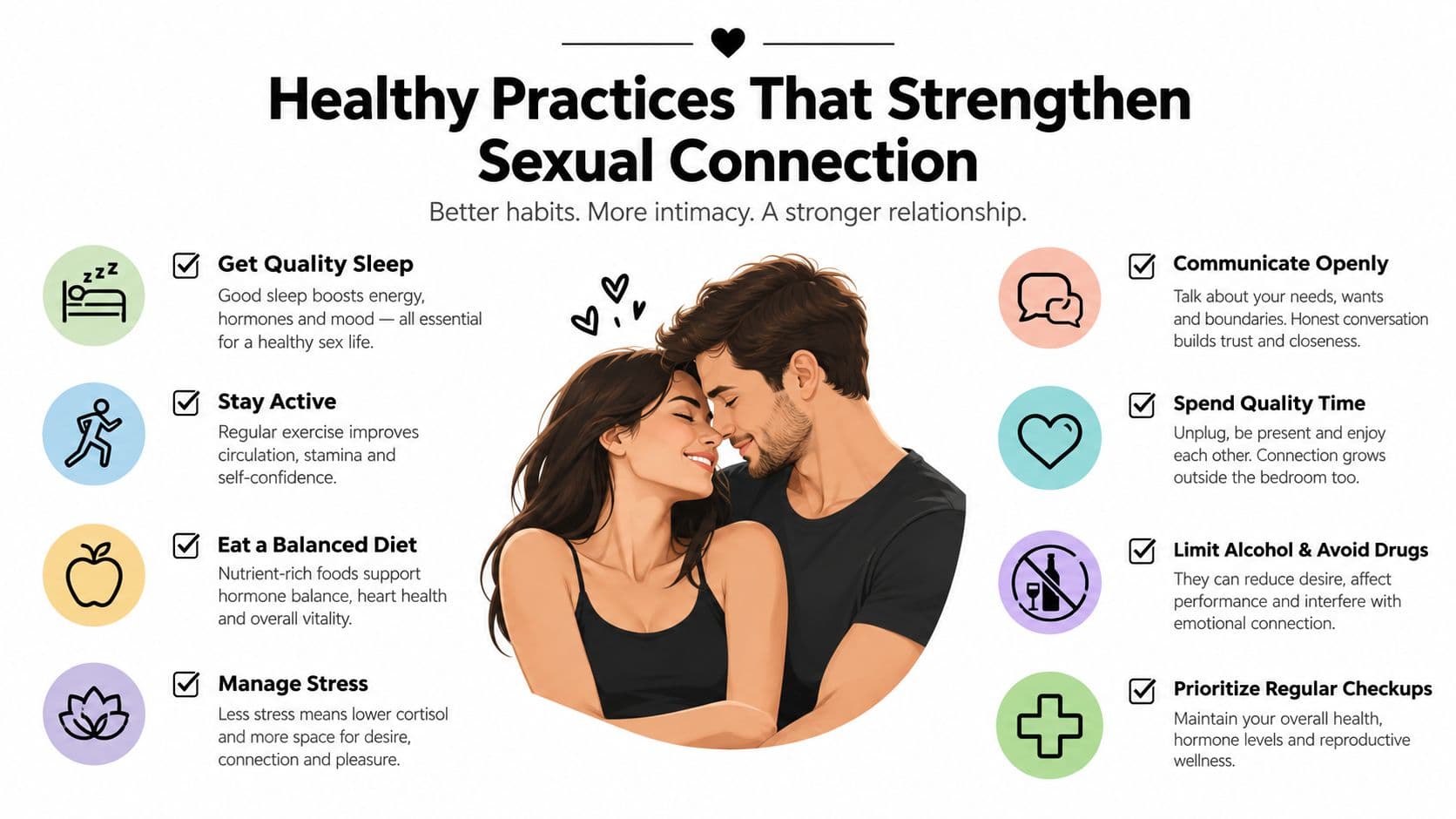
Healthy sexual connection grows through repeated actions. Four practices make the strongest foundation: sexual communication, mutual consent, emotional honesty, and self-knowledge.
Talk about sex before a crisis
The 93-study meta-analysis cited earlier distinguishes communication quality from communication frequency. More conversations aren't automatically better if they are vague, defensive, or pressuring. A thoughtful conversation can be brief and still useful.
Try asking, “What helps you feel wanted without feeling obligated?” or “Is there a kind of touch you'd enjoy more often?” Keep the setting low pressure. A walk, quiet evening, or regular relationship check-in may feel safer than raising the subject immediately after disappointment.
Make consent specific and ongoing
Consent isn't a general permission slip. It applies to the activity happening now, and it can change during the experience. Partners should be able to pause, decline, renegotiate, or ask questions without punishment.
Practical rule: A clear “yes” matters, and a partner must also feel free to change their mind.
Share emotional information without blame
Instead of “You never want me,” try “I feel unwanted when we go for long periods without affection, and I want to understand what makes closeness easier for you.” This wording doesn't guarantee agreement, but it gives the other person something they can respond to.
Pacing matters too. Resources on pacing and touch for deeper connection can help couples think about touch as communication rather than a race toward a particular outcome.
Build self-knowledge
Reflect on your own patterns before asking a partner to solve them. Notice what your life-path description brings into focus. Do you seek reassurance, autonomy, novelty, predictability, caretaking, or admiration? Which need can you express directly instead of hoping your partner will infer it?
The emotional intelligence in relationships perspective is useful here because self-awareness and empathy belong together. Understanding your feelings doesn't make every impulse right, but it gives you more choice in how you act.
Rethinking Modern Relationship Norms and Expectations
A relationship doesn't become unhealthy just because it doesn't follow a familiar sexual timeline. Some people date later, have little partnered sex, prefer nonsexual intimacy, or build closeness through digital spaces. The better question is whether the arrangement is chosen, consensual, emotionally sustainable, and honest.
One 2025 Kinsey-linked survey reported that one in four Gen Z adults aged 18 to 24 had not experienced partnered sex yet. The Guardian's report on Gen Z sex and dating places delayed sexual experience within a wider cultural conversation about dating, connection, and expectations. That doesn't tell us what any individual wants. It does challenge the assumption that everyone is moving through intimacy at the same pace.
Replace automatic assumptions
Low sex doesn't automatically mean low love. Sexual frequency and sexual satisfaction are different measures. A couple may value affection, companionship, shared purpose, or nonsexual touch more than a cultural script expects.
Delayed dating doesn't automatically mean personal failure. People may face social anxiety, disability, health needs, financial pressure, changing priorities, or simple lack of interest. Accessible communities, including dating sites for disabled people, can offer options that recognize different practical realities.
AI-mediated intimacy isn't automatically equivalent to human intimacy. Digital companionship may provide reflection, routine, or a sense of being heard, but it also raises questions about privacy, reciprocity, dependency, and whether the experience supports or replaces desired human relationships. A chatbot can respond, but it doesn't share human vulnerability or mutual responsibility in the same way a partner does.
Ask three questions before judging your relationship against a norm: “Do we both feel respected?” “Can we speak openly about what we want?” and “Does this pattern support our wellbeing?” Those answers matter more than comparison with an imagined universal timetable.
Bringing It All Together for Lasting Intimacy
Lasting intimacy is less like reaching a permanent destination and more like maintaining a shared home. The psychological layer helps you understand your history, defenses, and needs. The emotional layer helps you communicate vulnerability and respond with care. The spiritual layer helps you decide what the relationship means and what kind of life you want to build through it.
The WHO's broad definition keeps sexuality connected to whole-person well-being. Research on communication and satisfaction shows why honest dialogue matters. Consent and safety establish the conditions for trust. Life-path reflection, drawn from Dan Millman's The Life You Were Born to Live, can act as a personal compass for recognizing patterns that might otherwise remain invisible.
A compass doesn't predict the weather or choose your destination. It gives you orientation. Your life path can't excuse controlling behavior, prove that two people are destined to stay together, or replace medical, therapeutic, or safety support. It can help you notice whether you keep pursuing admiration when you need reassurance, offering care when you need reciprocity, or withdrawing when you need to ask for comfort.
Intimacy becomes more durable when insight leads to a specific action.
Choose one conversation rather than attempting a complete relationship overhaul. Name one desire without making it a demand. State one boundary clearly. Ask your partner what helps them feel safe. Then listen long enough to learn something you didn't already know.
Sexuality and relationships change as bodies, identities, circumstances, and expectations change. A fulfilling partnership doesn't require constant intensity or perfect compatibility. It requires enough honesty, consent, curiosity, and shared effort for both people to remain real inside the connection.
The Life Purpose App helps you explore Dan Millman's 45 life paths, relationship dynamics, and compatibility themes through birth-date-based self-knowledge. Visit Life Purpose App to examine your own patterns and use that insight as a starting point for more honest conversations about intimacy, needs, and connection.
Discover your life path today
Enter your date of birth and see your life path, free.
Find your life path