Explore the deep connection between sexuality and spirituality. This guide covers historical views, modern integration, and practical ways to find harmony.
August 10, 2026 (1mo ago)
Sexuality and Spirituality: A Guide to Wholeness
Explore the deep connection between sexuality and spirituality. This guide covers historical views, modern integration, and practical ways to find harmony.
← Back to blog
You're lying awake after a spiritual practice, a breakup, a sermon, or a long conversation with yourself, and the same question keeps circling back. Can you be fully sexual and still be spiritually grounded, or does one cancel out the other?
For a lot of people, that question doesn't feel abstract. It shows up as shame, desire, confusion, grief, or a quiet sense that some part of the self has been split off and hidden away. That tension is real, but it doesn't mean the two parts of you are enemies.
More Than Just Opposites
A woman can leave a meditation retreat feeling calm and then feel unsettled the moment she notices attraction again. A man can pray, journal, or attend services and still feel pulled toward touch, fantasy, or intimacy that doesn't fit the version of himself he thinks he should be. Those moments can feel like failure, but they're often just signs that two powerful human needs are asking to be understood together.
A large-scale survey of over 3,800 women found that sexual experiences were often perceived as more than just physical, connecting them to a sense of self, their partner, and even a spiritual or divine presence, and that this connection was correlated with better personal and relational health. That doesn't mean every sexual experience feels sacred. It does mean many people already experience intimacy as something richer than body mechanics alone.
Why the conflict feels so personal
The pain usually isn't just about sex. It's about meaning, belonging, and identity. If you were taught that desire makes you less pure, or that spirituality means rising above the body, then attraction can feel like a betrayal instead of a part of being alive.
That's why curiosity matters more than dogma here. The question isn't “How do I become acceptable?” The question is “What does my body, my history, and my inner life need?”
Practical rule: if your sexuality always comes with dread, pause and ask whether the dread belongs to your values, your conditioning, or a wound that needs care.
For some readers, the first act of integration is admitting that pleasure and devotion don't have to be opposites. They can live in the same person, even if they don't always show up in the same moment.
Defining the Deep Connection
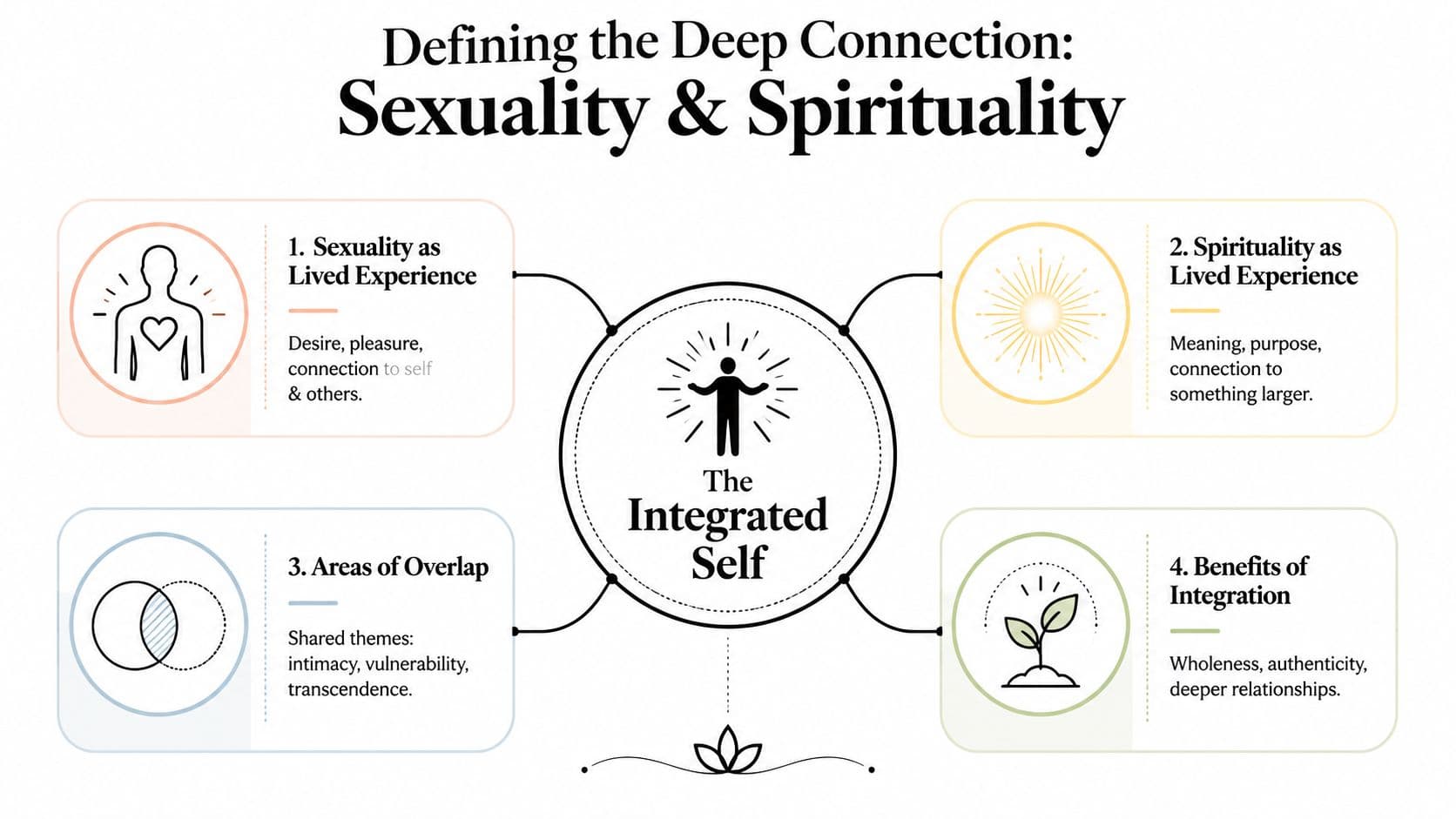
Two lived experiences, not two labels
Sexuality is more than behavior. It includes desire, pleasure, attachment, embodiment, and how you relate to your own aliveness. Spirituality is also more than doctrine. It includes meaning, transcendence, awe, purpose, and the sense that life is connected to something larger than the self.
Psychological research has formalized the integration of sexuality and spirituality by identifying four key measurable dimensions: viewing sex as sacred, experiencing transcendence, having peak experiences, and acknowledging sexual experience's spiritual importance. That matters because it gives people language for something many already feel but don't know how to name. The conversation shifts from vague conflict to specific inner experiences. See the scale-based research on sexuality and spirituality integration.
What overlap can look like
Some people notice a feeling of surrender during intimacy. Others describe deep trust, presence, reverence, or a sense of being fully seen. None of that requires a particular theology. It means the experience of sex can touch identity, connection, and meaning all at once.
If you want a useful way to sort your own experience, ask three questions. Does this feel embodied? Does this feel connected? Does this feel meaningful? If the answer is yes to all three, you're probably in the overlap where sexuality and spirituality meet.
For readers who like structured self-inquiry, a related lens is available in the mind's impact on intimacy, especially if you've noticed how thoughts, beliefs, and attention shape what your body can receive. Mind and body never show up separately in real life, so it makes sense that intimacy doesn't either.
A helpful reframe is this, spiritual depth doesn't erase physical sensation. It often makes sensation more noticeable, more honest, and harder to ignore.
A Tangled History of Separation and Union
Human cultures have never agreed on what sex means. Some religious traditions have treated the body as suspect and celibacy as a higher calling, which left many people with the message that desire is a distraction from the sacred. Other traditions, including Eastern and esoteric streams, have treated sexual energy as something that can be transformed, refined, or used as a path toward awakening.
That split still lives in modern people. Some inherited a story of restraint and purity. Others inherited a story of liberation and embodied spirituality. Often, individuals inherited a mix of both, plus family rules, cultural pressure, and private experiences that made the body feel either holy, dangerous, or both.
Why LGBT people often feel the split more sharply
A 2025 Pew Research Center survey found that 48% of U.S. LGBT adults identified with a religion, compared with 73% of non-LGBT Americans, while 52% of LGBT adults were religiously unaffiliated compared with 26% of non-LGBT adults. The same survey found that 17% of LGBT adults said religion is very important to them personally, compared with 42% of non-LGBT adults, yet 80% of lesbian, gay, or bisexual adults believed people have a soul or spirit in addition to the physical body. It also found that 69% believed in something spiritual beyond the natural world. Read the Pew Research Center survey on religion and spirituality among LGBT Americans.
That mix matters. Many sexual-minority adults are less tied to institutions, but they haven't abandoned inner life. They've often kept the spiritual questions while stepping away from communities that didn't feel safe, affirming, or honest about sexuality.
What this history can free you from
If you feel torn, it may not be because you're inconsistent. It may be because you're carrying a history that never made peace with the body. You can't always heal that by trying harder to fit in.
You can, however, start noticing where your fears came from. That question alone creates room for a more authentic path.
Navigating Common Tensions and Myths
One of the biggest myths is that true spirituality requires celibacy. Another is that sex is automatically sinful, lower, or spiritually immature. A third is the reverse, that spiritual sex has to look a certain way to count as meaningful. All three create unnecessary pressure and make honest self-understanding harder.
The research doesn't support a neat moral shortcut. A systematic review of 59 studies found that 78% reported a significant relationship between religiosity or spirituality and compulsive sexual behavior, with most showing a small-to-moderate positive correlation. That complicates the simple idea that spirituality always produces restraint. Review the systematic summary of religiosity, spirituality, and compulsive sexual behavior.
Why “spiritual” doesn't automatically mean “safe” or “good”
Another study in the same research area found that spirituality, distinct from religiousness, was associated with a greater number of sexual partners and more frequent condomless sex in young adults. That doesn't make spirituality bad. It does mean the relationship between inner life and sexual behavior is more complex than many people assume.
So the useful question isn't whether spirituality is on your side or against you. The useful question is whether your values, your choices, and your behavior are aligned. A person can be spiritual and still act impulsively. A person can be highly religious and still struggle with desire, secrecy, or shame.
Clear takeaway: if a belief system makes you afraid to look honestly at your behavior, it's probably obscuring insight instead of creating it.
Many people find themselves stuck. They think the goal is to choose between repression and indulgence. In practice, the healthier path is usually a third option, discernment. You can honor desire without treating every desire as a command.
The most grounded stance is often the least dramatic one. Pay attention. Tell the truth. Let your ethics be concrete instead of symbolic.
Practical Paths to Healthy Integration
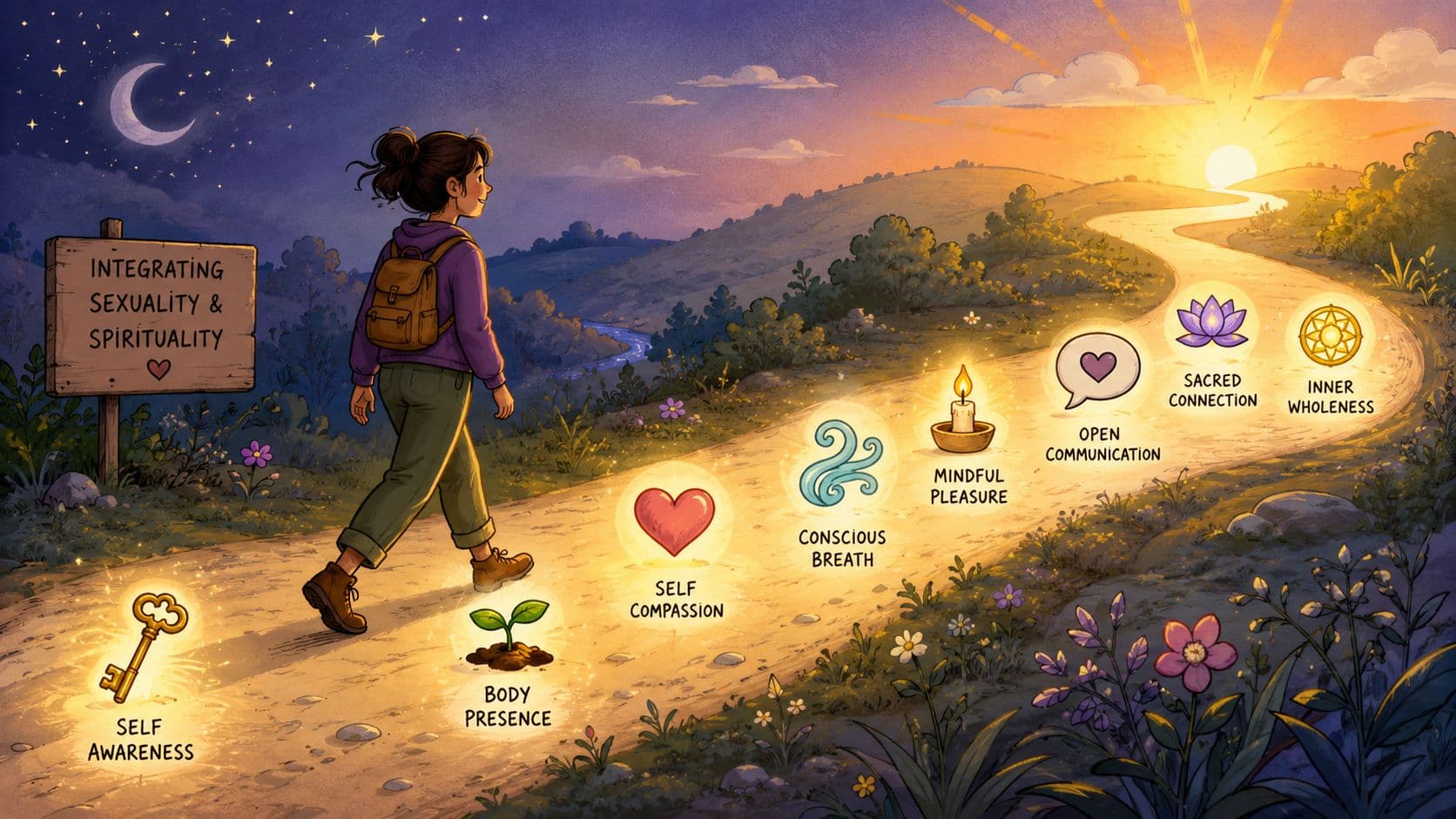
Start with the body, not the argument
You don't have to solve the whole philosophy to begin. Notice what happens in your body when attraction, guilt, tenderness, or longing shows up. Tight chest, shallow breathing, numbness, warmth, restlessness, and ease can all be data.
If a practice helps you slow down and feel more honest, it's useful. If it pushes you toward performance or self-judgment, it's not. That's why simple somatic work can be more effective than trying to think your way into peace.
For people who want a grounded clinical frame, holistic healing through somatic therapy can be a relevant starting point because it treats the body's responses as meaningful rather than embarrassing. That approach fits well with the reality that sexuality is lived through sensation, timing, safety, and attention.
Use practices that build trust
A few gentle options can help:
- Breath before touch: take slow breaths and notice whether your body softens or braces. This helps you see what's happening before you act.
- Name the feeling out loud: say “I feel curious,” “I feel guarded,” or “I feel tender.” Naming a state often makes it easier to stay present with it.
- Set one consent question: ask, “What kind of touch feels good right now?” That keeps intimacy anchored in mutuality.
- Create a short arrival ritual: sit together in silence for a minute, hold hands, or make eye contact before moving into closeness.
These aren't performance tricks. They're ways of teaching your nervous system that intimacy can be honest and safe.
If language about energy, embodiment, and spiritual movement resonates with you, the ideas can offer another symbolic framework. Not everyone uses that language, but many people find it helpful for mapping inner experience.
A Tangled History of Separation and Union
Human cultures have never agreed on what sex means. Some religious traditions have treated the body as suspect and celibacy as a higher calling, which left many people with the message that desire is a distraction from the sacred. Other traditions, including Eastern and esoteric streams, have treated sexual energy as something that can be transformed, refined, or used as a path toward awakening.
That split still lives in modern people. Some inherited a story of restraint and purity. Others inherited a story of liberation and embodied spirituality. Often, individuals inherited a mix of both, plus family rules, cultural pressure, and private experiences that made the body feel either holy, dangerous, or both.
Why LGBT people often feel the split more sharply
A 2025 Pew Research Center survey found that 48% of U.S. LGBT adults identified with a religion, compared with 73% of non-LGBT Americans, while 52% of LGBT adults were religiously unaffiliated compared with 26% of non-LGBT adults. The same survey found that 17% of LGBT adults said religion is very important to them personally, compared with 42% of non-LGBT adults, yet 80% of lesbian, gay, or bisexual adults believed people have a soul or spirit in addition to the physical body. It also found that 69% believed in something spiritual beyond the natural world. Read the Pew Research Center survey on religion and spirituality among LGBT Americans.
That mix matters. Many sexual-minority adults are less tied to institutions, but they haven't abandoned inner life. They've often kept the spiritual questions while stepping away from communities that didn't feel safe, affirming, or honest about sexuality.
What this history can free you from
If you feel torn, it may not be because you're inconsistent. It may be because you're carrying a history that never made peace with the body. You can't always heal that by trying harder to fit in.
You can, however, start noticing where your fears came from. That question alone creates room for a more authentic path.
Navigating Common Tensions and Myths
One of the biggest myths is that true spirituality requires celibacy. Another is that sex is automatically sinful, lower, or spiritually immature. A third is the reverse, that spiritual sex has to look a certain way to count as meaningful. All three create unnecessary pressure and make honest self-understanding harder.
The research doesn't support a neat moral shortcut. A systematic review of 59 studies found that 78% reported a significant relationship between religiosity or spirituality and compulsive sexual behavior, with most showing a small-to-moderate positive correlation. That complicates the simple idea that spirituality always produces restraint. Review the systematic summary of religiosity, spirituality, and compulsive sexual behavior.
Why “spiritual” doesn't automatically mean “safe” or “good”
Another study in the same research area found that spirituality, distinct from religiousness, was associated with a greater number of sexual partners and more frequent condomless sex in young adults. That doesn't make spirituality bad. It does mean the relationship between inner life and sexual behavior is more complex than many people assume.
So the useful question isn't whether spirituality is on your side or against you. The useful question is whether your values, your choices, and your behavior are aligned. A person can be spiritual and still act impulsively. A person can be highly religious and still struggle with desire, secrecy, or shame.
Clear takeaway: if a belief system makes you afraid to look honestly at your behavior, it's probably obscuring insight instead of creating it.
Many people find themselves stuck. They think the goal is to choose between repression and indulgence. In practice, the healthier path is usually a third option, discernment. You can honor desire without treating every desire as a command.
The most grounded stance is often the least dramatic one. Pay attention. Tell the truth. Let your ethics be concrete instead of symbolic.
Practical Paths to Healthy Integration
Start with the body, not the argument
You don't have to solve the whole philosophy to begin. Notice what happens in your body when attraction, guilt, tenderness, or longing shows up. Tight chest, shallow breathing, numbness, warmth, restlessness, and ease can all be data.
If a practice helps you slow down and feel more honest, it's useful. If it pushes you toward performance or self-judgment, it's not. That's why simple somatic work can be more effective than trying to think your way into peace.
For people who want a grounded clinical frame, holistic healing through somatic therapy can be a relevant starting point because it treats the body's responses as meaningful rather than embarrassing. That approach fits well with the reality that sexuality is lived through sensation, timing, safety, and attention.
Use practices that build trust
A few gentle options can help:
- Breath before touch: take slow breaths and notice whether your body softens or braces. This helps you see what's happening before you act.
- Name the feeling out loud: say “I feel curious,” “I feel guarded,” or “I feel tender.” Naming a state often makes it easier to stay present with it.
- Set one consent question: ask, “What kind of touch feels good right now?” That keeps intimacy anchored in mutuality.
- Create a short arrival ritual: sit together in silence for a minute, hold hands, or make eye contact before moving into closeness.
These aren't performance tricks. They're ways of teaching your nervous system that intimacy can be honest and safe.
If language about energy, embodiment, and spiritual movement resonates with you, the ideas can offer another symbolic framework. Not everyone uses that language, but many people find it helpful for mapping inner experience.
A Tangled History of Separation and Union
Human cultures have never agreed on what sex means. Some religious traditions have treated the body as suspect and celibacy as a higher calling, which left many people with the message that desire is a distraction from the sacred. Other traditions, including Eastern and esoteric streams, have treated sexual energy as something that can be transformed, refined, or used as a path toward awakening.
That split still lives in modern people. Some inherited a story of restraint and purity. Others inherited a story of liberation and embodied spirituality. Often, individuals inherited a mix of both, plus family rules, cultural pressure, and private experiences that made the body feel either holy, dangerous, or both.
Why LGBT people often feel the split more sharply
A 2025 Pew Research Center survey found that 48% of U.S. LGBT adults identified with a religion, compared with 73% of non-LGBT Americans, while 52% of LGBT adults were religiously unaffiliated compared with 26% of non-LGBT adults. The same survey found that 17% of LGBT adults said religion is very important to them personally, compared with 42% of non-LGBT adults, yet 80% of lesbian, gay, or bisexual adults believed people have a soul or spirit in addition to the physical body. It also found that 69% believed in something spiritual beyond the natural world. Read the Pew Research Center survey on religion and spirituality among LGBT Americans.
That mix matters. Many sexual-minority adults are less tied to institutions, but they haven't abandoned inner life. They've often kept the spiritual questions while stepping away from communities that didn't feel safe, affirming, or honest about sexuality.
What this history can free you from
If you feel torn, it may not be because you're inconsistent. It may be because you're carrying a history that never made peace with the body. You can't always heal that by trying harder to fit in.
You can, however, start noticing where your fears came from. That question alone creates room for a more authentic path.
Navigating Common Tensions and Myths
One of the biggest myths is that true spirituality requires celibacy. Another is that sex is automatically sinful, lower, or spiritually immature. A third is the reverse, that spiritual sex has to look a certain way to count as meaningful. All three create unnecessary pressure and make honest self-understanding harder.
The research doesn't support a neat moral shortcut. A systematic review of 59 studies found that 78% reported a significant relationship between religiosity or spirituality and compulsive sexual behavior, with most showing a small-to-moderate positive correlation. That complicates the simple idea that spirituality always produces restraint. Review the systematic summary of religiosity, spirituality, and compulsive sexual behavior.
Why “spiritual” doesn't automatically mean “safe” or “good”
Another study in the same research area found that spirituality, distinct from religiousness, was associated with a greater number of sexual partners and more frequent condomless sex in young adults. That doesn't make spirituality bad. It does mean the relationship between inner life and sexual behavior is more complex than many people assume.
So the useful question isn't whether spirituality is on your side or against you. The useful question is whether your values, your choices, and your behavior are aligned. A person can be spiritual and still act impulsively. A person can be highly religious and still struggle with desire, secrecy, or shame.
Clear takeaway: if a belief system makes you afraid to look honestly at your behavior, it's probably obscuring insight instead of creating it.
Many people find themselves stuck. They think the goal is to choose between repression and indulgence. In practice, the healthier path is usually a third option, discernment. You can honor desire without treating every desire as a command.
The most grounded stance is often the least dramatic one. Pay attention. Tell the truth. Let your ethics be concrete instead of symbolic.
Practical Paths to Healthy Integration
Start with the body, not the argument
You don't have to solve the whole philosophy to begin. Notice what happens in your body when attraction, guilt, tenderness, or longing shows up. Tight chest, shallow breathing, numbness, warmth, restlessness, and ease can all be data.
If a practice helps you slow down and feel more honest, it's useful. If it pushes you toward performance or self-judgment, it's not. That's why simple somatic work can be more effective than trying to think your way into peace.
For people who want a grounded clinical frame, holistic healing through somatic therapy can be a relevant starting point because it treats the body's responses as meaningful rather than embarrassing. That approach fits well with the reality that sexuality is lived through sensation, timing, safety, and attention.
Use practices that build trust
A few gentle options can help:
- Breath before touch: take slow breaths and notice whether your body softens or braces. This helps you see what's happening before you act.
- Name the feeling out loud: say “I feel curious,” “I feel guarded,” or “I feel tender.” Naming a state often makes it easier to stay present with it.
- Set one consent question: ask, “What kind of touch feels good right now?” That keeps intimacy anchored in mutuality.
- Create a short arrival ritual: sit together in silence for a minute, hold hands, or make eye contact before moving into closeness.
These aren't performance tricks. They're ways of teaching your nervous system that intimacy can be honest and safe.
If language about energy, embodiment, and spiritual movement resonates with you, the ideas can offer another symbolic framework. Not everyone uses that language, but many people find it helpful for mapping inner experience.
A Tangled History of Separation and Union
Human cultures have never agreed on what sex means. Some religious traditions have treated the body as suspect and celibacy as a higher calling, which left many people with the message that desire is a distraction from the sacred. Other traditions, including Eastern and esoteric streams, have treated sexual energy as something that can be transformed, refined, or used as a path toward awakening.
That split still lives in modern people. Some inherited a story of restraint and purity. Others inherited a story of liberation and embodied spirituality. Often, individuals inherited a mix of both, plus family rules, cultural pressure, and private experiences that made the body feel either holy, dangerous, or both.
Why LGBT people often feel the split more sharply
A 2025 Pew Research Center survey found that 48% of U.S. LGBT adults identified with a religion, compared with 73% of non-LGBT Americans, while 52% of LGBT adults were religiously unaffiliated compared with 26% of non-LGBT adults. The same survey found that 17% of LGBT adults said religion is very important to them personally, compared with 42% of non-LGBT adults, yet 80% of lesbian, gay, or bisexual adults believed people have a soul or spirit in addition to the physical body. It also found that 69% believed in something spiritual beyond the natural world. Read the Pew Research Center survey on religion and spirituality among LGBT Americans.
That mix matters. Many sexual-minority adults are less tied to institutions, but they haven't abandoned inner life. They've often kept the spiritual questions while stepping away from communities that didn't feel safe, affirming, or honest about sexuality.
What this history can free you from
If you feel torn, it may not be because you're inconsistent. It may be because you're carrying a history that never made peace with the body. You can't always heal that by trying harder to fit in.
You can, however, start noticing where your fears came from. That question alone creates room for a more authentic path.
Boundaries Ethics and Seeking Support
Healthy integration needs a safe container. Consent is paramount, and spiritual language should never be used to pressure, manipulate, or override someone's limits. If a partner, teacher, or community frames your discomfort as failure, that's a warning sign, not a path to growth.
For people healing from shame or religious trauma, the process can be especially delicate. Experts suggest that spirituality itself can be a culturally sensitive framework for recovery, but it requires careful navigation. Therapists are often encouraged to ask whether a religious upbringing or institution was helpful or harmful to a client's sexual well-being, because that question can open the door to healing without forcing a premature conclusion. Read the clinical discussion of religion, stigma, and sexual well-being.
When support is the right next step
Seek professional help if your exploration keeps leading to panic, dissociation, compulsive behavior, or relationship harm. A qualified therapist, sex therapist, or trauma-informed counselor can help you separate values from fear and explore your history without shame.
You don't have to untangle everything alone. Sometimes the most spiritual thing you can do is ask for support before the pain hardens into a pattern.
If you want a grounded way to explore your own pattern of intimacy, meaning, and life direction, Life Purpose App can give you a structured starting point based on Dan Millman's “The Life You Were Born to Live,“ including themes that touch relationships and sexuality. Use it as a self-inquiry tool, then bring what you learn into reflection, conversation, or therapy so your path toward wholeness stays practical and real.
Discover Your Life Purpose Today!
Unlock your true potential and find your life’s purpose.
