Discover how a true shift in consciousness unfolds—from its origins and science to practical practices and next steps for lasting transformation.

July 28, 2026 (2mo ago)
Shift in Consciousness: A Complete Guide
Discover how a true shift in consciousness unfolds—from its origins and science to practical practices and next steps for lasting transformation.
← Back to blog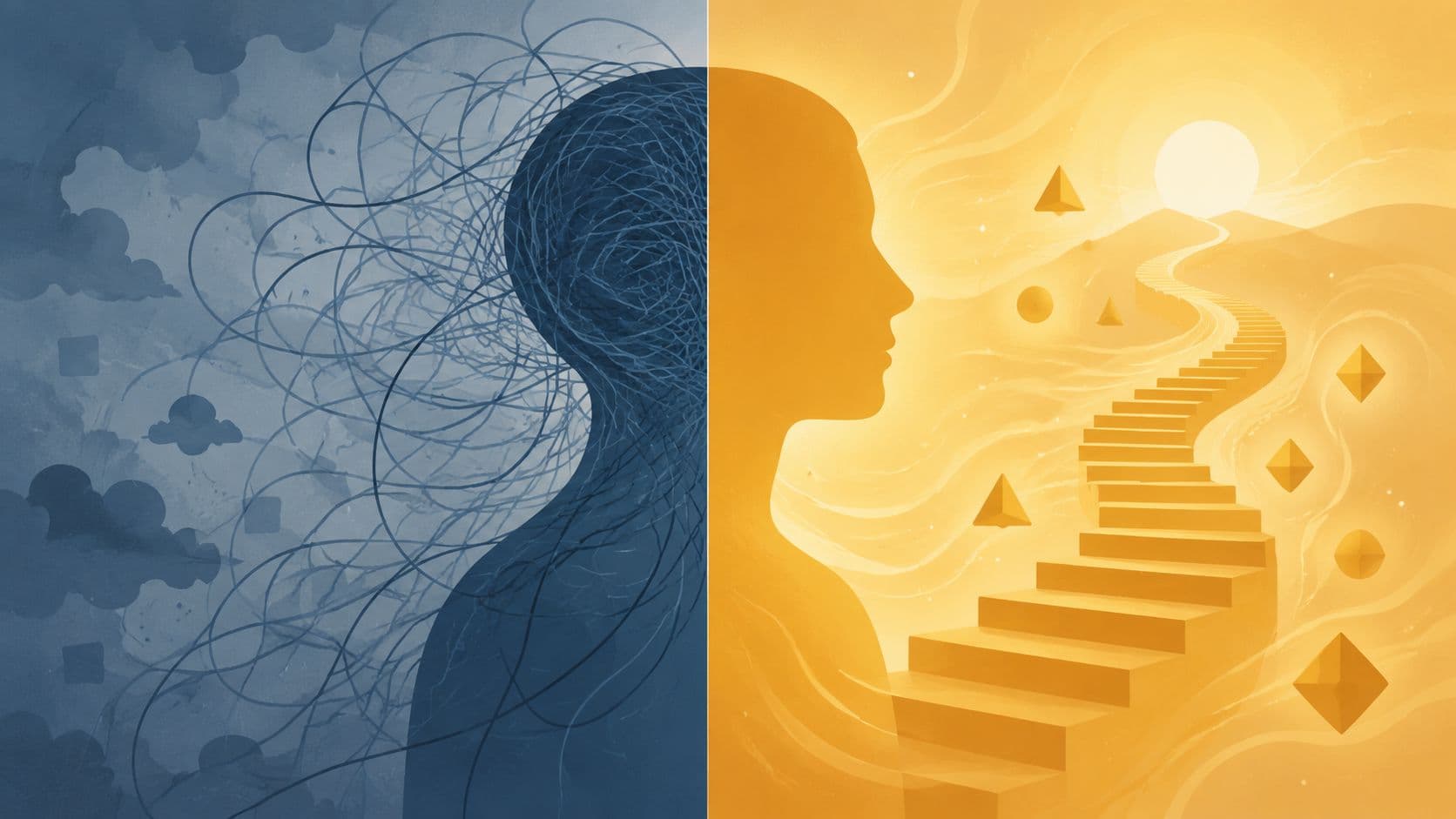
Discover how a true shift in consciousness unfolds—from its origins and science to practical practices and next steps for lasting transformation.
You wake up, check your phone, and notice something odd. The same inbox, commute, and half-finished obligations are still there, yet your reaction has changed. The noise feels thinner, the day feels wider, and you keep asking yourself whether this is just a good morning or the start of a real shift in consciousness.
That question matters because people often mix up a passing altered state with a deeper transformation. One can fade after a meditation session, a retreat, or a powerful conversation, while the other tends to reshape how you perceive, decide, and live. Ancient traditions framed this kind of change as a major human turning point, and modern neuroscience now asks a sharper question, whether a change is merely experienced, or measurable.
Introduction to Shift in Consciousness
A woman sits at her kitchen table, staring at a message she would normally overthink. This time, she reads it once, feels the familiar knot in her stomach, and doesn't spiral. She notices the feeling, lets it pass, and answers with a calmness that would've felt impossible a month earlier.
That kind of moment is why people talk about a shift in consciousness. It can feel subtle from the inside, more like a new lens than a dramatic lightning bolt. The world doesn't necessarily change, but the way you meet it does.
The confusion starts because plenty of experiences can feel profound in the moment. A breathwork session can make time feel strange, meditation can quiet mental chatter, and a powerful dream can leave you thinking differently all day. Those experiences matter, but they aren't automatically the same as a lasting shift.
Practical rule: if the change only lives inside the moment, treat it as an altered state. If it keeps showing up in your choices, relationships, and attention, you may be seeing the beginning of a deeper transformation.
That distinction gives this topic real value. It helps you sort spiritual language from lived change, and it keeps you from chasing every peak experience as if it were proof of growth. It also gives you a cleaner way to connect inner change with purpose, which is where many people feel they need the most clarity.
Defining Shift in Consciousness
A shift in consciousness is not just “feeling different.” It usually means your baseline way of perceiving has changed enough that your ordinary reactions, assumptions, or priorities no longer run the show in the same way. The easiest analogy is software, a temporary state is like opening a new app, while a real shift is closer to changing the operating system.
That distinction matters because the same experience can be interpreted in very different ways. Global neuronal workspace theory says a mental state becomes conscious when it is broadcast across brain networks, while recurrent processing theory argues that feedback loops in sensory areas are enough for perceptual consciousness. In simple language, one theory emphasizes wide distribution, the other emphasizes local looping, but both are trying to explain how awareness becomes available at all. The Stanford Encyclopedia of Philosophy's overview of consciousness in neuroscience is a useful anchor for that debate.
Structural change versus passing experience
A temporary altered state often feels vivid, unusual, or even mystical. A lasting shift usually leaves fingerprints after the event has ended, for example, a different response to stress, a new tolerance for silence, or a wider emotional range. Neuroscience literature also keeps this distinction clear, describing altered states as typically temporary and qualitative, not the same thing as a permanent change in the person.
Ancient frameworks echo the same basic idea in a different language. Historical syntheses describe human development through recurring structures such as archaic, magic, mythical, mental, and integral, which treats consciousness as something that can move through major civilizational patterns rather than sit still. That long view helps explain why people keep asking the same question in new forms, “am I having an experience, or becoming a different kind of self?”
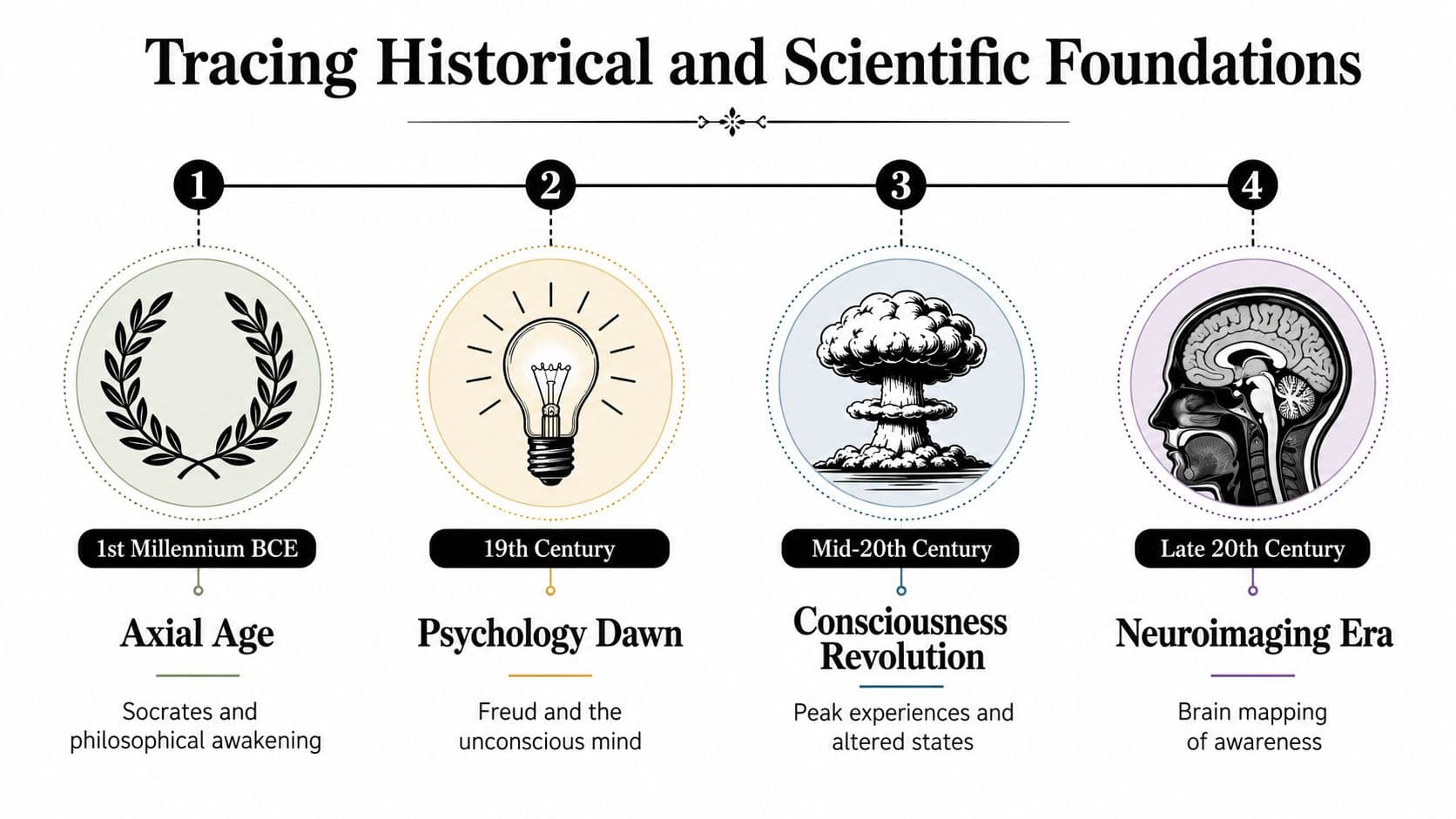
Tracing Historical and Scientific Foundations
The roots of this conversation go back far beyond modern self-help language. A lecture by philosopher Mark Vernon places a major change in the first millennium BCE, when, in his words, “a consciousness that is akin to our own first began to emerge,” connecting that shift to philosophy in the West and to Socrates in the 5th century BCE. That historical frame matters because it shows people have long understood consciousness as something that can evolve, not just something that exists.
Modern science gives the same broad story a different kind of evidence. The 2020 review Consciousness: The last 50 years (and the next) describes a major shift between roughly 1965 and 1990, when consciousness research sat on the fringe, followed by a much larger wave of work in the late 1980s and early 1990s. The review links that change to modern neuroimaging and to high-profile scientists such as Francis Crick and Gerald Edelman. That review in PMC shows how quickly a once-marginal topic became a mainstream neuroscientific program.
Why the history matters now
That arc helps explain why the topic feels both ancient and newly technical. On one side, people still speak about awakening, wisdom, and expanded awareness. On the other, researchers now ask whether a state can be induced, detected, and repeated with enough consistency to study it seriously.
A good way to hold both is to think in layers. Ancient traditions asked what kind of person one becomes. Modern neuroscience asks what changes in the brain, what networks participate, and what can be measured over time. Those are different questions, but they point toward the same human mystery.
For readers interested in the energetic side of that long arc, this adjacent lens offers a useful perspective without collapsing spiritual language into scientific proof.
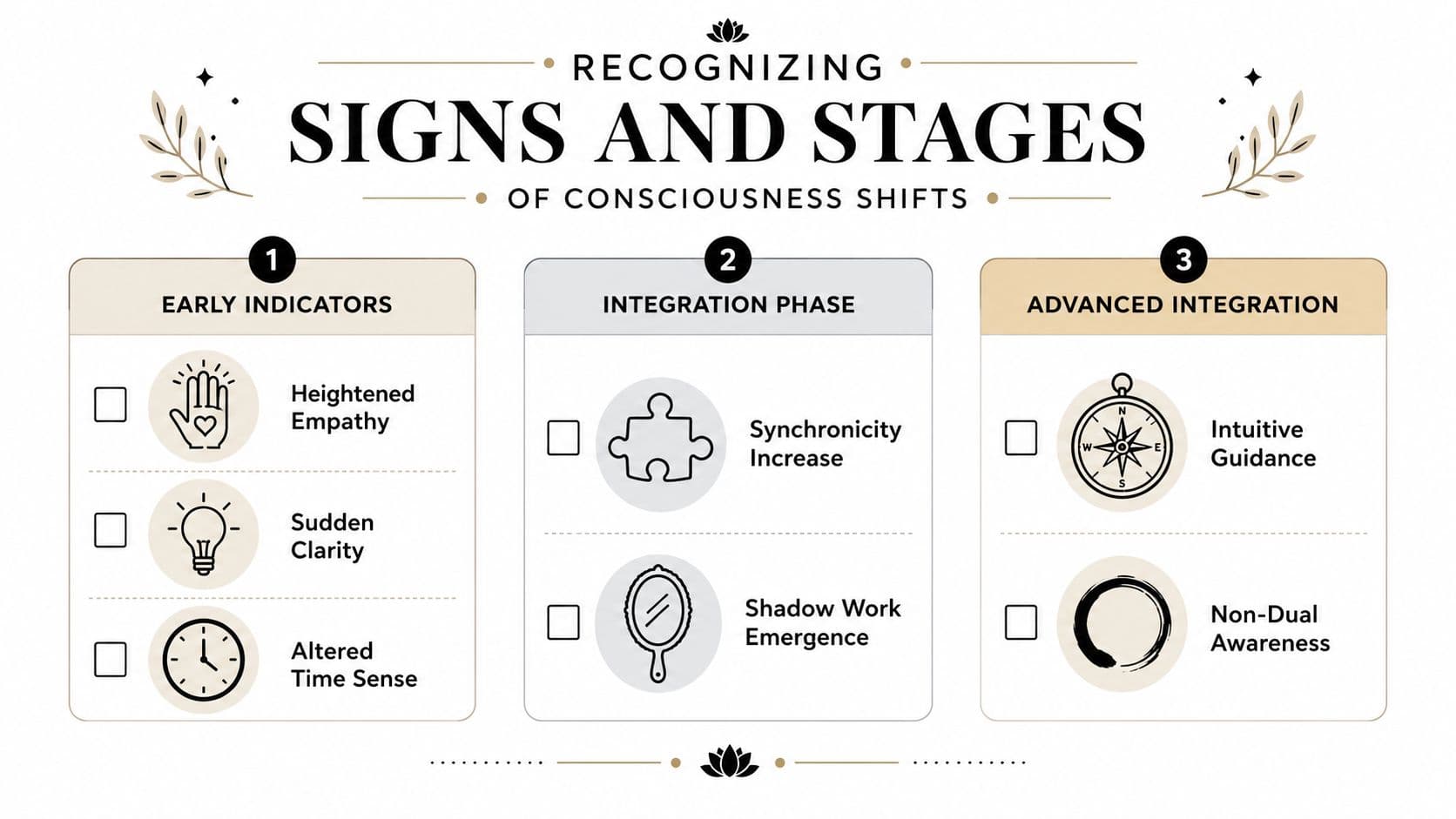
Recognizing Signs and Stages of Consciousness Shifts
Not every change arrives with fireworks. Many people notice the first signs in ordinary life, during a conversation, while driving, or when they react differently to something that used to trigger them. The challenge is that early signs can look ordinary unless you know what to track.
Early indicators
The first cluster often shows up as heightened empathy, sudden clarity, and an altered sense of time. You might feel more affected by other people's moods, reach conclusions more quickly than before, or notice that a day feels oddly spacious. Those signs don't prove a permanent shift, but they do signal that your attention is organizing itself differently.
Integration phase
Middle-stage change is quieter. You may feel old emotional patterns surfacing for review, not because something is wrong, but because your system is trying to reorganize around new insight. Some people also notice stronger symbolic thinking, more meaningful coincidences, or a growing need to simplify relationships and routines.
Tracking question: what keeps changing after the experience ends, your mood, your habits, or only your memory of the experience?
That question helps separate fascination from integration. If the change only lives in journal pages but never reaches behavior, it's probably still in the altered-state category. If it starts shaping how you speak, rest, set boundaries, and make decisions, then the pattern is moving into deeper territory.
Advanced integration
Longer-term markers look less dramatic from the outside. People often describe steadier intuition, less reactivity, and a stronger sense that life has an internal order they can trust. You may also find that old goals lose their grip because they no longer fit the person you're becoming.
For a broader framework on these stages, this guide on stage of consciousness fits well with the historical perspective above and helps you keep the vocabulary grounded.
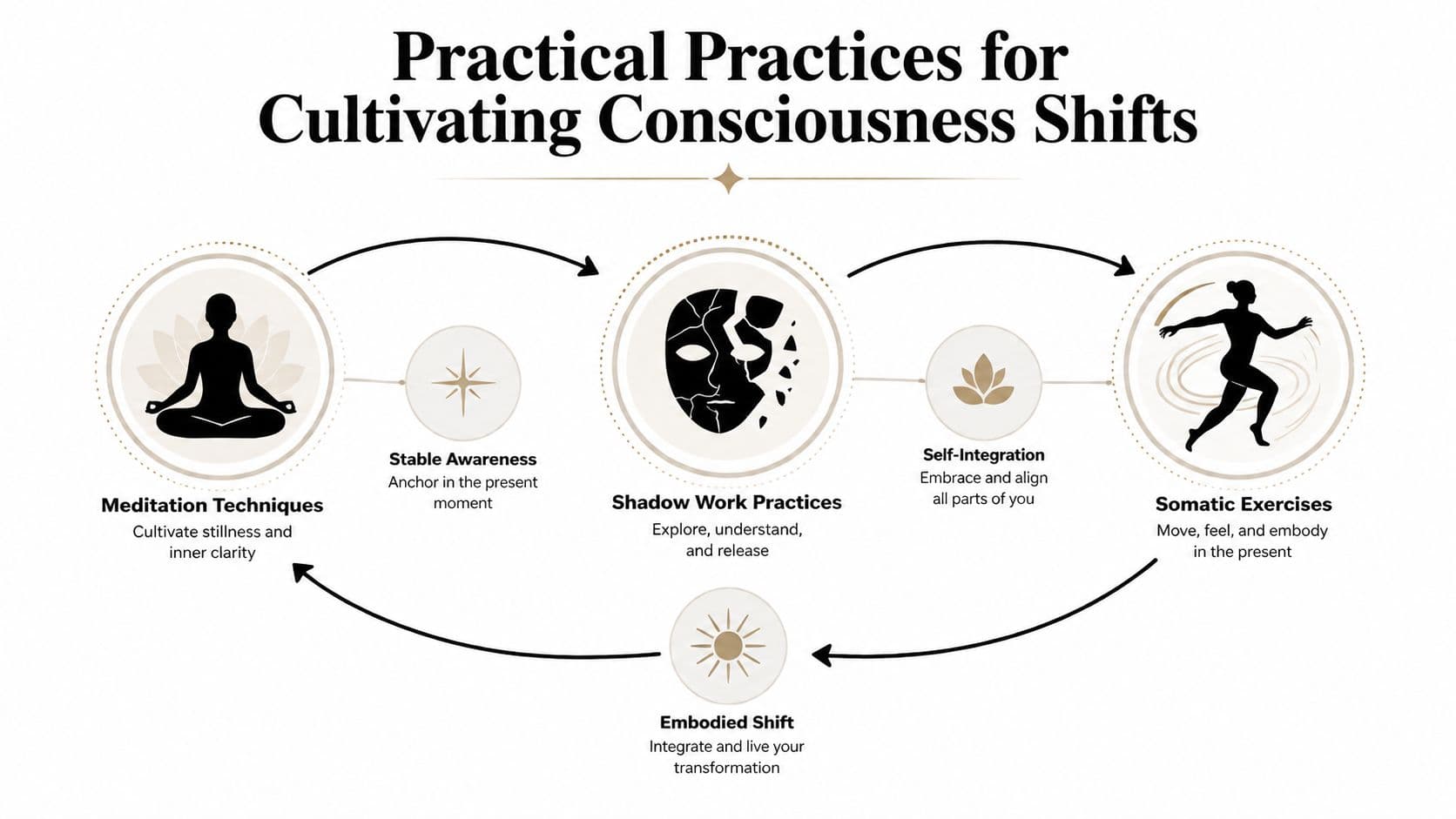
Practical Practices for Cultivating Consciousness Shifts
People often want the peak without the practice. The problem is that stable change usually comes from repetition, not intensity alone. Meditation can steady attention, shadow work can bring hidden material into view, and somatic work can keep insight from floating away into abstraction.
Modern training is also getting more precise. The announced 333 Study from Neuforia, the Monroe Institute, and Efforia describes an EEG-based initiative using Brain Signal Variability monitoring to measure and train specific states of consciousness. The important point is not just that brain activity is observed, but that variability itself becomes a target for repeatable markers and session design. Neuforia's announcement shows where this field is heading.
Meditation first, because it makes change observable
Start with a simple practice that lets you notice thought instead of obeying it. A few quiet minutes each day can show you how often the mind tries to narrate, predict, and correct. Research on altered states notes that regular meditators can experience unusual states such as calmness of thought or a sense that the self is one with the world, sometimes after short practice, more often after many years of intensive work. MIT Press's discussion of altered states is useful here because it keeps the language honest.
Shadow work and body work keep the insight from leaking away
Shadow work asks what you've been avoiding. That could be resentment, grief, envy, or an outdated self-image that keeps returning under pressure. Somatic exercises then help you feel where that material sits in the body, so the insight becomes embodied instead of merely intellectual.
If you want a practical companion for dream symbolism while you journal, what flying dreams symbolize can be a helpful reference point, especially when your inner life starts expressing itself in vivid images.
A simple integration sequence
- Pause: notice the state without trying to extend it.
- Write: record what felt different, and what changed afterward.
- Practice: return to meditation, shadow inquiry, or body awareness.
- Repeat: watch for patterns across days rather than one session.
- Align: ask whether the insight changes how you live, not just how you feel.
For readers who want the contemplative angle, this bridge between experience and sustained practice offers a useful path.
Common Pitfalls and Misconceptions about Shifts
The biggest mistake is treating intensity as proof. A powerful retreat, a spontaneous mystical moment, or a dramatic meditation session can feel like the answer, but feeling expanded for an hour is not the same as becoming more grounded over time. The experience may be meaningful, but it still needs to survive ordinary life.
Another common error is to chase state changes and ignore integration. People sometimes keep looking for the next peak because the peak itself feels like progress. In reality, the true test shows up later, when a stressful email lands, a relationship gets hard, or old habits try to return.
A lasting shift changes perception and behavior together. If only the sensation changes, the transformation is probably incomplete.
That idea lines up with the neuroscience literature, which distinguishes temporary altered states from sustained change in the person. The PMC review on altered states makes that boundary clear, and it's one of the most useful filters you can use when evaluating your own experience.
A final misconception is that a genuine shift should feel permanent right away. Often it doesn't. Early growth can feel uneven, with clarity one day and confusion the next, because the mind is learning a new pattern and the old one still has momentum. Stability usually arrives through repetition, reflection, and time.
Next Steps for Exploring Consciousness Shifts
A good next step is to stop asking only whether something was profound and start asking what it changed. Keep a short journal with three prompts, what happened, what you felt, and what stayed different the next day. That simple record helps you separate memorable experiences from durable transformation.
Peer support helps too. Talk with people who don't need to force your experience into one story, either purely spiritual or purely skeptical. A grounded conversation can reveal whether you're becoming more open, more regulated, or just more enthusiastic for a moment.
Recent commentary also suggests that the feeling of a collective shift today may be amplified by social media networks, not just by a single global metaphysical event. That argument from Scott Britton's commentary is useful because it asks a sharper question, are more people changing, or are more people now able to see and share their inner shifts in real time?
Ways to keep going without getting lost
- Keep a pattern log: note recurring triggers, insights, and emotional changes.
- Choose one practice: stay with it long enough to see whether it affects daily behavior.
- Use community wisely: seek people who value both experience and discernment.
- Study life direction: connect inner change to work, relationships, and purpose.
If you like structured self-knowledge, the Life Purpose App can help you explore your life path through Dan Millman's The Life You Were Born to Live, map recurring cycles, and compare relationship dynamics in a way that fits this topic naturally. For anyone trying to turn a shift in consciousness into something lived, not just felt, that kind of framework can make the next steps much clearer.
If you're ready to turn insight into a clearer daily path, visit Life Purpose App and explore how your life path, cycles, and relationship dynamics can give your experiences a practical frame. It's a useful companion when you want to understand a shift in consciousness without losing the grounded, everyday side of your life.
Discover your life path today
Enter your date of birth and see your life path, free.
Find your life path