Ready to try sitting in silence? This practical guide shows why silence helps your body and attention settle, how to start with short, doable sessions, and ways to deepen the practice without forcing results.

May 24, 2026 (5mo ago) — last updated September 10, 2026 (1mo ago)
Sitting in Silence for Inner Calm
Learn simple steps to sit in silence, calm your nervous system, and build a sustainable practice for clarity and self-discovery.
← Back to blog
Ready to try sitting in silence? This practical guide shows why silence helps your body and attention settle, how to start with short, doable sessions, and ways to deepen the practice without forcing results.
Title: Sitting in Silence for Inner Calm
Summary: Learn simple steps to sit in silence, calm your nervous system, and build a sustainable practice for clarity and self-discovery.
Introduction: Ready to try sitting in silence? This practical guide shows why silence helps your body and attention settle, how to start with short, doable sessions, and ways to deepen the practice without forcing results.
Content:
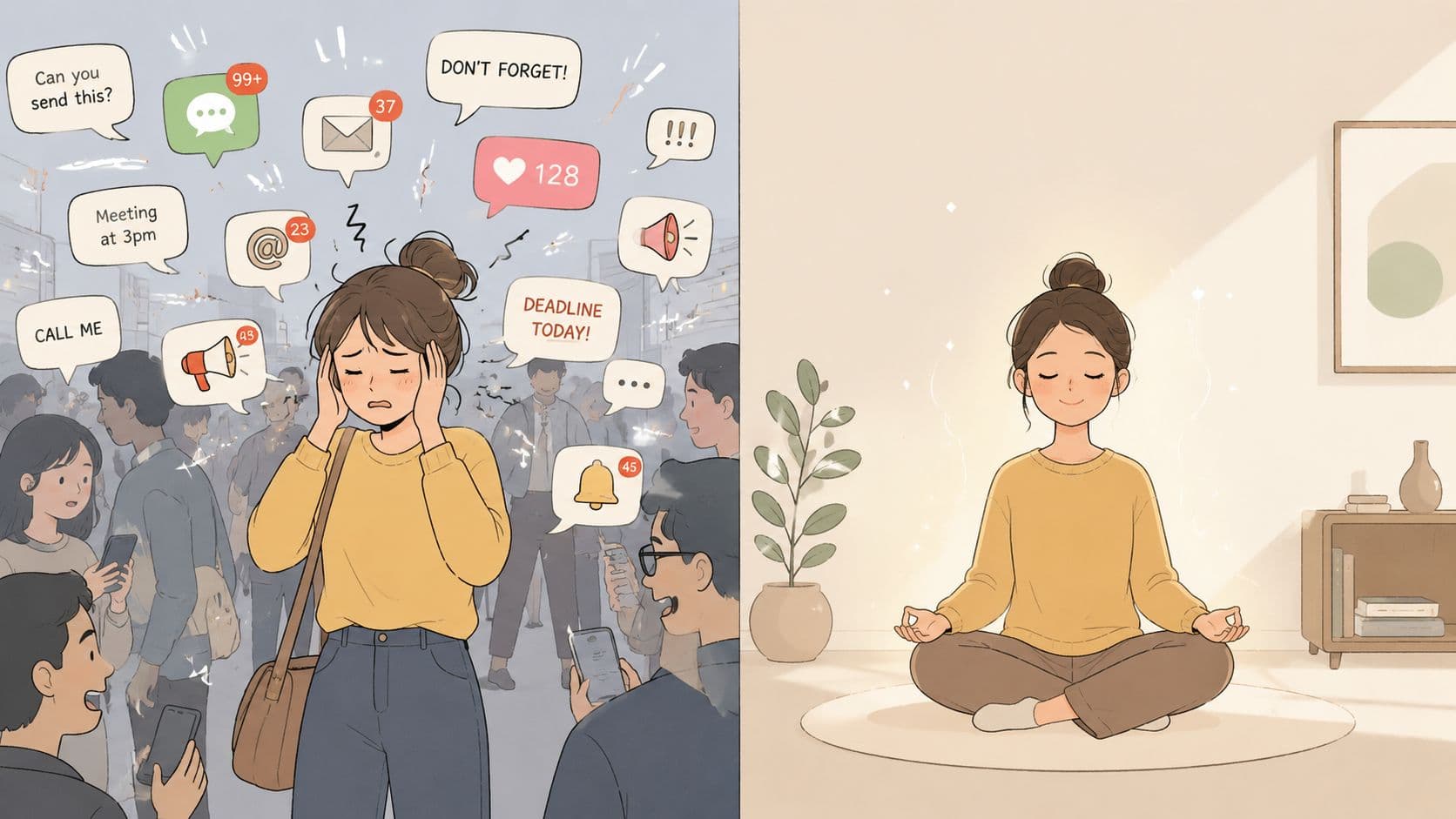
One often comes to silence because noise has stopped feeling normal. Your phone keeps lighting up, your mind keeps replaying conversations, and even when the room is quiet, your nervous system isn’t. You sit down for a minute to rest and somehow feel busier than before.
That’s why sitting in silence matters. It gives your body a chance to stop bracing and your attention somewhere simple to land. If you stay with it long enough, it can become more than a calming habit. It can become a place where you hear yourself more clearly.
What it means to sit in silence and why it matters
Sitting in silence isn’t the same as performing a perfect meditation session. It’s more basic than that. You intentionally remove stimulation, stay still for a while, and let your system settle without immediately reaching for a screen, a conversation, or another task.
For many people, that sounds easy until they try it.
The modern problem isn’t only loud environments. It’s constant input. Notifications, commentary, background audio, and internal pressure all pile up. Silence can feel unusual at first because your mind has gotten used to being continuously occupied.
Silence as regulation practice
Research links silence with measurable reductions in blood pressure, heart rate, and stress hormones, and brief periods of quiet can reduce physiological arousal and support self-regulation1. Treat silence not as empty time but as recovery time for your attention and nervous system.
There’s also a psychological shift when you stop filling every gap. At first, silence shows you how scattered you feel. Then, if you stay, it starts showing you what’s underneath the scatter. That’s often where clarity begins.
Silence is active, not passive
A common misunderstanding is that sitting in silence means doing nothing. In practice, you are doing something. You’re noticing. You’re pausing reactivity. You’re allowing your internal pace to slow enough for real awareness to catch up.
That’s why people often describe silence as both soothing and revealing. It can soften tension and expose it at the same time.
A good first goal isn’t transcendence. It’s familiarity. Learn what happens in you when the external world goes quiet. That alone can change a lot.
Your first steps into silence
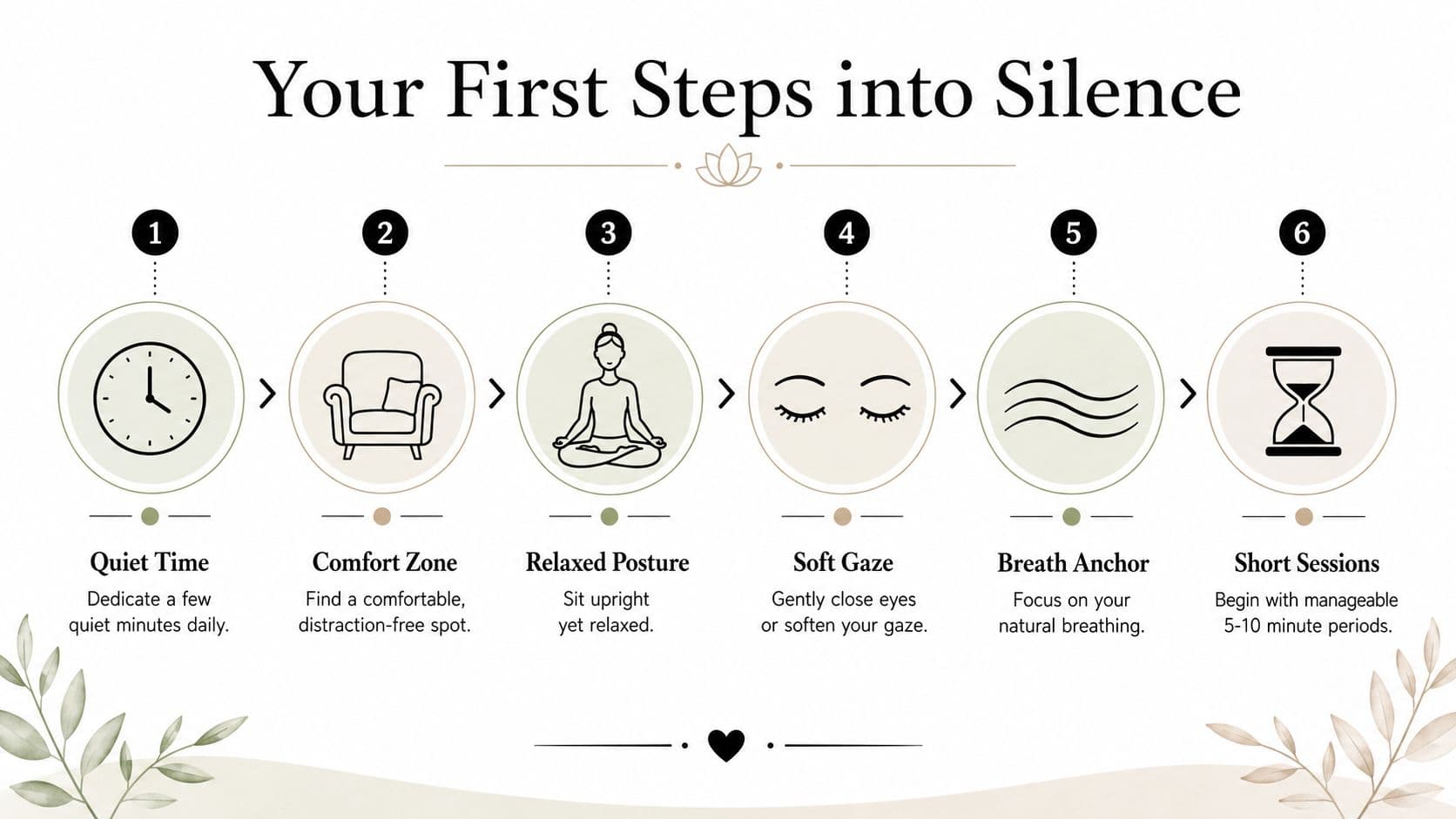
Your first session should feel simple enough that you’ll do it. If you make the setup too precious or too difficult, you’ll keep postponing it. Silence works best when it fits inside ordinary life.
Start with a place that asks little from you. A chair is fine. The edge of your bed can work, though many people get sleepy there. A parked car can even work if it’s the only private place you have. What matters is that you won’t be interrupted every few seconds.
Set the room so your body can cooperate
Many failed sessions have nothing to do with mindset. The room is too stimulating, the phone is within reach, or the posture is so stiff that discomfort becomes the whole experience.
Checklist:
- Choose one spot: Pick the same chair, corner, or cushion most days so your body begins to associate that place with settling.
- Move the phone away: Out of sight is better than face down beside you.
- Sit upright but not rigid: Your spine can be lifted without being military.
- Lower the eyes or close them gently: Strain defeats the point.
For a broader primer on attention training, see Mindfulness Basics.
Let the breath do some of the work
The easiest anchor is the breath you already have. You don’t need dramatic inhales. Forcing the breath often creates more agitation. The better approach is quieter and steadier. Practices like resonance breathing—around five to six breaths per minute—support regulation and pair well with silence2.
A practical beginner rhythm:
- Arrive: Sit down and do nothing for a few breaths.
- Notice contact points: Feet on the floor, hands resting, body supported.
- Follow the breath: Feel the air at the nostrils, chest, or belly.
- Return when distracted: Not sharply. Just return.
If you want tools for breathing practice, try Breathing Techniques.
What works and what usually doesn’t
What works is consistency, a timer, and a manageable session. What usually doesn’t work is trying to have a profound experience on day one, checking how much time is left, or deciding that a busy mind means you’re bad at this.
Silence becomes approachable when you stop treating it like a test. You are not trying to win at calm. You are learning how to stay.
Navigating inner noise and discomfort
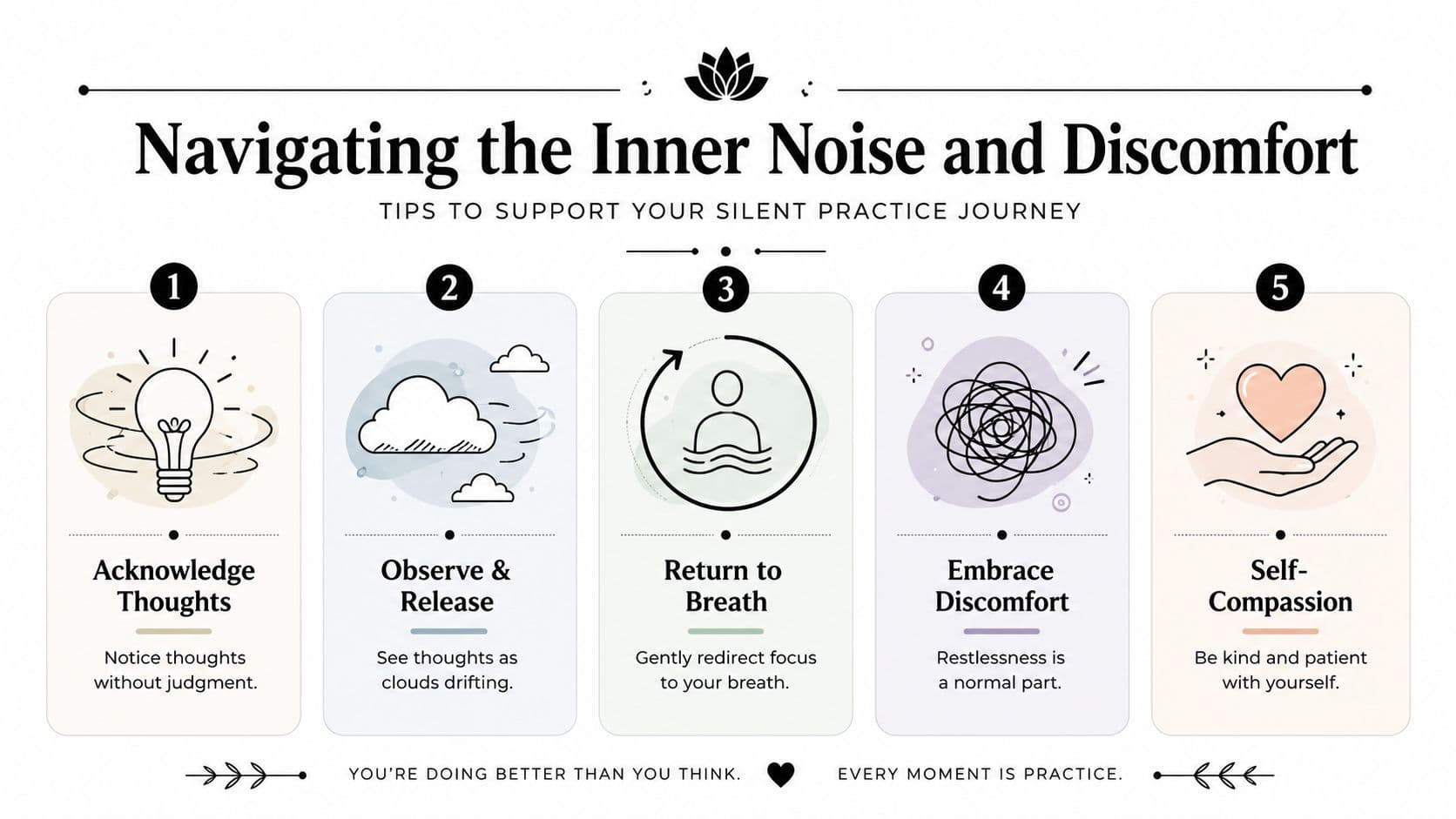
A quiet room can make an unquiet mind feel louder. Thoughts speed up. Old feelings surface. Some people become restless almost immediately. Others feel sleepy, irritated, or strangely emotional.
That isn’t a sign the practice is wrong. It often means the practice is finally honest.
When silence helps and when it doesn’t
For some people, uninterrupted silence brings relief right away. For others, it amplifies internal distress. Starting with small amounts of regulated quiet and sensory grounding can help when silence feels overwhelming3.
If you have trauma, anxiety, or a highly activated nervous system, forcing long silent sits can backfire. The kinder move is to create enough quiet for regulation, not so much that you feel flooded.
You do not need to prove you can tolerate discomfort. You need to learn what helps you stay present without getting overwhelmed.
Grounding tools that help in the moment
If your inner noise spikes, don’t grit your teeth and push harder. Shift the method. Try one of these:
- Name what you hear: Pick out five sounds in the environment.
- Feel your feet: Press them lightly into the floor and notice contact and weight.
- Use paced breathing: Let the exhale be easy and steady rather than deep and dramatic.
- Shorten the sit: A brief, regulated practice is better than a longer one that leaves you rattled.
If you’re preparing your body for quiet, nervous-system tools can complement sitting in silence beautifully.
How to relate to thoughts without fighting them
It’s common to get tangled up here. The goal isn’t to stop thinking. The goal is to stop obeying every thought.
Notice mental activity as movement rather than meaning. Planning, replaying, worrying, judging—these are events passing through awareness. When you see that, returning to the breath feels less like failure and more like training.
Drop self-criticism first. A wandering mind is not a mistake. It’s the material you practice with.
Deepening practice with self-discovery
Silence becomes especially powerful when you stop using it only to calm down and start using it to listen inward with intention. Once the nervous system settles enough, deeper questions can come into focus. What am I avoiding? What pattern keeps repeating? What am I being asked to learn in this season of life?

Quiet creates space for meaningful reflection
Many people use silence as a recovery tool, then realize it’s also a truth-telling tool. In stillness, your usual defenses aren’t as busy. That doesn’t mean you instantly receive life answers. It means you can finally notice what your life keeps trying to show you.
Some people find pairing reflective silence with a structured inquiry helps. If you want a practical app-based companion for life-path work, try Journaling for Insight.
Use silence before journaling, not instead of it
A useful pattern is to sit first, then write while your mind is less scattered. Silence softens the noise. Writing gives shape to what surfaced.
Try one question after a sit, such as:
- What lesson keeps returning in my relationships right now?
- Where am I forcing instead of trusting my process?
- What strength am I being asked to develop, not just display?
If you prefer structure, SMART personal-development templates can help translate insight into action.
A strong silence practice doesn’t end when the timer goes off. It continues in the choices you make afterward.
What this looks like in real life
Some days silence is just silence. You settle, breathe, and leave a little steadier than you arrived. Other days, a clear pattern emerges. You notice that a conflict isn’t really about the other person. You admit you’ve been drifting away from what matters. You reconnect with a deeper sense of purpose.
That’s the hidden gift in sitting in silence. It doesn’t only lower the volume. It changes what you can hear.
Sample session plans for every level
A good plan should feel doable, not admirable. Standard clinical guidance often points to 10 to 20 minutes per session, 5 to 7 days per week, with the strongest results when practice is consistent over several weeks3. Consistency beats ambition.
Sample silence session plans
| Level | Duration | Focus | Tip |
|---|---|---|---|
| Beginner | 5 minutes | Sit comfortably, notice the breath, keep it simple | When attention drifts, return to one physical cue, such as the feeling of air at the nostrils |
| Beginner who feels uneasy in quiet | 2 minutes | Regulated quiet with feet on the floor and awareness of surrounding sounds | Keep your eyes softly open if closed-eye silence feels too intense |
| Intermediate | 10 minutes | Breath-focused attention and a short settling period before asking one reflective question | Let the question rest in the background; don’t chase an answer |
| Intermediate with journaling | 15 minutes | Sit, then write for a few minutes about what surfaced | Focus on one theme rather than trying to capture everything |
| Advanced | 20 minutes | Alternate breath awareness and spacious noticing without clinging to thoughts | If the mind gets busy, simplify and return to the breath |
| Advanced reflective | 20 minutes | Sit in silence, then reflect on current lessons or challenges with structured prompts | Keep reflections grounded and linked to present choices |
A simple rule for progression
Stay with your current level until it feels steady. Don’t increase duration just because you think you should. Increase it when the practice starts feeling familiar enough that a little more time supports you instead of draining you.
Making silence a sustainable habit
The people who benefit most from silence usually aren’t the ones with perfect discipline. They’re the ones who make the practice easy to return to. They miss a day, then come back. They keep the setup simple. They stop expecting every session to feel meaningful.
Build around your real life
Attach the practice to something that already happens. After you brush your teeth. Before you open email. Once the coffee is brewing. Tying silence to an existing routine removes a lot of unnecessary negotiation.
Anchors:
- Keep one dedicated spot: A certain chair can become a cue.
- Use a timer: It prevents clock-watching.
- Protect the first minute: The urge to get up is often strongest right at the start.
- Leave room for imperfect days: A shorter sit still counts.
Let the practice mature naturally
Some days sitting in silence will feel nourishing. Some days it will feel ordinary. Some days it will reveal how tired, reactive, or sad you really are. All of that belongs.
What matters is that you keep meeting your true self.
Silence doesn’t ask you to become someone else. It asks you to stay long enough to become less divided. Over time, that changes how you listen, how you respond, and how you move through the rest of the day. The external world may stay noisy. You won’t have to match it.
If you want a structured way to continue the self-discovery side of this work, the Life Purpose App is a practical companion to Dan Millman’s The Life You Were Born to Live. It can help you explore your life path, reflect on recurring lessons, and bring more clarity to insights that arise when you spend time in silence.
Frequently asked questions
1. How long should my first silent sit be?
Start with two to five minutes. If silence feels intense, begin at two minutes of regulated quiet and build up gradually.
2. What if silence makes me feel worse?
Shorten the sit, add grounding (feet on the floor, naming sounds), and use paced breathing. If silence consistently triggers distress because of trauma or severe anxiety, seek guidance from a mental-health professional.
3. How do I make silence a habit?
Attach the practice to an existing routine, keep the setup simple, use a timer, and allow imperfect days. Consistency matters more than length.
1.
Current Opinion in Psychology, review on silence and health outcomes (2020), noting links between silence and reduced blood pressure, heart rate, and cortisol; see https://www.sciencedirect.com
2.
On resonance breathing and slow-paced breathing (about five to six breaths per minute) as a tool for autonomic regulation: Lehrer, P. M., et al., “Heart rate variability biofeedback,” PubMed. https://pubmed.ncbi.nlm.nih.gov/15313872/
3.
Systematic reviews on mindfulness program formats and clinical guidance that commonly recommend 10–20 minute sessions and several weeks of consistent practice for measurable benefits: Goyal, M., et al., “Meditation Programs for Psychological Stress and Well-being: A Systematic Review and Meta-analysis,” JAMA Internal Medicine (2014). https://jamanetwork.com/journals/jamainternalmedicine/fullarticle/1809754
Discover your life path today
Enter your date of birth and see your life path, free.
Find your life path