You’ve just finished a spiritual compatibility test with someone you care about. The result may feel intimate or definitive, but it’s most useful when read as a prompt for real conversation. This guide explains what different tests measure, how to interpret life-path readings like Dan Millman’s, and how to turn insights into practical questions you can test in daily life.

October 16, 2026 (1mo ago) — last updated November 7, 2026 (11d ago)
Spiritual Compatibility Test: What to Do Next
Use a spiritual compatibility test to open conversations, compare life-path readings, and turn results into behavior-based decisions.
← Back to blog
You’ve just finished a spiritual compatibility test with someone you care about. The result may feel intimate or definitive, but it’s most useful when read as a prompt for real conversation. This guide explains what different tests measure, how to interpret life-path readings like Dan Millman’s, and how to turn insights into practical questions you can test in daily life.
Title: Spiritual Compatibility Test: What to Do Next
Summary: Take a spiritual compatibility test to understand your connection. Learn what results mean and how to use them to strengthen your relationship.
Introduction: Take a spiritual compatibility test to understand your connection. Learn what results mean and how to use them to strengthen your relationship.
Tags: spiritual compatibility test, life path compatibility, Dan Millman compatibility, relationship dynamics, numerology test
Spiritual Compatibility Test: What to Do Next
Take a spiritual compatibility test to understand your connection. Learn what results mean and how to use them to strengthen your relationship.
You’ve just finished a spiritual compatibility test with someone you care about. The result looks precise, perhaps even intimate, yet one question remains: what should you do with it? A reading can highlight patterns, but it can’t tell you whether two people will listen during conflict, respect different practices, or make room for one another’s doubts.
A grounded approach treats the result as a conversation starter. Some tools ask directly about belief, ritual, values, and spiritual identity. Others, including date-of-birth systems connected with Dan Millman’s The Life You Were Born to Live and the Life Purpose App, compare life paths to surface possible needs, talents, and relationship patterns.3
The useful question isn’t “Are we destined to work?” It’s “What does this result invite us to discuss?” That distinction matters whether you’re considering a partner, reflecting on a friendship, or trying to understand family differences. Even resources about intense spiritual experiences emphasize the importance of context, preparation, and integration rather than treating a single experience as a complete answer.7
A Result in Your Hand and a Question in Your Heart
Maya printed the reading before meeting Daniel for coffee. She’d expected something light, perhaps a few shared traits and a reassuring conclusion. Instead, the report described different ways of approaching purpose, uncertainty, and emotional closeness. She recognized parts of herself in it, but she also felt a little uneasy. Was the difference a warning, or something worth talking about?
That reaction is common. People often approach a spiritual compatibility test hoping for certainty, especially when a relationship feels important but unresolved. A result can feel authoritative because it organizes complicated feelings into clear language. Yet organization isn’t the same as prediction.
Read the result as a prompt
A thoughtful reading may help you name a tension that was already present. Perhaps one person needs regular communal worship while the other prefers private meditation. Maybe both people value compassion, but they disagree about how that value should shape money, family obligations, sex, or child-rearing.
Those differences don’t automatically define the relationship. Research on perceived similarity in religious beliefs found that similarity alone wasn’t directly associated with relationship satisfaction; the effect depended on whether partners accommodated one another’s identities, including how they practiced and expressed those identities.1
Practical rule: A result can suggest a question. Only lived behavior can show how someone answers it.
This article separates the interpretive value of a life-path comparison from the evidence of everyday compatibility. You’ll see what different test formats measure, how to use a reading without surrendering your judgment, and how to turn a surprising result into a calm, specific conversation.
What a Spiritual Compatibility Test Actually Measures
A spiritual compatibility test usually examines how two people relate to beliefs, values, rituals, meaning, and direction. It may ask whether you share a religious identity, how often you pray or meditate, what role community plays in your life, and how you make moral decisions. It may also explore whether you feel safe discussing uncertainty or disagreement.
The phrase covers two broad formats. A questionnaire asks about your stated beliefs and behavior. A numerology-based reading uses two birth dates to compare life-path patterns associated with each person. One format gathers direct answers. The other interprets a symbolic framework.
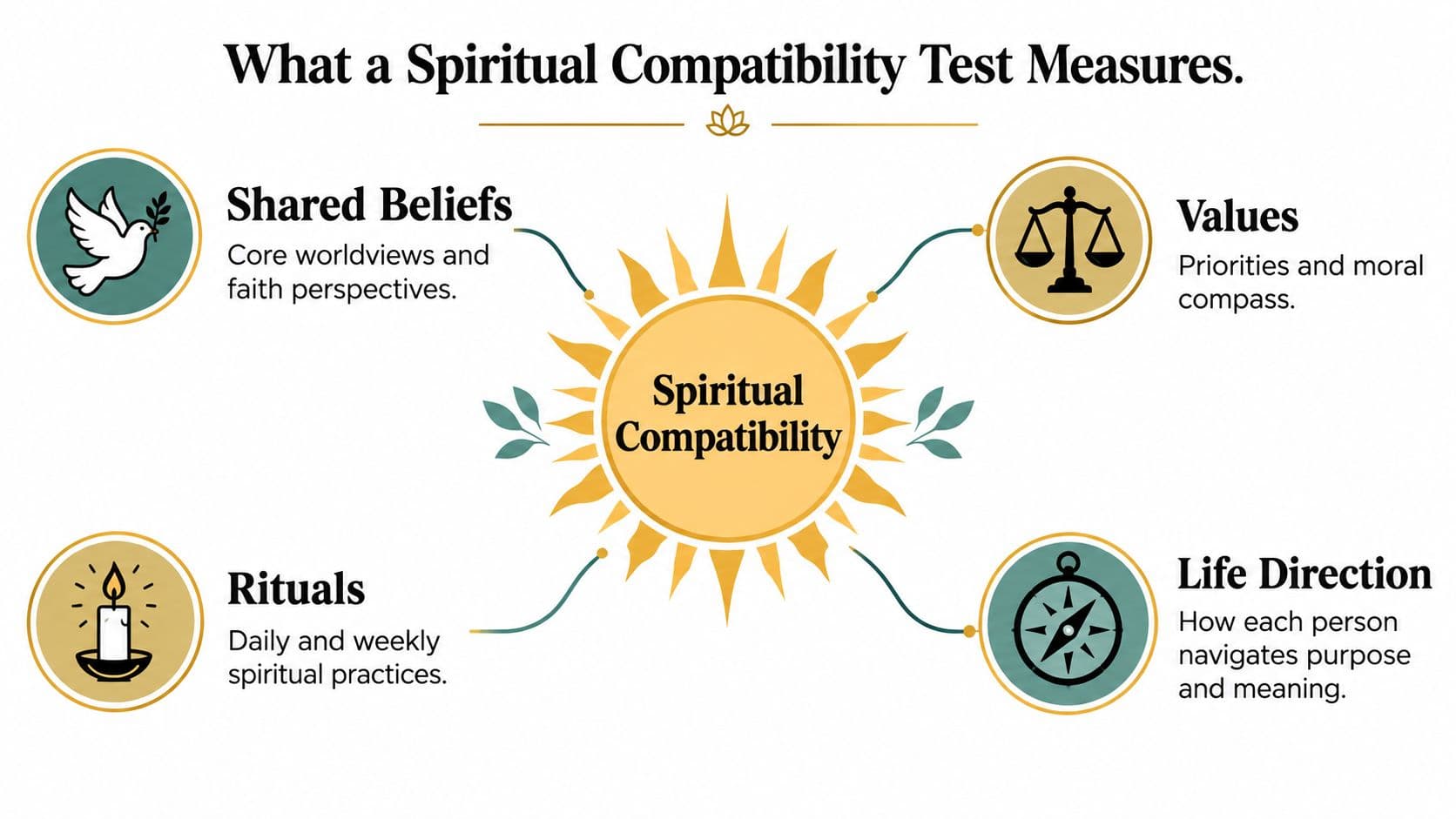
Two ways to look at the same relationship
Think of a questionnaire as comparing two grocery lists. You can see whether both people selected meditation, religious community, service, family tradition, or spiritual independence. The information is explicit and easy to discuss.
A life-path reading is more like comparing the kitchens those grocery lists came from. It looks at the underlying patterns associated with how each person may approach purpose, challenge, responsibility, and intimacy. It doesn’t replace the lists. It offers another lens for asking why two people choose, prepare, and share things differently.
The distinction matters because spiritual intimacy involves more than matching labels. A 2025 study of 207 dating couples found that sharing spiritual or religious experiences, doubts, and struggles with a partner was associated with greater emotional intimacy, relationship satisfaction, and commitment, even after accounting for shared beliefs and religious attendance.2
For a broader explanation of compatibility as a multidimensional idea, see our guide to how beliefs become behavior at /how-spiritual-intimacy-works. The central lesson is simple: a useful test should help you investigate how beliefs become behavior, not merely award a matching label.
Dan Millman’s Life-Path System in Plain English
For a numerology-based spiritual compatibility test, the relevant reference is Dan Millman’s The Life You Were Born to Live. The system begins with a person’s date of birth and uses it to identify a life path. That path is then interpreted through themes connected with talents, needs, challenges, and recurring patterns.3
The system has also changed across editions. The original edition described 37 life paths, while the revised 25th Anniversary Edition expanded the system to 45 paths for people born between 1750 and the present. The book applies those paths to relationships as well as health, career, money, sexuality, and personal development.3
From one birth date to two
The Life Purpose App applies this framework by first interpreting one birth date as an individual life path. A second birth date can then be added so the system compares the two paths. The resulting relationship analysis is intended to surface possible areas of alignment, tension, complementary strengths, and differing needs.
That doesn’t mean a birth date reveals a hidden psychological diagnosis. It means the system supplies a structured language for reflection. One person may recognize a strong need for independence, while another sees a pattern around responsibility or emotional expression. The value lies in testing those observations against real experience.
Readers who want a separate explanation of the calculation process can explore how to find your life path number at /numerology-explained, then return to Millman’s book for the system’s interpretation. The framework should remain anchored to The Life You Were Born to Live and the Life Purpose App, rather than being blended casually with unrelated numerology systems.

A comparison between two life paths can be especially useful when the language gives both people something concrete to discuss. “You’re different” creates distance. “You seem to need more solitude before making decisions, while I need conversation,” creates an opening.
For further context on the system itself, the Dan Millman numerology guide keeps the discussion connected to the book and its life-path approach.
Questionnaires and Life-Path Readings Compared
A questionnaire and a life-path reading answer different questions. If you want to know what someone believes, ask them directly. If you want a symbolic framework for exploring how two people may approach purpose and relationship challenges, a date-of-birth reading may offer useful prompts.
Neither format is automatically more accurate or more meaningful. A questionnaire is transparent because you can trace every conclusion to an answer. A life-path reading is interpretive because it works from the framework described in The Life You Were Born to Live and applies it to two people’s paths.
| Dimension | Questionnaire Test | Life-Path Reading, Life Purpose App |
|---|---|---|
| Main input | Direct answers about beliefs, values, practices, and identity | Two birth dates interpreted through Dan Millman’s life-path system |
| Best for | Clarifying explicit views and current behavior | Exploring patterns, needs, talents, and relationship themes |
| Strength | Easy to understand and challenge | Offers language for patterns people may not have named |
| Limitation | Answers can change or be shaped by self-perception | A symbolic reading can’t verify everyday behavior |
| Conversation value | Produces direct questions about rituals and boundaries | Produces reflective questions about how each person operates |
| Sensible use | Treat answers as a snapshot, not a permanent identity | Treat patterns as prompts, not proof of destiny |
Choose based on the question you’re asking
Use a questionnaire when the practical issue is visible. Are you comfortable with different religious communities? Do you expect shared holidays? Do you want children raised within a particular tradition? These questions need explicit answers.
Use a life-path reading when the issue feels less defined. You may sense that one person withdraws under pressure while the other becomes more directive, but you haven’t found language for the pattern. A reading can give you a starting point for exploring that difference.
A combined approach is often richer. Start with a life-path comparison, then check its themes against direct questions and observed behavior. An online numerology reading can provide the symbolic layer, while honest discussion supplies the lived evidence.
How to Take the Compatibility Analysis Step by Step
Start with your own date of birth rather than jumping immediately to a partner comparison. In the Life Purpose App, this opens your individual life path within the framework of Dan Millman’s The Life You Were Born to Live. Read the interpretation slowly and mark the passages that feel familiar, confusing, or clearly unlike your experience.
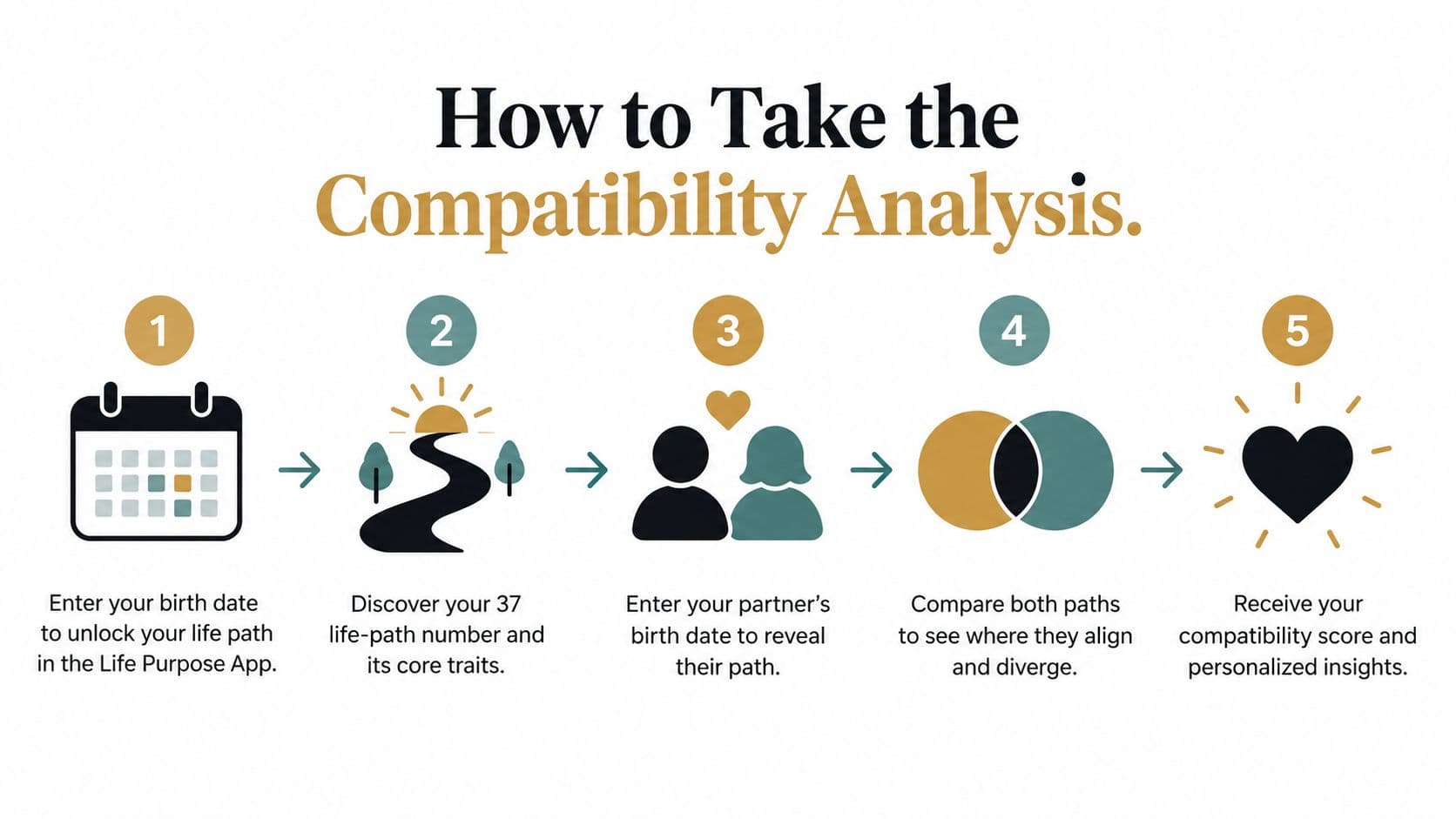
A practical sequence
-
Enter your birth date. Begin with your own life path. This prevents you from using the other person’s reading as a shortcut around self-reflection.
-
Add the second person. Depending on the app’s available options, you can select someone from your contacts or use an in-app lookup for a public figure. The comparison can apply to a partner, friend, family member, co-worker, or another person you want to understand.
-
Read the relationship analysis. Look for themes involving issues, talents, needs, and relationship patterns described through Millman’s system. Don’t scan only for positive language. A difficult passage may identify a useful conversation topic.
-
Separate recognition from proof. Write down what feels accurate, what feels questionable, and what you can test through observation. If the reading suggests different needs around independence, ask whether that pattern appears in actual decisions and conflict.
-
Turn observations into questions. Replace “The reading says you avoid closeness” with “When you’re stressed, do you prefer space or reassurance?” The second wording invites a response instead of imposing an identity.
A good interpretation leaves you more curious about the person, not more certain that you’ve solved them.
The final step matters most. A result has no practical value if it stays on a screen. Bring one or two observations into a conversation, listen without trying to force agreement, and notice whether both people can discuss the subject with respect.
Why Identical Labels Are Not the Whole Story
Sharing a religious label can create common ground, but it doesn’t guarantee shared expectations. Partners may belong to the same tradition while disagreeing about attendance, private practice, family customs, ethics, or how much authority the community should have in daily decisions.
Pew Research Center found that 74% of married U.S. adults share a religion with their spouse, yet only 51% say their beliefs are very similar. The same study found that 36% discuss religion weekly, while 16% never discuss it.4
Those figures separate three ideas that people often collapse into one:
- Identity: What label does each person use?
- Perceived similarity: How alike do the partners believe their convictions are?
- Communication: How often and how safely do they discuss religion or spirituality?
Practice can change the meaning of similarity
A couple may share a faith but have incompatible expectations about attendance or observance. Another couple may come from different traditions but agree on boundaries, family respect, children’s education, and how to handle disagreement.
A review of research on religion and marriage found that the relationship between attendance and stability depends on context. Shared attendance may support stability in couples who share a faith, while attendance can have a different association in interfaith or mixed-belief couples.5
That’s why a Life Purpose App comparison should be read in three stages: first as a pattern, then as a prompt, and finally against behavior. A similar life path doesn’t prove that two people will practice spirituality in the same way. A different path doesn’t prove that they can’t build a respectful relationship.
A Three-Dimensional Framework for Reading Any Result
A useful spiritual compatibility test can be read through belief similarity, practice compatibility, and dialogue compatibility. These dimensions prevent a symbolic result from carrying more weight than it can support.
Belief similarity concerns worldview. Do both people believe in a higher power, a spiritual reality, a religious tradition, or a secular understanding of meaning? A life-path reading may offer language for different orientations toward purpose, but only direct conversation can clarify what each person believes.
Practice compatibility concerns the calendar and the household. How often does each person attend services, pray, meditate, observe rituals, volunteer, or participate in a spiritual community? A life-path comparison may suggest different needs or priorities, but it can’t tell you whether one partner expects the other to attend every ceremony.
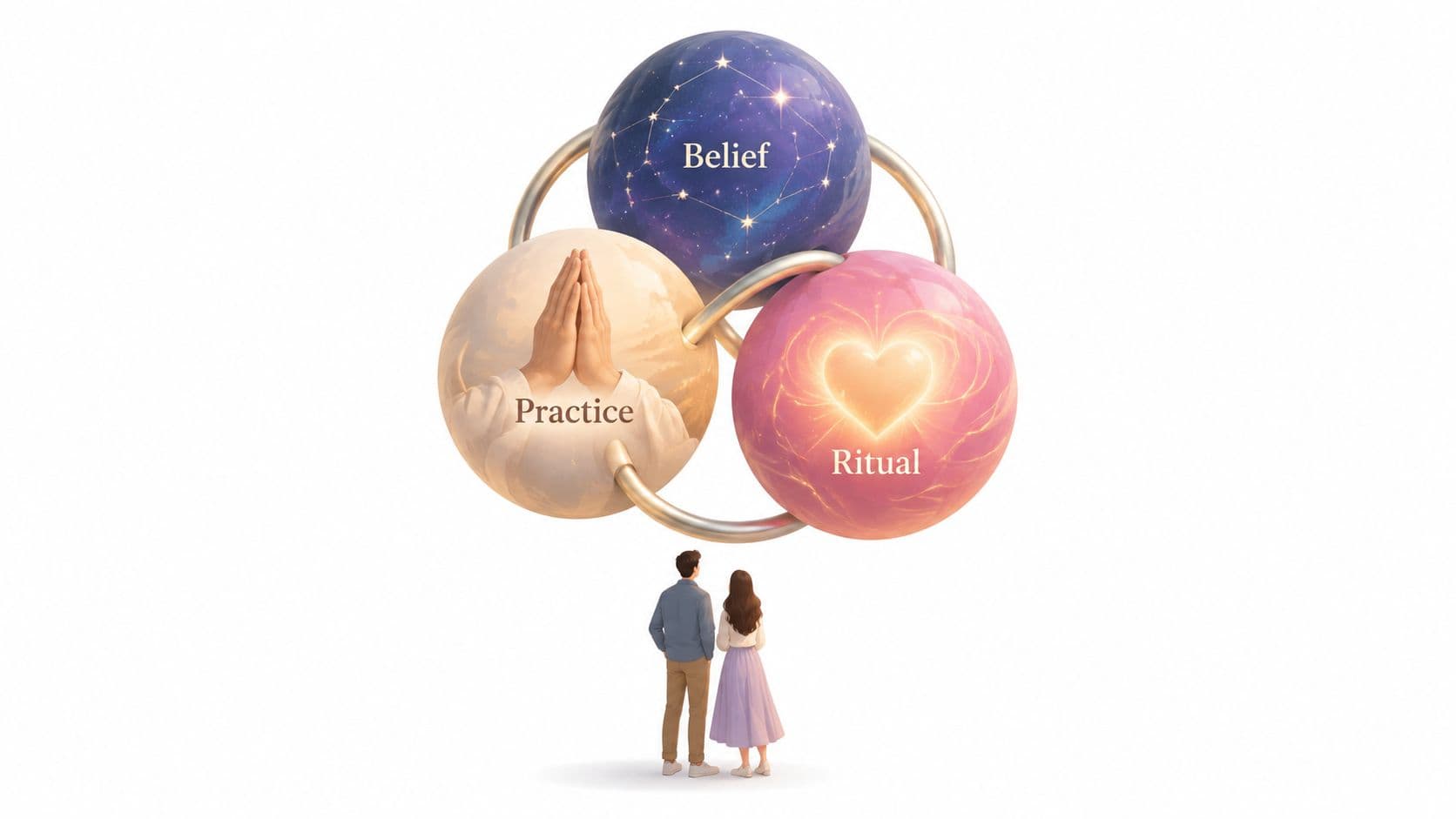
Dialogue compatibility is the test beneath the test
Dialogue compatibility asks whether both people can discuss doubt, disagreement, and change without pressure or contempt. A shared label can fail here, and a difference can succeed. Someone may share your beliefs but dismiss your questions. Another person may disagree with you while listening carefully and honoring your boundaries.
Research on perceived similarity found stronger similarity effects for areas such as age, education, physical characteristics, leisure interests, and role preferences. Effects were more moderate for political and religious attitudes, and findings were weaker or inconsistent for personality traits. Perceived similarity also tended to remain more consistent than actual similarity among established couples.6
After reading a result, ask:
- Beliefs: What do we each mean by spirituality, faith, doubt, or meaning?
- Practice: Which rituals are personal, shared, optional, or essential?
- Family: How will we approach holidays, relatives, and child-rearing?
- Ethics: How do our beliefs shape money, sex, work, illness, and responsibility?
- Dialogue: Can either person disagree without punishment, ridicule, or control?
Best Practices and Honest Red Flags to Watch For
Use the reading with humility. Return to Dan Millman’s The Life You Were Born to Live when you need context, but keep the interpretation connected to actual conversations and repeated behavior.
Healthy ways to use the result
- Treat patterns as prompts: Ask whether a theme appears in real life before accepting it.
- Discuss concrete choices: Talk about money, family obligations, holidays, child-rearing, sex, and moral decisions.
- Check for mutuality: Both people should be free to interpret, question, and reject parts of a reading.
- Notice repair: Pay attention to whether disagreement leads to listening, negotiation, and accommodation.
Red flags that deserve attention
- Score-based control: Someone uses a compatibility score to dictate where you live, whom you see, or what you believe.
- Fatalistic interpretation: A low match becomes a sentence rather than an invitation to investigate.
- Confirmation bias: You notice only the passages that support fears or hopes you already had.
- Power imbalance: One person claims spiritual authority and expects the other to obey.
- Label substitution: A symbolic description replaces direct questions about safety, respect, and consent.
A spiritual compatibility test is most useful when it opens a conversation rather than closes one. The Life Purpose App can provide a structured life-path comparison, but the relationship itself is tested through honesty, boundaries, listening, and the willingness to accommodate meaningful differences.
Use the Life Purpose App to explore your birth-date-based life path and compare relationship dynamics through the framework of Dan Millman’s The Life You Were Born to Live. Bring the reading to a real conversation, and use its themes to ask clearer questions about values, practices, purpose, and mutual respect.
Q&A
Q: What does a spiritual compatibility test actually reveal?
A: It reveals patterns about beliefs, practices, and needs. Questionnaires show explicit choices; life-path readings offer symbolic language that can help explain recurring dynamics.
Q: How should I bring a reading into a real conversation?
A: Start with one or two nonjudgmental observations, turn labels into questions (for example, “When you’re stressed, do you prefer space or reassurance?”), and listen for behavior rather than assuming destiny.
Q: When is a reading a red flag?
A: When someone uses a score or label to control decisions, treats a low match as final, or refuses to discuss boundaries and consent.
1.
A. K. Smith et al., “Perceived similarity and relationship satisfaction in religious couples,” Taylor & Francis Online. https://www.tandfonline.com/doi/full/10.1080/15267431.2022.2069771
2.
Study: “Spiritual intimacy linked to higher relationship satisfaction and commitment in dating couples,” PsyPost. https://www.psypost.org/spiritual-intimacy-linked-to-higher-relationship-satisfaction-and-commitment-in-dating-couples/
3.
Dan Millman, The Life You Were Born to Live, 25th Anniversary Edition. Edition details: https://www.amazon.co.uk/Life-You-Were-Born-Live/dp/1932073752
4.
Pew Research Center, “Religious Intermarriage and Religious Similarity Among Married Adults,” 2025 Religious Landscape Study. https://www.pewresearch.org/religion/2025/02/26/religious-intermarriage/
5.
Review: “Religion and marriage: Attendance, beliefs, and relationship stability,” University of Florida IFAS. https://ask.ifas.ufl.edu/publication/FY1337
6.
E. González et al., “Perceived similarity and compatibility: A review,” Scielo. https://www.scielo.org.mx/scielo.php?script=sci_arttext&pid=S2007-48322011000200002
7.
Ayahuasca guide referenced for integration and context: Ayahuasca resources. https://ayahuasca.com/resources/choosing-a-retreat/ayahuasca-healing/
Discover your life path today
Enter your date of birth and see your life path, free.
Find your life path