Start a spiritual growth journal to unlock self-discovery. This guide covers setup, prompts for shadow work, and integrating life path insights.

June 27, 2026 (3mo ago) — last updated July 13, 2026 (2mo ago)
Your Spiritual Growth Journal: A Guide to Deeper Insight
Start a spiritual growth journal to unlock self-discovery. This guide covers setup, prompts for shadow work, and integrating life path insights.
← Back to blog
Start a spiritual growth journal to unlock self-discovery. This guide covers setup, prompts for shadow work, and integrating life path insights.
You may be sitting with a notebook you bought months ago, waiting for the “right” first entry. Or maybe you've filled plenty of journals, but every page still feels like a report on your moods instead of a doorway into real change. That stuck feeling is common. A spiritual practice can call to you long before it becomes clear.
A spiritual growth journal helps when your inner life feels scattered. It gives your questions a place to land. It gives your patterns somewhere to reveal themselves. Most of all, it turns vague longing into a practice you can return to when life gets noisy, disappointing, beautiful, or hard to understand.
The key is to stop treating journaling like a performance. It isn't about sounding wise. It isn't about producing neat pages full of gratitude and insight every morning. Used well, a journal becomes a place for honesty, discernment, and direct contact with what's happening within you. It can also help you work with the deeper themes of your life, including the life-path lens Dan Millman describes in The Life You Were Born to Live and related tools like the Life Purpose App, which I'll touch on later in a practical way.
Embarking on Your Inner Journey
Spiritual drift rarely looks dramatic. It often looks like functioning well on the outside while feeling oddly disconnected inside. You get through your days, answer messages, handle responsibilities, and still feel that low hum of “something is missing.”
That's where a spiritual growth journal becomes useful. Not as another task. As an anchor.
When the inner world gets foggy, writing slows it down enough for you to hear what's underneath the surface noise. Sometimes that's grief. Sometimes it's hunger for meaning. Sometimes it's a quiet invitation to live more honestly than you have been.
Treat the journal like a meeting place
Start with this simple shift. Your journal is not a logbook of events. It's a meeting place between your daily self and your deeper self.
Write as if you're entering a real conversation:
- Name what's present: confusion, numbness, gratitude, resentment, longing
- Ask one clean question: “What am I avoiding?” or “What wants my attention today?”
- Stay long enough to hear an answer: even if it arrives slowly or awkwardly
If you want a gentle starting point for the broader path itself, this guide on how to start a spiritual journey offers helpful orientation.
Practical rule: Don't wait to feel spiritual before you write. Write from the exact state you're in.
Create support around the practice
Inner work lands better when your outer environment supports it. A quiet corner, a favorite chair, a recurring morning ritual, or even a periodic reset retreat can help. Some people also like browsing a directory of holistic wellness spas when they need a restorative environment that helps them step out of autopilot and return to reflection with more presence.
This is also where the journal starts to move beyond simple reflection. A good spiritual growth journal doesn't only record your peace. It records your resistance, your repeated lessons, and the moments when life itself seems to press on a deeper theme. Later, that becomes especially powerful when you pair journaling with the life-path framework from Dan Millman's The Life You Were Born to Live and the Life Purpose App.
Laying the Foundation for Your Journaling Practice
A journal works best when you know what you're asking it to hold. If your intention is fuzzy, your entries usually become fuzzy too. You write a little about your day, a little about your feelings, then stop because nothing seems to deepen.
Define what spiritual growth means to you
For one person, spiritual growth means feeling closer to God. For another, it means seeing through self-deception. For someone else, it means becoming steadier under pressure, more compassionate in conflict, or more honest about the gap between values and behavior.
Write a single sentence at the front of your journal:
“I'm keeping this journal to become more aware of my patterns, more honest with myself, and more responsive to what is sacred.”
Use your own words, but keep it specific. “To grow spiritually” sounds noble and vague. “To notice when fear is running my decisions” gives you something real to work with.
Choose paper or digital by function, not image
Some people do better with a physical notebook because the body slows down when the hand writes. The page feels grounded. It's easier to stay with a hard truth when there's no tab to click away to.
Digital journaling has its own strengths. It's private, searchable, portable, and easier to maintain if your life moves fast. If you process thoughts out loud before writing them down, tools that help you organize your spoken entries can make the practice more workable.
A quick comparison helps.
| Format | Best for | Trade-off |
|---|---|---|
| Paper journal | Presence, tactile ritual, slower reflection | Harder to search and organize |
| Digital journal | Privacy, convenience, finding patterns over time | Easier to rush or multitask |
Neither format is more spiritual. The better one is the one you'll use when you're tired, triggered, or short on time.
Build a container that can hold honesty
A lot of people say they want a spiritual journal, but what they really want is a journal that only reflects the polished parts of themselves. That won't take you very far.
The practice gets useful when your journal can hold all of this:
- Your sincere prayers
- Your ugly reactions
- Your repeating stories
- Your moments of awe
- Your confusion about what any of it means
The strongest journaling process I know is simple. Make the page safe enough for truth, but structured enough that you don't wander in circles. That means writing with intention, but without self-censorship.
Structuring Your Journal for Consistent Reflection
A blank page can feel holy for about ten seconds. After that, it can feel demanding. Structure helps. Not rigid structure, but enough form that you don't have to reinvent the practice every time you sit down.
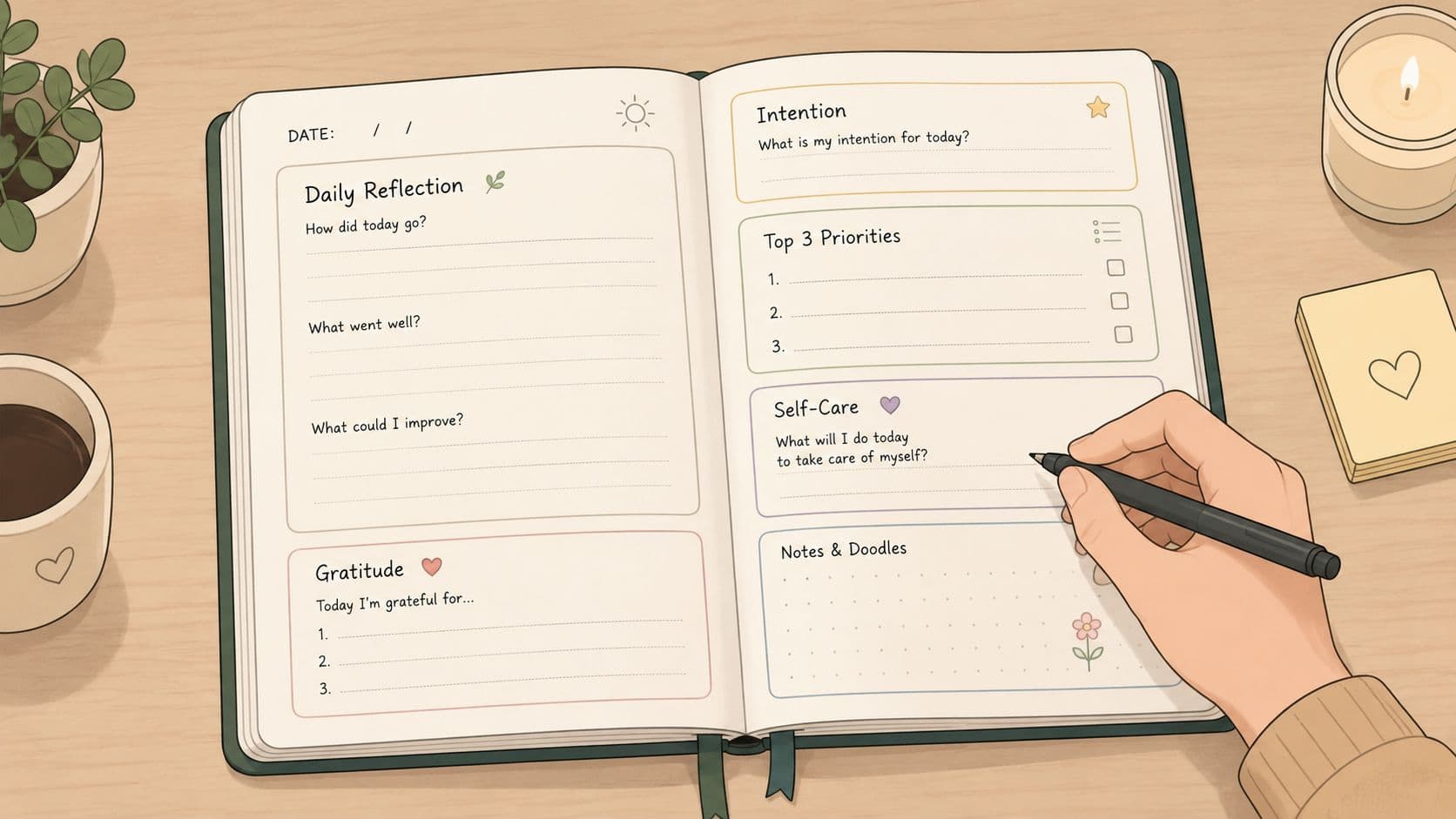
The most important thing to remember is this: the primary metric for success in journaling is consistency, not perfection; experts advise that even 5–10 minutes of daily writing is sufficient to build a sustainable spiritual habit (Corella Roberts).
A daily format that doesn't feel heavy
If you want a simple daily rhythm, keep it to three parts:
-
Morning intention
Write one sentence about how you want to meet the day. Not what you want to achieve. How you want to meet it. -
Midday noticing
Jot a phrase or two when something stirs you. Irritation, beauty, envy, tenderness, exhaustion. These are spiritual materials, not interruptions. -
Evening reflection
Ask, “Where was I aligned today, and where did I abandon myself?”
That's enough for a strong spiritual growth journal. You don't need pages of analysis to create continuity.
A weekly rhythm for busier seasons
If daily writing isn't realistic for a season, use a weekly review. Give each entry four short sections:
- What challenged me
- What opened my heart
- What pattern repeated
- What I need to face next
This works especially well if you already use a planning system. A practical personal development plan template can help you connect inner insight with actual follow-through.
Some days, one honest paragraph will move you further than three pages of polished reflection.
What works and what usually fails
I've seen people keep a journal going for years with a very small ritual. I've also seen beautiful notebooks die after a week because the process was too ambitious.
Here's the difference.
| What works | What usually fails |
|---|---|
| A repeatable entry template | Waiting for inspiration every time |
| Short sessions you can keep | Long idealized sessions you skip |
| Honest, unfinished writing | Trying to sound profound |
| Returning after missed days | Quitting because the streak broke |
A good structure should lower resistance, not increase it. If your current format makes you feel behind before you begin, simplify it immediately.
Curated Prompts for Deeper Self-Discovery
Most journaling prompts stay in safe territory. Gratitude. Intentions. General feelings. Those have value, but they won't always take you to the places where real transformation happens. A spiritual growth journal becomes far more potent when it includes prompts that reveal ego defenses, expose recurring falsehoods, and connect your inner life to the world around you.
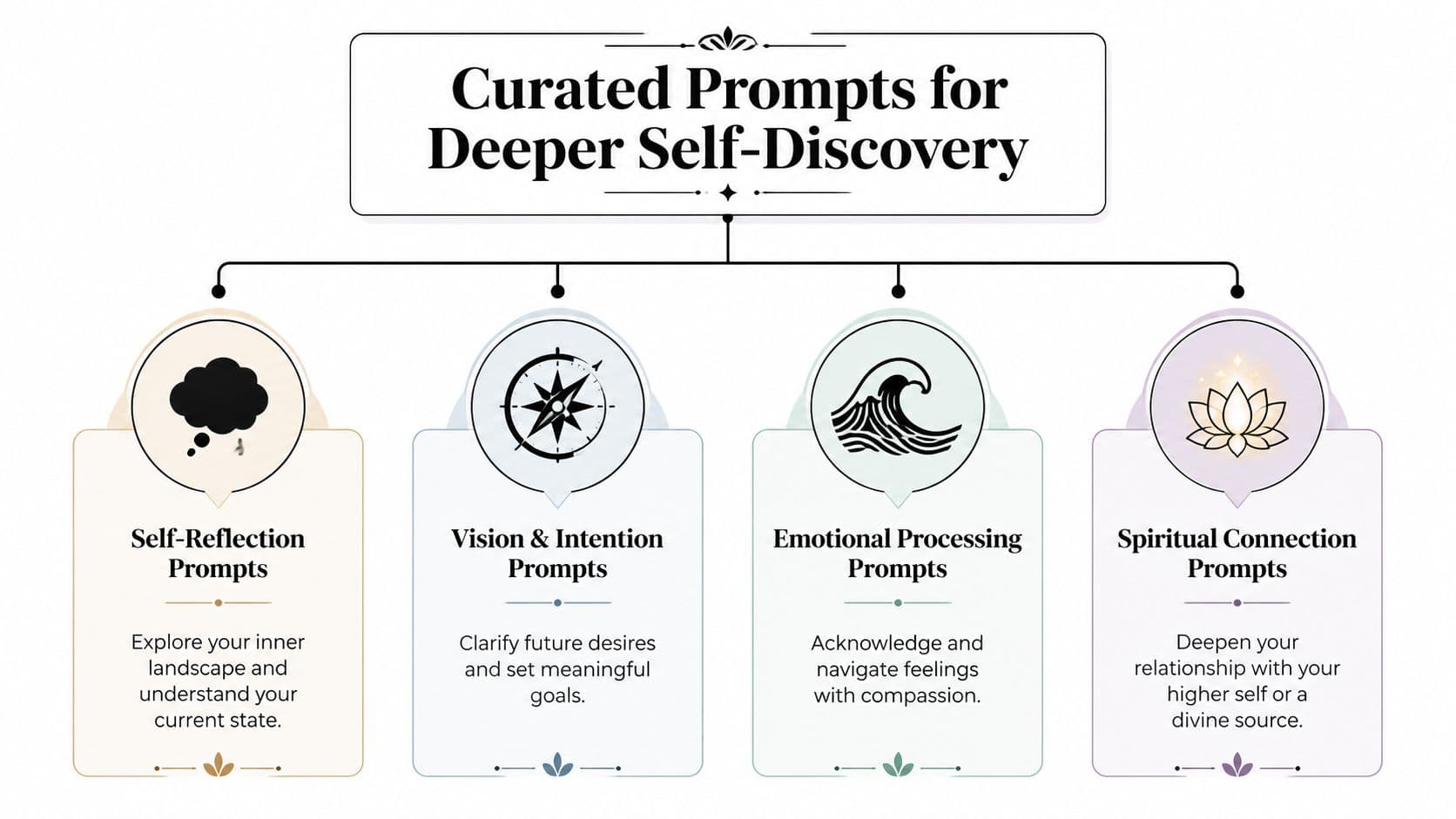
Self-reflection prompts that reveal your present state
These are useful when you feel vague, scattered, or emotionally flat.
- Start with the body: “What am I carrying in my body that I haven't admitted in words?”
- Track your energy: “When did I feel most contracted today, and what story was attached to that feeling?”
- Notice aliveness: “What gave me a sense of inner rightness recently?”
These prompts don't force meaning too quickly. They help you gather signal.
Vision and intention prompts that clarify direction
Not every journal entry needs to excavate pain. Some pages need to orient you toward what wants to emerge.
Try prompts like:
- What kind of person am I becoming through the choices I'm making now?
- What am I pretending not to know about the next step?
- If fear loosened its grip, what would I give myself permission to begin?
A journal becomes directional, not just reflective.
Emotional processing prompts for difficult days
When emotion is strong, the page can hold it without turning it into drama.
A few that work well:
- “What hurt me here, beneath the surface reaction?”
- “What did I need in that moment that I didn't ask for?”
- “What am I making this situation mean about me?”
If dreams are surfacing during this kind of work, a comprehensive guide to dream psychology can help you reflect on recurring symbols and emotional themes without flattening them into clichés.
Shadow work and ego-confrontation prompts
This is the territory many journaling guides avoid. But in practice, this is often where the breakthrough lives. Effective spiritual journaling often requires confronting the ego's defenses and unhelpful narratives, a method cited as a "catalyst for rapid expansion" that moves beyond simple reflection into profound growth (Kirsti Formoso).
A direct process can help. Some practitioners use a four-step “Honesty Tool” approach:
- invite divine guidance
- pour out uncensored thoughts about the situation
- underline the lies you notice when rereading
- record the response you sense from the divine
The power here is not in being harsh with yourself. It's in separating truth from the voice of fear, vanity, self-protection, or resentment.
Use prompts like:
- What am I defending right now?
- What story am I repeating that keeps me small or superior?
- Where am I calling something “discernment” when it's really avoidance?
- What do I not want to write because it would expose my pride?
Write the sentence you least want to write. That's often the sentence that opens the locked room.
Prompts tied to service and witnessing injustice
Inner work deepens when it meets real life. Spiritual growth doesn't happen only in silence, candles, and private contemplation. It also sharpens when you witness suffering, encounter unfairness, or step into service.
Research on service-learning found that spiritual growth occurred when students experienced significant challenge balanced with support, including moments when they witnessed injustice and engaged diverse perspectives.
That matters because a spiritual growth journal should be able to hold your response to the world, not just your response to meditation.
Try:
- What did I witness today that disturbed my conscience?
- Where did I feel called to act instead of merely reflect?
- How did service challenge the image I have of myself?
- What did another person's pain reveal about my own blind spots?
These prompts prevent spirituality from becoming private self-absorption. They bring the journal back into contact with life.
Connecting Your Journal to Your Unique Life Path
Some journals become repetitive because the writer can sense recurring themes but doesn't yet have a language for them. Dan Millman's work can, in such cases, add real precision. In The Life You Were Born to Live, and in the Life Purpose App, life paths are used not as fortune-telling labels but as a framework for understanding recurring gifts, challenges, and lessons.

Dan Millman's system assigns each person to one of 45 unique life paths, with each path describing common strengths and challenges derived from the full, unreduced sum of the birth date digits, as detailed in The Life You Were Born to Live and the Life Purpose App.
Use the system as a lens, not a script
This is an important distinction. A life path should not replace your own discernment. It should sharpen it.
Millman's method uses the full birth date in an unreduced-digit approach. The resulting sum is the key used to identify the life path in The Life You Were Born to Live and the Life Purpose App. In this framework, the right-hand digit or digits carry stronger influence on life purpose, while the left-hand digit points toward obstacles and opportunities encountered along the way.
That gives you a practical journaling angle. If your path highlights a recurring challenge around trust, discipline, boundaries, vulnerability, or self-worth, you can begin tracking how that theme shows up in ordinary life.
Journal with your path in mind
Instead of writing general entries, write through a focused lens.
Try prompts like:
- Where did my core challenge show up this week?
- How did my strengths help me, and where did they become overused?
- What obstacle keeps appearing in different clothing?
- Which relationships are activating my life lesson most clearly right now?
This turns the journal into a place of pattern recognition.
Reflection prompt: “How did today's conflict express one of my deeper lessons, rather than being just a bad moment?”
Keep the process grounded
The best use of numerology in a spiritual growth journal is practical. Don't use it to excuse behavior. Don't use it to harden your identity. Use it to notice the curriculum underneath your recurring experiences.
Dan Millman's The Life You Were Born to Live and the Life Purpose App are useful here because they give a structured way to name themes that many people can feel but not articulate. Once those themes have language, the journal becomes less like a diary and more like a field notebook for spiritual maturation.
Sustaining Your Practice and Building a Lifelong Habit
The true test of a spiritual growth journal isn't whether you can keep it for a week when motivation is high. It's whether you can return to it after disappointment, boredom, travel, grief, or a month of forgetting it exists.
That return matters more than intensity.
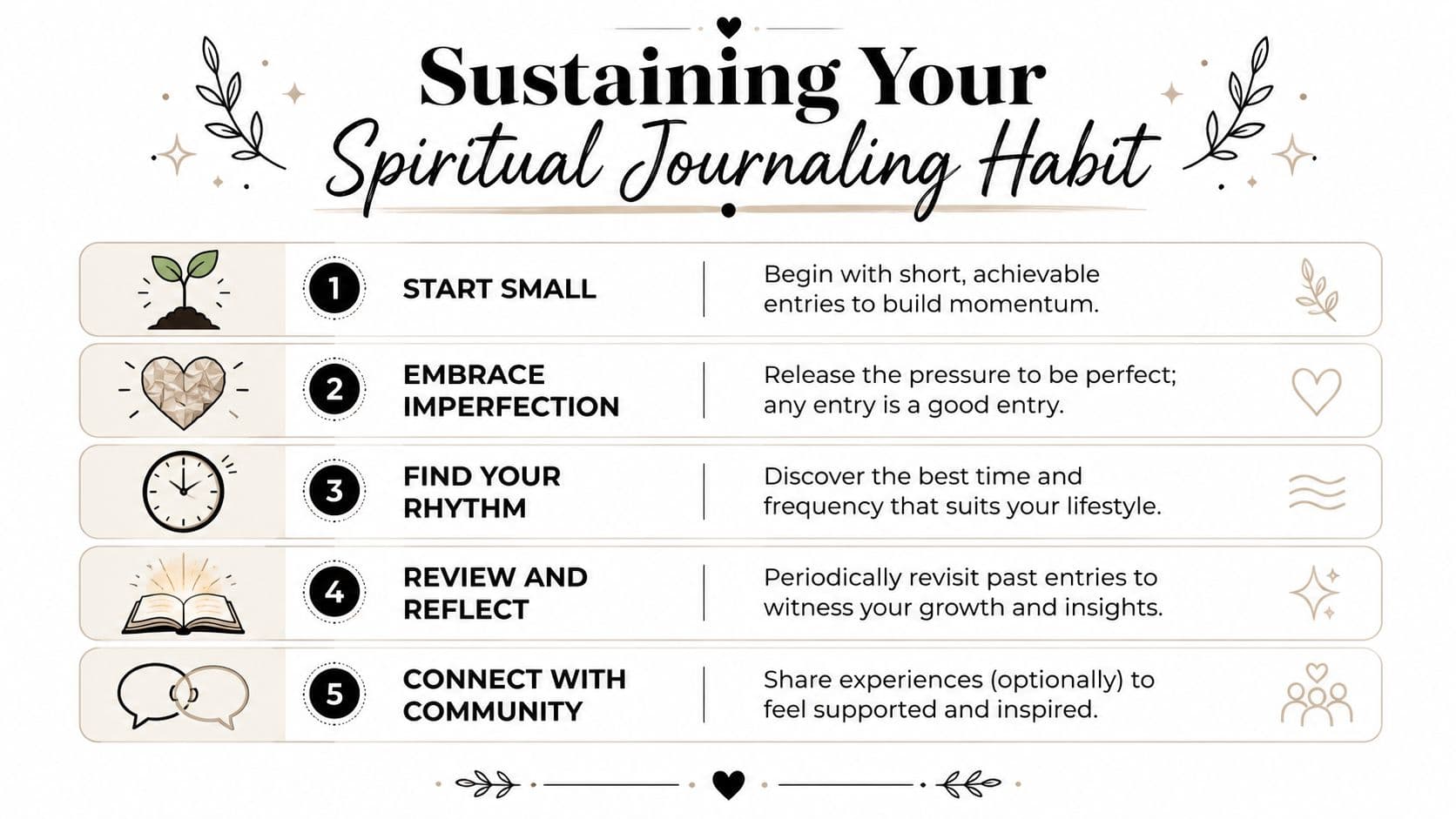
A strong reason to stay steady comes from the research itself. A study showed that individuals journaling 5–7 times per week exhibited significantly higher scores in spiritual growth and psychological well-being compared to those who journaled less frequently, confirming that consistency is key to measurable results (PMC study).
Make it easy to begin again
The habit survives when the threshold is low.
- Set a tiny baseline: one sentence counts
- Attach it to an existing rhythm: after tea, after prayer, before sleep
- Keep the journal visible: friction kills momentum
- Drop the catch-up mindset: write today's truth, not a summary of the missed days
If you enjoy digital support for inner work, exploring apps for personal growth can help you find a rhythm that matches your life.
Expect resistance and work with it
Some resistance is logistical. You're tired. You're busy. You forget.
Some resistance is spiritual. You know the page will tell the truth.
When people drift away from journaling, it's often not because the practice stopped working. It's because it started working well enough to expose something uncomfortable. That's why compassion matters. So does honesty.
A few practical responses help:
- If you feel uninspired, write about your resistance itself.
- If perfectionism kicks in, ban yourself from writing more than a short paragraph.
- If entries become repetitive, review older pages and circle recurring themes.
- If the process gets emotionally intense, slow down and seek wise support where needed.
The point isn't to keep a beautiful record. The point is to stay in relationship with your own unfolding life.
A lifelong journal practice becomes one of the quietest and strongest forms of spiritual companionship. It doesn't flatter you. It doesn't rush you. But if you keep showing up, it will keep showing you where you are, what you're learning, and who you're becoming.
If you want to explore your deeper themes through Dan Millman's system in The Life You Were Born to Live, the Life Purpose App offers a practical way to identify your life path and bring those insights into your journaling practice. It's a useful next step if you're ready to turn reflection into more focused self-understanding.
Discover your life path today
Enter your date of birth and see your life path, free.
Find your life path