Spiritual Laws Emerson. Explore Ralph Waldo Emerson's spiritual laws and their profound impact on personal growth. Learn how these timeless principles can guide

October 11, 2026 (4d ago)
Spiritual Laws Emerson: Discovering 7 Timeless Principles
Spiritual Laws Emerson. Explore Ralph Waldo Emerson's spiritual laws and their profound impact on personal growth. Learn how these timeless principles can guide
← Back to blog
Spiritual Laws Emerson. Explore Ralph Waldo Emerson's spiritual laws and their profound impact on personal growth. Learn how these timeless principles can guide
You can have a full calendar, a respectable career, and people around you, yet still feel strangely detached from your own life. Perhaps you keep asking whether your decisions reflect your values or just satisfy expectations. Ralph Waldo Emerson's spiritual laws offer a way to examine that feeling without reducing it to a quick motivational slogan. His philosophy asks you to look at the relationship between perception, character, conduct, and consequence.
Emerson wasn't offering a quantified system or a promise that positive thinking controls every outcome. He was describing an inward moral order, then asking readers to test it through reflection and action. That makes his work especially useful now, when self-discovery can easily become either vague inspiration or rigid certainty.
Why Emerson's Spiritual Laws Matter Today
Modern life gives you more choices, but choice alone doesn't create purpose. A job can provide security without expressing your abilities. A relationship can look healthy from the outside while leaving you unable to speak your truth. Even a spiritual practice can become another task to perform if it isn't connected to the way you make decisions.
Emerson's answer begins with attention. He believed that your inner convictions shape what you notice, what you choose, and how you behave. Repeated choices then form character, and character influences the relationships and circumstances you help create. His spiritual law is therefore ethical and causal, not supernatural bookkeeping. It asks you to examine the part of a recurring result that belongs to your own habits.

A philosophy of participation
Emerson's essay “Spiritual Laws” appeared in Essays: First Series, published in 1841. The volume contained 12 essays, including “Self-Reliance,” “Compensation,” “The Over-Soul,” “Circles,” and “Spiritual Laws,” placing the essay within the foundational publication of his mature philosophy (Ralph Waldo Emerson's biography and works).
That context matters. “Spiritual Laws” wasn't originally a modern list of numbered rules. It was part of a compact collection about conscience, intuition, moral reciprocity, spiritual connection, and the individual's place in the world. Reading it alongside the other essays prevents a narrow interpretation based only on intuition or personal success.
The same balance appears in other traditions of reflective reading. Someone exploring the relationship between conscience, faith, and moral formation might also find value in these Augustine and C.S. Lewis picks, especially when comparing different approaches to inner transformation.
Meaning without magical guarantees
Emerson's ideas can support a modern search for purpose, but they shouldn't be turned into a claim that your thoughts mechanically determine your health, finances, relationships, or future. The more useful interpretation is practical: your beliefs affect your attention, your attention affects your behavior, and your behavior creates patterns that deserve honest review.
That approach also connects with broader reflections on ancient wisdom in modern times. Emerson remains relevant because he doesn't ask you to escape ordinary life. He asks you to meet work, friendship, disappointment, and responsibility with greater awareness.
The Historical Context Behind Spiritual Laws
A 19th century listener might have first met Emerson in a crowded lecture room, not alone with a book. Between 1833 and 1881, he delivered approximately 1,500 lectures in 283 cities across the United States, shaping his philosophy in public as he refined it on the page (historical research on Emerson's lecture career).
That setting helps modern readers approach “Spiritual Laws” more accurately. The essay grew from spoken teaching, where ideas had to reach people carrying ordinary burdens: work, grief, family duty, doubt, hope. Emerson was not writing for a sealed academic world. He was testing whether large spiritual claims could hold up in daily life. That is one reason the essay often feels direct and compressed, like advice delivered to an attentive room.
From lecture hall to lasting book
Essays: First Series appeared in 1841, followed by Essays: Second Series in 1844. By 1860, a collected edition was being marketed to readers who already knew Emerson as a major author. The pattern matters. His ideas moved from live speech to printed essays to wider circulation, which helped “Spiritual Laws” become part of a larger conversation rather than a single isolated text.
That conversation belonged to American Transcendentalism. At its center was a demanding question: how does a person recognize truth inwardly without drifting into mere impulse? Emerson's answer was disciplined, not casual. Intuition mattered, but so did reading, observation, action, and moral testing. In that sense, his spiritual laws work less like magical rules and more like a practice of self-study. Dan Millman's numerology system asks a similar modern question through a different method. It invites people to read patterns in a life and use them for self-knowledge rather than passive belief.
Emerson's influence spread widely, touching figures such as Whitman, Thoreau, Nietzsche, and William James. They did not all agree with him. They did inherit a language for discussing conscience, individuality, growth, and participation in something larger than the isolated self.
That helps explain why Emerson still appears in discussions of what different religions have in common. His focus stayed on direct contact with meaning, then testing that contact in how a person lives.
Understanding Emerson's Key Spiritual Principles
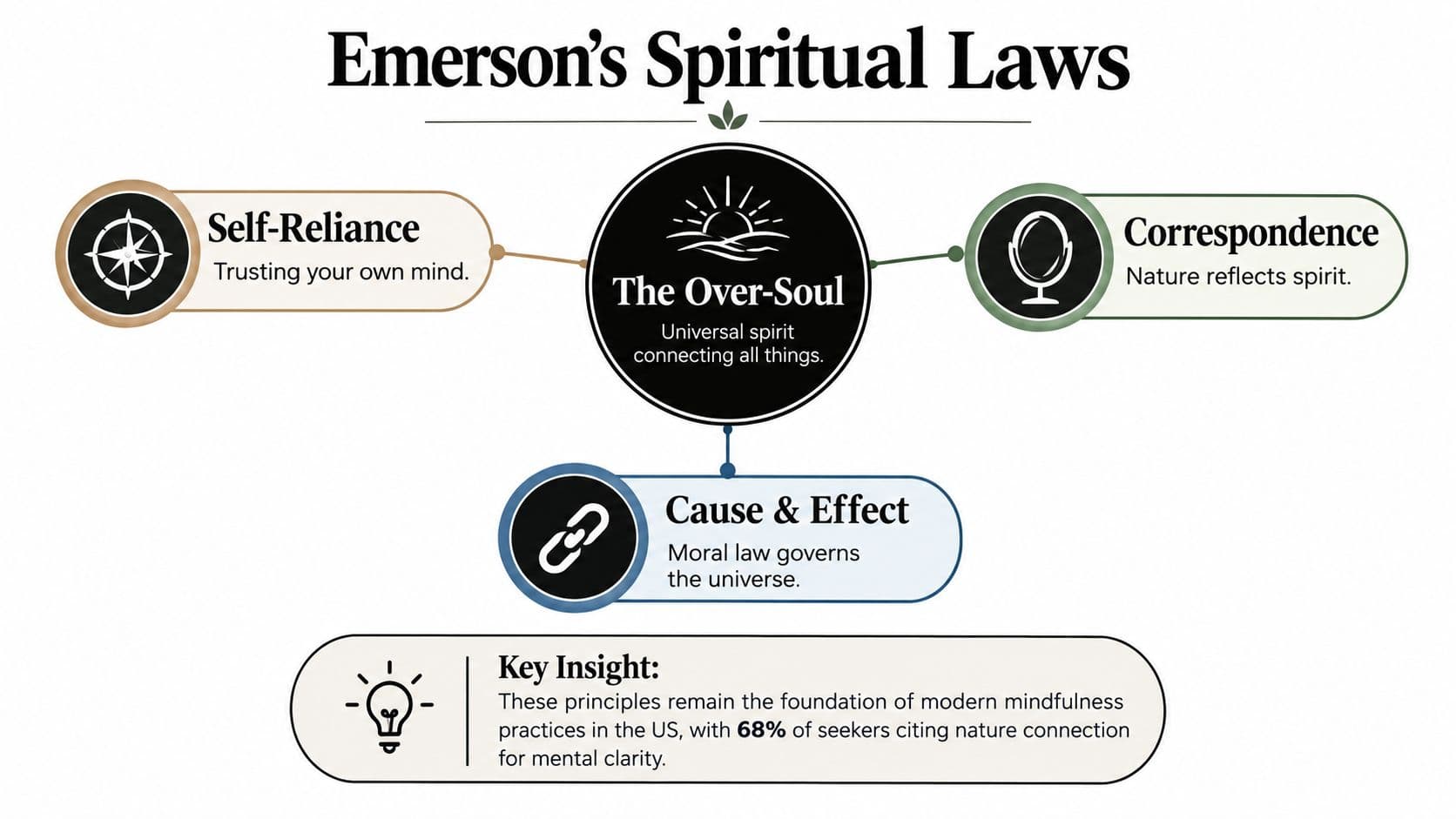
Emerson's spiritual law works best as a connected model. It begins with inward perception, moves through conduct, and expands toward a sense of participation in something larger than the isolated ego. Each principle corrects a common mistake.
Spiritual law as moral cause and effect
Emerson's concept of spiritual law is best understood as an ethical-causal model, not a quantified or experimentally testable law. In “Spiritual Laws,” human development depends on an inward moral order: perception, character, and conduct are linked, so external outcomes can't be separated entirely from the quality of the self that produces them (Routledge's account of Emerson's early works).
Consider a manager who repeatedly interrupts colleagues. The immediate result may be frustration or silence. Over time, the manager receives less honest feedback, then interprets that silence as agreement. The pattern doesn't prove that every consequence is deserved or predictable. It does show how conduct can shape the environment in which future decisions occur.
Compensation as reciprocal consequence
In “Compensation,” Emerson presents a reciprocal mechanism rather than a numerical formula. Every gain carries a corresponding loss, and every deficiency may contain some compensating excess. He applies this idea to labor, wealth, virtue, and moral consequence, arguing that benefits cannot be separated permanently from their costs (Emerson's text of “Compensation”).
A promotion, for example, may bring recognition while demanding more time and responsibility. A failure may remove an opportunity while exposing a skill that needs development. Compensation doesn't mean every painful event is secretly good. It means mature reflection can ask what an experience costs, teaches, reveals, or requires.
Self-reliance as examined judgment
Self-reliance means more than doing whatever feels authentic in the moment. It means developing the capacity to evaluate inherited expectations, listen to your own judgment, consider effects on others, and revise your position when experience proves it incomplete.
The Over-Soul and shared being
The Over-Soul places individual development within a larger spiritual unity. You aren't a sealed-off personality inventing meaning alone. Your conscience, relationships, encounters with nature, and participation in culture all contribute to how you become yourself.
That makes Emerson's system less selfish than some modern summaries suggest. Inner authority matters, but so do humility, responsibility, and connection. His principles become coherent when you see them as a movement from self-observation toward ethical participation.
For a broader introduction to this kind of reflection, what spiritual wisdom means can provide useful language for comparing inward insight with lived practice.
The Danger of Misreading Self-Reliance
The popular version of Emerson often sounds simple: trust yourself, ignore everyone else, and follow your instincts. That reading is attractive because it turns a demanding philosophy into a permission slip. It also misses the discipline at the heart of “Self-Reliance.”
Scholarly interpretation treats the essay as a program of moral and political self-education. Emerson asks readers to develop original thought, but he also expects continuing self-revision. His aphoristic style makes you practice independent judgment instead of passively receiving a neat sequence of instructions (Oxford commentary on “Self-Reliance”).
Impulse and judgment are not the same
An impulse says, “I want this now.” Authentic judgment asks, “What value am I protecting, what evidence do I have, and what effects might follow?” Fear can feel like intuition because both arrive with emotional force. Social conformity can feel like wisdom because it has been repeated by people you trust.
A useful comparison looks like this:
| Distorted self-reliance | Emersonian self-reliance |
|---|---|
| Rejects criticism automatically | Examines criticism without surrendering judgment |
| Treats preference as truth | Separates preference, evidence, and value |
| Avoids responsibility | Accepts responsibility for chosen action |
| Confuses isolation with freedom | Preserves autonomy while remaining connected |
| Defends a fixed identity | Revises the self through experience |
The distinction protects Emerson from becoming a slogan for arrogance. A person who refuses every outside perspective may be independent, but not necessarily wise. Self-reliance requires enough confidence to think for yourself and enough humility to discover where your thinking fails.
Practical rule: Trust your judgment provisionally. Let action, consequences, trusted relationships, and honest review teach you what your first impression couldn't.
This interpretation also makes Emerson compatible with community responsibility. Historical analysis challenges the idea that his critique of institutional charity amounts to a rejection of all obligation. Immediate, local, fraternal care can coexist with a demand that individuals cultivate conscience rather than outsource it.
Applying Spiritual Laws to Personal Growth
Philosophy becomes useful when it changes what you notice on an ordinary day. Emerson's framework can become a small practice of observation, testing, and revision rather than an abstract belief system.

Begin with a recurring pattern
Choose one result that keeps appearing. Perhaps you agree to work you resent, avoid difficult conversations, or seek approval before making even small decisions. Don't begin by blaming yourself. Describe the pattern precisely.
Write down:
- The repeated result: What keeps happening?
- The decision point: Where could you have acted differently?
- The governing belief: What assumption influenced your choice?
- The cost: What did the decision require from you or others?
- The experiment: What small change can you test responsibly?
This exercise turns spiritual law into behavioral analysis. You're tracing the movement from conviction to attention, from attention to conduct, and from conduct to consequence.
Test intuition instead of worshipping it
Emerson presents education as a combination of nature, books, and action, not inward feeling alone (Stanford Encyclopedia of Philosophy on Emerson). That gives you a reliable answer to a difficult question: how can you distinguish spiritual intuition from impulse, fear, or personal preference?
Notice the inner signal. Then ask what would happen if you acted on it in a limited and responsible way. Seek feedback from someone trustworthy, observe the result, and revise your understanding. Intuition that survives evidence and ethical reflection becomes more useful than a feeling protected from every challenge.
A short daily practice can help:
- Pause before reaching for your devices. Notice the concern or desire that is already present.
- Observe one natural detail. Let the senses interrupt your usual mental loop.
- Journal one honest question. “What am I refusing to trust today?” is more useful than “How can I become certain?”
- Review one decision later. Ask whether the result supports or complicates your original interpretation.
People who want additional structure can browse life coach strategies, then adapt any exercise to Emerson's emphasis on reflection, action, and responsibility.
Connecting Emerson to Modern Self-Discovery Systems
Emerson gives you a broad philosophical lens. Dan Millman's numerology system, presented in “The Life You Were Born to Live,” offers a more personalized framework based on birth dates and life-path patterns. These approaches shouldn't be treated as identical. Emerson asks how a person develops through conscience, experience, and conduct, while Millman's system gives users a symbolic starting point for exploring gifts, challenges, and purpose.
That difference can be productive. A broad principle such as self-reliance may prompt you to ask whether you're following inherited expectations. A personal life-path reading can give you a set of themes to examine in areas such as career, relationships, health, money, and personal growth. The interpretation still depends on your honesty and choices.

A map, not a verdict
The most responsible way to combine these systems is to use numerology as a prompt for self-inquiry, not as proof that a birth date mechanically determines personality or destiny. Emerson's method supports that caution. Inner insight gains strength when you compare it with lived experience, ethical consequences, learning, and relationships.
The Life Purpose App is a digital companion to Dan Millman's “The Life You Were Born to Live.” It uses a date of birth to present one of 45 unique life paths, explore associated spiritual laws, examine gifts and challenges, map nine-year life cycles, and compare relationship dynamics. It also includes relationship comparisons for friends, family, coworkers, or public figures through in-app Wikipedia look-ups. A free tier provides a life-path summary and system overview, while paid options provide the complete text from the 25th Anniversary Edition, detailed analyses, unlimited contacts, and access to primary numbers and cycles. It is available in English, French, and German.
Those features can make an abstract question more concrete: Which pattern am I being invited to examine? Where do I resist responsibility? Which strengths do I overlook because they feel ordinary? The answers shouldn't replace evidence, professional advice, or personal accountability. They can, however, help you choose a subject for the kind of reflective experiment Emerson valued.
Spiritual insight becomes practical when it changes the next honest action you take.
Emerson's spiritual laws and Millman's life-path system meet at that point. One offers a philosophy of moral development; the other offers a personalized vocabulary for reflection. Used carefully, both can help you move from vague longing toward clearer questions, observable choices, and a more deliberate sense of purpose.
The Life Purpose App helps you explore Dan Millman's The Life You Were Born to Live through birth-date-based life paths, associated spiritual laws, life cycles, and relationship comparisons. Visit Life Purpose App to turn Emerson's questions about character, intuition, and purpose into a structured practice of self-discovery.
Discover your life path today
Enter your date of birth and see your life path, free.
Find your life path