You check your phone. Another mixed signal. Discover four spiritual laws—self-love, resonance, allowance, and shared growth—that help you stop repeating patterns and build deeper, conscious connection.
May 10, 2026 (4mo ago) — last updated July 31, 2026 (1mo ago)
4 Spiritual Laws of Love for Conscious Connection
Learn four spiritual laws—self-love, resonance, allowance, shared growth—to break repeating relationship patterns and build deeper, conscious connection.
← Back to blog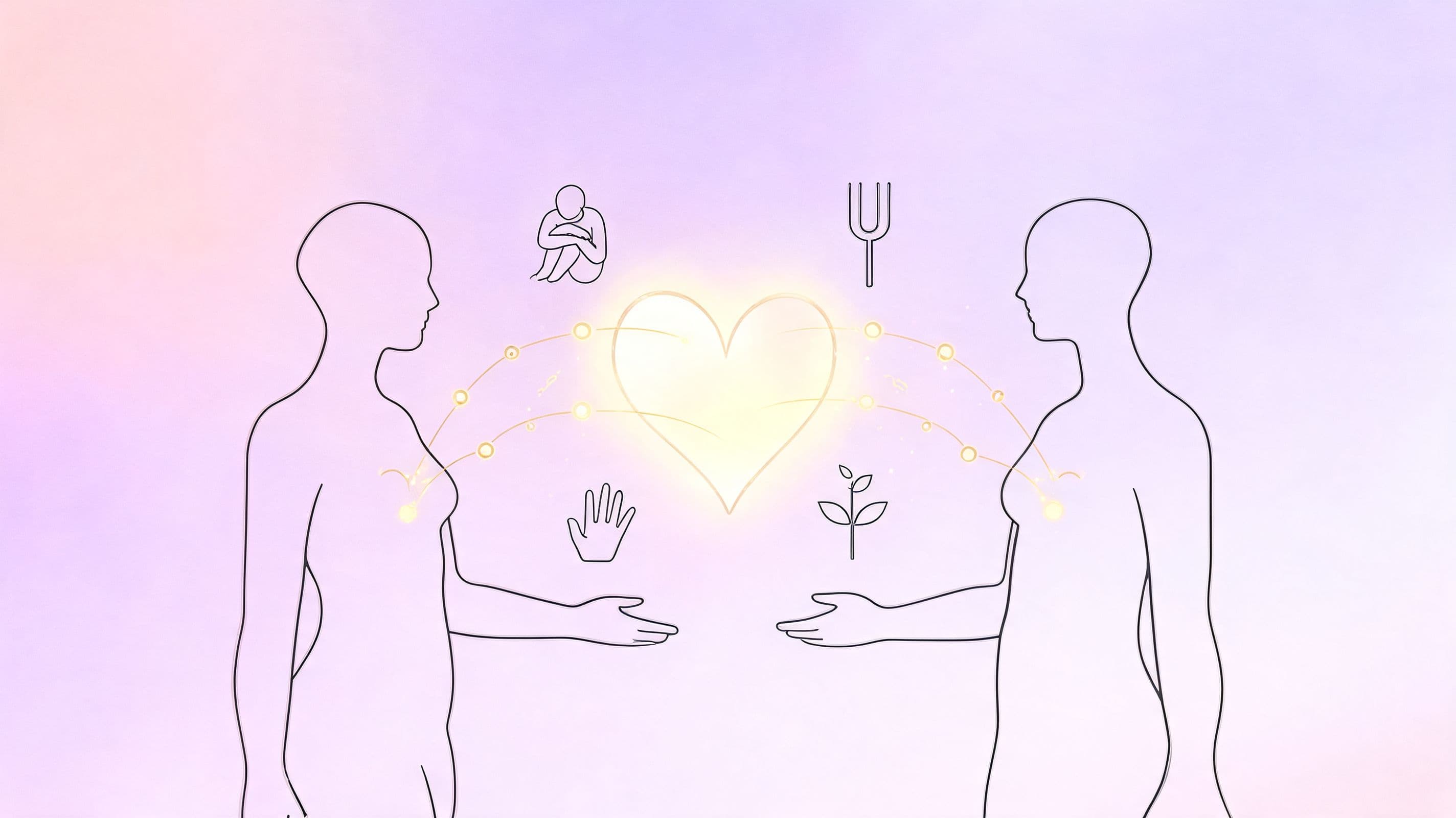
4 Spiritual Laws of Love for Conscious Connection
Unlock practical spiritual laws to transform repeating relationship patterns and build deeper connection. Learn four core principles—self-love, resonance, allowance, and shared growth—that help relationships move from accidental to intentional.

Introduction
You check your phone. Another mixed signal. Another conversation that felt promising and then turned cloudy. Maybe you’re not dating at all. Maybe you’re in a long relationship and wondering why the same argument keeps returning in a different outfit.
Why does love feel natural in some moments and confusing in others? Beyond luck, timing, and chemistry, subtle patterns shape how we give love, receive it, resist it, or distort it. These are the spiritual laws of love: practical principles you can learn to notice and apply so your relationships stop feeling accidental and start feeling intentional.
Beyond chance: the hidden map to deeper love
A woman I once spoke with summed it up: “I keep meeting different people, but it feels like the same relationship.” The details change, but the emotional terrain stays familiar. You attract someone exciting, then shrink to keep the peace. You fall for people who seem open until intimacy becomes real. Or you stay in a good relationship yet feel lonely because the deeper parts of you never come into the room.
That repetition can make love feel accidental. It often reflects repeated patterns of energy, expectation, and avoidance. Once you start seeing love through this lens, it becomes less like gambling and more like learning. You begin to understand why some connections drain you, why others soften you, and why the most healing love usually asks you to become more honest before it asks you to become more together.
When love feels chaotic
Many painful relationship patterns aren’t random. They’re signals. Common examples include:
- Overgiving early to hide a fear of losing connection
- Chasing certainty and needing immediate reassurance
- Trying to fix the other person instead of accepting them
- Ignoring your inner life and expecting the relationship to provide internal grounding
None of this means you’re broken. It means you’re human.
“Spiritual laws don’t remove mystery from love. They give you language for what your heart has already been experiencing.”
What are the spiritual laws of love?
Think like a gardener. You can’t force a seed to bloom by staring at it. You create conditions that support growth: good soil, water, light, space, and patience. Relationships respond to similar conditions. You can’t force depth, trust, or devotion, but you can cultivate the inner and relational environment that allows them to arise.
These laws are not tricks to control another person, excuses to stay in harm, or promises that relationships won’t hurt. They are principles of awareness, energy, pattern recognition, and mutuality that help you become capable of healthy closeness.
For a broader orientation, see the guide on what spiritual laws are at [/blog/what-are-spiritual-laws].
Practical rule: Don’t ask, “How do I make love happen?” Ask, “What kind of inner environment am I creating for love to live in?”
The four core laws of conscious connection
Some traditions name many laws. For everyday relationships, these four are simple to remember and deep enough to teach you for years.
The law of self-love
Self-love is often mistaken for self-admiration. It’s closer to self-respect. It’s the quiet ability to stay connected to your worth when someone is distant, irritated, or unavailable. Without self-love, intensity can feel like intimacy and attention can be mistaken for care.
Small daily practices help more than grand declarations:
- Name your need clearly: “I need honesty,” or “I need a slower pace.”
- Watch your inner voice and repair it when it becomes cruel after conflict
- Let affection match dignity. Love that costs you your self-respect asks for your silence
The law of resonance
Resonance means your inner world affects what feels familiar, attractive, and acceptable. You don’t manifest every painful experience, but unexamined patterns shape choices. If chaos feels exciting and calm feels boring, notice it. If withholding feels magnetic because it mirrors an old wound, that matters.
Reflective tools—journaling, therapy, breathwork, prayer—help you see these patterns. For practical skill-building, see [/blog/emotional-intelligence-in-relationships].
“You don’t attract only what you want. You often move toward what feels emotionally familiar.”
The law of allowance
Allowance asks you to stop gripping. You can invite and set boundaries, but you can’t force another person into readiness. Allowance is not passivity. It’s honest non-control.
Signs you’ve left allowance behind include constant monitoring of texts and tone, over-explaining to persuade someone, or treating potential like reality by staying attached to who someone might become.
Allowance restores peace by returning you to what is actually yours: your truth, your pace, your response.
The law of shared growth
Healthy love doesn’t require two perfected people. It requires two people willing to grow. Conscious partnerships support honesty, repair, accountability, and expansion. They create room for evolution; different seasons ask different strengths from each person.
A short way to remember the four laws:
| Law | Everyday question |
|---|---|
| Self-love | Am I abandoning myself to keep this connection? |
| Resonance | What in me finds this pattern familiar? |
| Allowance | Am I relating to reality or to my wish for control? |
| Shared growth | Does this relationship support mutual evolution? |
Some models describe heart–brain coherence as a measurable state that can improve relational harmony and physical well-being; coherence techniques have been linked to improvements in emotional regulation and physiological markers1.
A note on spiritual partnerships
Qualitative research on spiritual partnerships distinguishes experiences of immediate mutual bonding, synchronicities, and heightened intimacy from patterns like limerence or love addiction4. Spiritual connection tends to include reciprocity and secure mutual presence rather than projection.
How these laws shape everyday relationships
The spiritual laws become real in ordinary moments: the pause before replying, the drive home, the choice to defend or to soften.

Before and after self-love
Before, someone dates from hunger. They feel relieved when a partner gives attention and panicked when it fades. They accept inconsistency because being chosen matters more than being met.
After, they notice the cost of that pattern. They slow down and stop treating red flags like spiritual tests. They ask, “Do I feel calm, clear, and respected here?”
Before and after allowance
Before, a partner spends months trying to improve the relationship by improving the other person. They send articles and rehearse conversations, hoping understanding will produce change.
After, they practice allowance. Not indifference. Clarity. They say what’s true once or twice, then watch what the other person consistently does. They stop bargaining with reality.
Pair these shifts with emotional skills work. See [/blog/how-to-rebuild-trust-in-a-relationship] and [/blog/emotional-intelligence-in-relationships] for practical exercises.
What spiritual intimacy looks like in practice
Spiritual intimacy doesn’t require matching beliefs. It looks like honest conversation, reverence for each other’s inner life, and a willingness to discuss meaning, pain, hope, and values without contempt.
A longitudinal study found that greater spiritual intimacy predicted more warmth, humor, and love, and less negativity and hostility in marital interactions2.
That kind of intimacy sounds like:
- “I’m upset, but I still want to understand you.”
- “This conflict is touching something old in me.”
- “I don’t need you to be me. I need us to stay honest.”
These are quieter sacred moments that create warmth where there could have been defense.
Discover your personal love blueprint with Dan Millman
General principles help. Personal insight helps more.
Dan Millman’s The Life You Were Born to Live uses your birth date to reveal one of 45 life paths, offering a framework for understanding recurring themes, strengths, and lessons in relationships, work, health, and purpose. For a modern overview, see [/blog/dan-millman-numerology].
People often know they need boundaries or patience but still repeat emotional patterns. Unresolved emotional baggage is a major driver of recurring relationship issues; these patterns commonly persist until underlying blocks are addressed with intention and support3.
Use Millman’s system as a mirror rather than a map that dictates fate. Ask questions like:
- What lesson keeps repeating in my relationships?
- Do I overfunction, withdraw, idealize, or control under stress?
- What gifts do I bring when I’m grounded?
- What partner dynamic tends to teach me the most?
The Life Purpose App offers a digital way to work with Millman’s framework by entering your birth date to explore one of the 45 life paths: https://lifepurposeapp.com
“A spiritual map is most helpful when it increases responsibility, not dependence.”
Begin your journey to conscious love
The spiritual laws of love aren’t hoops to jump through. They’re patterns to practice with. Start with one law. Track it for a week and note shifts in your body, interactions, and decisions. Love often transforms internally before it transforms visibly.
Small acts count: a calmer response, a clearer boundary, a softer tone, a more honest yes, a more honest no.
Frequently Asked Questions About Spiritual Love
| Question | Answer |
|---|---|
| Can spiritual love exist without romance? | Yes. Many people experience profound love through friendship, family bonds, mentorship, and care for animals. The spiritual dimension is about depth, presence, and meaning, not just romance. |
| Does a strong spiritual connection mean the relationship is meant to last? | Not always. A connection can be meaningful and still be temporary. Some relationships awaken growth rather than long-term partnership. |
| How do I know if I’m feeling intuition or projection? | Intuition tends to be calm and clear. Projection usually comes with urgency, fantasy, or fear. Give it time and watch for consistent behavior. |
| What if my partner isn’t spiritual? | Shared language helps, but respect matters more than matching beliefs. Two people can build deep intimacy if they value honesty, reflection, and growth. |
| Can rituals help support loving energy? | They can, if they help you become more present. Breathwork, prayer, journaling, or scent can settle the heart. |
| What’s the first thing to do if I keep repeating painful patterns? | Slow the pattern down. Track when it appears, what it feels like in your body, and what story it triggers. Awareness comes before change. |
Quick Q&A — Three Practical Questions
Q: What’s the first step to applying these laws?
A: Pick one law and practice it for a week. Notice your body, choices, and tone. Awareness precedes change.
Q: How do I balance allowance with healthy boundaries?
A: State your truth clearly, set limits, and then observe behavior rather than bargaining for who someone might become.
Q: When should I seek external help?
A: If patterns repeat despite awareness or if a relationship feels unsafe, consider therapy or coaching to clear underlying blocks5.
Concise Q&A: Common user concerns
Q: How do I stop attracting the same relationship type?
A: Look for resonance—what feels familiar—and work with self-love practices to change what feels acceptable.
Q: How can I tell the difference between allowance and avoidance?
A: Allowance includes honest communication and boundaries; avoidance avoids necessary truth and repair.
Q: Can spiritual practices actually improve relationship health?
A: When practices build presence, emotional regulation, and mutual reflection, relationship quality often improves12.
If you want a practical next step, explore the Life Purpose App at https://lifepurposeapp.com to work with Dan Millman’s The Life You Were Born to Live by entering your birth date.
1.
HeartMath Institute, research on coherence and emotional regulation, https://www.heartmath.org/research/
2.
Bowling Green State University, summary of longitudinal findings on spiritual intimacy and marital interactions, https://www.bgsu.edu/arts-and-sciences/psychology/graduate-program/clinical/the-psychology-of-spirituality-and-family/research-findings/marriage-couples/spiritual-intimacy.html
3.
David Ghiyam, discussion of recurring maladaptive patterns and relationship dynamics, https://davidghiyam.com/love
4.
Qualitative study on spiritual partnerships distinguishing them from limerence and love addiction, https://www.tandfonline.com/doi/full/10.1080/20440243.2021.1955454
5.
American Psychological Association, overview of couples and family therapy effectiveness, https://www.apa.org/topics/psychotherapy/couples
Discover Your Life Purpose Today!
Unlock your true potential and find your life’s purpose.
