Unlock the spiritual laws of money and align your finances with your purpose. This practical guide blends inner work with real budgeting, giving you tools and questions to build lasting abundance that fits your life path.
May 9, 2026 (4mo ago) — last updated August 29, 2026 (23d ago)
Spiritual Money Laws & Your Life Path
Align your finances with purpose: practical spiritual money laws, budgeting exercises, and life-path guidance for sustainable abundance.
← Back to blog
Spiritual Money Laws & Your Life Path
Summary: Align your finances with purpose: practical spiritual money laws, budgeting exercises, and life-path guidance for sustainable abundance.
Introduction
Unlock the spiritual laws of money and align your finances with your purpose. This guide blends practical finance with inner work so you can stop choosing between soul and strategy—learn simple practices, clear principles, and life-path questions that help money support the life you’re actually trying to build.
Why money advice often misses the middle
Money advice usually splits into two camps that don’t help enough. One side treats money as math only. The other treats it as magic only. The uncomfortable middle is a common reality, where bills are real, emotions are loud, and purpose still matters.
If you’ve ever earned money and still felt unsafe, or tried to be “spiritual” about money while avoiding your bank account, you’re not failing. You’re meeting one of life’s deepest classrooms. Money tends to reveal what we believe about worth, trust, power, giving, receiving, and responsibility.1
The spiritual laws of money can be useful—not as rigid rules, but as a way to notice inner patterns shaping your outer financial life.
Your relationship with money is a spiritual practice
Your money life isn’t separate from your spiritual life. It’s one of the places where values become visible.
If you feel panic every time you check your balance, that reaction matters. If you spend impulsively after a hard day, that matters too. If you undercharge, overgive, hide from debt, or feel guilty receiving support, those patterns aren’t just financial habits. They’re spiritual signals.

Money shows you what you trust
A lot of people think spirituality and money pull in opposite directions. They don’t. Money magnifies what’s already present. If you trust yourself, money often becomes a tool. If you fear your own power, money can feel dangerous, dirty, or never quite enough.
Think of money like electricity in a house. Electricity isn’t moral. It follows the wiring. If the wiring is frayed, the current becomes stressful. If the wiring is sound, the same current powers light, warmth, and useful work.
Your beliefs are the wiring.
Practical rule: Don’t ask only, “How can I make more?” Also ask, “What happens in me when money arrives, and what happens in me when it leaves?”
Financial choices carry spiritual meaning
A budget can be spiritual. So can saving. So can saying no to a purchase that looks impressive but pulls you away from peace.
That doesn’t mean every financial choice needs a ritual. It means daily choices reflect deeper priorities. A person who spends in alignment with their values often feels calmer than a person who earns more but lives in contradiction.
A simple test looks at three categories:
- Earning: Does the way you earn feel honest and life-giving?
- Spending: Does your spending express your real values or your temporary emotions?
- Saving: Does saving feel like self-trust, or like fear dressed up as control?
Many people get confused when they hear “money is energy” and assume spreadsheets don’t matter. They do. Spiritual maturity doesn’t replace practical finance. It changes the spirit in which you practice it.
Understanding the spiritual laws of money
The phrase spiritual laws of money sounds ancient and official. In reality, it’s better understood as a modern spiritual framework—popular in contemporary self-help and prosperity literature rather than documented as a single, codified doctrine in historical religious or economic texts.2
That honesty keeps us grounded.
A modern framework, not a historical doctrine
If these laws aren’t a formal ancient system, why do people find them helpful? Because they give language to patterns people already experience. Gratitude affects spending. Fear affects earning. Shame affects debt. Generosity affects how people relate to enough. These are lived realities.
Hold the concept lightly. Don’t treat it as a cosmic rulebook. Treat it as a reflective lens.
A useful analogy is a river. Money flows in, flows out, changes direction, and responds to what blocks it. Scarcity thinking acts like debris in the water. Hidden fees, ignored debt, resentment about work, and vague goals can all narrow the channel.
Where people get mixed up
Some hear “flow” and assume they should stop planning and only trust. Others try to control everything and dam the whole river with fear.
Healthy spiritual money practice holds both truths:
- Money needs movement: hoarding, compulsive spending, and avoidance all distort flow.
- Money needs structure: accounts, limits, dates, and decisions give direction to that flow.
- Money needs meaning: without values, more money can amplify confusion rather than peace.
If debt is part of your story, spiritual reflection should include practical wisdom. See practical debt management guidance at /debt-management.
You may also compare money principles with broader life-purpose ideas at /life-purpose-app.
A spiritual framework is useful when it helps you face reality more honestly, not when it helps you escape it.
The four core principles of financial flow
Most teachings on spiritual laws of money circle around a few recurring themes. Work with these four principles as practices that help you relate to money with clarity and less confusion.
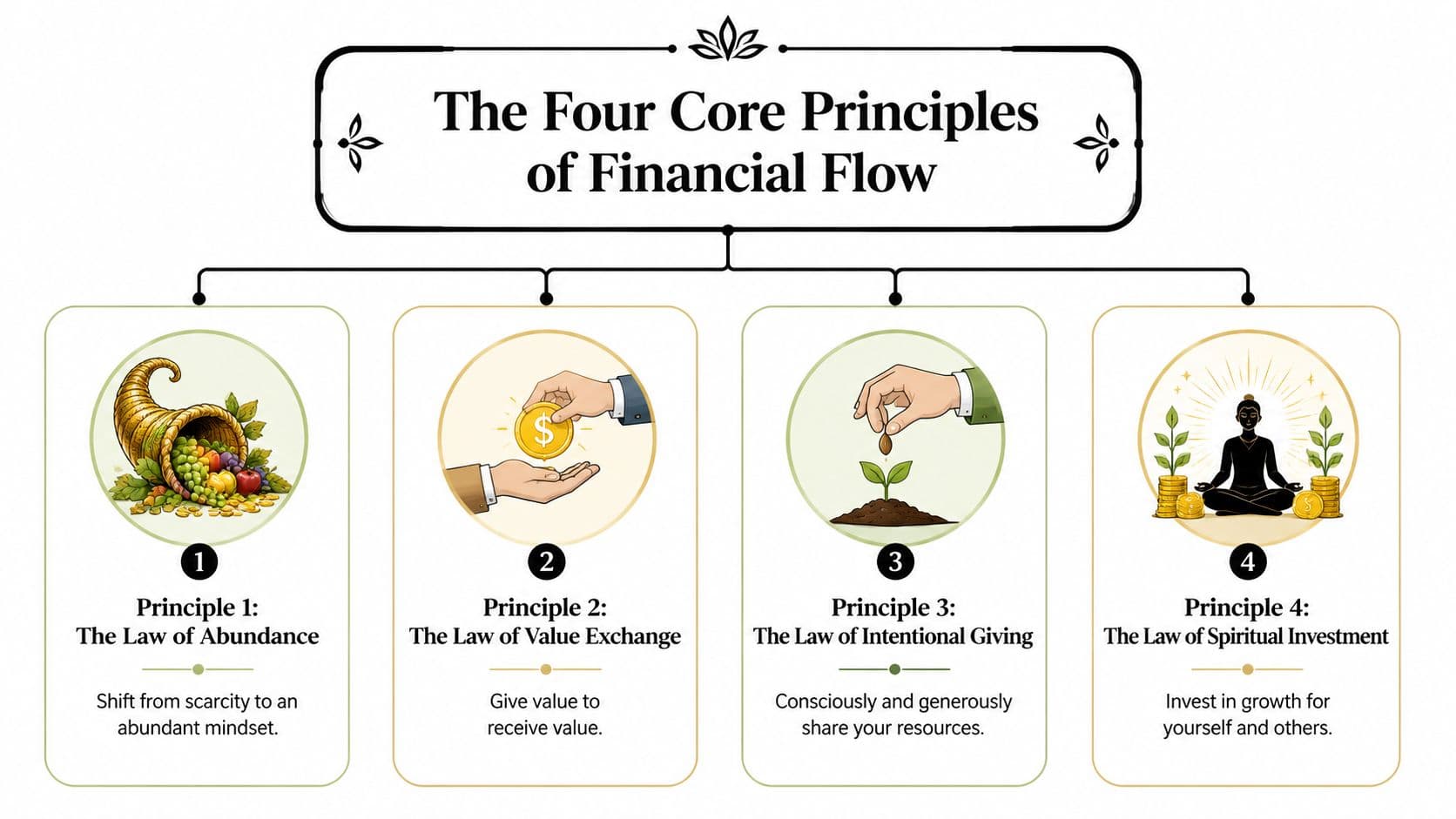
The law of abundance
Abundance doesn’t mean pretending resources are unlimited. It means refusing to build your identity around lack.
A scarcity mindset says, “There will never be enough, so I must cling, compare, panic, or settle.” An abundant mindset says, “I can make wise choices, create value, and trust that my life isn’t defined by one temporary number.”
That shift changes behavior. People who live in scarcity often delay decisions, underprice their work, or buy things to soothe insecurity. People who practice abundance still plan carefully, but they don’t make every choice from fear.
Try this today:
- Name one fear story: Write the sentence that repeats in your mind, such as “I always fall behind.”
- Replace it with a grounded truth: Try “I can learn to manage money one decision at a time.”
- Take one concrete action: Review one account, one bill, or one expense category.
The law of giving and receiving
Many spiritual traditions and prosperity teachings emphasize giving. Tithing and planned giving appear widely in both ancient practice and modern advice, and they often change behavior around budgeting and spending.3
The spiritual insight isn’t “give money away and the universe pays you back on schedule.” It’s simpler and more demanding. Planned giving changes your relationship to consumption. It trains your nervous system away from grasping.
Receiving matters too. Some people give easily but can’t receive help, pay, praise, or support without guilt. That imbalance blocks flow just as much as selfishness does.
A helpful practice:
| Practice | What to do | Why it helps |
|---|---|---|
| Planned giving | Choose a consistent amount or percentage that feels sincere and sustainable | It turns generosity into a habit instead of a mood |
| Conscious receiving | When someone pays, helps, or thanks you, pause and accept it fully | It reduces shame around worth |
| Review the effect | Notice whether giving improves clarity around spending | It reveals whether generosity is making you more intentional |
The law of value exchange
Money often arrives through exchange: you solve a problem, offer a skill, create something useful, support someone’s progress, and receive compensation.
This principle cuts through spiritual fog. Abundance isn’t only about belief. It’s also about contribution.
Ask:
- What problem do I help solve?
- What skill am I avoiding developing?
- Where am I offering effort when I should be offering clearer value?
A teacher, designer, therapist, carpenter, manager, coder, or healer all practice value exchange differently. The common thread is integrity. Real value tends to create more stable income than performance, posturing, or branding without substance.
Your income may not reflect your worth as a human being, but it often reflects how clearly your value is expressed, delivered, and received.
The law of intention
Money goes where attention goes. If your spending is unconscious, your values stay theoretical.
Intention means assigning purpose before money leaves your account. It means deciding what each dollar is for instead of discovering later what your emotions chose.
Here's a simple monthly check-in:
- Choose three priorities: peace, debt reduction, creativity, service, rest, home, learning.
- Match your money to them: give each priority visible financial support.
- Review without shame: if your spending drifted, correct it calmly.
Intention turns money from a reaction into a relationship.
Apply these laws to your unique life path
Generic advice can only take you so far. “Be grateful.” “Raise your vibration.” “Trust abundance.” None of that is useless, but it often stays abstract. People need guidance that fits their temperament, gifts, and recurring challenges.
That’s where a life-path approach becomes valuable. Dan Millman’s The Life You Were Born to Live offers a lens for distinct patterns of lessons, strengths, and growth edges. When you apply that to money, the question changes from “What are the spiritual laws of money?” to “How do these principles express through my specific path?”
One person may be naturally generous but weak with boundaries. Another may be disciplined but emotionally closed. Both can improve financially, but they won’t do it the same way.
See Life Purpose App at /life-purpose-app for a reference to Dan Millman’s framework and how it may shape money habits.
How two people can need opposite money medicine
Consider two simplified examples:
- A creative, expressive person may resonate with abundance but struggle with structure. Their practice may involve calendars, invoices, pricing, and finishing what they start. For them, the law of intention matters more than more affirmations.
- A leadership-oriented person may know how to produce income but treat rest, receiving, or generosity as weakness. Growth may come through giving, sharing credit, and softening the belief that control equals safety.
Same spiritual laws. Different application.
Questions to ask through the lens of purpose
Use these prompts while reflecting on your life-path and experience:
- Where do I naturally create value?
- What money pattern repeats? Underearning, overspending, rescuing others, hiding, overworking?
- What lesson might sit beneath the pattern? Boundaries, patience, trust, discipline, self-respect?
- What kind of work feels aligned? Not easy. Aligned.
The right financial strategy often feels less like forcing and more like becoming honest about who you are.
When people link money to purpose, they usually make cleaner decisions. Not always easier, but cleaner.
Actionable exercises for financial alignment
Insight helps, but repetition changes lives. If you want these principles to become habits, return to practices when you’re tired, triggered, or tempted.
Build a purpose-driven budget
A standard budget asks, “Where did the money go?” A purpose-driven budget asks, “Did my money serve the life I'm trying to live?”
Start with three value words. Choose words that matter to you, such as service, stability, freedom, healing, family, or creativity. Then review your spending and look for matches and mismatches.
Process:
- List your core values: keep it to three.
- Mark current spending: place each major category beside one value, or admit it serves none.
- Adjust one category this month: don't rebuild your whole life at once.
If systems help you stay consistent, automation tools can support discipline and alignment. See /financial-well-being for practical strategies.
Practice a weekly gratitude and giving ritual
Choose one day each week. Open your bank app, your budget, or your notebook. Then do three things in sequence.
- Give thanks for what is present: income, shelter, support, food, skills, opportunities.
- Review one financial fact: account balance, upcoming bill, current saving habit.
- Make one generous choice: a donation, a gift, a helpful act, or a planned transfer into a giving category.
Gratitude softens fear. Reality prevents denial. Giving keeps the heart open.
Keep a value assessment journal
Once a week, answer these questions in writing:
| Prompt | Why it matters |
|---|---|
| What value did I create this week? | Trains you to see your real contribution |
| Where did I undercharge or overextend? | Reveals leaks in value exchange |
| What skill would make me more useful? | Points toward grounded growth |
| What did I avoid because of fear? | Names the inner block, not just the outer result |
Write like an honest witness, not a performance review.
Create a money intention ceremony
At the start of each month, sit for a few minutes with your wallet, laptop, budget, or account summary. Take a breath and choose one sentence of intention.
Examples:
- I use money to create stability without closing my heart.
- I receive payment with gratitude and clear boundaries.
- I direct my resources toward what matters most.
Then follow the ceremony with one practical action: pay a bill, move money to savings, send an invoice, or cancel a draining subscription. Spiritual intention lands best when it touches the calendar.
Living a spiritually abundant life
A spiritually abundant life isn’t measured only by what sits in your account. It’s measured by the quality of your relationship with earning, spending, saving, giving, and receiving. Peace matters. Integrity matters. Purpose matters.
These principles help you tell the truth. They help you notice where fear has been making decisions. They help you bring structure to generosity, courage to value exchange, and meaning to planning.

A practical spiritual path with money doesn’t ask you to choose between soul and strategy. It asks you to unite them. Keep going gently. Financial healing rarely happens in one dramatic breakthrough. It happens through repeated honest choices. You look at the numbers. You feel what you feel. You act in alignment anyway.
That’s how abundance becomes lived, not just imagined.
Frequently Asked Questions
Q: How do spiritual laws of money help with everyday bills?
A: They help you notice the attitudes that shape your behavior, then give you simple practices—budgeting with values, intentional spending, and planned giving—that make bills manageable rather than overwhelming.
Q: I’m spiritual but avoid my bank account. What’s a first step?
A: Start with one small practical action: review one account or one bill. Pair it with a grounding intention like, “I’ll look so I can make clear choices.” This pairs inner work with practical steps.
Q: How do I apply these ideas to my unique path?
A: Identify recurring money patterns, name the lesson beneath them, and choose one aligned action that fits your temperament—structure for creators, receiving practices for givers, boundaries for rescuers.
1.
Federal Reserve, “Report on the Economic Well‑Being of U.S. Households in 2019,” May 2020. [https://www.federalreserve.gov/publications/2019-economic-well-being-of-us-households-in-2019.htm]
2.
Encyclopaedia Britannica, “Law of Attraction.” [https://www.britannica.com/topic/law-of-attraction]
3.
See Investopedia, “Tithing” for context on historic and modern practice, [https://www.investopedia.com/terms/t/tithing.asp], and Dunn, Aknin, and Norton, “Spending money on others promotes happiness,” Science, 2008, [https://www.science.org/doi/10.1126/science.1169675].
Discover Your Life Purpose Today!
Unlock your true potential and find your life’s purpose.
