Strength Discovery. Learn how to discover your real strengths through journaling, feedback, and life-path insight, then turn them into a focused 90-day action
August 26, 2026 (28d ago) — last updated August 27, 2026 (27d ago)
Strength Discovery: A Practical Guide to Finding What You Do
Strength Discovery. Learn how to discover your real strengths through journaling, feedback, and life-path insight, then turn them into a focused 90-day action
← Back to blog
You know the pattern. You can name every weakness on your performance review, every task you avoid, and every habit you'd like to change. Yet when someone asks, “What are you naturally good at?” your answer becomes vague: hardworking, adaptable, a people person. Strength discovery begins when you stop treating that uncertainty as a personal flaw and start investigating your own repeated patterns.
The work is practical. You observe what gives you energy, compare those observations with trustworthy feedback, use a life-path reading as a reflective lens, and then test your conclusions through action. This approach combines modern positive-psychology research with Dan Millman's framework from The Life You Were Born to Live, without treating either a psychological assessment or numerology as a final verdict.
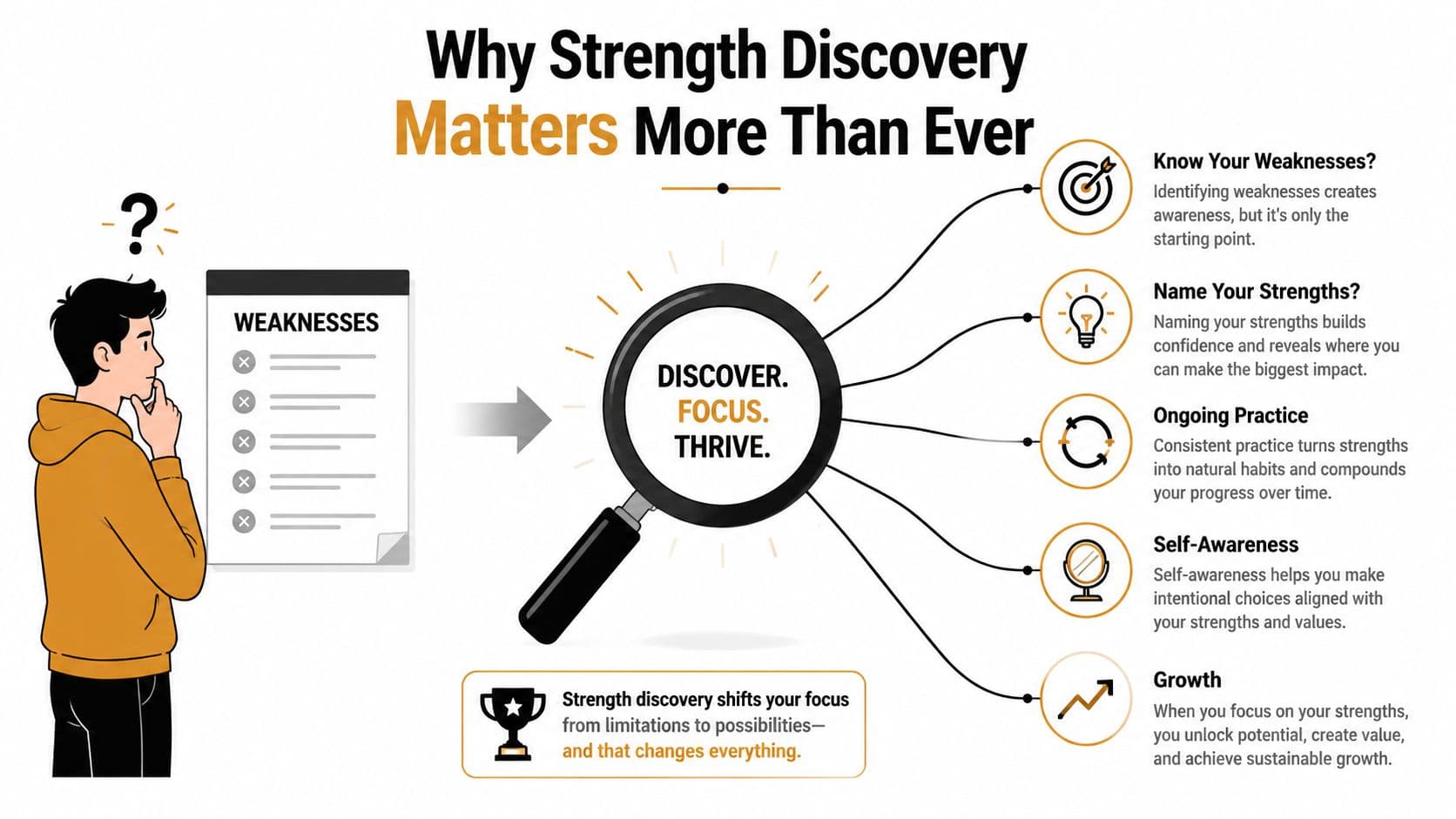
Why Strength Discovery Matters More Than Ever
Many people approach development as a repair project. They focus on speaking more confidently, organizing better, becoming less emotional, or fixing whatever a manager, teacher, parent, or partner once criticized. Those goals may matter, but a life built entirely around correcting deficits can leave you with an impressive list of problems and little understanding of what makes you effective.
Strength discovery asks a different question: When do you contribute naturally, learn quickly, recover steadily, or help other people move forward? A strength isn't merely something you enjoy, and it isn't the same as a skill listed on LinkedIn. It's a repeatable way of thinking, feeling, or acting that helps you handle meaningful situations.
Positive psychology gave this kind of inquiry a substantial research foundation. The VIA classification identifies 24 character strengths organized under 6 core virtues, and the VIA Inventory of Strengths has been administered to 13,000,000 people worldwide. The research base includes well over 1,000 scientific and scholarly articles, with more than 100 new studies each year, according to the research overview in the National Library of Medicine. That work connects strengths with well-being, coping, and effective functioning across different areas of life.
A label is only the beginning
Naming curiosity, fairness, creativity, or perseverance doesn't change a decision by itself. The useful question is what that quality looks like in behavior. If your strength is curiosity, you might ask better discovery questions in a client meeting. If it's kindness, you might notice when a colleague is overloaded and offer specific help rather than general reassurance.
Research supports this action-oriented approach. A 2019 meta-analysis found that using signature strengths in new ways was associated with positive affect, reduced depression, and greater life satisfaction, with weighted effect sizes of g = 0.32, g = 0.21, and g = 0.42 respectively. The authors also found that results varied considerably, which is a useful warning. A generic exercise isn't enough. The practice has to fit the person and the situation. You can also explore why aspirations matter for hiring, especially when your strengths are influencing career choices.
Your process will move through four phases: prepare your attention, interpret patterns through Dan Millman's life-path system, translate strengths into choices, and run a 90-day action plan. For a complementary perspective on self-awareness, explore related insights. The objective isn't to discover a perfect identity. It's to create enough evidence that your next decision becomes clearer.
Preparing Your Mind Before the Work Begins
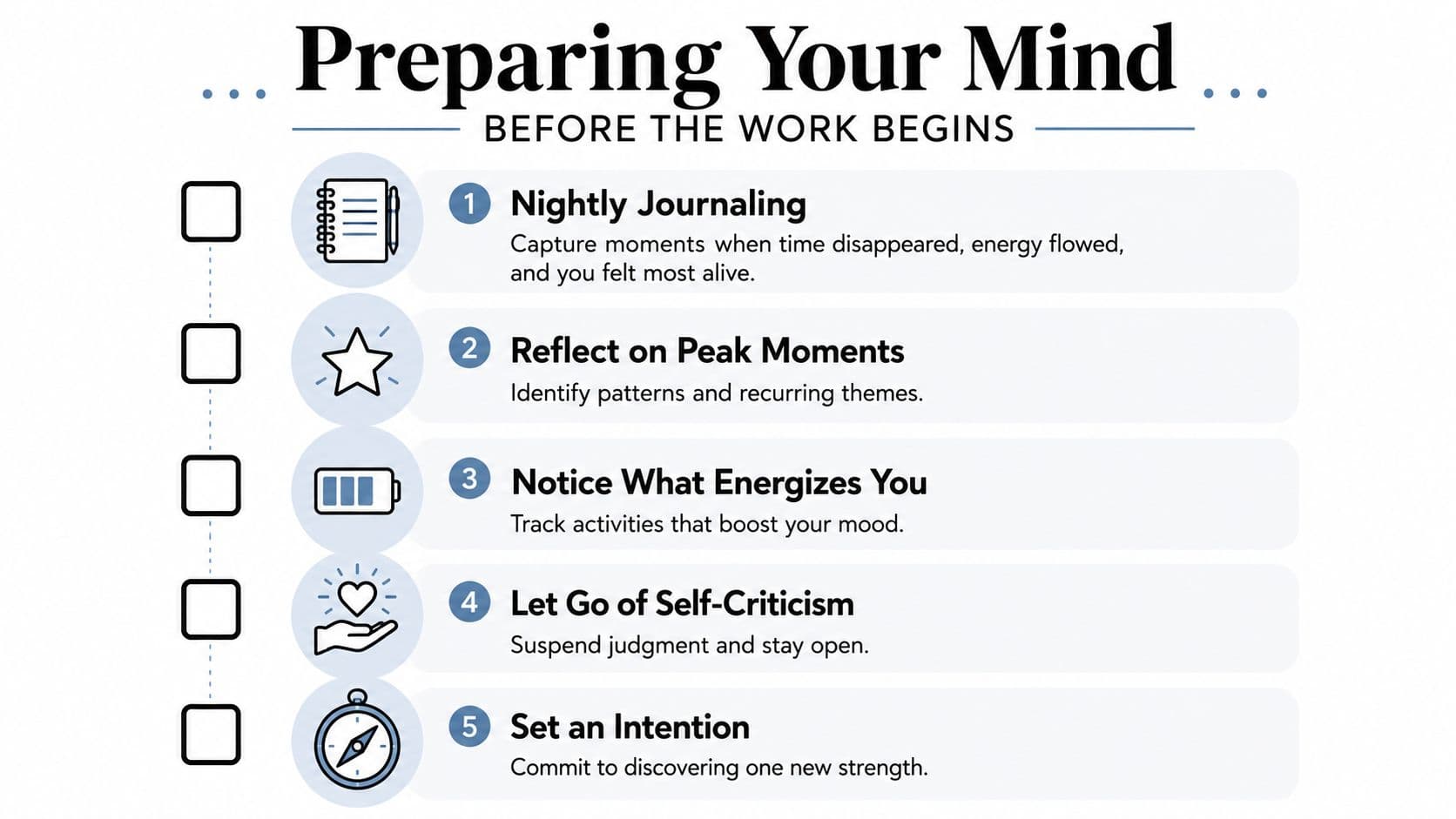
Start with observation, not interpretation. For the next two weeks, keep a short evening journal and record moments when time seemed to disappear, energy rose, or learning felt unusually fast. Include ordinary events. A smooth conversation with a difficult customer may reveal as much as a major professional achievement.
Use three prompts each night:
- Time: What were you doing when you stopped checking the clock?
- Energy: Which activity left you more alert than when you began?
- Ease: What did you understand or organize faster than expected?
Don't write what sounds impressive. Write what happened. “I solved a complex problem” is less useful than “I noticed three conflicting requirements, grouped them, and helped the team choose one direction.” The second version gives you observable behavior to examine later.
Replace performance with pattern recognition
Your most polished moment may not reveal your strongest pattern. Sometimes people perform well because they're anxious, overprepared, or following a familiar script. Look for recurrence instead. Do you repeatedly simplify confusing information, calm tense conversations, connect unrelated ideas, or persist through uncertain work?
Ask five trusted people one open question: “When have you seen me at my most effective?” Don't supply them with a list of strengths, because that can steer their answers. Ask for a specific situation and listen for the verb in their response. “You're creative” is broad. “You keep finding a third option when everyone else sees only two” is evidence.
Record small wins as they happen. Notice your first reaction when a problem appears. Do you investigate, organize, encourage, challenge, repair, teach, or experiment? Natural reactions can reveal strengths before you've had time to turn them into a polished story.
Practical rule: Treat praise as a clue, not proof. Ask what you did that made the praise possible.
Finish the preparation with a simple calibration exercise. List your current activities, then place each on two scales: how energizing it feels and how draining it feels. A task can be difficult and still energizing, or easy and still exhausting. This baseline will help you compare later interpretations with lived experience rather than forcing your life to match a description. If your mind feels crowded during this process, reset your focus and review practical evidence-based burnout prevention strategies.
Reading Your Life Path Through the Life Purpose App
Dan Millman's The Life You Were Born to Live presents a life-path system based on birth-date calculations. The revised 25th Anniversary Edition covers 45 life paths and describes themes involving core issues, innate talents, special needs, career guidance, relationship dynamics, and life cycles, as detailed in the Apple Books edition description. Earlier material described 37 life paths, while the revised framework expanded the system to 45, including people born after 2000, according to the book listing and edition information.
The calculation adds all digits in a birth date and keeps the full sum rather than reducing it immediately to a single digit. Examples described in summaries of the system include results such as 27/9 or 37, with the resulting number identifying the life path. The Life Purpose App lets you enter a birth date and immediately view a number with a short description of the corresponding path, a method Millman also describes for looking at friends, relatives, colleagues, and other people through the same birth-number logic in his discussion of the Life Purpose Calculator.
Use the reading as a mirror. First, enter your information into the Life Purpose App and read the summary without trying to make every sentence fit. Then review the fuller sections, marking themes that match your journal, your feedback, and your energy notes. Leave unmarked anything that feels forced. Numerology can help you ask a sharper question, but it can't replace observation or choice.
Compare three sources before you decide
Choose three candidate strengths from your notes. For each one, look for convergence across lived experience, other people's observations, and the language of the life-path reading.
| Candidate Strength | Journaling Evidence | Feedback Quotes | Life-Path Theme Match |
|---|---|---|---|
| Pattern recognition | Repeatedly grouped confusing information into clear categories | “You find the structure inside messy projects” | Matches themes involving analysis or seeing connections |
| Encouragement | Noticed when others withdrew and invited them into the discussion | “People tell you things they don't tell others” | Matches themes involving support or connection |
| Persistence | Returned to difficult tasks after setbacks | “You keep working when the first plan fails” | Matches themes involving endurance or disciplined growth |
Don't treat the table as a scoring contest. A strength becomes more credible when all three sources point in a similar direction. If the reading suggests leadership but your journal and feedback show that you prefer careful support work, hold both observations and investigate the difference.
Personality tools can be useful for organizing patterns, but they remain interpretive instruments. A practical resource on how to predict behavior with personality tests can help you compare assessment language with actual behavior. For another reflective layer connected to the same life-path tradition, you can explore the [Life Purpose Oracle], while keeping your own evidence at the center.
Turning Strengths Into Career and Relationship Choices
A strength becomes useful when it changes what you do. Once you have a working list of three to five strengths, give each one a behavioral definition and place it in two contexts: work and relationships.
| Strength | Career Application | Relationship Application |
|---|---|---|
| Pattern recognition | Forecast demand, identify project risks, or clarify a sales pipeline | Notice a friend's repeated stress pattern and ask about it directly |
| Curiosity | Improve interviews, research customer needs, or test assumptions | Ask open questions before offering advice |
| Calm persistence | Continue a complex project through setbacks | Stay engaged during a difficult conversation instead of abandoning it |
| Encouragement | Help a team member develop confidence through specific feedback | Recognize effort and invite honest communication |
| Perspective | Reframe a problem so a team can choose its next step | Separate a temporary conflict from the overall health of the relationship |
The same strength may look different across settings. Pattern recognition at work can mean spotting a process bottleneck. With a partner, it may mean noticing that arguments begin after fatigue, rushed evenings, or unspoken expectations. The underlying capacity is similar, but the responsible behavior changes with the relationship and its boundaries.
Three choices that reveal the difference
A mid-career professional choosing between two roles might compare the daily demands rather than the titles. One position may reward analysis and independent problem-solving. The other may offer more mentoring and collaboration. If the person's strongest evidence points to pattern recognition and teaching, the decision should include which role permits those behaviors regularly, not merely which role sounds more prestigious.
A new manager may discover that their strength is synthesis, yet run meetings as open-ended discussions. They could translate the strength into a short practice: summarize competing views, name the unresolved question, and propose the next decision. The strength becomes visible because the meeting changes.
A long-term partner who identifies attentiveness as a strength might still miss important conversations. The practical translation could be setting aside uninterrupted time, reflecting back what they heard, and asking what support would be useful. Good intentions don't count as strength use until another person can experience the behavior.
A strength that can't be expressed as a behavior this week is probably still a flattering label.
Run a sanity check before committing to your list. For each strength, write one action you can take in a real situation, one condition that helps it work, and one sign that you're using it poorly. This prevents you from confusing a preferred self-image with a capacity you can reliably apply.
Your 90-Day Strengths Action Plan
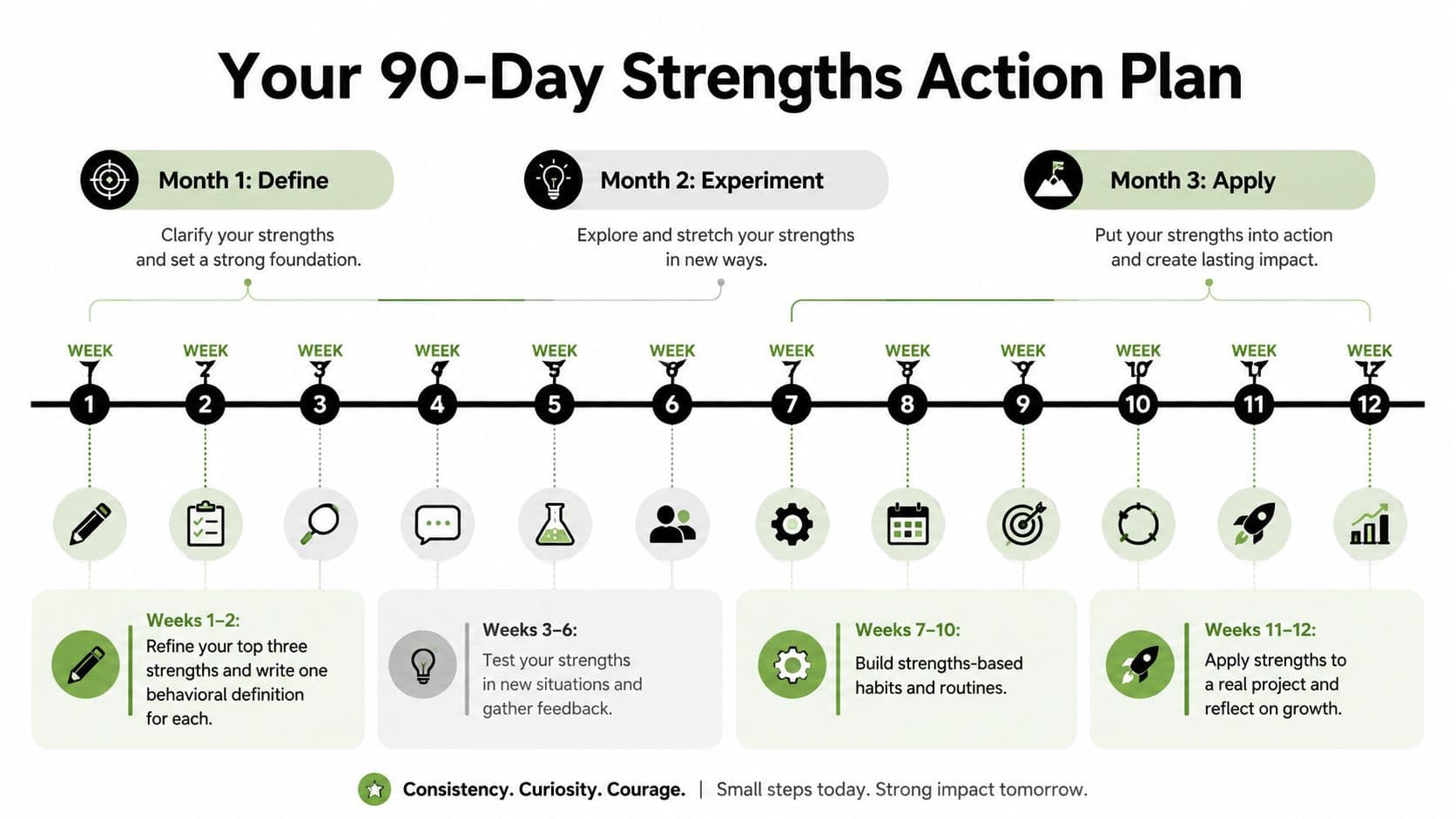
Treat the next 90 days as a series of small experiments rather than a personality makeover. You'll refine your list, test it in real conditions, review what happened, and keep only the practices that create useful changes.
Month one defines the experiment
During weeks 1 to 2, reduce your list to three strengths. Write one behavioral definition for each. “Creativity” might become “I generate alternative approaches when the first solution stalls.” “Empathy” might become “I notice emotional shifts and ask a respectful follow-up question.”
During weeks 3 to 6, choose one work situation or key relationship in which to use those strengths deliberately. Change one behavior at a time. Log what you tried, what happened, and what the other person did next. Ask one trusted person for quick feedback, preferably using a concrete question such as, “Did my summary make the decision clearer?”
Month two tests consistency
During weeks 7 to 10, deepen the practice and add a second relationship context. If you tested curiosity with customers, use it in a family conversation. If you practiced perspective in team meetings, apply it when discussing a personal conflict. This comparison shows whether the strength travels across settings or depends on a specific role.
Remove one activity that doesn't draw on a core strength, or redesign it so a strength has a legitimate place. Don't use this step to avoid necessary responsibilities. Use it to stop spending energy on avoidable patterns, unclear commitments, or work that someone else could handle more appropriately.
Month three applies what survives
During weeks 11 to 13, apply your strengths to a real project and review the evidence. Adjust the list if a candidate strength repeatedly fails to produce useful behavior. Then lock in two permanent habits, such as a weekly decision review and a recurring feedback conversation.
Use this checkpoint at the end of each week:
- What did I try? Name the behavior, not the intention.
- Where did it help? Describe the observable result.
- What felt energizing or draining? Compare this with your original baseline.
- What feedback did I receive? Record exact wording when possible.
- What will I repeat, change, or stop next week?
Watch for three pitfalls. Overcommitting turns strengths work into another exhausting obligation. Confusing strengths with skills makes you claim competence before you have practiced it. Skipping the review removes the learning loop that tells you whether the experiment is working.
Success doesn't require a dramatic revelation. Look for small, measurable wins: a clearer decision, a better conversation, a task completed with steadier energy, or feedback that identifies a behavior others can recognize.
What Comes After the First 90 Days
The first cycle gives you a baseline, not a permanent identity. By the fourth month, many people can make decisions faster because they filter options through known strengths instead of comparing every possibility equally. They may also notice less drift in daily choices, more candid feedback from colleagues and friends, and a clearer sense of which difficult work feels worth doing.
Those changes don't mean every choice becomes easy. A strength can make demanding work more sustainable, but it doesn't remove competing values, limited resources, health concerns, or relationship responsibilities. Use the evidence to make better trade-offs, not to justify every preference.
Review with the seasons
Every 90 days, repeat the inquiry in one new context. A strength that was obvious at work may need testing in a volunteer role, family setting, creative project, or period of uncertainty. Retire a strength that no longer fits your current responsibilities, and add one that has begun appearing in your recent behavior.
Keep the review concrete:
- Which strength produced the clearest helpful behavior?
- Which strength depended too heavily on a particular role?
- What new situation revealed a capacity I hadn't named?
- What energy pattern has changed?
- Which habit deserves another cycle?
The broader evidence supports this cautious approach. A 2023 comparative multilevel meta-analysis found only a small but statistically significant advantage for strength-based psychotherapies over bona fide psychotherapies, with g = 0.166 and a 95% confidence interval of [0.027, 0.305], as reported in the PubMed record. The same evidence points toward a practical limitation: insight alone isn't enough, and broad improvements in functioning or quality of life shouldn't be assumed without behavioral follow-through.
Workplace research makes the environmental point even more clearly. A 2025 meta-analysis found that strengths use was associated with work performance at ρ = .421 and well-being at ρ = .621, while also identifying organizational support, positive leadership, and positive self-concept as relevant conditions. The findings, summarized in the OpenAIRE record for the research, suggest that your environment can either make a strength usable or keep it hidden. A later review of strengths-based leadership also identifies fragmented definitions and measurement problems, so be careful with claims that one leadership style automatically activates everyone's strengths.
Revisit the Life Purpose App reading annually or after a major life event. Read it against your current stage, not the identity you're leaving behind. Dan Millman's The Life You Were Born to Live can provide recurring themes for reflection, while your journal, feedback, and experiments show how those themes are appearing now.
Strengths compound through repeated use. You learn to recognize a pattern, then apply it with more precision, then choose environments where it can contribute without consuming you. That cycle is the practice of strength discovery.
Life Purpose App offers a birth-date-based reading connected to Dan Millman's The Life You Were Born to Live, with life-path themes, natural talents, career guidance, relationship dynamics, and life-cycle perspectives. Visit Life Purpose App to use the reading as one reflective input in your next strengths review, then test what you uncover through the 90-day plan.
REQUIREMENTS:
- Remove each broken blog link completely (both the markdown link syntax and the descriptive text)
- Rewrite sentences naturally after removing references
- Preserve all other markdown formatting
- Only remove references to the specific broken blog links, don't change other content
- Process all broken URLs in a single pass
Example: After: "...for your small business."
Please return your response in the following JSON format: { "updatedContent": "the full content with all broken links removed", "removals": [ { "brokenUrl": "the broken blog URL", "explanation": "brief explanation of what was removed and how the text was adjusted" } ] }
Discover Your Life Purpose Today!
Unlock your true potential and find your life’s purpose.
