Learn how talents and abilities differ, how to uncover your core gifts, and how the Life Purpose App maps your life path to growth and purpose.
August 14, 2026 (1mo ago)
Talents and Abilities: Discover Your True Gifts
Learn how talents and abilities differ, how to uncover your core gifts, and how the Life Purpose App maps your life path to growth and purpose.
← Back to blog
You can go years hearing that you're “good at a lot of things” and still not know what your real strengths are. Maybe you're the one people rely on, the one who adapts, the one who gets things done, yet when someone asks what your talent is, the answer feels oddly blank. That confusion is common, and it's usually not because you lack ability, it's because talents and abilities get mixed together until both become hard to see.
The cleanest way to start is to stop treating strength as one vague thing. In labor-market research, talent is often operationalized as a multi-skill profile, not a single trait, which is one reason the U.S. Bureau of Labor Statistics works with the Occupational Information Network to score 17 skills across occupations, including adaptability, creativity and innovation, critical and analytical thinking, leadership, mathematics, problem solving, speaking and listening, and writing and reading (BLS skills data). That kind of framework is useful because it turns “I think I'm good at this” into something you can examine.
For a more personal lens, Dan Millman's The Life You Were Born to Live and the Life Purpose App treat recurring strengths and recurring challenges as clues, not labels. If you've ever felt that your life keeps circling the same patterns, that can be a sign that your gifts are already present, just not yet named in a way that feels usable. A useful first step is to get curious enough to look.
The Moment You Realize Your Strengths Feel Invisible
A lot of people first notice this problem in ordinary moments. A coworker asks what you're naturally good at, and you freeze. A friend says you're “so capable,” but the compliment feels too broad to hold onto, like trying to grab smoke with both hands. You know you can perform, help, fix, organize, and adapt, but none of that neatly answers the deeper question of what your core gift is.
Why that blank feeling happens
Part of the confusion comes from how often people are praised for outcomes instead of patterns. A teacher may have noticed that you were reliable. A manager may have liked your calm under pressure. A family member may have depended on your listening ear. Those are real strengths, but they're not yet organized into a clear picture of what comes naturally to you and what you've built through effort.
Practical rule: if a strength keeps showing up in different settings, it's worth treating it as a clue, not a coincidence.
That's why a framework matters. Without one, people keep using flat labels like “smart,” “creative,” or “good with people,” even when those labels don't explain why some tasks feel effortless and others always feel heavy. A clearer lens helps you separate what you do well because of temperament from what you do well because you practiced hard and learned the system.
For self-knowledge work, that distinction matters more than it sounds. The conversation isn't just about feeling reflective, it's about making better decisions with the strengths you already have. When you can name what feels natural, you can stop spending so much energy trying to be impressive in the wrong places.
That's also where the Life Purpose App fits naturally. It gives people a structured way to look at recurring themes in the context of Dan Millman's work, which can make a vague sense of “I'm meant for something” feel more concrete and usable.
How Talents and Abilities Differ
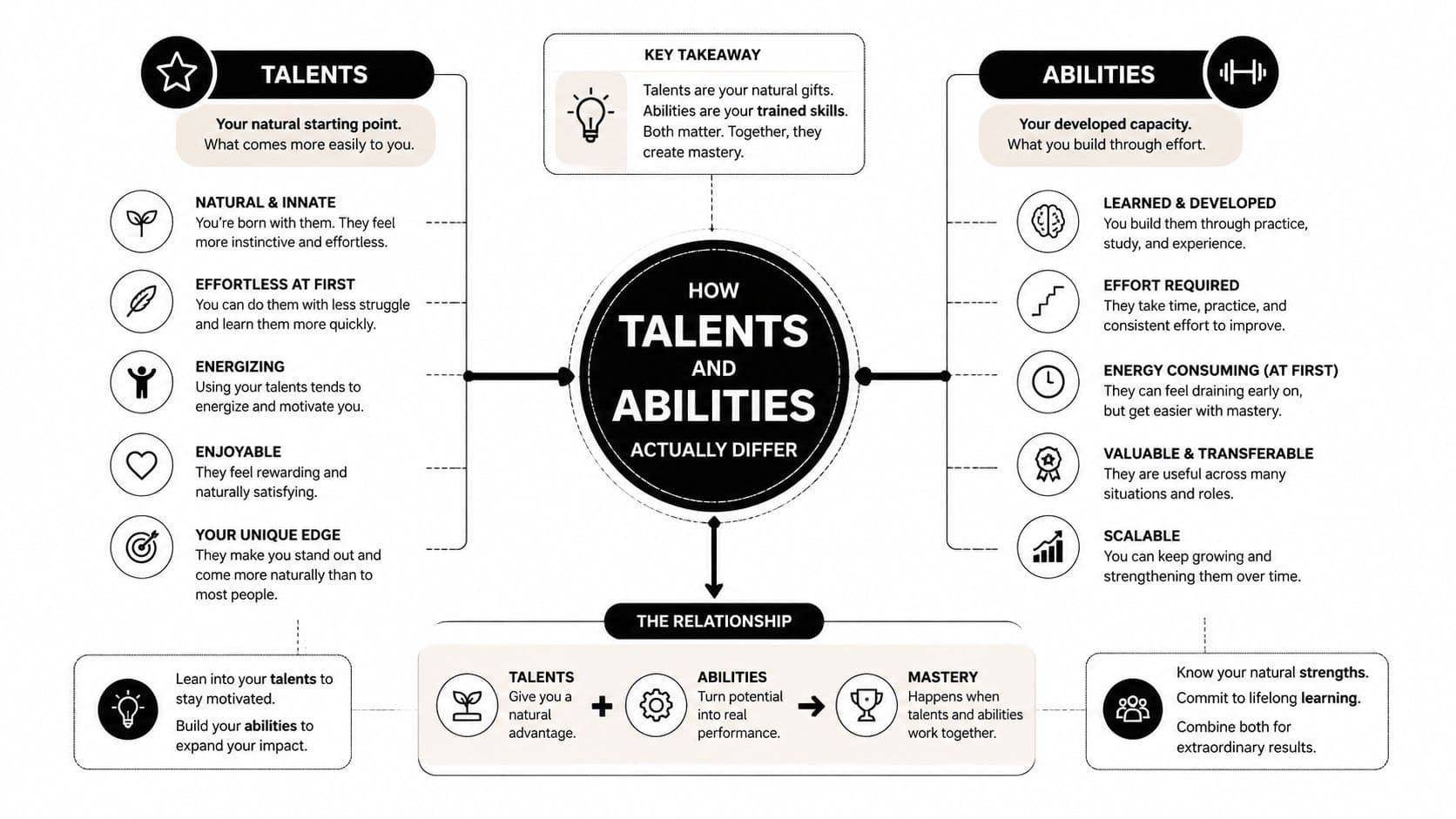
A person may have a quick instinct for patterns, language, rhythm, or social cues, yet still need practice to turn that instinct into reliable performance. That is the basic difference between talents and abilities. Talent is the recurring natural pattern that shows up early or often. Ability is the capacity that grows through training, feedback, repetition, and correction.
A simple way to tell them apart
A musician with perfect pitch may have a real talent for hearing differences that others miss. That does not mean the musician can automatically play a difficult piece well. Performance still depends on abilities, things like timing, technique, stamina, and reading notation, all of which improve through practice. Talent points the direction, ability carries the work.
The same distinction shows up in hiring and development. The European Commission's Joint Research Centre defines competence as a combination of knowledge, skills, and attitudes, and it distinguishes skills as the capacity to carry out processes and use existing knowledge to achieve results (JRC on skill and competence). That is why someone can be naturally insightful and still need training to manage a project, write a report, or lead a team.
Dan Millman's The Life You Were Born to Live uses a similar practical idea, even though it comes from a different tradition. The book looks at recurring gifts and recurring challenges as part of a person's life path, and the Life Purpose App makes that framework easier to access in a modern format. Instead of treating identity as one fixed label, it invites you to notice repeating strengths, pressure points, and patterns that keep asking for development.
A cleaner mental model
Talent is the pattern you keep returning to.
Ability is the thing you can build, prove, and refine.
Competence is what happens when both show up together in real life.
Some people are born with a strong inclination. Everybody still has to learn how to use it well.
That is why people get stuck when they ask, “Am I talented?” A better question is, “What keeps showing up for me, and what have I learned to do with it?” That shift makes room for both natural gifts and acquired strengths, which is usually where the answer lives.
Core Gifts and Challenges From Your Life Path
Dan Millman's framework treats self-knowledge as patterned rather than random. The Life Purpose App is a digital companion to The Life You Were Born to Live, and it gives readers access to one of 45 unique life paths with core gifts and challenges tied to health, money, sexuality, career, and relationships. For readers who want a separate starting point, find my life path number can help them orient themselves before they sit with the deeper text in Millman's book. The result is less like fortune-telling and more like a structured mirror for recurring themes.
Reading patterns without turning them into fate
Say someone keeps running into the same relationship problem. They may call it bad luck, but a life-path lens asks a different question. Is the issue a gift for emotional perception that still needs stronger boundaries? Or is the person so tuned in to other people that they keep setting aside their own needs before a relationship can become stable?
Money patterns often work the same way. A person who repeatedly avoids tracking finances may not be lazy. They may be carrying a hidden belief about worth, security, or receiving that keeps disrupting the practical side of earning and saving.
A life-path profile does not replace judgment. It can still help a person notice where the same theme keeps surfacing, especially when the pattern shows up in more than one area of life. In that sense, the framework works like a map with familiar landmarks. It does not choose the route for you, but it shows where you keep turning.
What the pattern is really for
The point is to ask whether a repeated challenge has been mistaken for a flaw when it may be part of a gift that needs shaping. A person who feels things may need emotional regulation, not less sensitivity. A person who thinks in systems may need social ease, not less precision.
That is why life-path language can be useful for self-understanding. Labor-market research often separates natural strengths from skills learned on the job, while cognitive research shows that people do better when they can name patterns in how they think and respond. Millman's model adds another layer by asking what seems to recur across a person's life, not just what shows up in a résumé. It gives readers a way to hold strength and friction together, so a recurring challenge becomes information instead of proof of failure.
When you read your patterns that way, your strengths stop looking invisible and start looking familiar.
Exercises That Surface Hidden Talents
The easiest talents to miss are often the ones that feel ordinary to you. If something comes naturally, you may never think to name it, which is why simple observation exercises can be more useful than trying to “discover your purpose” in one dramatic moment.
Three low-pressure ways to notice what keeps working
Start with flow. Think back to a time when you lost track of time because you were absorbed in what you were doing. Maybe you were editing something, calming a tense conversation, designing a layout, or organizing a messy plan. Write down what happened, what part felt easy, and what part other people might have found hard.
Then list compliments you've brushed off. If people often say you're calming, sharp, persuasive, patient, or unusually good at explaining things, don't dismiss it too quickly. Those comments can point to a recurring strength you've normalized. For example, “I'm good at helping people feel safe enough to talk” is more useful than “people like me.”
Finally, look at old projects that felt more like play than work. The work itself doesn't have to be glamorous. A report, a fundraiser, a spreadsheet, a presentation, or a community event can all reveal talent if the process felt energizing rather than draining.
A notebook helps here, and so does a notes app if that's easier. Keep the answers short, concrete, and repeated over time. The goal isn't to write a biography, it's to catch patterns before they disappear.
Try this: after each prompt, write one sentence about what felt natural and one sentence about what needed effort.
The values clarification exercise is a good companion to this kind of reflection because values often help explain why a strength matters to you in the first place. Some people are talented at public speaking but only feel alive when they use it to teach. Others are gifted at structure but only care about it when it serves care, service, or freedom.
How the app can help you notice what you miss
Entering a birth date into the Life Purpose App can add another layer of pattern recognition, especially when your own self-observation feels incomplete. The app is built to surface life-path themes alongside gifts and challenges, which gives you a structured place to compare your lived experience with a symbolic framework. Used alongside your notes, it can make hidden patterns easier to see.
Why Talents Cluster and Abilities Grow Unequally
A lot of people are relieved when they hear that ability is not a moral verdict. That relief makes sense. Research in Behavior Genetics reported heritability estimates for aptitude ranging from .32 to .71, while estimates for talents ranged from .50 to .92, with shared environment contributing only a small effect, and the review concluded that genetic factors contribute to variation in intellectual, creative, and sports abilities across men and women (Behavior Genetics review). The point isn't that genes decide everything, it's that people don't start from the same internal setup.
What the numbers do and don't mean
Those ranges help explain why talent often seems to cluster within families. A child may inherit a pattern that makes verbal play, rhythm, coordination, spatial reasoning, or other abilities easier to notice and develop. But the ranges are wide, which matters. They show variation, not destiny.
That is where environment re-enters the picture. A separate analysis, Innate Talents, Reality or Myth?, argues that early experiences, preferences, opportunities, habits, training, and practice are central to excellence, and that claim fits what many people see in real life (Innate Talents: Reality or Myth?). Two people can have similar potential and end up in very different places if one gets support, feedback, and time while the other gets interruption and stress.
The labor market shows the same logic in a practical form. The U.S. Department of Labor lists professionalism, communication, teamwork, and critical thinking as key soft skills for success (DOL soft skills fact sheet). Those are learnable, but they're also easier to build when a person has stable access to feedback and opportunity.
Who gets to show their talent
A more uncomfortable truth is that talent is often hidden by unequal access, not just by lack of ability. Research on gifted education identifies underserved groups including twice-exceptional students, English learners, rural students, Hispanic students, and Native American students, while low-income high-ability students often need mentorships, apprenticeships, tutoring, and community support to translate potential into achievement (ERIC gifted education review).
That changes the question. It's not only “Who is talented?” It's also “Who has been given enough access to show it?” Once you ask that, a lot of supposedly average performance looks less like absence and more like blockage.
How Gifts and Skills Show Up in Real Life
The most useful tests of talent are usually mundane. They show up in work, money, and relationships long before they show up in any formal assessment. If you want to spot them, watch for the places where one part of life feels oddly natural and another part still needs deliberate training.
Career, money, and relationships
In career settings, a talent for pattern recognition can look like spotting what's about to go wrong before anyone else notices. That's different from the ability to manage the response, which usually comes from practice, systems, and repetition. One person may see the trend. Another person may know how to document it, assign tasks, and close the loop.
Money shows a similar split. A natural gift for negotiation can help someone advocate for better terms or notice hidden value, but the ability to track numbers is a separate skill. If someone has both, they're usually in a stronger position than someone who has only enthusiasm. The same is true in relationships, where emotional attunement and boundary-setting are related but not identical abilities.
The Life Purpose App also includes relationship dynamics and compatibility features, which makes it easier to think about how different patterns interact across friends, family members, coworkers, or public figures. That kind of comparison can be helpful because it turns vague tension into something you can observe with more honesty.
A strong gift without a matching skill can stay frustrating. A useful skill without a clear gift can feel busy but unremarkable.
That resource fits naturally here because many people need help naming the strengths that already show up in their daily choices.
Reading patterns without turning them into fate
Say someone keeps running into the same relationship problem. They may call it bad luck, but a life-path lens asks a different question. Is the issue a gift for emotional perception that still needs stronger boundaries? Or is the person so tuned in to other people that they keep setting aside their own needs before a relationship can become stable?
Money patterns often work the same way. A person who repeatedly avoids tracking finances may not be lazy. They may be carrying a hidden belief about worth, security, or receiving that keeps disrupting the practical side of earning and saving.
A life-path profile does not replace judgment. It can still help a person notice where the same theme keeps surfacing, especially when the pattern shows up in more than one area of life. In that sense, the framework works like a map with familiar landmarks. It does not choose the route for you, but it shows where you keep turning.
What the pattern is really for
The point is to ask whether a repeated challenge has been mistaken for a flaw when it may be part of a gift that needs shaping. A person who feels things may need emotional regulation, not less sensitivity. A person who thinks in systems may need social ease, not less precision.
That is why life-path language can be useful for self-understanding. Labor-market research often separates natural strengths from skills learned on the job, while cognitive research shows that people do better when they can name patterns in how they think and respond. Millman's model adds another layer by asking what seems to recur across a person's life, not just what shows up in a résumé. It gives readers a way to hold strength and friction together, so a recurring challenge becomes information instead of proof of failure.
When you read your patterns that way, your strengths stop looking invisible and start looking familiar.
Exercises That Surface Hidden Talents
The easiest talents to miss are often the ones that feel ordinary to you. If something comes naturally, you may never think to name it, which is why simple observation exercises can be more useful than trying to “discover your purpose” in one dramatic moment.
Three low-pressure ways to notice what keeps working
Start with flow. Think back to a time when you lost track of time because you were absorbed in what you were doing. Maybe you were editing something, calming a tense conversation, designing a layout, or organizing a messy plan. Write down what happened, what part felt easy, and what part other people might have found hard.
Then list compliments you've brushed off. If people often say you're calming, sharp, persuasive, patient, or unusually good at explaining things, don't dismiss it too quickly. Those comments can point to a recurring strength you've normalized. For example, “I'm good at helping people feel safe enough to talk” is more useful than “people like me.”
Finally, look at old projects that felt more like play than work. The work itself doesn't have to be glamorous. A report, a fundraiser, a spreadsheet, a presentation, or a community event can all reveal talent if the process felt energizing rather than draining.
A notebook helps here, and so does a notes app if that's easier. Keep the answers short, concrete, and repeated over time. The goal isn't to write a biography, it's to catch patterns before they disappear.
Try this: after each prompt, write one sentence about what felt natural and one sentence about what needed effort.
The values clarification exercise is a good companion to this kind of reflection because values often help explain why a strength matters to you in the first place. Some people are talented at public speaking but only feel alive when they use it to teach. Others are gifted at structure but only care about it when it serves care, service, or freedom.
How the app can help you notice what you miss
Entering a birth date into the Life Purpose App can add another layer of pattern recognition, especially when your own self-observation feels incomplete. The app is built to surface life-path themes alongside gifts and challenges, which gives you a structured place to compare your lived experience with a symbolic framework. Used alongside your notes, it can make hidden patterns easier to see.
Why Talents Cluster and Abilities Grow Unequally
A lot of people are relieved when they hear that ability is not a moral verdict. That relief makes sense. Research in Behavior Genetics reported heritability estimates for aptitude ranging from .32 to .71, while estimates for talents ranged from .50 to .92, with shared environment contributing only a small effect, and the review concluded that genetic factors contribute to variation in intellectual, creative, and sports abilities across men and women (Behavior Genetics review). The point isn't that genes decide everything, it's that people don't start from the same internal setup.
What the numbers do and don't mean
Those ranges help explain why talent often seems to cluster within families. A child may inherit a pattern that makes verbal play, rhythm, coordination, spatial reasoning, or other abilities easier to notice and develop. But the ranges are wide, which matters. They show variation, not destiny.
That is where environment re-enters the picture. A separate analysis, Innate Talents, Reality or Myth?, argues that early experiences, preferences, opportunities, habits, training, and practice are central to excellence, and that claim fits what many people see in real life (Innate Talents: Reality or Myth?). Two people can have similar potential and end up in very different places if one gets support, feedback, and time while the other gets interruption and stress.
The labor market shows the same logic in a practical form. The U.S. Department of Labor lists professionalism, communication, teamwork, and critical thinking as key soft skills for success (DOL soft skills fact sheet). Those are learnable, but they're also easier to build when a person has stable access to feedback and opportunity.
Who gets to show their talent
A more uncomfortable truth is that talent is often hidden by unequal access, not just by lack of ability. Research on gifted education identifies underserved groups including twice-exceptional students, English learners, rural students, Hispanic students, and Native American students, while low-income high-ability students often need mentorships, apprenticeships, tutoring, and community support to translate potential into achievement (ERIC gifted education review).
That changes the question. It's not only “Who is talented?” It's also “Who has been given enough access to show it?” Once you ask that, a lot of supposedly average performance looks less like absence and more like blockage.
How Gifts and Skills Show Up in Real Life
The most useful tests of talent are usually mundane. They show up in work, money, and relationships long before they show up in any formal assessment. If you want to spot them, watch for the places where one part of life feels oddly natural and another part still needs deliberate training.
Career, money, and relationships
In career settings, a talent for pattern recognition can look like spotting what's about to go wrong before anyone else notices. That's different from the ability to manage the response, which usually comes from practice, systems, and repetition. One person may see the trend. Another person may know how to document it, assign tasks, and close the loop.
Money shows a similar split. A natural gift for negotiation can help someone advocate for better terms or notice hidden value, but the ability to track numbers is a separate skill. If someone has both, they're usually in a stronger position than someone who has only enthusiasm. The same is true in relationships, where emotional attunement and boundary-setting are related but not identical abilities.
The Life Purpose App also includes relationship dynamics and compatibility features, which makes it easier to think about how different patterns interact across friends, family members, coworkers, or public figures. That kind of comparison can be helpful because it turns vague tension into something you can observe with more honesty.
A strong gift without a matching skill can stay frustrating. A useful skill without a clear gift can feel busy but unremarkable.
That resource fits naturally here because many people need help naming the strengths that already show up in their daily choices.
Reading patterns without turning them into fate
Say someone keeps running into the same relationship problem. They may call it bad luck, but a life-path lens asks a different question. Is the issue a gift for emotional perception that still needs stronger boundaries? Or is the person so tuned in to other people that they keep setting aside their own needs before a relationship can become stable?
Money patterns often work the same way. A person who repeatedly avoids tracking finances may not be lazy. They may be carrying a hidden belief about worth, security, or receiving that keeps disrupting the practical side of earning and saving.
A life-path profile does not replace judgment. It can still help a person notice where the same theme keeps surfacing, especially when the pattern shows up in more than one area of life. In that sense, the framework works like a map with familiar landmarks. It does not choose the route for you, but it shows where you keep turning.
What the pattern is really for
The point is to ask whether a repeated challenge has been mistaken for a flaw when it may be part of a gift that needs shaping. A person who feels things may need emotional regulation, not less sensitivity. A person who thinks in systems may need social ease, not less precision.
That is why life-path language can be useful for self-understanding. Labor-market research often separates natural strengths from skills learned on the job, while cognitive research shows that people do better when they can name patterns in how they think and respond. Millman's model adds another layer by asking what seems to recur across a person's life, not just what shows up in a résumé. It gives readers a way to hold strength and friction together, so a recurring challenge becomes information instead of proof of failure.
When you read your patterns that way, your strengths stop looking invisible and start looking familiar.
Letting Go of Fixed-Talent Myths and Reclaiming Your Path
One of the biggest myths about talent is that it has to appear early and look obvious. Another is that if you didn't “get it” young, you missed your chance. Both ideas flatten human growth and ignore how much excellence depends on practice, context, and repetition.
What growth really looks like
The old lone-genius story makes people think the gifted few arrive fully formed. Real life is messier. Some people show ability early, others develop it later, and many discover their strongest capacities only after they've had to solve hard problems for a while. That doesn't make the talent less real, it just means it matured in the open instead of announcing itself loudly.
Dan Millman's The Life You Were Born to Live stays useful. It doesn't need to compete with personal development, because it can be used as part of it. The Life Purpose App turns that same idea into an accessible tool for ongoing reflection, not a one-time identity label.
If you're wondering how these themes show up visually or in your own presence, a practical guide like how to pose for headshots can even be a reminder that presentation, confidence, and self-recognition are learned too. Sometimes people need to see themselves more clearly before they can speak about their strengths with any confidence.
Revisit your life-path profile. Try one of the exercises above. Then look again at the patterns that keep repeating in your work, relationships, and decisions. That's usually where the answer lives.
If you want a structured way to explore your recurring strengths, challenges, and life-path themes, visit Life Purpose App. It's built around Dan Millman's The Life You Were Born to Live and gives you a practical place to reflect on talents, abilities, and the patterns shaping your path.
Discover Your Life Purpose Today!
Unlock your true potential and find your life’s purpose.
