Discover the spirit of the laws in Dan Millman's life path system. Learn how spiritual laws shape your purpose, gifts, and daily living.

September 16, 2026 (1mo ago)
The Spirit of the Laws and Your Life Path
Discover the spirit of the laws in Dan Millman's life path system. Learn how spiritual laws shape your purpose, gifts, and daily living.
← Back to blog
Discover the spirit of the laws in Dan Millman's life path system. Learn how spiritual laws shape your purpose, gifts, and daily living.
She sat at the kitchen table with a cold cup of coffee, wondering why another year had ended with the same tired questions. The job had looked right, the relationship had seemed promising, yet both had left her facing familiar disappointment.
A Moment When Nothing Makes Sense
At first, she treated the pattern as evidence that she was making poor choices. Perhaps she lacked discipline. Perhaps she expected too much. Perhaps everyone else understood adulthood better than she did.
But repeating themes don't always point to personal failure. Sometimes they reveal a lesson you haven't learned how to recognize yet. In Dan Millman's system, presented in The Life You Were Born to Live, the spirit of the laws offers a different way to read these patterns. A recurring conflict can become an alignment signal, not a verdict on your character.
Consider someone who repeatedly accepts demanding work, earns praise, and eventually feels resentful. The surface details change, but the underlying tension remains. The person may need to examine boundaries, receiving, rest, or the desire to prove worth through constant effort. The pattern doesn't dictate a single answer. It points toward a question that keeps returning.
Practical rule: A repeated life theme deserves curiosity before it deserves self-criticism.
This approach can feel relieving because it doesn't require you to believe you're broken. It suggests that your experiences have structure, even when that structure isn't obvious. The system treats a life path as a way to notice tendencies, gifts, and challenges that may otherwise look like disconnected events.
That doesn't mean every setback carries a mystical message, or that personal responsibility disappears. Choices still matter. Circumstances still matter. The value lies in slowing down long enough to ask what your familiar situations are asking you to practice.
The pages ahead translate these patterns into plain language. You'll see what spiritual laws mean in this framework, how they relate to the 45 life paths in The Life You Were Born to Live, and how you can use the ideas in ordinary decisions about work, relationships, health, and growth.
What the Spirit of the Laws Actually Means
Start with a simple comparison. Gravity pulls an apple downward whether the apple understands gravity or not. In Dan Millman's life path system, spiritual laws work as recurring principles that draw your attention toward particular lessons, abilities, and challenges connected with a birth number.
The word spirit doesn't mean a ghost. It means the underlying purpose or direction behind a rule. A written instruction tells you what to do. Its spirit explains why that instruction exists and how it should guide behavior when circumstances change.
In The Life You Were Born to Live, the 25th Anniversary Edition presents a system expanded from 37 life paths to 45 life paths, as described in the edition overview and interview. Each path combines themes that help describe the kinds of tensions and opportunities a person may repeatedly encounter.
You can think of a spiritual law as a recurring instruction life keeps handing you until you understand its lesson. If your experiences repeatedly challenge you to balance independence with cooperation, the pattern may invite a different response from the one you've used before. If you keep waiting for perfect certainty, the relevant lesson may involve process, attention, or trust.
Direction rather than a fixed identity
A life path isn't the same as a personality label. Personality language often describes what you are like. The spirit of the laws describes how your life tends to move, including the areas where growth may require deliberate practice.
That distinction matters. Someone may have a strong service-oriented pattern without being naturally selfless in every situation. A person whose path includes creative themes may still struggle to focus. The framework doesn't remove contradiction. It gives contradiction a context.
Readers who want a concise introduction can explore what spiritual laws mean in the Life Purpose system. The useful working definition is this: spiritual laws are recurring principles that help you recognize the lessons, gifts, and choices associated with your life path.
That definition keeps the idea practical. Instead of asking, “What fate has been assigned to me?” you can ask, “What pattern keeps appearing, and what response would bring it into better alignment?”
How Spiritual Laws Shape Your Life Path
Your date of birth is the starting point in Dan Millman's system. It generates a birth number connected with one path among the framework's 45 life paths. That path then highlights recurring themes and spiritual laws, giving you a way to examine familiar experiences with greater clarity.
The number does not mechanically cause events. It works more like a map legend: it helps identify the terrain, while your choices, history, relationships, and circumstances shape the route you take through it.
From birth number to recurring themes
A service-oriented path, for example, may bring repeated encounters with responsibility, humility, boundaries, and receiving support. The same theme can surface in different parts of life:
- At work, you accept extra tasks, then feel frustrated when others overlook your effort.
- In relationships, you offer practical help but hesitate to ask for care.
- In personal growth, you mistake being needed for being valued.
The law does not force a single result. It makes certain questions easier to see. You might continue giving beyond your limits, or learn to serve while respecting your own needs. The practical value lies in noticing the pattern before it becomes another automatic response.
The book's description includes health, money, sexuality, and livelihood within the system, keeping spiritual reflection connected to ordinary decisions. A recurring theme may appear in a budget, a career choice, a health concern, or a difficult conversation. It does not belong only to meditation or abstract belief.
Life phases and timing
The system also describes nine-year cycles of life, as stated in the publisher description of the revised edition. These cycles represent changing phases in which familiar themes may return for review, growth, or release.
A cycle is not a promise that a specific event must occur at a specific moment. It offers a timing question instead: Is this a period for consolidating, beginning, completing, or letting go?
A life path shapes the terrain. It doesn't choose your steps.
The framework's moving parts fit together simply. The laws point to recurring lessons, the cycles suggest when certain themes may receive attention, and free will shapes your response. Used this way, the system supports reflection without replacing judgment. It connects the 45 life paths with everyday choices, helping you test an idea in lived experience rather than treating it as a fixed prediction.
Key Spiritual Laws in Dan Millman's System
The laws become easier to understand when attached to ordinary situations. In The Life You Were Born to Live, they aren't merely decorative ideas. They help describe how people meet recurring challenges in areas such as work, relationships, health, and personal direction.
Law of Balance
The Law of Balance asks you to honor opposing needs rather than allowing one to dominate. Action and rest provide the clearest example. Someone may keep accepting new projects because movement feels productive, then wonder why motivation disappears. Balance doesn't mean avoiding ambition. It means recognizing that sustained effort requires recovery.
In a relationship, balance may involve giving and receiving. If one partner always solves problems while the other always depends on that help, resentment can replace intimacy. The law points toward mutual participation.
Law of Attention
The Law of Attention concerns the weight your focus gives to an experience. Attention doesn't magically guarantee an outcome, but it affects what you notice, practice, and reinforce. A person who spends every workday studying a chosen skill is more likely to recognize opportunities connected with that skill than someone who thinks about it only occasionally.
The same principle can expose a problem. Repeatedly monitoring a fear may make the fear feel larger, while ignoring a health concern can leave it unaddressed. Attention is a form of participation.
Law of Intention
The Law of Intention distinguishes a vague wish from a direction you can act on. “I want a better career” leaves many options open. “I want work that uses my teaching ability and allows a steadier routine” gives a decision-making standard.
Intention doesn't eliminate uncertainty. It helps you choose among imperfect options. During a career pivot or financial plateau, clarity can prevent you from chasing every attractive possibility.
Law of Process
The Law of Process teaches that meaningful development unfolds through stages. A writer improves by drafting, revising, and continuing to write. A person repairing trust in a relationship has to show consistency rather than demand instant reassurance.
Shortcuts can sometimes save time, but they can't replace learning. When progress feels slow, this law asks whether you're abandoning a sound process because the result hasn't appeared quickly enough.
Law of Surrender
The Law of Surrender becomes relevant when effort turns into control. You can prepare carefully for a conversation, but you can't force another person to respond with maturity. You can apply for work, but you can't command an employer's decision.
Surrender isn't passivity. It means releasing the demand that reality follow your preferred schedule while continuing to act responsibly. The overview of the laws of spirit provides a useful reference point for readers who want to explore the system's terminology.

Where the Laws Show Up in Everyday Life
A Tuesday morning can make an abstract principle tangible. You wake late, skip breakfast, answer messages while commuting, and promise yourself that rest will happen later. By evening, the problem is clearer than any definition: your routine has no space for recovery.
In health, a useful test is specific rather than mystical. Set a regular bedtime, prepare a simple meal before hunger decides for you, or place a short walk after an existing habit. Then observe what changes in your energy and attention. The spiritual-law framework does not diagnose illness or replace medical care. It gives you a way to notice whether your daily choices support the body you ask to carry them.
Money becomes concrete at the moment of a choice. Before renewing a subscription or making an unplanned purchase, write down what the expense is meant to provide. If it serves no clear purpose, delay it and review the budget later. That pause turns a vague wish for financial control into an observable practice. The framework can help reveal habits, though it cannot guarantee wealth or replace qualified financial advice.
Relationships and work
A relationship may show the pattern through a small request. Instead of agreeing to plans you resent, state the time and support you can offer. The response gives you useful information, while your honesty prevents kindness from becoming silent self-erasure.
Work offers another ordinary experiment. During a career transition, compare opportunities using a short list of duties, learning needs, and practical constraints. After choosing, spend one work session developing a skill the role requires. This makes a life-path theme testable: your direction appears through repeated choices, not through a single dramatic sign.
Personal growth often looks even smaller. Keep a note of one promise you made to yourself and whether you kept it. Over several entries, the pattern may show whether your difficulty comes from unclear commitments, crowded routines, or expectations that leave no room for adjustment.
The Life Purpose App can provide language for reviewing these moments alongside your life path. Used carefully, it works like a mirror, not a command. The value lies in comparing its themes with lived evidence, then choosing a response you can practice.

Applying the Laws Through the Life Purpose App
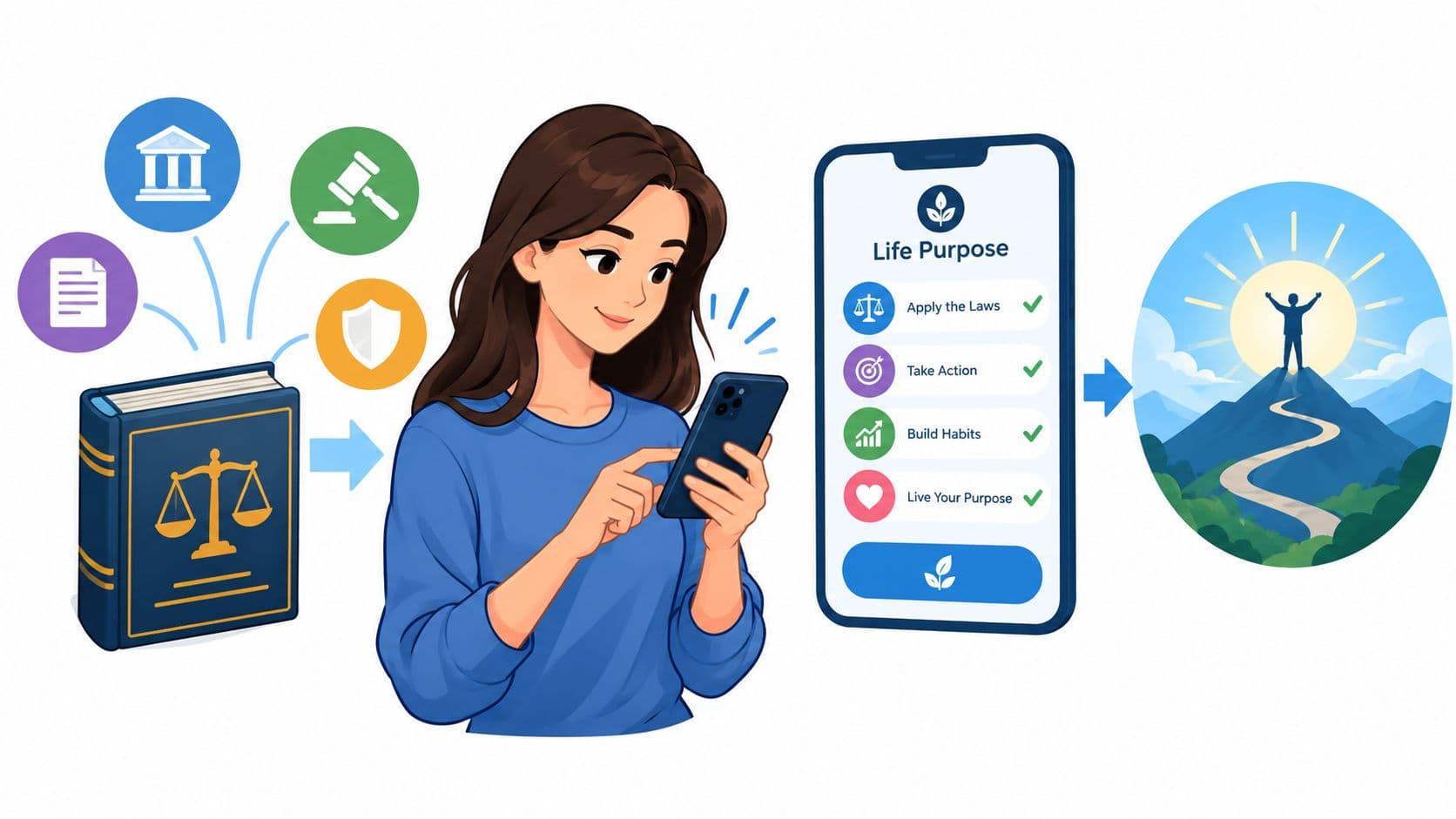
The Life Purpose App turns the framework into a reference point you can revisit. You enter a date of birth, then read the resulting life path number and summary. The system connects that path with core gifts, challenges, life cycles, and themes associated with The Life You Were Born to Live, including the revised edition's expanded framework of 45 life paths.
The app can be used as a starting point, not as an authority that makes decisions for you. Read the summary slowly. Mark the descriptions that feel familiar, then separate genuine recognition from the temptation to accept every statement automatically.
A simple practice
Use the information in a small weekly routine:
- Review the insight: Read the relevant life path material and note one theme that appears in your current circumstances.
- Name the active law: Write down whether the week seems to involve balance, attention, intention, process, surrender, or another recurring principle.
- Record evidence: Describe the actual conversation, decision, or habit that brought the theme into view.
- Choose one response: Select a behavior you can practice without expecting instant results.
- Revisit the pattern: Look back after some time and ask whether your response changed the situation or clarified the lesson.
The book's description says the system addresses core issues, inborn talents, and special needs connected with each path, including health, money, sexuality, and livelihood. That gives your journaling a concrete direction. You might examine how a law appears in your work habits one week and in your relationships the next.
You can also use the app's life purpose oracle resource as a prompt for reflection. Before making a major decision, consider the relevant life phase and ask whether you're beginning, developing, completing, or resisting a process.
The most grounded use of the app is as a mirror. It helps you notice patterns and name possible lessons, but it can't know every fact about your life. You remain responsible for testing the interpretation against experience and choosing your response.
Misconceptions and a Grounded Way Forward
The most common misunderstanding is that a life path number locks you into a fixed destiny. It doesn't have to be read that way. In Dan Millman's framework, the spirit of the laws reveals tendencies, themes, gifts, and challenges. It doesn't sentence you to a particular job, relationship, illness, success, or failure.
A second misunderstanding treats numerology as vague fortune-telling. The Life Purpose system has a repeatable starting point, a date of birth, and it organizes interpretations around birth numbers, life paths, and cycles. The Life You Were Born to Live also states that its revised edition covers people born from 1750 to the present, while some people born after 2000 receive single-digit birth numbers rather than older multi-digit paths, as described in the book's published description.
That structure doesn't make every interpretation objectively proven. It makes the method specific enough to examine. You can ask whether a description fits your experience, where it doesn't, and what useful question it raises.
Blueprint and free will
Gravity provides a helpful analogy again. It operates reliably, but people still decide where to walk, whether to climb, and how carefully to move. Likewise, the laws can represent stable tendencies without eliminating choice.
A grounded reading avoids two extremes:
- Fatalism: “My number made me do this, so I can't change.”
- Dismissal: “A number can never help me reflect, so no pattern is worth examining.”
The middle position is more useful. Treat the life path as a conversation between a possible blueprint and your lived choices. If a recurring conflict suggests a lesson in boundaries, you still decide whether to speak clearly, seek support, change the arrangement, or remain with the familiar pattern.
The purpose isn't to surrender your authority. It's to gain language for experiences that once felt random. When the language helps you act with more awareness, the spirit of the laws becomes a practical tool for self-knowledge rather than a replacement for judgment.
The Life Purpose App offers date-of-birth life path insights, spiritual-law themes, and cycle guidance connected with Dan Millman's The Life You Were Born to Live. Visit Life Purpose App to explore your path, identify the patterns you keep meeting, and turn reflection into a more deliberate daily practice.
End of content.
Discover your life path today
Enter your date of birth and see your life path, free.
Find your life path