March 21, 2026 (Today)

Beyond Just Feeling: A Deep Dive Into the Three Kinds of Empathy

Discover the three kinds of empathy: cognitive, emotional, and compassionate. Learn how to develop each to transform your relationships and personal growth.

← Back to blog
Cover Image for Beyond Just Feeling: A Deep Dive Into the Three Kinds of Empathy

Discover the three kinds of empathy: cognitive, emotional, and compassionate. Learn how to develop each to transform your relationships and personal growth.

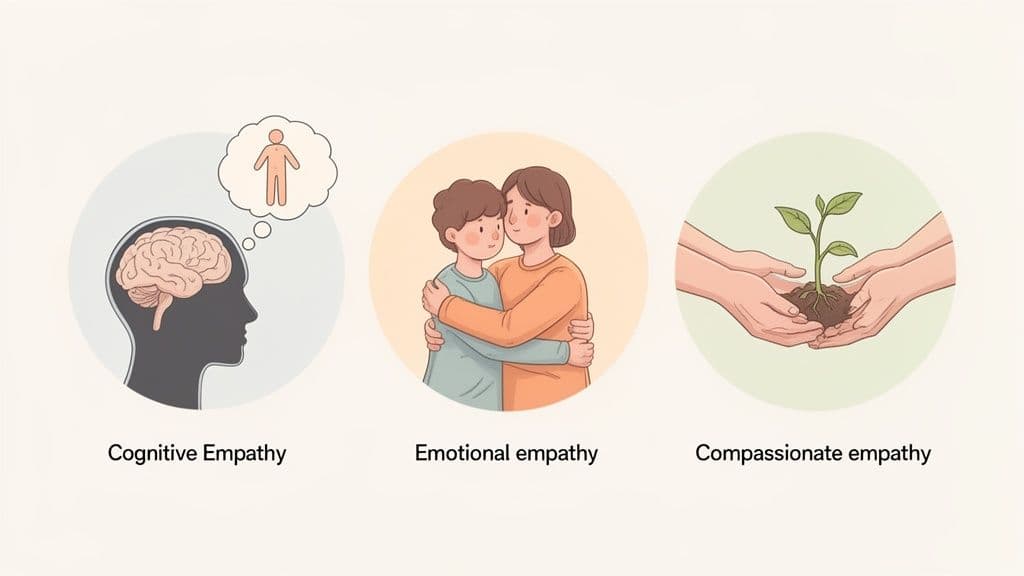
You’ve probably heard the word 'empathy' a thousand times, usually described as walking in someone else’s shoes. But that simple phrase barely scratches the surface. True empathy is a complex, multi-layered ability that is absolutely essential for building strong relationships, navigating life’s challenges, and understanding ourselves on a deeper level. It’s not just one thing; it’s a whole set of skills. Knowing the difference between the three kinds of empathy is key to mastering this fundamental part of human connection.

In this guide, we'll break down each type of empathy, popularized by researchers like Daniel Goleman and others. We will explore how to recognize each in yourself and others, provide real-life examples, and offer brief exercises to help you develop these distinct abilities. Understanding these different facets can bring incredible clarity to your personal journey, much like the system of self-knowledge found in Dan Millman's book, The Life You Were Born to Live. If you’ve ever used tools like the Life Purpose App to explore different life paths, you're already practicing a form of empathy. To further explore the nuances of emotional understanding, consider resources that delve into the broader concept of emotional intelligence. Now, let’s go deeper and unlock the full power of empathy in your daily life.

1. Cognitive Empathy

Cognitive empathy is the intellectual ability to understand another person's perspective. It’s often called "perspective-taking." This form of empathy allows you to comprehend someone's thoughts, beliefs, and mental state without necessarily feeling the emotions attached to their experience. Think of it as putting yourself in someone else's shoes mentally, not emotionally. This capacity is fundamental for clear communication and objective analysis, especially when navigating complex relationship dynamics or personal life patterns.

Two profiles face each other, one with a thinking brain and gears, the other with a speech bubble.

Popularized in the work of emotional intelligence researcher Daniel Goleman, cognitive empathy is a skill you can consciously develop. It involves setting aside your own biases to truly grasp why someone thinks or acts the way they do. This is a core principle within the life-path system found in Dan Millman's book, The Life You Were Born to Live, which helps people understand the diverse psychological frameworks that shape human behavior.

How to Recognize and Use Cognitive Empathy

You are using cognitive empathy when you can accurately explain someone else’s point of view, even if you disagree with it. It's the ability to say, "I understand why you see it that way," and mean it. This skill is vital for effective negotiation, leadership, and conflict resolution. It allows you to anticipate others' reactions and communicate in a way that resonates with their frame of reference.

A great example is found when using the Life Purpose App to explore relationship compatibility. Imagine a user with a 27/9 life path (focused on integrity and wisdom) is in a relationship with someone on a 34/7 path (focused on independence and analysis). The 27/9 might feel frustrated by their partner’s need for solitude, but cognitive empathy allows them to understand that this need isn't a rejection; it's a fundamental aspect of the 34/7's path for processing the world.

Key Insight: Cognitive empathy is not about agreement; it's about understanding. It's the "thinking" part of the empathy equation, giving you a map of another person's mental world.

Practical Steps to Build Cognitive Empathy

Developing this skill requires conscious practice and a genuine curiosity about others. It's a key component of active listening, and you can learn more about its application by exploring the principles of empathic listening.

Here are a few actionable ways to build your cognitive empathy:

  • Study Different Worldviews: Use the detailed descriptions in the Life Purpose App or Dan Millman's book, The Life You Were Born to Live, to mentally "try on" another life path. Read about its core strengths and challenges to understand the logic driving someone with that number.
  • Ask "Why?": During a disagreement, pause and ask yourself, "Given their life path and experiences, why might they believe this is the right way to think or act?" This shifts you from judgment to curiosity.
  • Analyze Life Cycles: Document the patterns in your own nine-year cycles as outlined in the app. Recognizing how your own thinking and priorities evolve over time helps you appreciate that others are on their own distinct developmental journeys.
  • Focus on Logic Before Emotion: When analyzing compatibility, first try to intellectually grasp the structure of your partner's life path. Understand how they think before you react to what they feel.

2. Emotional Empathy (Affective Empathy)

Emotional empathy, also known as affective empathy, is the ability to truly feel what another person is feeling. This goes beyond intellectual understanding; it's a visceral, gut-level response where you resonate with someone's joy, sorrow, or fear as if it were your own. It's the emotional bridge that allows for deep, authentic human connection and is a cornerstone of meaningful relationships. This capacity for shared feeling is what allows us to connect with the raw human experience behind each of the unique life paths described in Dan Millman's book, The Life You Were Born to Live, and the Life Purpose App.

Two cartoon figures sharing glowing hearts through a red string forming a central heart.

The concept of feeling with someone is central to the work of many thinkers, including therapist Carl Rogers, who emphasized unconditional empathic regard, and researcher Brené Brown, whose work highlights vulnerability and emotional connection. Within the life-path system of Dan Millman's The Life You Were Born to Live, emotional empathy is what brings the numbers to life. It’s what transforms a description of a life path from an abstract concept into a felt sense of that person's journey.

How to Recognize and Use Emotional Empathy

You are using emotional empathy when you don't just understand someone's sadness, you feel a pang of it yourself. It's the welling up of joy for a friend's success or the heaviness in your chest when a loved one is struggling. This skill is vital for creating safe, healing spaces where people feel truly seen and heard. It is the foundation of genuine compassion and helps move relationships beyond surface-level interactions into profound attunement.

Consider a parent with a 2 life path (focused on Cooperation and Balance) whose child is on a 7 path (the Spiritual Seeker). Cognitive empathy might help the parent understand the child's need for solitude, but emotional empathy allows the parent to feel the peace and sense of discovery their child finds in that quiet introspection. This shared feeling validates the child's experience and deepens their bond, showing them their emotional world is accepted.

Key Insight: Emotional empathy is not about feeling sorry for someone; it’s about feeling with them. It's the "feeling" part of the empathy equation, creating a shared emotional experience.

Practical Steps to Build Emotional Empathy

Developing this capacity involves tuning into your own heart and creating space to connect with the emotions of others without judgment. It requires a willingness to be present with feelings, both yours and theirs.

Here are a few actionable ways to build your emotional empathy:

  • Feel into the Paths: When using the Life Purpose App to read about a friend or partner's life path, pause after learning about their core challenges. Close your eyes and try to imagine the frustration, joy, or pressure associated with that path's journey.
  • Practice Active Feeling, Not Fixing: When someone shares a difficult emotion, resist the urge to immediately offer solutions. Instead, simply say, "That sounds incredibly hard," and allow yourself to sit with the feeling they are conveying.
  • Journal on Your Cycles: As you track your nine-year cycles in the app, write about the emotional quality of each phase. How did it feel to be in a year of beginnings versus a year of endings? This builds your emotional vocabulary and self-awareness.
  • Balance with Boundaries: High emotional empathy can lead to burnout. Consciously practice distinguishing your feelings from others'. Acknowledge what you are feeling in response to them without taking on their emotion as your own permanent state.

3. Compassionate Empathy (Empathetic Concern)

Compassionate empathy is the integration of understanding and feeling with the genuine drive to help. It goes beyond perspective-taking and emotional resonance to become empathy in action. This form moves you from simply knowing how someone feels to being motivated to alleviate their suffering or support their well-being. It is the bridge between internal experience and external support, the final step that turns awareness into a constructive force.

An illustrative hand holds a glowing golden heart, connected by a bright line to a stylized green brain.

This active form of care is a central theme in the teachings of spiritual leaders like The Dalai Lama and Thich Nhat Hanh, who speak of interconnectedness and mindful compassion. It's also reflected in the work of figures like Brené Brown, who connects vulnerability with compassionate action. In the context of the life-path system found in Dan Millman’s The Life You Were Born to Live, compassionate empathy is the highest expression of understanding. It’s where you not only grasp another's path but actively help them live it more fully.

How to Recognize and Use Compassionate Empathy

You are using compassionate empathy when your understanding and feelings for someone lead you to take supportive action. It's not about fixing someone's problems but about being a steady, encouraging presence on their journey. It could be as simple as listening without judgment or as involved as helping someone create a plan that aligns with their life purpose. This is the most relational of the three kinds of empathy, focused on building connection through tangible support.

A great example is when a family supports a loved one on a 5 life path (focused on freedom and discipline). Instead of criticizing their need for new experiences and travel, the family uses compassionate empathy. They understand this is a core need for the 5’s growth. They then act on this by helping them plan a trip or celebrating their adventures, showing they support their path while maintaining a strong family bond. This active support is the hallmark of compassionate empathy.

Key Insight: Compassionate empathy is the active desire to help, born from understanding and feeling. It's the "doing" part of empathy, turning concern into meaningful action.

Practical Steps to Build Compassionate Empathy

Developing this quality means learning to channel your insights and feelings into helpful, supportive behaviors. It requires balancing care with respect for another's autonomy. You can deepen your understanding of this process by exploring principles of compassion in action.

Here are a few actionable ways to build your compassionate empathy:

  • Offer Targeted Support: Use the "Core Challenges" section in the Life Purpose App to see where a friend or partner might struggle. If their path involves self-doubt, offer specific, genuine encouragement. If it involves over-extension, help them set boundaries.
  • Ask, "How Can I Help?": Instead of assuming you know what's best, ask directly: "Given what you're going through with your life path, what kind of support would feel most helpful to you right now?"
  • Practice Service: In the spirit of Dan Millman's work in The Life You Were Born to Live, consider how the strengths of your own life path can serve others. A person focused on spiritual intuition can offer insightful guidance to a person focused on stability who feels stuck in a routine.
  • Support, Don't Rescue: Recognize the difference between helping someone walk their path and trying to carry them. True compassion empowers others to face their own challenges, knowing you are there to support them.
  • Anticipate Needs: Use the nine-year cycle information in the Life Purpose App to see when someone is entering a period of change or difficulty. A simple check-in during a challenging "1" year of new beginnings can make a world of difference.

4. Somatic Empathy (Body-Based Empathy)

Somatic empathy is the physical, body-based resonance with another person's experience. It's an instinctive form of empathy that operates through the nervous system, allowing you to sense someone's emotional or physical state through your own body. You might feel their tension in your shoulders, their joy as a lightness in your chest, or their grief as a heaviness in your gut. This embodied awareness bridges the gap between understanding someone intellectually (cognitive) and feeling with them emotionally (affective), making it a key part of the full spectrum of the three kinds of empathy.

While less commonly discussed than the primary types, somatic empathy is increasingly recognized as vital for authentic connection. This form of empathy is explored in the work of figures like Bessel van der Kolk, who highlights the body's role in trauma, and Peter Levine, founder of Somatic Experiencing. It is the body's wisdom in action, offering raw, unfiltered data about another person's state that words often fail to convey.

How to Recognize and Use Somatic Empathy

You are using somatic empathy when you notice a physical shift in your own body in response to someone else. It's the moment a friend shares stressful news, and you feel your own stomach tighten in response. It's the life coach who senses a client's nervous system becoming overwhelmed during a session and intuitively knows to pause and create space for integration, rather than pushing forward with the discussion.

This body-based intuition is powerful when exploring the life paths found in Dan Millman's book, The Life You Were Born to Live. Imagine you are reading the description of a life path in the Life Purpose App that mirrors your own core challenges. Somatic empathy is what creates that jolt of recognition-a physical resonance that confirms, "Yes, this is me." It can also help in relationships. A person with a life path focused on spiritual intuition might physically sense the energetic depletion of their partner, who has a life path focused on freedom and experience, even when the partner claims they are "fine."

Key Insight: Somatic empathy is feeling with someone in your own body. It's the nervous system's way of creating connection and providing gut-level information about another person's state of being.

Practical Steps to Build Somatic Empathy

Developing this physical sensitivity requires tuning into your own body first. The more aware you are of your own physical baseline, the more clearly you can recognize when you are resonating with someone else. This is a subtle yet deep skill, and you can explore more about this connection by reading about psychic and empathic abilities.

Here are a few actionable ways to build your somatic empathy:

  • Practice Body Awareness: Engage in practices like yoga, tai chi, or simple body-scan meditations. The goal is to get familiar with the normal sensations in your body so you can notice changes more easily.
  • Notice Sensations with Others: When you are with someone, especially during an emotional conversation, check in with your body. Do you feel tightness, expansion, warmth, or coolness? Don't judge it; just notice it.
  • Ground Yourself: To avoid absorbing others' states, practice grounding. Stand with your feet firmly on the floor and imagine roots growing down into the earth. This helps you stay centered while remaining open.
  • Embody Life Paths: As you learn about different life numbers in the Life Purpose App or Dan Millman's book, The Life You Were Born to Live, try to imagine how that energy would feel in your body. How does the groundedness of a 22/4 feel versus the expressive energy of a 21/3?

5. Empathic Attunement (Relational Empathy)

Empathic attunement is the dynamic, moment-to-moment synchronization with another person's emotional and relational state. It is the real-time dance of presence and responsiveness that creates secure, harmonious connections. Instead of being a single type of empathy, it is the skilled integration of all dimensions working together within a relationship. This is perhaps the most practically valuable form for relationship success, involving continuous adjustment based on what the other person needs in each moment.

This concept of relational harmony is deeply explored in the work of attachment theorists like Edward Deci and Richard Ryan, as well as relationship experts like Sue Johnson and John Gottman. It also aligns with the principles of Dan Millman's book, The Life You Were Born to Live, which emphasizes that understanding life paths is the first step toward creating truly harmonious relationships.

How to Recognize and Use Empathic Attunement

You are practicing empathic attunement when you can sense a shift in your partner’s mood without them saying a word and adjust your own presence accordingly. It’s the ability to offer support when it's needed and provide space when it's required, creating a fluid, supportive connection. This skill moves beyond static understanding to active, in-the-moment participation in the relationship.

A clear example can be seen when using the Life Purpose App to understand relationship dynamics. Imagine a parent focused on creative expression and partnership is raising a teenager with a 34/7 path (focused on independence and analysis). Empathic attunement allows the parent to recognize the teen's growing need for privacy and solitude not as rejection, but as a crucial part of their development. The parent can then shift from offering constant engagement to providing quiet, steady support from a distance, meeting the teen where they are in their life cycle.

Key Insight: Empathic attunement is not a static state but a continuous practice of presence. It’s the "dancing with" part of the empathy equation, where you fluidly respond to the rhythm of another's inner world.

Practical Steps to Build Empathic Attunement

Developing this relational skill requires a commitment to both self-awareness and a deep curiosity about your partner. It’s the practical application of the life-path knowledge found in the Life Purpose App and Dan Millman's book, The Life You Were Born to Live, turning insights into loving actions.

Here are a few actionable ways to build your empathic attunement:

  • Practice Regular Check-ins: Go beyond "How was your day?" and ask, "How are you feeling right now?" and then listen with your full attention. Mirror back what you hear: "So, it sounds like you’re feeling overwhelmed by that project at work."
  • Study Vulnerable Points: Use the Life Purpose App or Dan Millman's book, The Life You Were Born to Live, to understand your partner's core challenges and fears, not just their strengths. Knowing their vulnerable spots helps you offer more precise and gentle support.
  • Notice Nine-Year Cycles: Pay attention to when your partner’s nine-year cycle shifts, as described in the Life Purpose App. A new cycle often brings new priorities and challenges, and adjusting your support can make a significant difference.
  • Pause Before Responding: When conflict arises, take a breath. Instead of reacting, try to sense what your partner truly needs beneath their words. Are they asking for a solution, or just to be heard?
  • Celebrate Connection: Acknowledge and celebrate the moments when you feel truly in sync. These positive experiences become anchors that strengthen your bond and make attunement a more natural habit.

Five Empathy Types Comparison

Empathy TypeImplementation Complexity 🔄Resource Requirements ⚡Expected Outcomes 📊Ideal Use Cases 💡Key Advantages ⭐
Cognitive EmpathyModerate — practice perspective‑taking and mental modelingLow–Medium — learning materials and analytic exercisesClearer understanding and communication; limited emotional changeCompatibility analysis, coaching, app-based life‑path interpretationObjective insights, predictive clarity, reduces projection
Emotional Empathy (Affective)Moderate — cultivate emotional resonance and boundary skillsMedium — emotional energy, reflective practice, supervisionDeeper bonds and compassionate responsiveness; risk of overwhelmTherapy, close relationships, healing conversationsAuthentic connection, motivates caring action
Compassionate Empathy (Empathetic Concern)High — integrates understanding, feeling, and intentional actionHigh — time, emotional labor, discernment, healthy boundariesSupportive action, strengthened relationships, community supportMentorship, crisis support, coaching, community careTurns empathy into effective help; fosters growth and resilience
Somatic Empathy (Body‑Based)Moderate — requires body awareness and somatic trainingMedium — somatic practices (breathwork, grounding), trainingEnhanced nonverbal attunement and embodied insight; can be intenseBody‑oriented therapy, somatic coaching, relational presence workDetects incongruence, informs present‑moment responses
Empathic Attunement (Relational)Very High — continuous, real‑time integration of multiple empathy modesVery High — sustained presence, mutual commitment, emotional regulationSecure, responsive relationships with improved conflict resolutionLong‑term partnerships, parenting, couples therapy, high‑trust teamsReal‑time responsiveness; durable relational health and mutual growth

From Understanding to Action: Weaving Empathy into Your Life

We’ve journeyed through the distinct yet interconnected realms of empathy, moving from the intellectual grasp of cognitive empathy to the shared feelings of emotional empathy, and finally to the supportive response of compassionate empathy. Understanding these three kinds of empathy is like learning the notes of a chord; individually, they are simple, but when played together, they create a rich and resonant harmony in our relationships.

The real growth, however, isn't in just knowing the definitions. It's in the messy, beautiful practice of applying them. It's about pausing before you respond to a frustrated friend, asking yourself: Do I understand their perspective (cognitive)? Am I feeling with them, or just feeling sorry for them (emotional)? And what action can I take that truly supports them right now (compassionate)?

Putting Empathy into Practice

Mastering these skills is a lifelong process, not a final destination. It requires patience and a willingness to get it wrong sometimes. The goal is progress, not perfection. Here are some key takeaways to focus on as you integrate these ideas into your daily life:

  • Start with Self-Awareness: Before you can truly show up for others, you must recognize what’s happening within yourself. Are you absorbing someone's stress? Are you jumping to solutions without understanding? Acknowledging your own default tendencies is the first step toward conscious change.
  • Balance is Essential: Too much emotional empathy without the structure of cognitive understanding or the outlet of compassionate action can lead to burnout. Conversely, relying only on cognitive empathy can feel distant or cold. A balanced approach protects your well-being while strengthening your connections.
  • Action Anchors Understanding: Empathy becomes real when it inspires action. This doesn't always mean grand gestures. It can be as simple as actively listening, validating someone's feelings with a nod, or asking, "What would be most helpful for you right now?" These small acts of compassionate empathy are what build trust and intimacy.

The insights from systems like the one Dan Millman presents in The Life You Were Born to Live offer a powerful map for navigating human dynamics. Knowing someone's life path number can give you a profound head start in cognitive empathy, offering a framework for their core motivations and challenges. But a map is not the territory. The true journey begins when you use that knowledge to connect on a human level, walking alongside them with genuine care. For those looking to apply these concepts in real-world settings, you can find a practical guide on how to teach empathy in various environments.

Ultimately, practicing the three kinds of empathy opens up your world. It allows you to build bridges instead of walls, to find connection in moments of conflict, and to lead with a heart that is both wise and kind.

Ready to deepen your understanding of yourself and the people in your life? The Life Purpose App, based on the work in Dan Millman's book The Life You Were Born to Live, provides a unique framework to practice cognitive empathy by revealing the hidden motivations and life paths of those around you. Discover your path and connect with others on a more meaningful level by downloading the Life Purpose App today.

← Back to blog

Discover Your Life Purpose Today!

Unlock your true potential and find your life’s purpose.