Discover the ancient practice of tongue cleaning ayurveda. Our 2026 guide shows you how this simple ritual can enhance your health, clarity, and self-awareness.
July 17, 2026 (1mo ago)
Tongue Cleaning Ayurveda: Your 2026 Guide to Wellness
Discover the ancient practice of tongue cleaning ayurveda. Our 2026 guide shows you how this simple ritual can enhance your health, clarity, and self-awareness.
← Back to blog
You wake up, sip a little water, and catch that familiar feeling in your mouth. Your tongue feels coated, your breath feels stale, and your whole system seems half awake. Many people treat that sensation as normal and move on. Ayurveda doesn't.
In practice, that fuzzy morning mouth is one of the simplest daily signals your body gives you. It asks for clearing before consuming, noticing before rushing, and a little care before the day starts pulling at you from every direction. That's where tongue cleaning Ayurveda becomes more than oral hygiene. It becomes a small act of self-respect.
A Simple Morning Ritual to Transform Your Day
One of the easiest ways to understand Ayurvedic tongue cleaning is to notice what happens before you do anything else in the morning. Before coffee. Before breakfast. Before scrolling. Your tongue often carries a film from the night, and your mouth feels heavy. In Ayurveda, that residue isn't brushed aside as meaningless. It is part of what the tradition calls Ama, the buildup the body wants to clear before the senses fully engage.
Tongue cleaning, known in Ayurveda as Jihva Nirlekhana, is documented in foundational Sanskrit medical texts like the Charaka Samhita, dating back over 2,500 years. These texts prescribed it as a mandatory component of the daily morning routine to remove Ama and clear overnight bacterial buildup in the classical daily routine of Dinacharya, as described in this discussion of the Charaka Samhita and Sushruta Samhita.
That matters because a ritual this old usually survives for one reason. People keep finding it useful.
What it feels like in real life
For a new client, I don't frame tongue scraping as another wellness task to perform perfectly. I frame it as a reset. You wake up, stand at the sink, and clear what doesn't belong to the new day. The effect is practical, but it's also subtle. You feel cleaner, more awake, and a bit more present in your own body.
A good morning ritual doesn't need to be elaborate. It needs to be repeatable.
That's why tongue cleaning fits so well into a broader rhythm of care. If you already value thoughtful habits, these practices make more sense when they begin with the body's most immediate signals rather than with abstract goals.
Why beginners stick with it
People usually continue this practice for three reasons:
- It's fast: It takes very little time.
- It's tangible: You can see what you're removing.
- It changes the tone of the morning: The day starts with awareness instead of autopilot.
That combination is rare. Many health practices promise a lot and ask even more. This one asks almost nothing, and it gives immediate feedback.
The Ayurvedic View on a Clear Tongue and Clear Mind
Ayurveda sees the tongue as both a cleansing surface and a communication surface. It holds residue, yes, but it also reflects internal patterns. When the tongue is coated, taste can feel dulled and the mind often feels a little dull with it. That's why this ritual has always carried more meaning than “fresh breath.”

Ama is physical, but the experience is broader
In Ayurvedic language, Ama refers to residue that hasn't been properly cleared. On the tongue, that idea becomes visible. You don't need to make it mystical to appreciate it. When the tongue feels thickly coated, food often tastes flatter, the mouth feels unclean, and the day can begin with a subtle sense of drag.
Ayurveda links that physical clearing to mental clarity through direct experience. Remove what's sitting on the tongue, and the senses become cleaner. The practice invites attention, and attention changes the quality of the morning.
Ancient logic meets modern support
Modern dentistry and Ayurveda don't use the same language, but there is overlap. Modern science offers plausible mechanisms for the benefits, showing that tongue scraping significantly lowers volatile sulfur compounds, the main cause of bad breath. While the evidence base for systemic effects is still developing, the immediate, measurable impact on oral hygiene is well-supported, as summarized in this review of tongue scraping and volatile sulfur compounds.
That balance is important. Tongue scraping has real value. It is not a cure-all.
Practical rule: Treat tongue scraping as a small, reliable oral-care practice with a broader ritual value, not as a substitute for brushing, flossing, or dental care.
Self-knowledge has more than one map
Ayurveda also teaches that not every body responds the same way. A dry, sensitive Vata tongue needs a gentler approach than a thicker, heavier Kapha coating. A person with more heat may notice different signs than someone with more dryness or heaviness. If you want a simple introduction to that lens, this overview of Dosha is a useful starting point.
That kind of observation connects naturally with other systems of self-understanding. Some people learn their patterns through Ayurveda. Others are drawn to life-path work through Dan Millman's book, The Life You Were Born to Live, and the Life Purpose App. Both approaches ask a similar question: what is your nature, and how do you care for it wisely?
Tongue cleaning becomes more meaningful when you see it in that context. You aren't just removing a coating. You're practicing a form of daily self-reading.
Choosing Your Ayurvedic Tongue Scraper
The best tongue scraper is the one you'll use daily, clean properly, and handle gently. In Ayurveda, metal has always been the preferred choice. The old texts named metals such as gold, silver, copper, tin, and brass. Today, copper or stainless steel are commonly chosen because they're practical and easy to maintain.
What Ayurveda prefers and why
Traditional texts recommend metals like copper and silver for their antimicrobial properties, and a modern gap exists for guidance on sustainable, non-metal alternatives. The focus remains on finding a tool that can be properly sanitized and doesn't harbor bacteria, which is a key reason plastic is traditionally avoided, as discussed in this piece on the benefits of tongue scraping.
That last point matters more than people expect. Many beginners buy the cheapest scraper available, often plastic, then wonder why practitioners steer them elsewhere. The concern isn't trendiness. It's hygiene, durability, and whether the tool can be kept clean.
Comparison of Tongue Scraper Materials
| Material | Key Benefit | Best For |
|---|---|---|
| Copper | Traditional Ayurvedic favorite, easy to sanitize | People who want a classic Ayurvedic option |
| Stainless steel | Durable, widely available, simple to clean | Beginners who want a low-maintenance tool |
| Silver | Traditional metal choice with a refined feel | Those who prefer a classic premium option |
| Non-metal eco alternatives | May suit sustainability preferences if they can be sanitized well | People prioritizing material values and careful maintenance |
| Plastic | Commonly available, but traditionally discouraged | Generally not the preferred Ayurvedic choice |
What I recommend to most beginners
For most new clients, I suggest either copper or stainless steel. Copper feels more traditional. Stainless steel feels more neutral and easier for some people to adopt without overthinking the material.
If you tend to identify with a dry, delicate presentation, it also helps to think through your constitution before choosing routines and tools. This introduction to Vata in Ayurveda gives a good sense of why gentleness matters so much for some people.
A good scraper should have a smooth edge, a comfortable grip, and enough width to clear the tongue without awkward maneuvering. If the tool feels flimsy, sharp, or annoying to clean, it probably won't stay in your routine.
Your Step-By-Step Guide to Jihva Nirlekhana
The technique is simple, but the feeling should be precise. Gentle, steady, and never harsh. If you're forcing it, you're doing too much.
The basic method
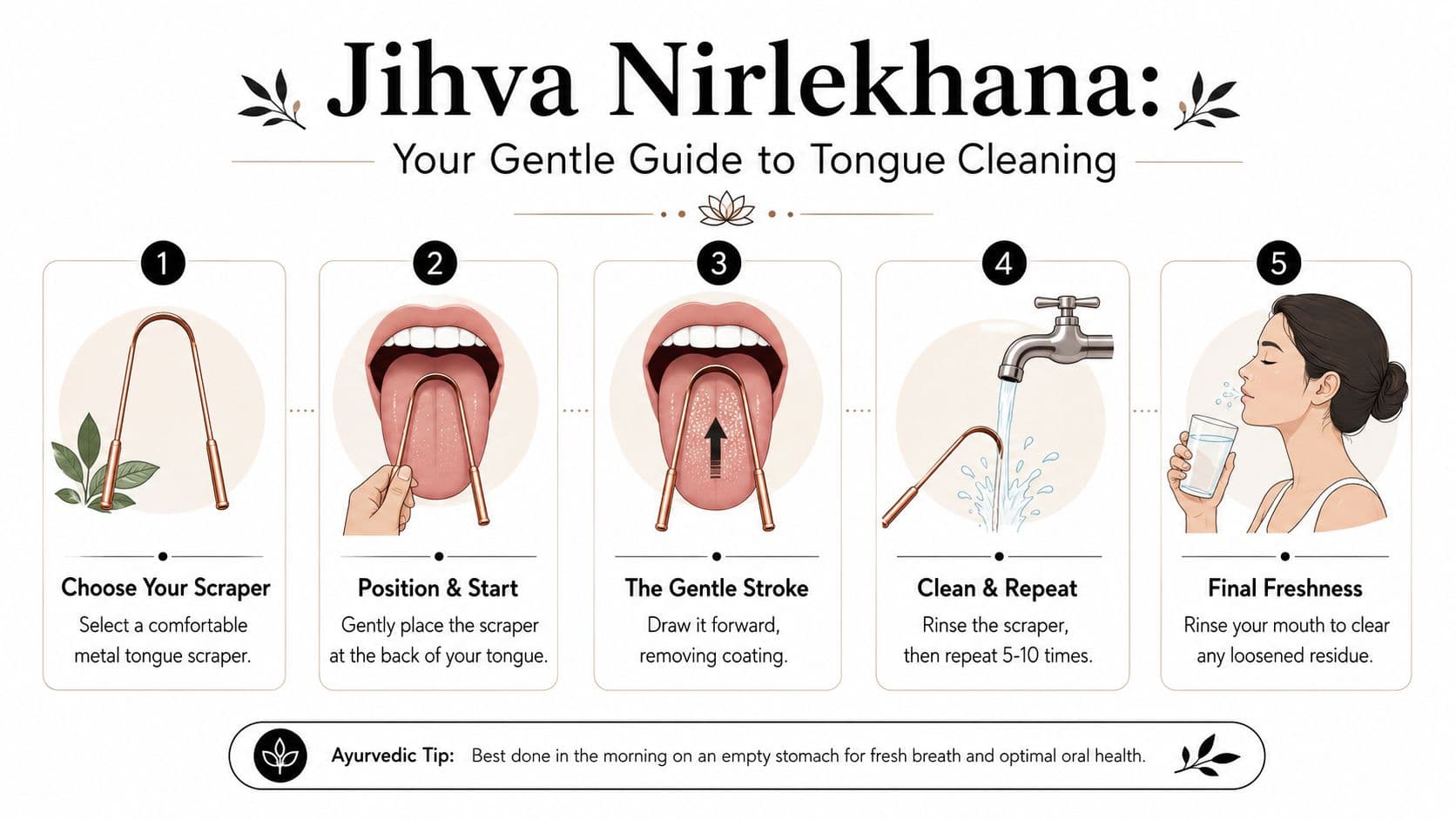
The correct technique is to perform the cleaning first thing in the morning, before any food or drink. Extend the tongue, place the scraper as far back as is comfortable, and gently pull forward to the tip, repeating 7 to 14 times to clear the entire surface, as demonstrated in this Ayurvedic tongue-cleaning technique guide.
If you've never done it before, don't start at the absolute back of the tongue. Start where you can stay relaxed. A calm stroke from a slightly shallower position is better than an aggressive stroke that triggers gagging.
How to make the practice work
Use this rhythm:
- Start empty: Do it on waking, before food, drink, or brushing.
- Stand comfortably: A mirror helps at first.
- Extend the tongue: Let it relax rather than stiffen.
- Set the scraper gently: Place it back only as far as feels manageable.
- Pull forward smoothly: One clean motion toward the tip.
- Rinse between passes: Clear the coating off the scraper each time.
- Stop when the tongue feels clear: You do not need to keep going once the loose residue is gone.
A dedicated visual can help if you learn best by seeing the motion. Mouthology has a practical guide to proper tongue scraping that shows the hand position and stroke clearly.
Pressure is where most beginners go wrong
The tongue is not a countertop. You are not scrubbing it. You're lifting the overnight coating from the surface.
If the stroke feels rough, shorten it and lighten your hand.
That one adjustment changes almost everything. The practice should feel clean and relieving, not raw. Afterward, rinse your mouth well. Then clean the scraper thoroughly with warm water and let it dry fully before the next use.
Common Mistakes and Gentle Corrections
Most problems with tongue cleaning don't come from the practice itself. They come from treating a gentle ritual like a hard-cleaning job. When beginners struggle, the fix is usually simple.
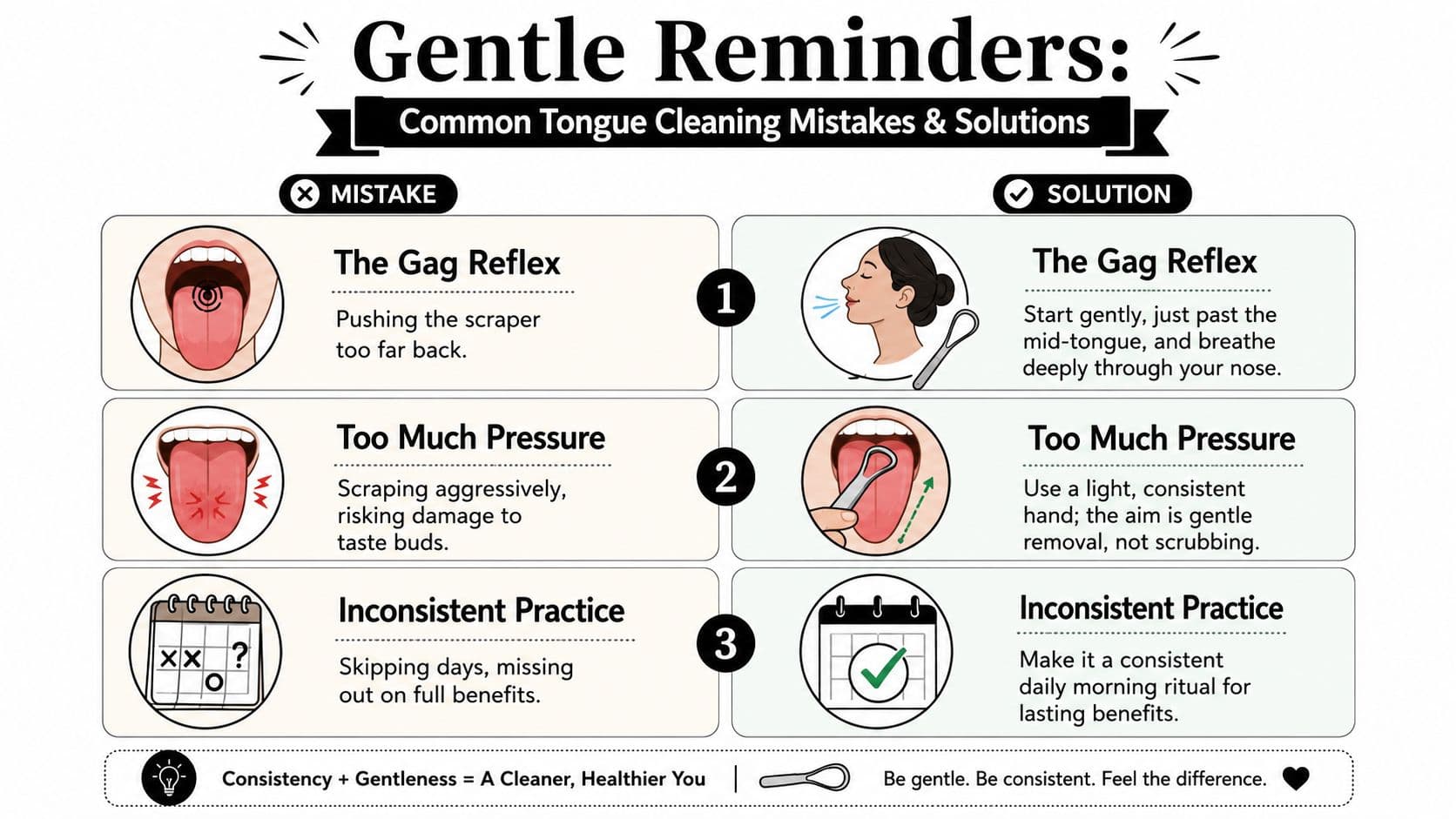
The three mistakes I correct most often
- Going too far back too soon: This triggers the gag reflex and makes the ritual feel stressful. Start farther forward and move back gradually as comfort improves.
- Using too much pressure: If the tongue looks irritated afterward, the hand was too heavy.
- Treating inconsistency like failure: Missing a day doesn't matter. Returning the next morning does.
A little awkwardness at the beginning is normal. A painful or abrasive experience is not.
The microbiome concern
A reasonable question comes up often. Does scraping remove too much and disturb the mouth's natural balance?
A common concern is whether scraping disrupts the oral microbiome. While excessive or forceful scraping can be irritating, the Ayurvedic intention is to gently remove the loose overnight coating, not to scrub the tongue's delicate surface, thereby supporting rather than harming the local microbial environment, as explained in this discussion of the tongue scraper in Ayurveda.
That distinction matters. Gentle removal and aggressive abrasion are not the same thing.
Many people assume “cleaner” means “harder.” On the tongue, harder usually means less skillful.
When to pause and reassess
If you notice persistent soreness, visible irritation, or any bleeding, stop and reassess your pressure, your tool, and your technique. The process should be pleasant. If it isn't, adjust before continuing.
A few gentle corrections usually solve the issue:
- Begin from the mid-tongue for a few days.
- Slow the stroke down.
- Use a smoother scraper.
- Reduce the number of passes if your tongue is sensitive.
The best tongue cleaning Ayurveda routine is the one your tissues tolerate well. Daily discipline only works when the body trusts the process.
Beyond the Scraper What Your Tongue Can Tell You
Once you start cleaning your tongue daily, you'll notice something else. The tongue changes. Some mornings it looks clearer. Other mornings it looks heavier, drier, rougher, or more coated in certain areas. That observation has a place in Ayurveda.
A mirror, not a diagnosis
Ayurvedic practitioners have long used the tongue as one part of broader assessment. Color, moisture, texture, and coating can all offer clues about balance. That does not make self-diagnosis wise. It makes self-observation useful.
A tongue can tell you that something is off in your routine, digestion, rest, or hydration. It cannot tell you everything, and it should never replace proper medical or dental evaluation. If you have structural concerns affecting the tongue or mouth, a specialized resource on infant to adult tongue tie issues can help you understand when anatomy, not just coating, may need attention.
The next oral ritual after scraping
In Ayurveda, scraping is often followed by oil pulling, also called gandusha. The classical sequence places scraping first, then the oil step after the tongue is clear. A tablespoon of sesame, coconut, or sunflower oil is held and swished for 10 to 15 minutes as part of oral cleansing, then discarded in a trash bin or toilet rather than a sink because oil can clog plumbing, as described in this explanation of the Ayurvedic approach to oral hygiene.
That pairing turns a quick hygiene habit into a deeper conversation with the body. Clean first. Then nourish and clear.
Frequently Asked Questions About Tongue Cleaning
Do I scrape before or after brushing?
Before. In Ayurveda, tongue cleaning comes first, while the overnight coating is still there to be removed.
How often should I do it?
Daily works best. It's meant to be part of the morning rhythm, not an occasional fix.
Is a toothbrush enough?
A toothbrush can clean some surface residue, but a scraper is shaped for this job and usually feels more effective and more comfortable.
What if I mainly want fresher breath?
Tongue cleaning can help, and it pairs well with regular brushing and flossing. If you want a conventional oral-care angle too, this article on how to get fresher breath from DentalHealth.com is a helpful companion read.
Should tongue cleaning hurt?
No. It should feel gentle and relieving. If it hurts, reduce pressure, shorten the stroke, or switch tools.
If you're drawn to daily practices that build self-knowledge from the inside out, the Life Purpose App is a thoughtful next step. It's a digital companion to Dan Millman's The Life You Were Born to Live, designed to help you explore your life path, gifts, challenges, and cycles with clarity. Just as Ayurveda helps you read patterns in the body, this system offers another lens for understanding your nature and living with more intention.
Discover Your Life Purpose Today!
Unlock your true potential and find your life’s purpose.
