Begin your transformation with a clear, practical roadmap. This guide lays out five stages of change, daily tools you can use today, and how life-path frameworks and focused journaling bring clarity and purpose.

January 16, 2026 (9mo ago) — last updated September 16, 2026 (1mo ago)
Personal Transformation: Practical Roadmap
Start lasting personal change with a five-stage roadmap, daily tools, journaling prompts, and life-path frameworks to clarify purpose and momentum.
← Back to blog
Begin your transformation with a clear, practical roadmap. This guide lays out five stages of change, daily tools you can use today, and how life-path frameworks and focused journaling bring clarity and purpose.
Personal Transformation: A Practical Roadmap
Begin your transformation of self with this practical, actionable guide. Learn the five stages of change, simple daily tools you can use now, and how life-path frameworks can clarify your purpose and reduce friction on your journey.
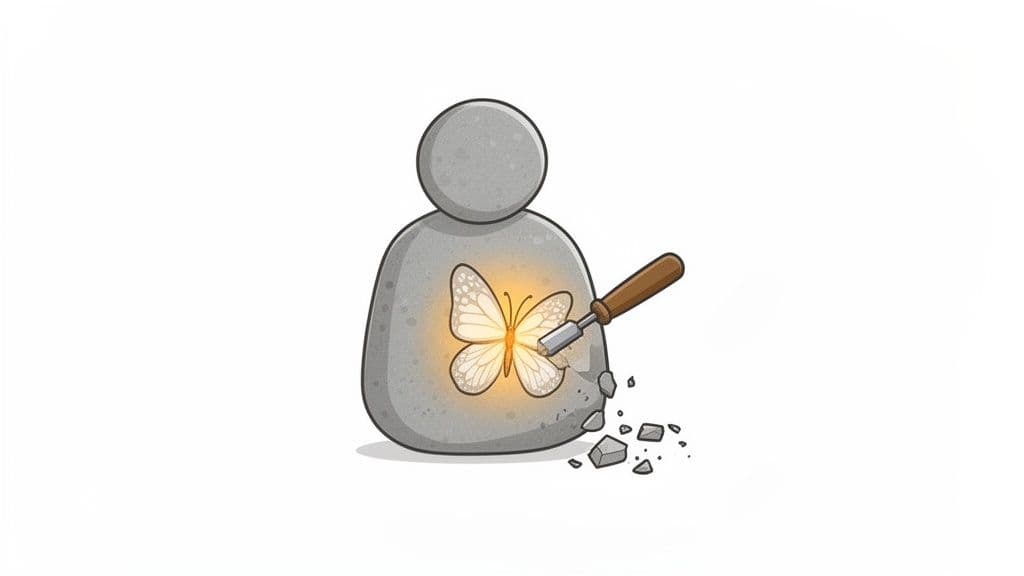
A true transformation isn’t a quick fix or a new persona. It’s an inward process of revealing who you already are by releasing what no longer fits. This guide breaks that process into clear stages, practical daily tools, and meaningful frameworks so you can move with purpose and momentum.
What Personal Transformation Really Means
Imagine a sculptor facing a raw block of marble. They don’t create something from nothing; they remove the excess to reveal the form inside. Transformation follows the same logic: you aren’t trying to become someone else. You’re returning to your core, messy and imperfect at times, and ultimately freeing.
This work requires courage. You’ll sit with discomfort, notice old patterns, and practice compassion as you let go of beliefs and habits that don’t serve you. The goal is integration, not perfection.
Core Components of Personal Transformation
| Component | What it means | Example |
|---|---|---|
| Authenticity | Aligning choices with your values rather than external expectations | Quitting a draining corporate job to pursue pottery, even with lower pay |
| Self-awareness | Observing thoughts, emotions, and behavior without judgment | Recognizing procrastination comes from fear of failure, not laziness |
| Integration | Accepting all parts of yourself, light and shadow | Expressing anger constructively rather than suppressing it |
| Letting go | Releasing beliefs, grudges, and identities that hold you back | Forgiving a parent to free yourself from ongoing resentment |
These components make transformation practical and actionable. It’s a series of small, meaningful shifts rather than a dramatic overnight change.
The Inner Blueprint for Your Journey
Several ancient and contemporary systems offer maps for personal growth. One accessible framework comes from Dan Millman’s work on life paths and recurring cycles, which describes patterns that shape strengths and challenges3. Tools like the Life Purpose App can use your birth date to create a personal blueprint that points to:
- Innate strengths you were born to express
- Recurring hurdles designed for growth
- A life-purpose theme that threads through your choices
With this map, you gain clarity and stop trying to fix what’s actually a meaningful part of your journey. In coaching and education, defining the transformation you promise is essential; the same applies to your life. See more on defining transformation at /blog/defining-transformation.
“The goal isn’t to erase your past or become flawless. It’s about integrating all parts of who you are so you can live a more whole, authentic life.”
The Five Stages of Personal Transformation
Seeing transformation as stages helps you recognize where you are and what to expect.
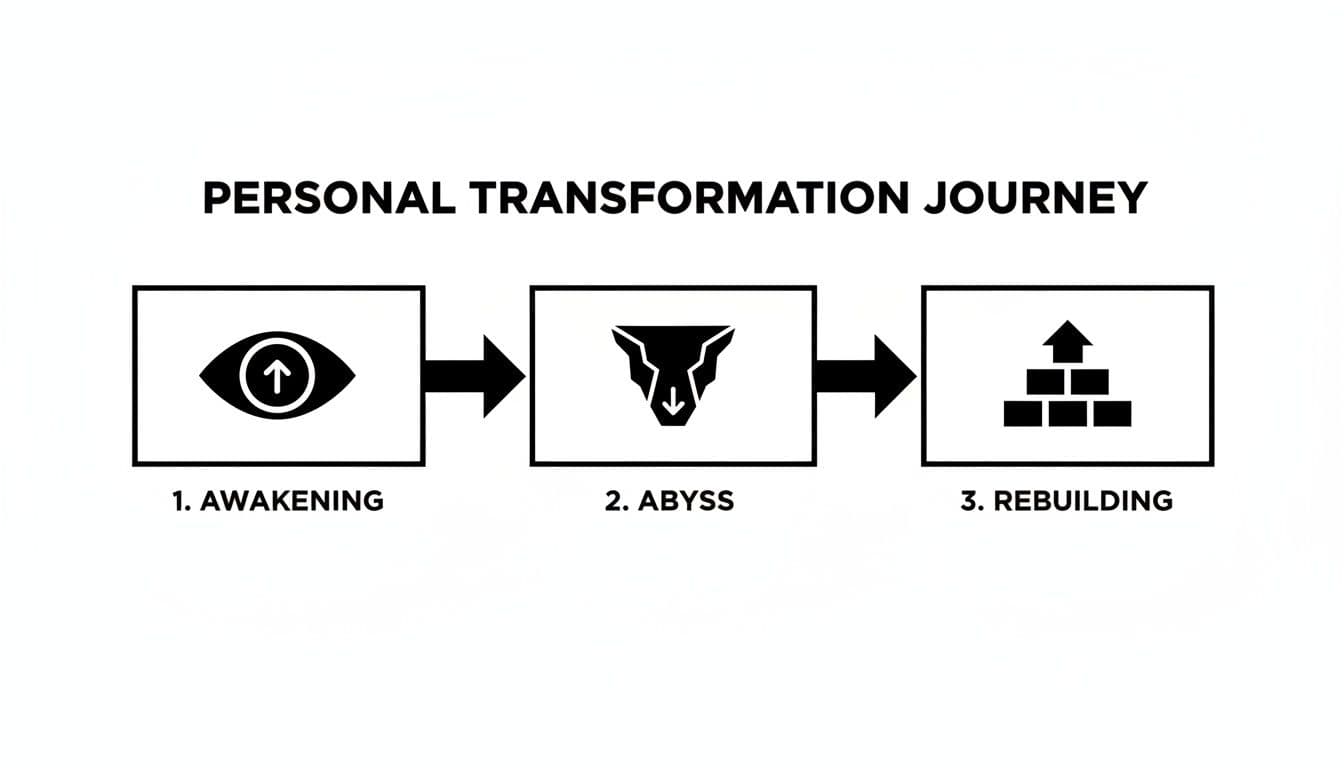
Stage 1: The Call to Change
A low-level discontent signals a misalignment. This call can feel like boredom, restlessness, or a sense that life should feel different. Ignoring it often leads to louder wake-up calls later.
Stage 2: The Awakening
Clarity arrives. You begin to see patterns, limiting beliefs, and unconscious routines. Awareness is the first and essential step toward change.
Stage 3: The Abyss
The Abyss is the painful work of shedding old identities. It feels confusing and lonely, but this is where deep healing happens. Recognizing cycles reassures you this phase is part of growth, not a personal failure.
Stage 4: The Rebuilding
After surrender comes intentional rebuilding. You form new habits, set boundaries, and adopt practices like journaling and meditation. You rewrite your inner story to reflect your values.
Stage 5: The Integration
Integration means the new ways of being feel natural. You act from center. Challenges still arise, but you meet them with resilience and clarity.
Combining Modern Tools with Ancient Wisdom
Modern psychology offers methods that help with habits and behavior, while older systems provide a soul-level framework. Dan Millman’s patterns show how strengths and lessons recur across relationships, career, and finances3.
Understanding your life path can reframe recurring struggles as lessons and give you language and strategy for working with them.
Decoding Your Life’s Purpose
Frameworks like the 45 life paths don’t hand you answers, but they provide the right questions and a compass for growth. The global wellness economy’s steady expansion shows many people are seeking tools for meaning and wellbeing, which confirms you’re part of a broader cultural search for purpose1.
Build a Personal Transformation Toolkit
Practical change rests on consistent daily habits. Below are tools designed for steady progress.
Transformative Journaling
Journaling is more than recording events. With focused prompts it becomes a tool to surface limiting beliefs and clarify values. Research finds expressive writing and structured journaling can improve mental health and coping over time4.
Try these prompts:
- Belief excavation: What is one “truth” I believe about myself that might not be true? Where did I learn this?
- Future visioning: If I were living as my most authentic self, what would a typical Tuesday look like?
- Pattern recognition: What challenging situation repeats in my life? What role do I play in it?
- Gratitude shift: What am I genuinely grateful for today that I usually take for granted?
Consistent use of these prompts helps rewrite your inner story and reduce negative self-talk.
Plan with Cycle Awareness
Life moves in cycles. Dan Millman’s system outlines nine-year cycles and personal-year themes, such as a ‘1’ year for beginnings and a ‘9’ year for completion. Aligning goals to cycle energy can reduce friction and increase momentum. Learn more about cycle-aware planning at /blog/cycle-awareness.
A Simple Ritual for Letting Go
Rituals anchor intention and create closure. Try this safe, simple ritual:
- Write what you want to release, clearly and specifically.
- Choose a private, safe space and a fire-safe container.
- Speak your intention aloud, thanking the old pattern for its lesson.
- Burn the paper safely and visualize the energy shifting.
- State what you now welcome into the space.
Rituals help you mark transitions and move forward with intention.
Real Stories of Transformation
Real journeys show transformation is gradual and imperfect.
The Career Changer
Sarah had an impressive résumé but felt hollow. A life-path reading clarified that creativity and service were central to her fulfillment. After months of journaling and facing fear, she retrained in graphic design and now runs a branding agency for non-profits. Clarity came from aligning action with purpose.
The Relationship Mender
Mark and his partner kept repeating the same fights. A life-path comparison showed differing core needs—independence versus security. With curiosity and vulnerable conversation, they rebuilt communication and found a stronger balance.
Organizations face similar hurdles: many begin digital or cultural transformations, but only about 30 percent reach their targets, which underlines that purpose, tools, and mindset are critical to deep change2.
Living an Integrated Life
Transformation is an ongoing way of living rather than a final destination. Integration means choosing daily, through intention and awareness, to act from your true center. Some days will feel easy; others will test your commitment. Gentle consistency and self-compassion matter most.
Your First Step
Begin by learning your unique blueprint. A clear life-path map can act like a compass, pointing you toward choices that fit your nature.
Quick Q&A
Q: How long will transformation take?
A: There’s no fixed timeline. Some shifts come in a single insight; deeper pattern changes may take months or years. Focus on steady small actions rather than deadlines.
Q: Isn’t working on myself selfish?
A: No. Self-work benefits others because when you heal and grow, you’re able to show up more fully. Self-care is an act of service, not selfishness.
Q: What if I fall back into old habits?
A: Slips are normal. Treat them as feedback, not failure. Each return to practice builds resilience and clearer insight.
1.
https://globalwellnessinstitute.org/industry-research/ — Global Wellness Institute, industry research and market-size estimates for the global wellness economy.
2.
https://www.mckinsey.com/business-functions/organization/our-insights/why-do-transformations-fail — Research and commentary on transformation success rates and common pitfalls; many transformations do not meet their targets.
3.
https://danmillman.com/ — Dan Millman’s work and the book “The Life You Were Born to Live,” including descriptions of life paths and cycles.
4.
https://www.ncbi.nlm.nih.gov/pmc/articles/PMC6124955/ — Meta-analytic review of expressive writing and mental health benefits; structured journaling shows positive effects on coping and wellbeing.
Discover your life path today
Enter your date of birth and see your life path, free.
Find your life path