Explore 8 types of men, their strengths, challenges, practical examples, and how to understand these archetypes without stereotyping.

October 19, 2026 (1mo ago)
8 Types of Men: Archetypes, Strengths, and Shadows
Explore 8 types of men, their strengths, challenges, practical examples, and how to understand these archetypes without stereotyping.
← Back to blog
Explore 8 types of men, their strengths, challenges, practical examples, and how to understand these archetypes without stereotyping.
The most popular advice about types of men often promises a quick answer: label someone “alpha,” “beta,” or “lone wolf,” then assume you know how he thinks. But men don't fit neatly into fixed categories, and a label should never excuse controlling, aggressive, distant, or emotionally dependent behavior. These eight archetypes work better as lenses for noticing motives, strengths, blind spots, and recurring patterns, not as diagnoses or rules about what a man is.
A man might show a steady hand at work and uncertainty in a relationship. He may be protective in one situation and eager to learn in another. The useful question isn't “Which type is he?” but “Which qualities does he need to express, and which shadow risks overshadowing them?” A pattern can help someone recognize what he does, then choose what to do next.
Some archetypes below draw on the King, Warrior, Magician, and Lover framework explored by Robert Moore and Douglas Gillette in King, Warrior, Magician, Lover. Others describe familiar approaches to steadiness, care, independence, and wisdom. None is a fixed personality test. If you're comparing ways of building discipline, for example, you might find your perfect martial art as a practical route to focused movement and training.
1. The King
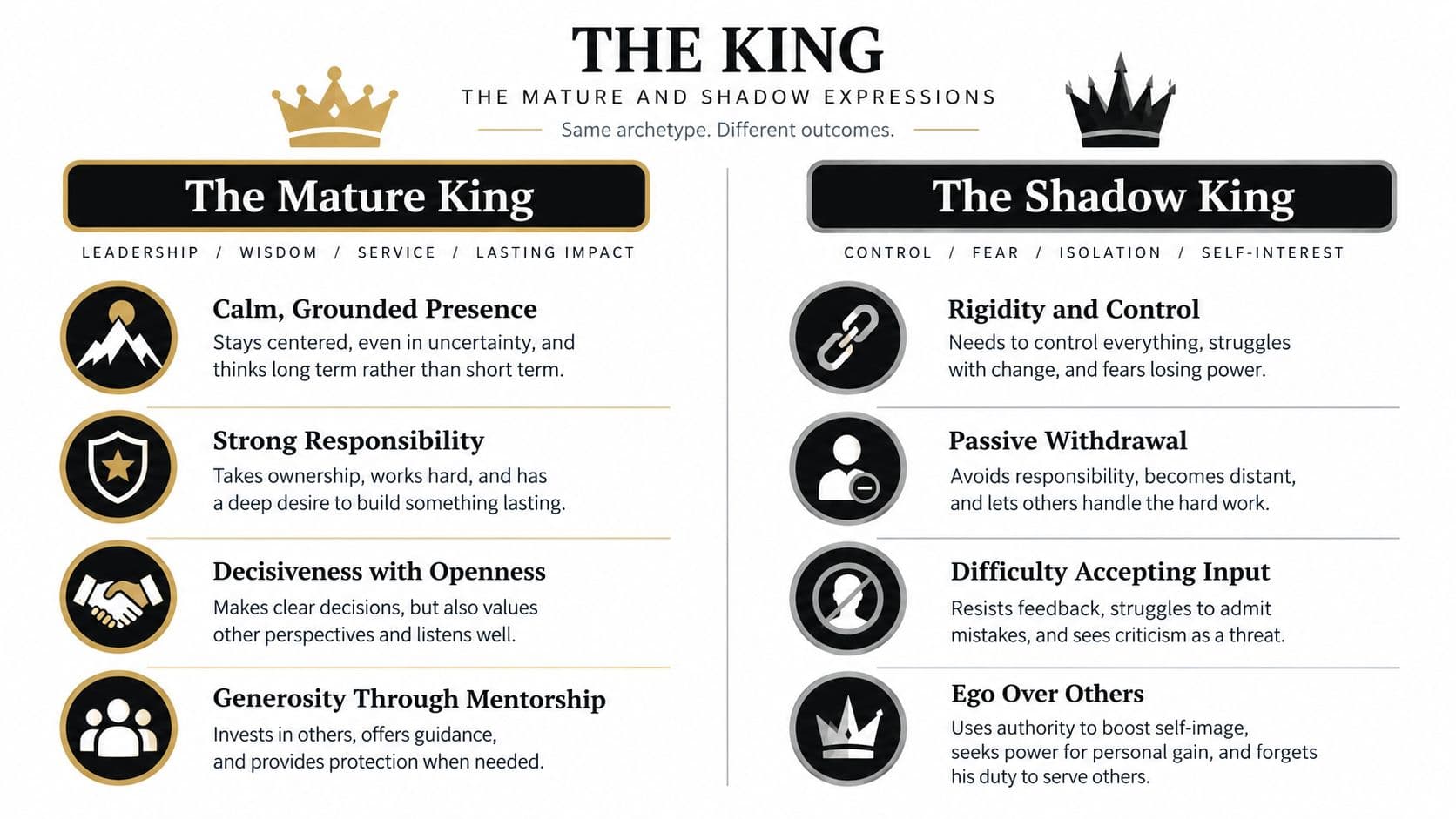
The King archetype centers on order, responsibility, and the ability to help others flourish. He doesn't need a title or a commanding voice. A quiet team member who notices confusion, sets a fair direction, and follows through may show more of this pattern than a manager who relies on status.
At his best, the King offers stability without taking away other people's agency. He considers the wellbeing of a family, team, or community, then makes decisions with both direction and consultation. Abraham Lincoln is often held up in leadership discussions as a principled, long-view leader during a national crisis. Nelson Mandela is frequently cited as an example of firm authority paired with reconciliation and generosity. They're examples to consider, not proof that leadership makes someone a particular archetype.
Authority that makes room
The King's constructive side is benevolent authority: setting expectations, taking responsibility, and making space for others to develop. His shadow appears when direction hardens into control, or when he avoids difficult decisions and leaves others without guidance. Both patterns can be ways of protecting himself from fear or criticism.
A useful distinction is whether responsibility serves the people involved or only protects the person in charge. A King who listens can revise a plan when the people affected explain what isn't working. A controlling version treats feedback as a challenge to his position.
A practical question: What do the people in my care need right now?
Try asking that before a decision, then check whether your response addresses a real need or a fear of losing control. Regular check-ins can give family members, colleagues, or team members a clear chance to say what's helping and what isn't. If this pattern interests you, explore how archetypes appear in mythology and consider how stories make authority visible through choices, not titles.
2. The Warrior
The Warrior is about discipline, courage, and focused action. He commits his effort to something he believes matters, trains his body or mind, and protects people or principles that need support. Muhammad Ali is remembered for discipline and conviction across both athletic and social life. Military and emergency-service leaders can also model calm courage and duty to others. Marcus Aurelius wrote about self-discipline and duty in Meditations, joining a warrior-like concern for action with Stoic reflection.
The important difference is between courage and combat. A mature Warrior chooses where his strength belongs. His shadow treats ordinary disagreement as a threat, or measures success by whether he wins. Discipline then becomes aggression, and emotional detachment can look like toughness while making it harder to understand other people.
Choose what deserves your strength
A useful Warrior doesn't need a battle every day. He can commit fully to a demanding project, defend a colleague who's being treated unfairly, or stay calm during an emergency without turning every conflict into a contest. The same drive can become exhausting when he can't stop proving himself or sees rest as weakness.
To put this archetype to work, start with a short personal code. Write down the principles you want your actions to reflect, then compare your choices with them. Schedule recovery as deliberately as training, and ask whether a disagreement needs a firm boundary, a patient conversation, or no fight at all.
Before you act: Are you fighting for something worthwhile, or simply fighting to win?
Practicing a martial art can offer one structured setting for focus, restraint, and physical challenge. The Way of the Peaceful Warrior offers another way to reflect on the relationship between strength and self-command. For a faith-centered reflection, you can also explore what the Bible says about courage.
3. The Magician
The Magician seeks to understand how things work, then uses insight and knowledge to make change possible. He might be the engineer who spots a process flaw, the teacher who makes a difficult idea clear, or the friend who notices a pattern beneath a recurring disagreement. Leonardo da Vinci's combination of observation, invention, and imagination fits this archetype. Steve Jobs is often described as a visionary who turned ideas into products, while Carl Jung explored the power of the psyche. These examples invite interpretation; they aren't personality verdicts.
The healthy Magician is curious and analytical, but his knowledge doesn't stop at collecting explanations. He tests ideas, improves systems, and offers what he knows in service of people. The shadow uses information to manipulate others, stays detached to avoid vulnerability, or treats being the smartest person in the room as a source of control.
Turn insight into practice
A man who recognizes this pattern can pair each new idea with a small experiment. If he believes his team meetings fail because nobody knows who owns the next step, he can try assigning clear responsibilities and see whether the conversation changes. If he thinks he withdraws whenever a partner asks for emotional honesty, he can notice the moment, name what's happening, and try staying present.
Insight becomes useful when it changes what you do.
Curiosity can create connection, but it can also become a way to keep people at a distance. Ask whether you're learning about someone because you want to understand them or because analysis feels safer than a direct conversation. Journaling about repeated choices can help sharpen self-awareness, especially when you write down what you'll try differently rather than only explaining the past.
For a structured reflection on personal patterns, the Life Purpose App is a digital companion to Dan Millman's The Life You Were Born to Live. It can serve as a reflective tool, not a substitute for direct human judgment.

4. The Lover
The Lover is drawn to feeling, beauty, and connection. This archetype isn't limited to romance. It can show up in a man who pays close attention to music, nature, friendship, craft, or the everyday emotional temperature of a room. Leonard Cohen's poetry and songs explore intimacy, longing, and spiritual depth. Marvin Gaye's music is known for emotional sincerity and romantic expression, while Pablo Neruda's love poetry expresses sensitivity and devotion.
A healthy Lover is attentive and emotionally present. He can enjoy closeness without demanding constant reassurance, and he can feel without treating every feeling as an instruction. The shadow may chase intensity, avoid commitment, or expect other people to provide all the meaning in his life. Passion becomes harder to sustain when it depends on dramatic highs or another person's constant availability.
Stay present beyond the high points
A Lover's growth often starts with ordinary moments. Notice whether you can enjoy a calm evening, a routine conversation, or time alone without deciding that the relationship has lost its spark. Being open to experience means giving attention to what's happening now, not only seeking the next emotional peak.
Closeness also needs clear boundaries. A man can tell a partner that he wants more affection while also respecting a request for space. He can share that a creative project matters to him without expecting a partner to carry his motivation. Warmth doesn't require smothering, and passion doesn't require impulsiveness.
Try these small practices:
- Name the feeling: Notice what you're experiencing during an everyday interaction, not only during a romantic high.
- Speak plainly: Tell a partner what you need for closeness and what you need for space.
- Broaden your outlets: Make room for creative or physical pursuits so relationships aren't your only source of intensity.
The Lover's strength is his ability to meet life with openness. His balance comes from pairing that openness with dependable commitments to himself and other people.
5. The Stoic
The Stoic archetype values self-command, clear judgment, and acceptance of what can't be changed. Ancient Greek and Roman Stoic philosophy emphasizes virtue, reason, and self-control as foundations for living well. Marcus Aurelius's Meditations remains a foundational Stoic text; Seneca's letters offer practical reflections on anger, loss, and time; and Epictetus taught a distinction between what's within our control and what isn't.
In daily life, a healthy Stoic might remain steady during a stressful meeting, admit what he can't control, and focus on the next responsible action. He doesn't have to deny pain to do this. His shadow appears when composure becomes numbness, when he refuses to ask for help, or when he treats vulnerability as a failure of character.
Composure isn't silence
The distinction matters in a relationship or workplace. A man who pauses before responding to criticism may be practicing self-command. A man who refuses to discuss a problem because “nothing bothers him” may be suppressing an emotion that needs attention. Endurance isn't the same as refusing support.
Each morning, separate what you can influence from what you can't, then spend your effort on the first group. When a strong feeling shows up, name it before you respond. You might say, “I'm frustrated because I don't know what happens next,” rather than shutting down or lashing out.
Accepting what you can't change doesn't mean ignoring what you can address.
Stoicism works best alongside compassion. You can keep your composure and still tell a friend you're struggling. You can accept that a decision is out of your hands while asking someone trustworthy to help you think through your next move. A grounded Stoic doesn't need to prove that he can carry everything alone.
6. The Caregiver
The Caregiver finds meaning in nurturing, service, and helping other people feel safe and valued. He may be a father who listens carefully after a hard day, a teacher who supports a student's confidence, a healthcare worker who treats patients with respect, or a neighbor who helps strengthen a community. Fred Rogers's television work modeled patience, kindness, and emotional honesty for children. Atticus Finch, the fictional lawyer in To Kill a Mockingbird, represents a quieter form of principled service.
This pattern's gift is devotion. The risk is giving without limits until generosity becomes exhaustion or resentment. A man might insist he's fine while taking on everyone's problems, then feel angry that nobody noticed his needs. He might also help in ways that keep someone dependent rather than helping that person grow.
Make care sustainable
Healthy caregiving includes reciprocity and boundaries. A father can support his child while allowing the child to attempt a difficult task independently. A colleague can offer help without taking over the entire project. A friend can listen and still say, “I care about you, but I can't be available tonight.”

Try checking your caregiving against a few direct questions:
- Protect your capacity: What routine helps you stay rested and able to give?
- Ask for reciprocity: What do you need from the people you support?
- Encourage growth: Are you helping someone build their own skills, or making yourself indispensable?
Care doesn't become less generous when you set a limit. A man who communicates what he can offer gives others a clearer, more dependable kind of support. The Caregiver's task isn't to rescue everyone. It's to offer care in a way that respects both the other person's agency and his own wellbeing.
7. The Maverick
The Maverick values independence, experimentation, and the freedom to challenge conventions. He may be an entrepreneur who tries an unfamiliar business idea, an artist who rejects a familiar form, or a worker who questions a process that wastes people's time. Richard Branson is known for building businesses across industries with a rebellious brand identity. Hunter S. Thompson's gonzo journalism broke with conventional reporting styles, while Steve Wozniak built early computers outside established corporate paths.
At his best, the Maverick helps people imagine alternatives. He's willing to ask whether a rule still serves its purpose and can take a risk when the potential benefit justifies it. His shadow shows up when he rejects structure automatically, mistakes contrarianism for honesty, or pushes away allies because their questions feel like limits.
Challenge thoughtfully
Independence doesn't mean refusing every form of cooperation. A Maverick who tests an idea on a small scale can learn from the result before making a larger commitment. A founder might share an early plan with a trusted colleague and ask what could fail. A creative worker might keep a stable routine that protects time for experiments rather than treating all structure as an enemy.
His useful discipline is to sort conventions into two groups: those worth respecting and those worth challenging. A rule that protects people from harm deserves a different response from a habit that exists only because nobody has revisited it. The difference becomes clearer when he asks what the rule does, who it affects, and what could happen if he changes it.
Three practices can keep independence connected to judgment:
- Test before leaping: Try a bold idea in a limited way and learn from the result.
- Check your motive: Are you challenging a rule for a principle, or out of habit?
- Keep trusted allies: Ask a few people you respect to question your assumptions.
The Maverick's strongest contribution isn't being different. It's showing that a better path is possible while staying willing to learn from people who see the risks he missed.
8. The Sage
The Sage seeks wisdom, reflection, and a clearer understanding of what's true. He may turn to philosophy, science, spiritual inquiry, or patient conversation. Socrates is associated with the recognition of how much remains unknown. Carl Sagan made science accessible while emphasizing humility before the cosmos. Confucius's teachings focus on self-cultivation and wise conduct.
A healthy Sage shares what he learns without treating knowledge as a reason to look down on others. He listens, revises his assumptions, and connects ideas to choices. His shadow may become aloofness, condescension, or endless analysis that keeps him from acting. He can explain what a good life might require and still avoid the difficult conversation or commitment that would bring his explanation into practice.
Let wisdom change your conduct
Wisdom becomes visible in behavior. A man who learns about listening can stop preparing his reply while someone else is speaking. A man who studies a conflict can ask what he contributed to it. The point isn't to abandon reflection, but to let reflection improve what he does.
Pick one insight each week and turn it into a concrete action. If you've realized that you interrupt when you feel impatient, try waiting until the other person finishes before responding. If you've been reading about humility, practice saying “I don't know” when it's true. Teaching someone else can deepen your understanding, but only if you teach without condescension.
Listen to understand, not just to prepare your reply.
The Sage's curiosity is valuable when it serves life rather than replacing it. He doesn't need the perfect explanation before taking a thoughtful step. He can learn from experience, make a careful choice, and stay open to what the result teaches him.
Comparison of 8 Types of Men
Read each row as a range rather than a label: a constructive side, a shadow risk, and a context where the pattern often fits.
| Archetype | Core Orientation | Key Advantages | Shadow Risks | Ideal Use Case |
|---|---|---|---|---|
| The King | Order, responsibility, and benevolent leadership | Builds stability, sets direction, and supports others' growth | Control, rigidity, or withdrawal from responsibility | Leading a family, team, or community with consultation and accountability |
| The Warrior | Discipline, courage, and focused action | Performs under pressure, protects others, and pursues mastery | Aggression, emotional detachment, or burnout | Meeting demanding goals, defending important values, or responding to crises |
| The Magician | Insight, knowledge, and transformation | Solves complex problems, identifies patterns, and guides change | Manipulation, detachment, or analysis without action | Improving systems, developing ideas, or guiding others through change |
| The Lover | Emotional connection, passion, and appreciation of experience | Creates warmth, intimacy, and expressive engagement | Dependency, weak boundaries, or pursuit of constant intensity | Building meaningful relationships and bringing creativity or presence to daily life |
| The Stoic | Self-command, reason, and acceptance | Maintains composure, resilience, and clear judgment | Emotional suppression, isolation, or reluctance to seek help | Managing stress while distinguishing what can be changed from what must be accepted |
| The Caregiver | Nurturing, service, and protection | Creates supportive environments and offers practical kindness | Burnout, resentment, or enabling dependence | Supporting family, communities, or people in need while maintaining healthy boundaries |
| The Maverick | Independence, nonconformity, and risk-taking | Challenges stale assumptions and drives innovation | Isolation, needless conflict, or rejection of useful structure | Exploring new approaches or constructively challenging outdated conventions |
| The Sage | Reflection, learning, and pursuit of truth | Offers considered counsel and adapts to evidence | Overthinking, aloofness, or condescension | Researching, teaching, or making thoughtful decisions grounded in learning |
Use the Pattern to Grow, Not to Judge
Every archetype has a gift and a shadow. The King can become generous authority or rigid control. The Warrior can become courageous discipline or chronic combat. The Magician can offer useful insight or use knowledge to manipulate. The Lover can bring warmth or become dependent on others for fulfillment. The Stoic can show resilience or numbness. The Caregiver can express devotion or burn out. The Maverick can foster innovation or isolation. The Sage can share wisdom or disappear into overthinking.
That range is why an archetype should be a starting point for reflection, not a verdict about someone's character. A man might be direct in one setting and hesitant in another. He might care about his family while struggling to ask for help. Look at what he does, consider the situation, and listen to how he describes his own choices. A title, reputation, or first impression can't tell you the whole story.
To use a pattern constructively, choose one strength to recognize, one shadow to examine, and one small action to practice. The King might ask for feedback before making a decision. The Warrior might choose not to turn a disagreement into a contest. The Lover might talk about needing both closeness and space. Small actions make reflection practical without pretending that a person can be reduced to one type.
A helpful three-question check can keep the conversation balanced:
- What is this person expressing well?
- What pattern may be costing him or others?
- What support or boundary would help him grow?
The same questions can help you reflect on yourself. If you recognize more than one archetype, that doesn't mean the framework has failed. People respond to different needs and relationships with different qualities, and a pattern can shift as circumstances change. You might lead with Caregiver energy at home, Warrior energy in a demanding project, and Sage energy while learning from a difficult experience.
Self-understanding works best when it leads to curiosity rather than self-judgment. A growth-oriented approach lets you recognize what's already working while making room to change what isn't. For more reflection on that approach, explore the Pretty Progress mindset guide.
The Life Purpose App is a digital companion to Dan Millman's The Life You Were Born to Live, offering a way to reflect on personal patterns, strengths, and challenges. If you'd like another prompt for exploring how your qualities shape your choices and relationships, visit Life Purpose App.
Discover your life path today
Enter your date of birth and see your life path, free.
Find your life path