Uncover the unicorn’s spiritual meaning—its ancient roots, symbolic themes of purity, unity, and transformation, and practical ways to notice and work with its energy.

May 29, 2026 (4mo ago) — last updated September 13, 2026 (1mo ago)
Unicorn Spiritual Meaning & Mystical Power
Explore the unicorn’s spiritual meaning—purity, healing, unity, and practical ways to notice and embody its guidance.
← Back to blog
Uncover the unicorn’s spiritual meaning—its ancient roots, symbolic themes of purity, unity, and transformation, and practical ways to notice and work with its energy.
Title: Unicorn Spiritual Meaning & Mystical Power
Summary: Unicorn meaning spiritual: Uncover its ancient history, symbols of purity, healing, and magic. Learn to connect with its powerful energy for your life.
Introduction: Unicorn meaning spiritual: Uncover its ancient history, symbols of purity, healing, and magic. Learn to connect with its powerful energy for your life.
Tags: unicorn meaning spiritual, unicorn symbolism, spiritual animals, unicorn magic, purity and innocence
A woman told me she kept seeing unicorns for a week straight. First on a child’s backpack, then in a dream, then on an old tapestry in a museum gift shop. By the third appearance, she wasn’t asking whether unicorns were real. She was asking whether the symbol meant something about her life.
When the Unicorn Appears in Your Life
That question is more common than people admit. You might see a unicorn in a dream during a hard season. You might feel oddly moved by the image, even if part of you thinks it’s silly. You might also wonder whether you’re having a spiritual experience or just noticing a symbol that happens to be everywhere in modern culture.
Both possibilities deserve respect.
The unicorn carries a strange tension. It can feel innocent and bright, almost childlike. At the same time, it can stir something older in us. A longing for what is pure. A hunger for healing. A wish that life still holds mystery. That’s why the unicorn meaning spiritual isn’t only about fantasy. It’s often about the part of you that wants to live with more wholeness.
A symbol can arrive when you need a mirror
Sometimes the appearance of a symbol doesn't predict anything. It reflects something. If you’re exhausted by cynicism, the unicorn may show up as a reminder that your spirit still wants beauty. If you’ve been hiding your differences, it may point toward the courage to be seen as you are.
Here are a few common ways people experience it:
- In dreams: A unicorn appears during sleep and leaves a feeling of peace, awe, or urgency.
- In repeating imagery: You keep noticing the symbol across books, clothing, art, or conversation.
- In meditation or prayer: The image arises unplanned and feels emotionally charged.
- In life transitions: It appears while you’re recovering, grieving, beginning again, or reclaiming your voice.
Practical rule: Before you call any symbol a sign, pause and ask what was happening in your inner life when it appeared.
That simple pause matters. Many people jump straight to meaning without noticing context. If you want a grounded way to think about synchronicity in general, a short guide on signs offers a helpful starting point.
The key is not to force a message. It’s to listen. A unicorn symbol may be spiritual. It may also be emotional, psychological, or cultural. Often it’s a blend of all three.
The Ancient Roots of Unicorn Symbolism
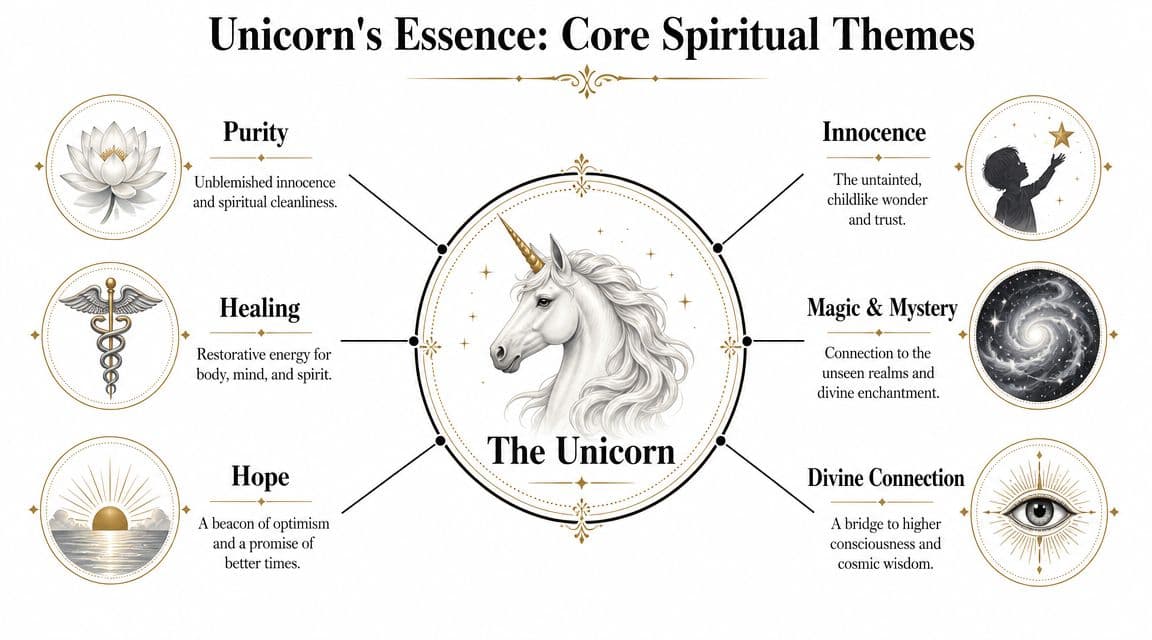
The unicorn didn’t begin as a glittery mascot for whimsy. Its oldest roots reach deep into history, across civilizations, myths, and religious imagination.
Evidence of unicorn-like imagery appears in ancient civilizations and early written accounts, and the symbol evolved through classical and medieval texts into Christian allegory. That means the unicorn’s spiritual meaning developed across at least 3,000 years and multiple cultural worlds.1
Before the fairy tale
In the oldest layers, the unicorn wasn't necessarily the gentle white horse many people picture now. Ancient descriptions often treated it as wild, powerful, and difficult to approach. That matters because spiritual symbols often begin in raw form before later traditions soften them.
The older image carries at least three strong ideas:
- Wildness: The sacred is not always tame.
- Rarity: What is most valuable often resists possession.
- Power: Purity in ancient symbolism was not weakness. It was force without corruption.
That last point helps clear up a common misunderstanding. People often hear “purity” and think “fragility.” Historically, the unicorn was not fragile. It was elusive, intense, and difficult to capture.
The Christian transformation
As the symbol moved into Christian allegory, it took on a different shape. The famous story of the unicorn being tamed by a virgin became spiritually charged. Medieval readers and artists didn't treat that story as simple fantasy. They read it as theology in symbolic form.
In that tradition, the unicorn could stand for Christ entering the world through the Virgin Mary, and its horn came to symbolize purifying and healing powers in Christian art and legend.2
The same image can survive for centuries because each age sees its own deepest concerns in it.
This is one reason the unicorn still moves people. It has never had only one meaning. It has carried strength, innocence, healing, holiness, longing, and mystery across centuries. Modern readers sometimes want a single clean definition. History doesn’t give us that. It gives us something richer.
Core Spiritual Themes of the Unicorn
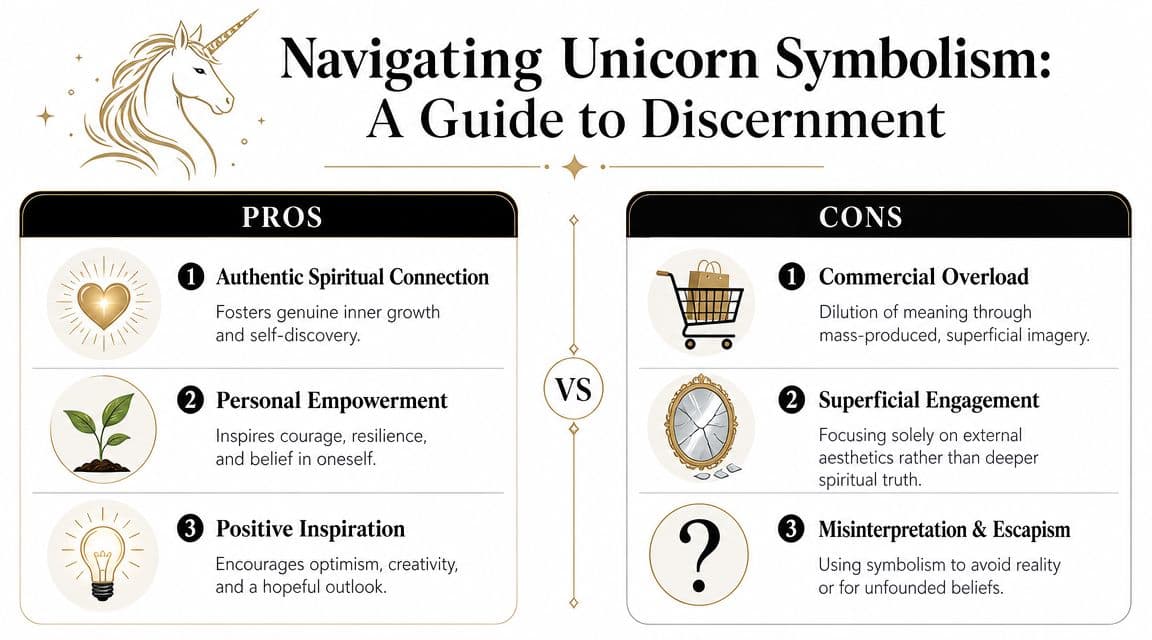
Once you leave pop culture aside, a few spiritual themes show up again and again around the unicorn. The most durable ones are purity, unity, and transformation. Across symbolic interpretations, the single horn is often seen as a sign of unity beyond duality, its placement is linked with higher consciousness, and its purifying role becomes a metaphor for turning toxicity into clarity.
Purity is inner alignment
Purity doesn't have to mean moral perfection. In spiritual language, it often means something cleaner and more useful. It means being undivided. Your words match your values. Your choices aren't constantly fighting your conscience.
That's why unicorn imagery can feel so piercing during periods of confusion. It calls attention to where life has become cluttered by mixed motives, resentment, self-betrayal, or noise.
A helpful question is this: where am I out of alignment with myself?
Unity is the end of inner splitting
The single horn has long invited symbolic reading. In many spiritual systems, “one” points toward wholeness. Not sameness, but integration. The unicorn can represent the movement beyond inner fragmentation.
You might feel this when:
- Your head and heart disagree: You know what matters, but you keep abandoning it.
- You're living in roles: You're one person in private and another in public.
- You're stuck in dualistic thinking: Everything feels like success or failure, pure or ruined, chosen or rejected.
The unicorn’s message here is not “be perfect.” It’s “be whole.”
Transformation is purification in motion
The old image of the horn purifying poison still speaks beautifully to modern life. Most of us don't worry about poisoned wells. We worry about toxic patterns, stale grief, compulsive comparison, or stories that cloud the mind.
Seen this way, the unicorn symbolizes a kind of inner alchemy. Not escape from difficulty, but the refining of difficulty into wisdom.
A healthy reading of the symbol asks: What in me is ready to be clarified, not denied?
That's where healing enters. The unicorn isn't only about sweetness. It's about refinement. Sometimes that process feels gentle. Sometimes it asks for honesty you've postponed for a long time.
Mystery still belongs here
The unicorn also keeps one foot in the unseen. It reminds people that not everything meaningful can be measured or explained away. But mystery doesn't mean vagueness. It means staying open while remaining honest.
So if you're exploring the unicorn meaning spiritual, the deepest themes aren't decorative. They're demanding in a quiet way. Purity asks for integrity. Unity asks for wholeness. Transformation asks you to let something false fall away.
Interpreting Unicorns in Dreams and Visions
A unicorn in a dream doesn't come with a caption. The image matters, but context matters more. The emotional tone of the encounter, the setting, your life circumstances, and your response all shape the meaning.
Many people often get confused on this point. They assume the symbol must always mean blessing, innocence, or magic. But sacred symbols are rarely that flat. Even in Christian allegory, the unicorn can carry more than one meaning, and the same icon can hold very different meanings depending on the setting.
Start with the feeling, not the object
If the unicorn appeared and you woke with calm, the symbol may be pointing toward trust, healing, or renewed innocence. If you woke unsettled, the message may be corrective. It may be showing you where you're idealizing something, avoiding reality, or clinging to a fantasy of purity that no human life can sustain.
Here's a simple way to sort through common encounters.
| Encounter Type | Potential Positive Meaning | Potential Shadow/Warning Meaning |
|---|---|---|
| Dream of a calm unicorn | Healing, hope, restored trust | Idealizing peace instead of creating it |
| Dream of a distant unicorn | A calling toward higher values or spiritual longing | Chasing what stays abstract and never becomes lived |
| Dream focused on the horn | Clarity, purification, insight, spiritual focus | Obsessing over being “pure” or right |
| Vision in meditation | Symbolic guidance arising from the deeper psyche or spiritual imagination | Mistaking every vivid image for literal instruction |
| Unicorn that won't approach | Respect for mystery, need for patience | Trying to force meaning before it ripens |
| Wounded or trapped unicorn | A hurt part of the self asking for care | Neglect of your own vitality, creativity, or truth |
A few grounded questions
Interpretation works best when you ask better questions. Instead of “What does a unicorn mean?” ask:
- What was happening in my life when it appeared?
- What emotion stayed with me after the encounter?
- Did the image invite responsibility, or only fantasy?
- Does this interpretation make me more honest, or just more comforted?
If you're exploring inner guidance more broadly, cultivate a calmer and more discerning approach by listening to your own inner guidance.
Dreams and visions speak in layers. A unicorn may reflect spiritual longing one night, creative awakening another, and grief for lost innocence on another. The point isn't to pin the symbol down forever. The point is to listen without flattening it.
How to Connect with Unicorn Energy
If the unicorn feels meaningful to you, you don't need elaborate ritual. You need attention, sincerity, and a willingness to let the symbol change you a little.
Some people connect through prayer. Others through meditation, art, journaling, or time in nature. What matters is that you approach the image as a doorway into qualities you want to embody, not as a collectible spiritual aesthetic.
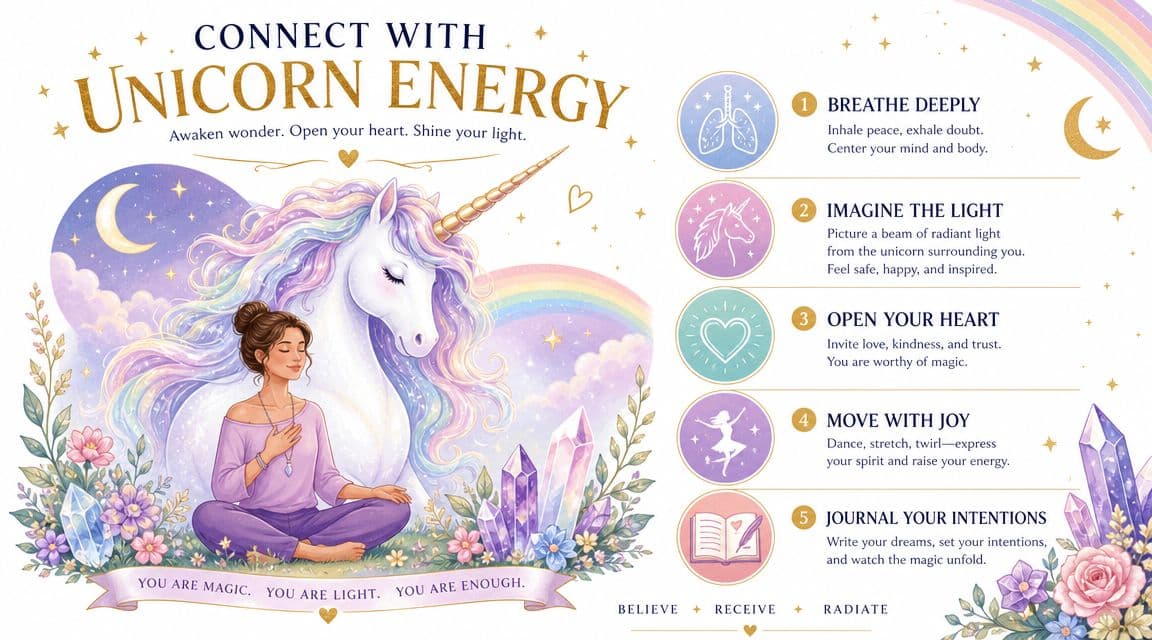
A simple meditation practice
Try this when you have ten quiet minutes.
- Settle your body. Sit comfortably and let your breath slow down. Don't strain for a mystical state.
- Call in one quality. Choose one word such as purity, courage, healing, or truth.
- Visualize a natural setting. A forest clearing, a dawn field, a silent shore. Let the place arise naturally.
- Let the unicorn appear or not appear. Don't force an image. Sometimes the practice still works even if no form comes.
- Ask one clear question. “What needs purification in me?” or “Where am I hiding my real nature?”
- Write down what you notice. A feeling, color, sentence, memory, or resistance all count.
This is not about proving that an external being visited you. It's about opening a wise conversation with the deeper layers of your own life.
Journal prompts that actually help
A lot of spiritual journaling stays too vague. These prompts are better because they invite action.
- Where have I confused purity with perfection?
- What part of my life feels poisoned by resentment, fear, or pretense?
- Where am I being asked to stay unique instead of agreeable?
- What kind of innocence do I need to reclaim, and what do I need to outgrow?
- What truth would make me feel more whole if I lived it?
Try this test: If your reflection doesn't lead to one honest next step, you're probably still circling the symbol instead of receiving it.
Bring it into daily life
You can work with unicorn energy in practical ways:
- Choose one act of purification: Clean a neglected corner, end a draining habit, or tell the truth where you've been blurry.
- Protect wonder: Read poetry, visit a museum, sketch, sing, or spend time where your mind quiets down.
- Honor your distinct path: Stop shrinking one part of yourself to fit a room that was never built for you.
If you're also doing manifestation work, a short practical guide to raising your vibration can offer support without losing the spiritual thread.
Discerning the Message — A Guide to Healthy Symbolism
Not every unicorn is a sign. Some are just branding. Some are nostalgia. Some are wishful thinking in costume.
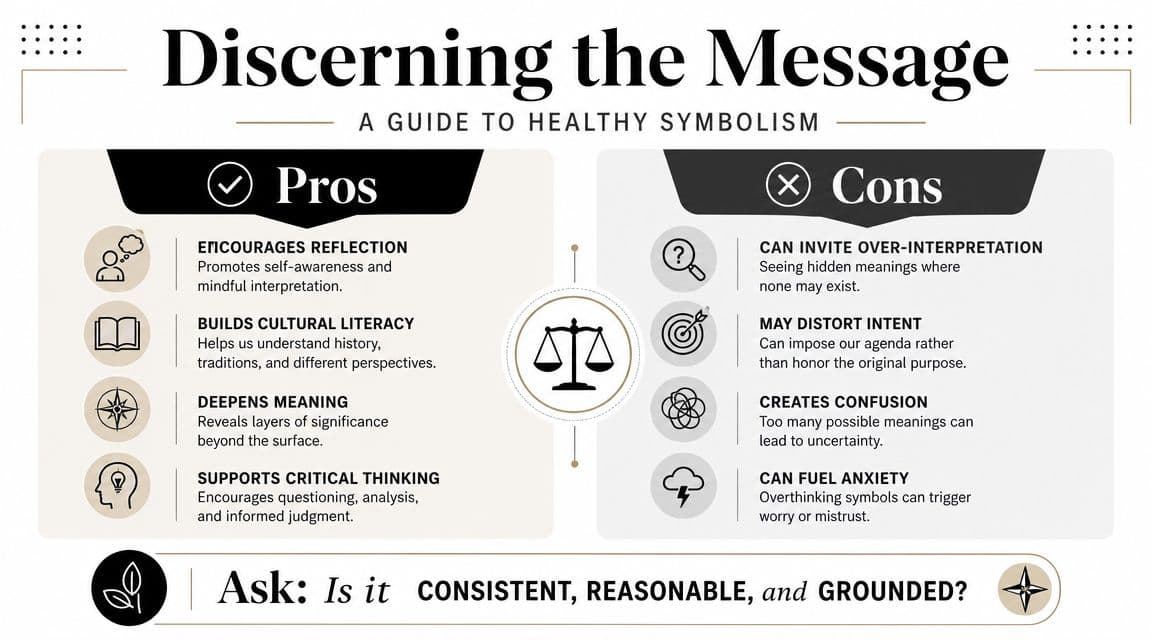
That doesn't make the symbol meaningless. It means discernment matters. This is especially important because unicorn imagery now travels through many different worlds at once, from spiritual circles to identity communities and pop culture; the symbol can serve many different functions at once.3
What healthy symbolism looks like
A symbol is helping you when it leads to greater honesty, steadiness, and compassion. It may comfort you, but it also clarifies you.
Good signs of healthy engagement include:
- It makes you more grounded: You feel clearer about real choices in your life.
- It invites responsibility: You sense a call to heal, apologize, create, or change.
- It deepens humility: The symbol opens wonder without making you feel specially superior.
What unhealthy symbolism looks like
A symbol becomes unhelpful when you use it to avoid life. That can happen very subtly.
Watch for these patterns:
- Escapism: You keep collecting meanings but don't act on any of them.
- Projection: You decide the unicorn confirms what you already wanted to believe.
- Inflation: You assume every unusual image means you've been singled out for a grand destiny.
- Aesthetic substitution: You decorate yourself with spiritual symbols while ignoring the inner work they ask for.
A real spiritual message usually costs something. Pride. Denial. Delay. Comfort. It asks for change, not just fascination.
A simple discernment filter
When a unicorn symbol feels important, run it through three questions:
- Does this interpretation make me kinder and more truthful?
- Does it help me face reality, or avoid it?
- Would I still value this message if nobody else ever knew about it?
If the answer to those questions is yes, the symbol is probably serving your growth. If not, step back. Let the image breathe. You don't need to wring a revelation out of every meaningful thing you notice.
Embrace Your Own Inner Unicorn
The unicorn has survived for so long because it speaks to something enduring in us. Not a childish wish, but a sacred tension. We want to stay openhearted without becoming naive. We want to be different without becoming isolated. We want healing that doesn't require pretending life has never wounded us.
That's why the unicorn meaning spiritual still matters. It points toward purity as integrity, unity as wholeness, and transformation as the courage to refine your life. It can appear as comfort, but it can also arrive as a challenge. Live with greater authenticity. Protect what is tender. Stop abandoning what is rare and true in yourself.
You don't need to chase the symbol forever out in the distance.
Sometimes the deeper invitation is to become the kind of person the unicorn represents. Clearer. Braver. Less divided. More willing to honor your strange, beautiful path without apology. That's where the symbol stops being decoration and becomes practice.
And when that happens, the unicorn is no longer only something you saw. It becomes something you live.
If you're exploring your spiritual path and want a grounded system for understanding your unique gifts and challenges, the Life Purpose App is a thoughtful place to begin. It's the digital companion to Dan Millman's The Life You Were Born to Live, and it helps you explore life-path insight in a way that feels practical, personal, and rooted in a larger wisdom tradition.
Frequently Asked Questions
What does the unicorn symbolize spiritually?
The unicorn often symbolizes purity as inner alignment, unity as integration of the self, and transformation as the process of refining difficulty into wisdom. It carries both comfort and challenge.
How should I interpret seeing a unicorn in a dream?
Start with the feeling and context. Note the setting, your emotional tone, and what was happening in your life. Use questions that invite responsibility and clarity rather than immediate certainty.
How can I work with unicorn energy in daily life?
Practice simple acts of purification (end a draining habit, clean a neglected corner), protect wonder (read, sketch, visit a museum), and take one honest next step that brings you closer to wholeness.
1.
Encyclopaedia Britannica, “Unicorn,” [https://www.britannica.com/topic/unicorn-mythical-animal]
2.
The Metropolitan Museum of Art, “Unicorn Tapestries,” [https://www.metmuseum.org]
3.
Google Trends, search term “unicorn,” [https://trends.google.com/trends/explore?q=unicorn]
Discover your life path today
Enter your date of birth and see your life path, free.
Find your life path