Learn what the universal law of polarity means, where it comes from in The Kybalion, how it shows up in life paths and relationships, and how to apply it.

October 27, 2026 (29d ago) — last updated October 27, 2026 (28d ago)
Universal Law of Polarity Explained for Personal Growth
Learn what the universal law of polarity means, where it comes from in The Kybalion, how it shows up in life paths and relationships, and how to apply it.
← Back to blog
Learn what the universal law of polarity means, where it comes from in The Kybalion, how it shows up in life paths and relationships, and how to apply it.
If hot and cold belong on the same thermometer, does that mean fear and courage belong on the same kind of scale? That's the useful question behind the universal law of polarity, and the point where a familiar analogy can become an unsupported claim about how life works.
You don't have to accept a cosmic rule to explore the idea. You can use contrasts to describe your experience, choose a manageable action, and check whether anything changes.
What the Universal Law of Polarity Claims
The universal law of polarity holds that everything has two poles, and that apparent opposites are different degrees of an underlying quality rather than unrelated things.
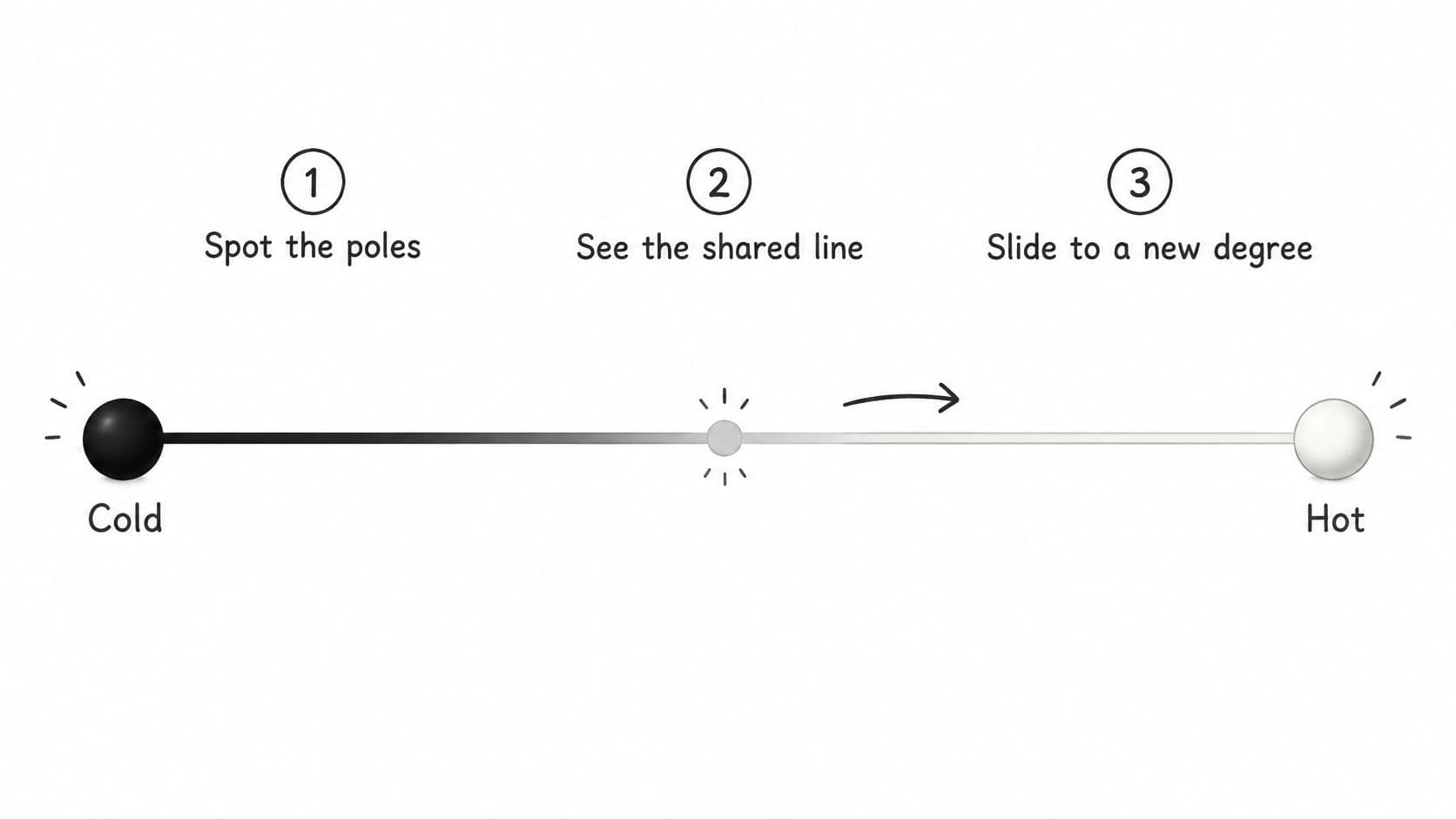
Think about a thermometer. Hot, warm, cool, and cold describe positions on a temperature scale. Nobody treats warmth and coldness as separate substances that happen to occupy the same room. You can move between those descriptions without crossing a boundary between kinds of temperature that differ in essence.
The claim beyond the thermometer
The spiritual principle extends that reasoning to experiences such as love and hate or fear and courage. Its central propositions are:
- Shared nature: Apparent opposites differ in degree rather than in their underlying nature.
- Connected extremes: The teaching holds that extremes meet.
- Possible movement: A person can shift a state toward another position on its scale.
That extension is where careful interpretation matters. A physical measurement doesn't establish that complex emotions have the same structure. You can feel affection and anger toward someone simultaneously, and courage needn't mean that fear has disappeared.
Working distinction: A helpful analogy isn't automatically a universal explanation.
This is a metaphysical principle associated with Hermetic philosophy, not a verified law of nature. Its value for personal growth rests on whether it helps you notice choices, not whether you can explain every event through opposites.
Readers of Dan Millman's The Life You Were Born to Live, users of the Life Purpose App, coaches, and curious journal writers can approach it on those terms. The useful ingredients are a clear definition, an understandable mechanism, a practice method, firm limits, and questions that leave room for disagreement.
How the Idea Moved from Magnetism to Modern Spirituality
The history begins with a word used to investigate nature, not with a self-improvement technique. Following its changing meaning helps explain why scientific and spiritual accounts can sound similar while making very different claims.
From observation to philosophy
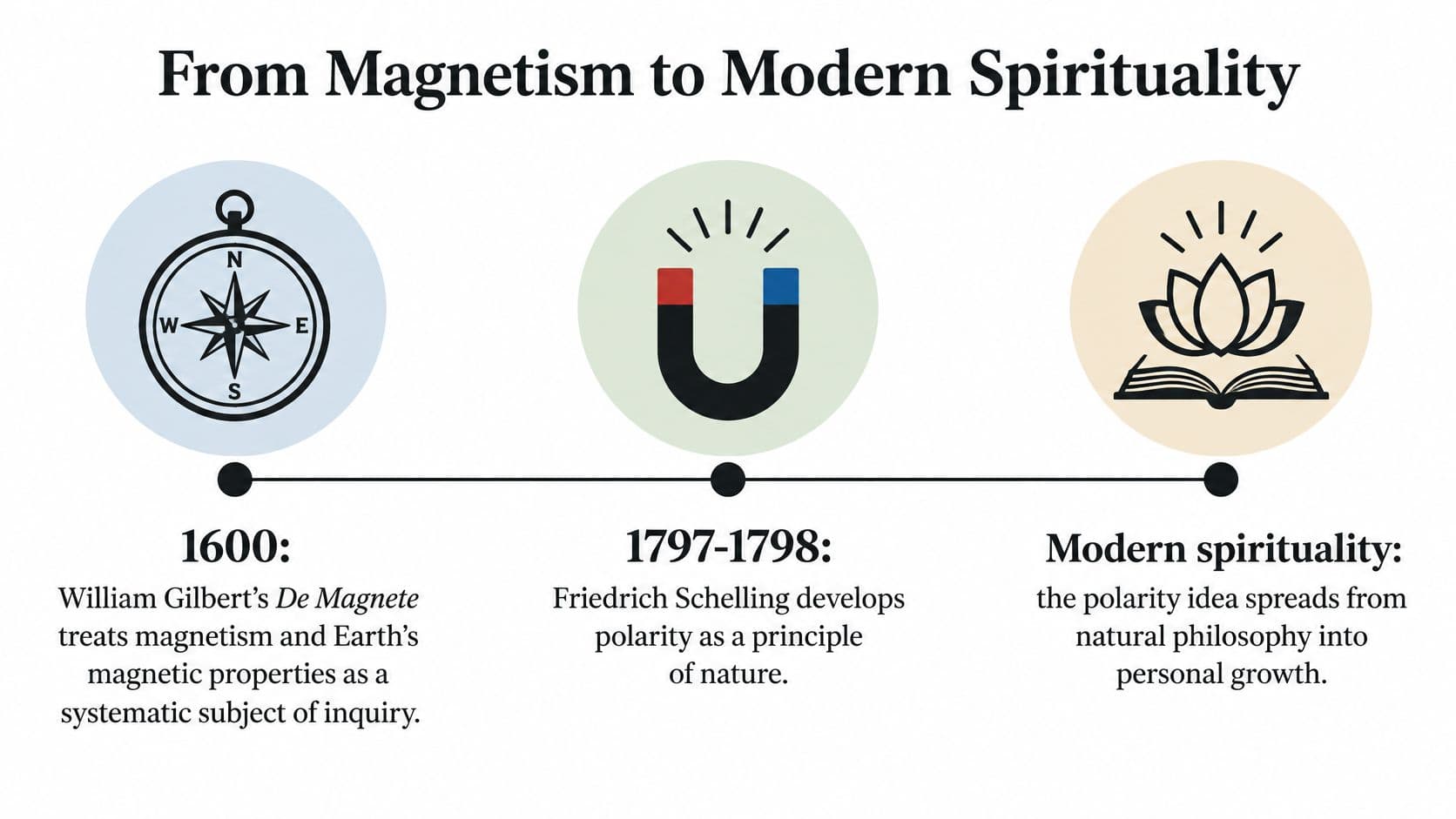
1600: William Gilbert's De Magnete treated magnetism and Earth's magnetic properties as systematic subjects of inquiry, while 1797–1798 marks Friedrich Wilhelm Joseph Schelling's discussion of polarity as differentiation from an original unity, according to Treccani's philosophical entry on polarity.
Those are different intellectual projects. Gilbert investigated magnetic phenomena; Schelling used polarity within a broader account of nature. Goethe applied related ideas to color, especially light and darkness, while Hegel considered attraction and repulsion in his philosophical treatment of magnetism.
The modern spiritual formulation
1908: The original edition of The Kybalion appeared in Chicago under the anonymous attribution “Three Initiates” and presented polarity as one of seven Hermetic principles.
The modern occult writer William Walker Atkinson, whose lifespan was 1862–1932, substantially influenced this formulation and its New Thought setting, rather than representing an unchanged doctrine demonstrably preserved from ancient Egypt.
The distinction is practical, not merely academic. The book draws on Hermetic themes, but the same seven-principle framework doesn't appear in surviving ancient Hermetic texts. Calling the teaching Hermetic therefore shouldn't imply that its entire modern presentation can be traced unchanged through antiquity.
A shared term doesn't make experimental science, natural philosophy, and spiritual practice the same discipline.
A reader encountering polarity today might meet any of those meanings. Ask what the writer is doing: describing a measurable phenomenon, proposing a philosophical account of nature, or offering a reflective exercise. The answer determines what kind of evidence would support the claim.
How Two Poles Share One Scale
In The Kybalion's chapter on polarity, the principle is identified as the fourth of seven and states that “everything is dual.” Opposites are described as “identical in nature, but different in degree,” followed by the claim that “extremes meet.”
The internal method is straightforward: identify contrasting endpoints, decide what common quality they describe, and locate intermediate degrees. The difficult part is deciding whether your chosen endpoints genuinely belong together.
Analogues aren't interchangeable explanations
Electric charge has positive and negative types, with like charges repelling and unlike charges attracting; an excess of electrons makes an object negatively charged, as explained in this technical reference on electric charge. The names are conventional, not moral judgments. This is a measurable physical relationship, not proof that human events obey an equivalent rule.
A separate philosophical example is taiji, translated as “the supreme polarity” in the Stanford Encyclopedia of Philosophy's account of Chinese metaphysics. Yin and yang arise within an original unity, making their relationship more subtle than good versus bad. For reflection, Yin and Yang balance offers a complementary perspective, but it shouldn't be treated as identical to The Kybalion's technique.
Pole pairs and the degrees between them
The emotional and behavioral rows below are working prompts, not validated measurement scales.
| Pole A | Degrees in between | Pole B | Question to ask |
|---|---|---|---|
| Hot | Warm, lukewarm, cool | Cold | Which degree describes the room I am in right now? |
| Fear | Caution, alertness, readiness | Courage | What one step would move me one degree toward courage? |
| Hate | Dislike, indifference, tolerance | Love | Is this feeling about the person or about the situation? |
| Withdrawal | Selective privacy, measured contact | Engagement | Am I choosing distance, or avoiding contact? |
| Rigidity | Firm routines, stated preferences | Flexibility | Which habits serve me, and which only protect me? |
| Dependence | Shared choices, mutual support | Autonomy | Which support do I need, and which can I offer? |
Don't assume that every row describes an orderly emotional progression. Indifference isn't necessarily a stage on the way to love, and mutual support can coexist with autonomy.
Test the shared quality first. If both ends don't describe the same quality in the situation you're examining, the pair isn't a useful polarity pair. Use separate descriptions instead of forcing an experience onto a misleading scale.
Reading Life Paths and Relationships Through Polarity
Say you enter your date of birth into the Life Purpose App, the digital companion to Dan Millman's The Life You Were Born to Live, and receive a life path summary. Read its descriptions of gifts and challenges as material to consider, not fixed labels you must accept.
Suppose you recognize a tendency to withdraw when a conversation becomes uncomfortable. You might choose engagement as a direction to explore, without claiming that this pairing is a quotation or a specific teaching from the book.
Turn a description into an observable choice
Define engagement in terms you can recognize: answering a message, asking for clarification, or saying that you need time before continuing. Then mark where you think you are between avoidance and participation in that particular situation.
This keeps interpretation grounded. You're not deciding whether you're withdrawn or engaged at your core; you're describing what you did under certain conditions. If the summary doesn't fit your experience, record that disagreement rather than rewriting your memories to match it.
A 2023 Frontiers in Psychology review recommends defining a construct's proposed continuum and examining whether it is bipolar, unipolar, or combinatorial. In plain language, don't assume that more of one experience always means less of another.
Practical rule: Define the behavior before assigning the rating.
Relationship dimensions rated on separate scales
The Life Purpose App's compatibility tools, associated with Dan Millman's The Life You Were Born to Live, can be used to explore connections involving friends, family, co-workers, or public figures. Treat those interpretations as prompts, not evidence about another person's motives or a verdict on compatibility.
For everyday reflection, applying polarity in relationships is more useful when you separate dimensions that can coexist. Closeness and conflict aren't opposite ends of a single scale: you can feel profoundly connected and still argue frequently.
Use the following as a self-designed 1-to-10 reflection exercise, not a clinical assessment.
| Dimension | Low end (1) | High end (10) | When to rate |
|---|---|---|---|
| Closeness | Distant, rarely in touch | Deeply connected | Monthly |
| Conflict | Calm, few disagreements | Frequent friction | Monthly |
| Emotional support | Rarely felt | Consistently available | After a hard week |
| Shared decisions | One person decides | Both decide together | Before a major choice |
Review all dimensions monthly, adding the event-based entries where useful. Include a short note about context, such as a demanding work period or an unresolved disagreement.
A persistent gap between closeness and support, for example, gives you something concrete to discuss. It doesn't tell you that the relationship is fated to succeed or fail.
How to Practice a Polarity Shift Step by Step
The Kybalion's practical instruction is to “put into operation the Principle of Polarity and concentrate upon the opposite pole.” Its sharper summary is “Kill out the undesirable by changing its polarity.”
Those are Hermetic instructions, not clinical findings. A gentler modern exercise can preserve the idea of redirecting attention without treating unwanted emotions as enemies.
Build a scale you can actually use
Try the following as a personal experiment, with the timings and ratings serving as practical choices rather than an established treatment protocol.
-
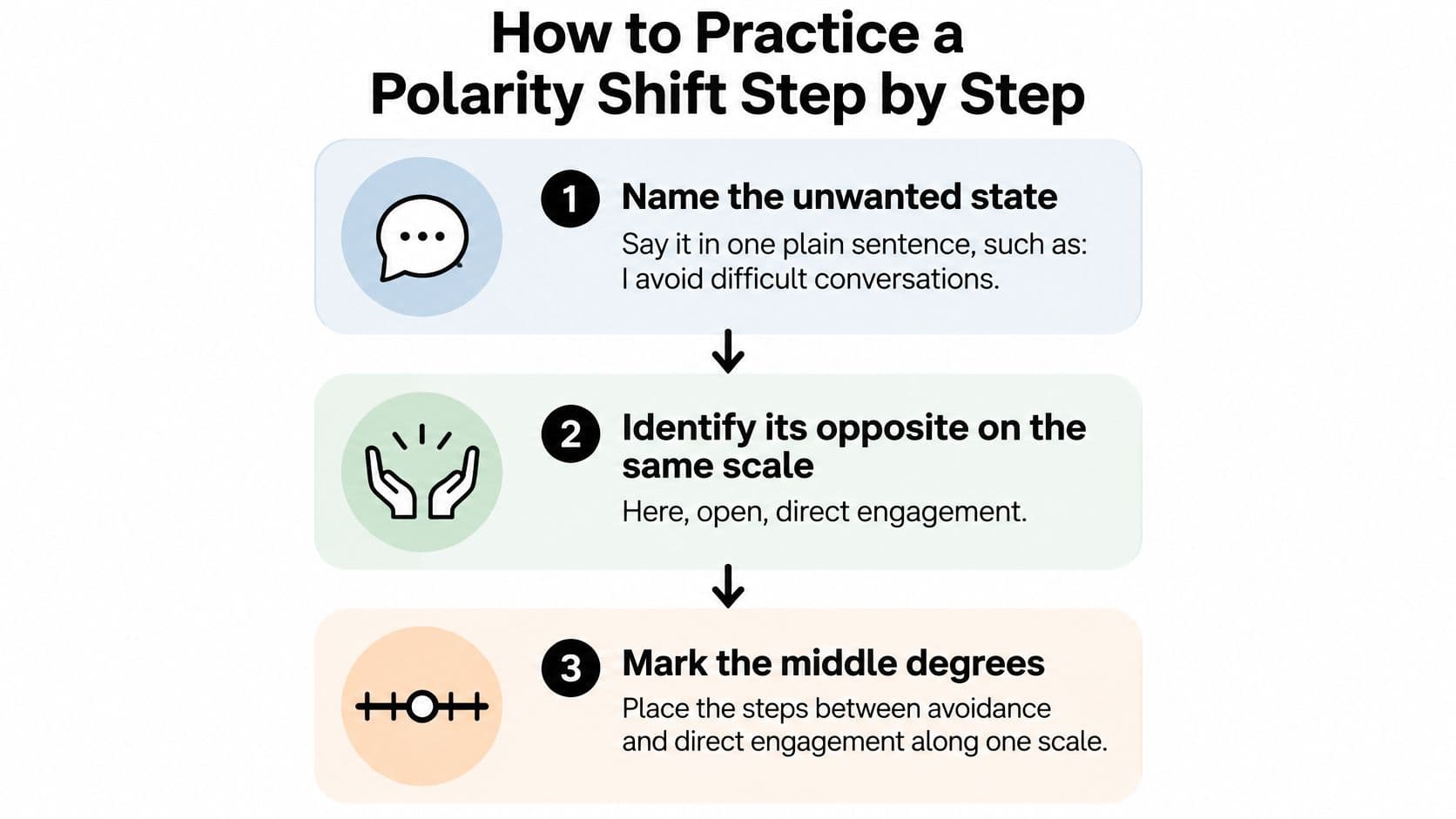
Name the unwanted state. Write a plain sentence: I avoid difficult conversations. Describe a behavior rather than condemning your character.
-
Identify a workable opposite. Here, choose open, direct engagement. Make sure that engagement means honest participation, not confrontation or abandoning your boundaries.
-
Mark the middle degrees. Your sequence might include noticing the avoided topic, drafting an opening sentence, asking a question, and arranging a conversation. These steps give you options between complete avoidance and an overwhelming confrontation.
-
Rate your current position from 0 to 10. Define the endpoints before choosing a rating, with complete avoidance at the low end and the specific engagement you want at the high end. Add a note describing what supports your estimate.
-
Give the desired direction a short daily window. For example, spend five minutes writing about what engagement would look like this week. Finish by selecting an action within your control.
-
Keep a daily log for two to four weeks. Record your rating, what you tried, and relevant circumstances. A missed conversation during illness shouldn't automatically receive the same interpretation as deliberate avoidance.
-
Review the pattern. Look for gradual, sudden, or uneven movement, and whether the exercise helps you act constructively. Continue if it's useful; if not, revise the intermediate steps or stop.
This is a Hermetic reflection technique, not an established psychological treatment. Anxiety, depression, and health concerns deserve support from a qualified professional; don't delay care while trying to change your polarity.
Attention is the part you can direct
You may discover that drafting a sentence is manageable but speaking feels unsafe. That observation matters more than making the rating rise, especially where intimidation or abuse is involved.
The exercise changes where you place attention and which action you consider. It doesn't determine how someone else responds, erase external constraints, or guarantee what happens to you.
Where the Law Stops Working as a Guide
A universal explanation can feel reassuring because it leaves nothing unexplained. That's also its weakness: if every possible outcome confirms the rule, you have no practical way to discover that your interpretation is wrong.
Historical analysis of The Kybalion and ancient Hermetica supports treating this framework as modern metaphysics rather than an empirically established mechanism.
Correct the interpretation before applying it
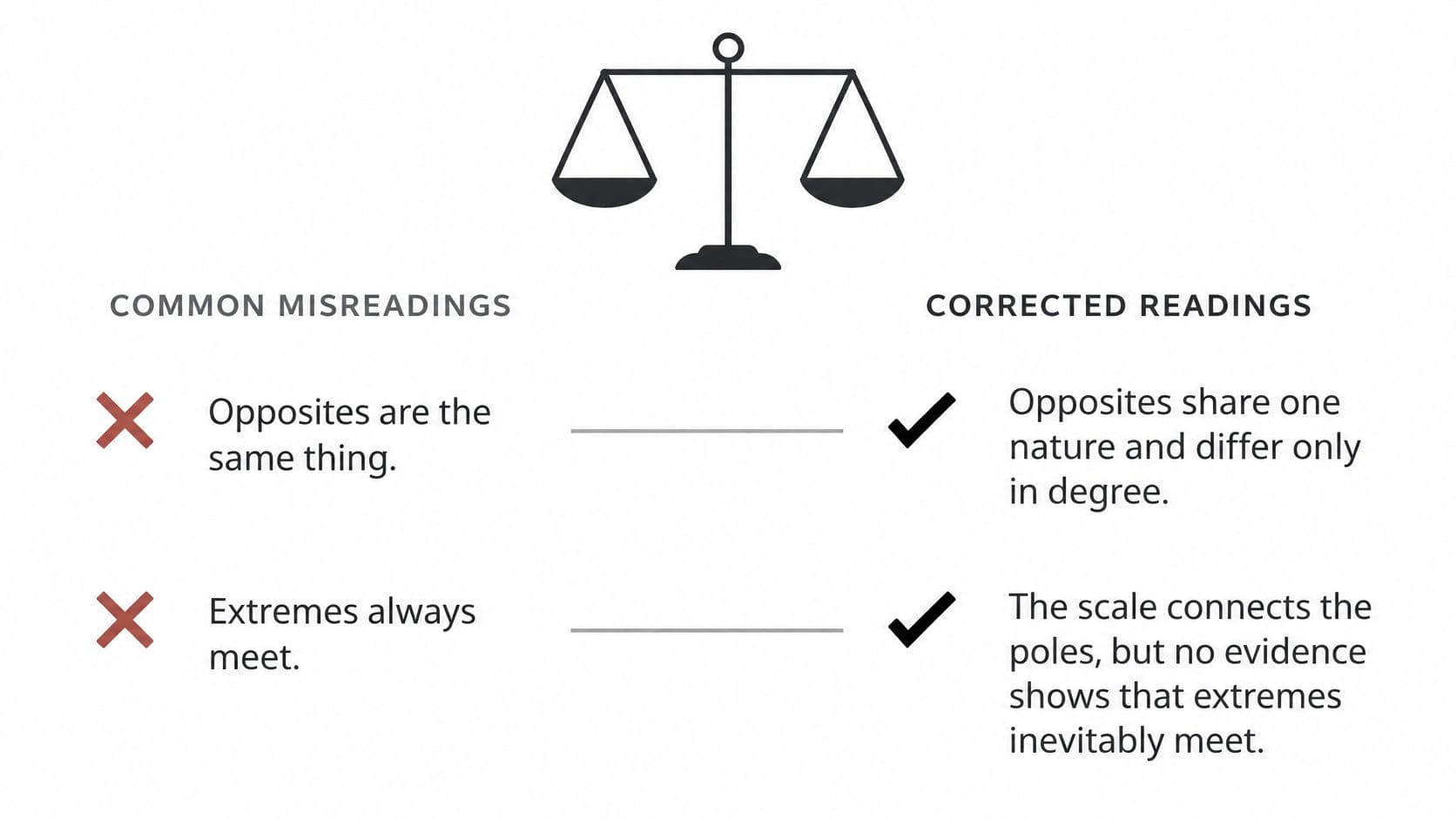
- Extremes always meet: A conceptual scale connects endpoints; that doesn't establish that extremes must turn into each other.
- Opposites are interchangeable: Rest and exhaustion contrast, but they aren't equally desirable in every context.
- Suffering is necessary for balance: Growth doesn't require you to excuse harm or remain exposed to it.
- A setback proves the rule: An isolated event doesn't confirm a cosmic explanation.
- Physics confirms the spiritual claim: Electrical relationships don't establish rules governing personal experiences.
Research reviewed in Frontiers in Psychology on opposites and reasoning indicates that opposite concepts influence human reasoning. That supports examining how people organize thoughts, not assigning positive and negative experiences predetermined proportions.
For readers reflecting within a Christian tradition, HolyJot offers a biblical perspective on idealization as a separate resource. Keep theological reflection distinct from empirical evidence about how a scale works.
If your interpretation explains away harm, inequality, illness, or financial hardship, reflection has become rationalization.
You can look for meaning without declaring suffering necessary. Use polarity to formulate questions and possible actions, not to claim that movement toward a desired state mechanically causes an opposite outcome.
Choose One Polarity to Track This Month
Survey reporting published by Phys.org indicates that online media helps 67% of religious respondents and 78% of nonreligious respondents discover new spiritual or religious ideas and practices. Discovery isn't verification, so check teachings encountered in apps and social feeds against their original sources.
Use these questions in the Life Purpose App's spiritual growth journal:
- Work: Where do I see this pair in my work this week?
- Stress: Which end do I default to under pressure?
- Action: What would one degree toward the other pole look like tomorrow?
- Relationships: Which connection needs separate ratings, and what do those ratings show?
- Recognition: Which part of my life path summary, explored through Dan Millman's The Life You Were Born to Live and the Life Purpose App, do I recognize, and which part do I reject?
- Disconfirmation: What result would tell me this framework isn't helping?
Choose a pair and try a 30-day personal experiment. At the end, decide whether to continue, change the pair, or stop, based on usefulness rather than loyalty to the idea.
If you want a starting prompt, the free summary in the Life Purpose App, companion to Dan Millman's The Life You Were Born to Live, lets you consider its approach before paying for anything more. It's available in English, French, and German.
The scale describes your movement, not your fate.
Visit Life Purpose App for a free life path summary based on Dan Millman's The Life You Were Born to Live. Choose a description you want to examine, turn it into a concrete reflection question, and test whether tracking it helps you make more deliberate choices.
Discover your life path today
Enter your date of birth and see your life path, free.
Find your life path