Discover your core beliefs. Our guide to the values clarification exercise helps you run it for yourself or a group to align your life with your true purpose.
July 20, 2026 (2mo ago)
Values Clarification Exercise: Find Your True Purpose
Discover your core beliefs. Our guide to the values clarification exercise helps you run it for yourself or a group to align your life with your true purpose.
← Back to blog
Some people land on a values clarification exercise after a quiet kind of frustration. Life looks functional from the outside, but your decisions feel borrowed. You keep saying yes to things you don't respect, chasing goals that lose their shine as soon as you reach them, or feeling oddly empty after doing what you were “supposed” to do.
That feeling usually isn't laziness or lack of ambition. It's often a signal that your actions and your deeper principles have drifted apart. When you name what matters most, choices stop feeling random. They start lining up.
Why You Feel Adrift and How Values Can Anchor You
You can be busy and still feel ungrounded. You can be capable, responsible, and outwardly successful, yet still sense that something important is off. In practice, that often happens when a person has clear tasks but no clear inner compass.
Values are that compass. They are guiding principles, not performance targets. “Connection” is a value. “Get everyone to like me” is a goal. “Creativity” is a value. “Publish a book this year” is a goal. One points to how you want to live. The other points to an outcome you may or may not reach.

Why this exercise matters in real life
A good values clarification exercise isn't just reflective. It's practical. It helps with ordinary decisions like how you spend your evenings, what kind of work you accept, how you handle conflict, and which trade-offs you're willing to make.
That matters because clarity changes behavior. A 2021 systematic review of 47 studies found that values clarification methods significantly increased values congruence, which means people made decisions that better matched their stated beliefs. The review also found significantly less regret after decisions were made. You can read that review in the PMC systematic review on values clarification methods (https://pmc.ncbi.nlm.nih.gov/articles/PMC8482297/).
Practical rule: If a decision keeps draining you, don't ask only, “What should I do?” Ask, “What value would this choice express?”
This also explains why surface-level self-improvement often doesn't stick. Productivity tools can help. Morning routines can help. But if the life you're organizing doesn't reflect your values, efficiency just gets you to the wrong destination faster.
What values are not
People often confuse values with mood, image, or social approval. Those are different.
- Values aren't trends. If everyone around you admires hustle, that doesn't mean hustle belongs at the center of your life.
- Values aren't roles. Being a parent, founder, artist, or caregiver shapes your life, but the value underneath might be devotion, contribution, beauty, or stewardship.
- Values aren't always comfortable. A value like honesty may force a difficult conversation. A value like peace may require firmer boundaries, not more accommodation.
If you need help getting settled before doing this work, it can help to calm your nervous system first. A simple grounding ritual, a walk, or even sensory support can make reflection easier. For a gentle resource on creating a calmer internal and home environment, the Aroma Warehouse peace guide offers a useful starting point.
Setting the Stage for Genuine Self-Discovery
It's easy to rush the setup, only to find answers feel thin. If you do this exercise while multitasking, checking messages, or trying to produce the “right” answer, you'll mostly hear your habits talking. Honest reflection needs a little space.
Build a container that supports honesty
You don't need a retreat. You need a short block of uninterrupted time and a setting that doesn't keep pulling your attention outward.
A simple setup works well:
- A notebook or journal. Writing by hand tends to slow your thinking enough for deeper answers to appear.
- A pen you like using. Small detail, but friction matters.
- A values list or worksheet. This helps when your mind goes blank.
- A timer. Give yourself a clear edge so the process feels doable.
Choose a place where you won't be performing for anyone. Kitchen tables can work. Park benches can work. A parked car can work. The issue isn't aesthetics. It's privacy.
Bring the right mindset
Curiosity matters more than discipline here. The useful stance is, “Let me see what's true,” not, “Let me produce an impressive identity.”
That means holding back judgment when your answers surprise you. You may discover that security matters more to you than adventure right now. Or that beauty matters more than achievement. Or that your life is built around responsibility, but your deeper self is asking for freedom. None of that is failure. It's information.
You're not trying to become a better-looking version of yourself on paper. You're trying to become more accurate.
If you tend to overthink, use short prompts and fast writing. If you tend to avoid introspection, schedule this like an appointment. Either way, the point is to hear your own signal before outside voices get loud again.
A simple pre-exercise checklist
Before you begin, make sure these three conditions are in place:
| Need | Why it matters | What to do |
|---|---|---|
| Quiet | Noise pushes you toward reactive answers | Silence notifications and close spare tabs |
| Time | Rushing keeps you at the surface | Block enough time to think without hurrying |
| Permission | Self-censorship distorts the result | Decide in advance that no answer has to look noble |
If you want support warming up your self-observation skills before doing a full values clarification exercise, this piece on practical ways to improve self-awareness is a helpful companion.
Your Personal Values Clarification Guide
Many individuals don't need a complicated method. They need a structure that helps them move from a long, fuzzy list to a short, usable set of principles they can live by.
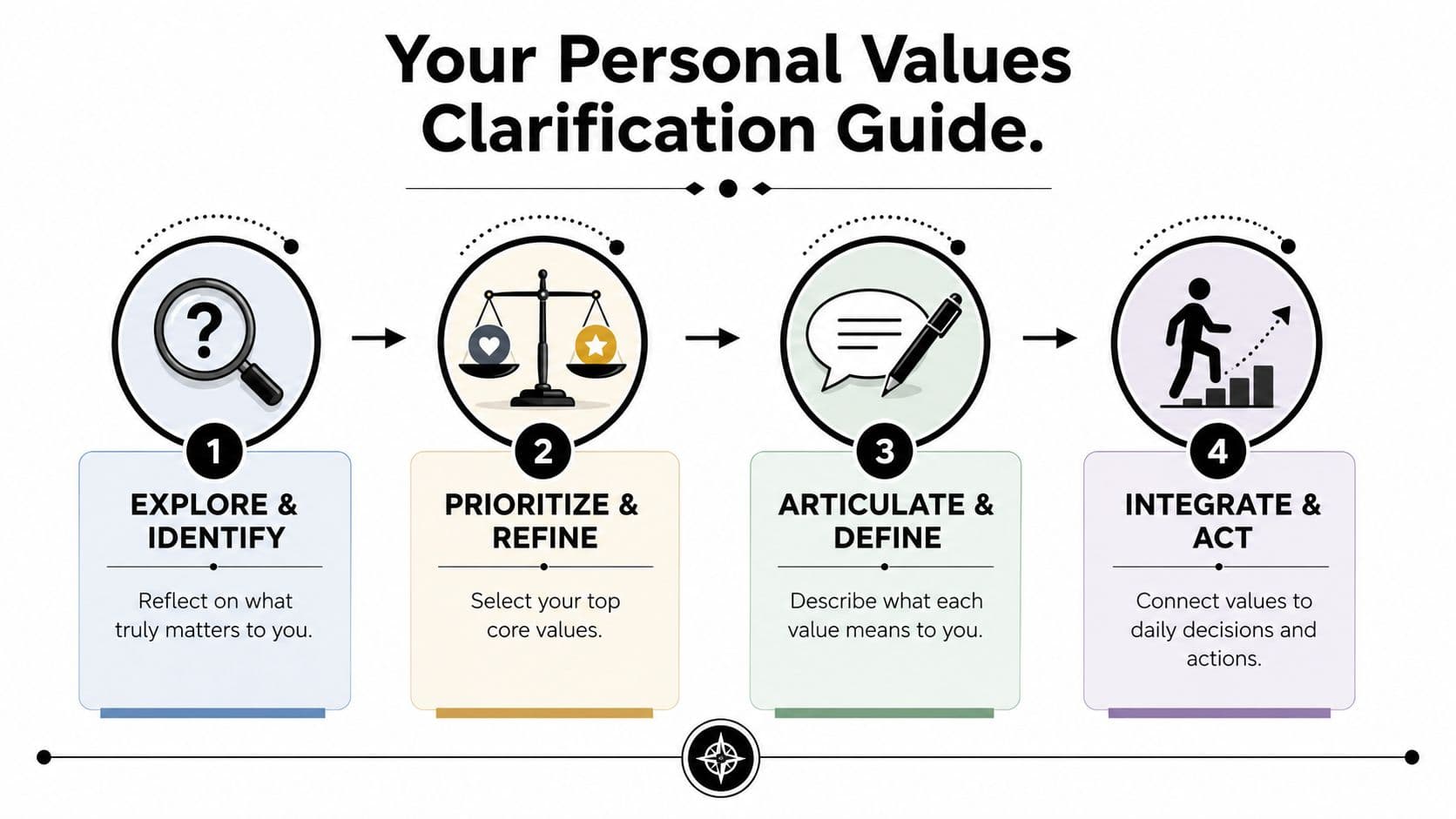
Explore and identify
Start broad. Use a long values list and circle every word that creates a felt response. Don't edit yet. If “stability,” “truth,” “play,” “faith,” “mastery,” “beauty,” and “service” all resonate, mark them all.
Then add your own words. Many people don't see their real values on prewritten lists because their language is more specific. “Tenderness” may fit better than “love.” “Craft” may fit better than “excellence.” “Quiet influence” may fit better than “leadership.”
A few reflection prompts help at this stage:
- What qualities do I respect in other people, even when I don't share their lifestyle?
- When have I felt proud of how I handled something, regardless of the outcome?
- What kinds of behavior in me feel clean and solid afterward?
- What repeatedly hurts when it's missing from my life?
If you're a writer or creator, it can help to notice that naming values feels a bit like choosing the right genre for your book. You may like many forms, but the right category gives shape to the work. Values do the same thing for a life.
Prioritize and refine
Once you have a large pool, begin grouping similar words. “Honesty,” “authenticity,” and “truth” may belong together. “Family,” “loyalty,” and “care” may point to devotion or belonging. This stage is less about removing words and more about finding the deeper theme.
Then narrow. You're aiming for 5 to 7 core values, not because smaller is morally better, but because a short list is usable under pressure.
Here's a useful test. Put two values side by side and ask, “If these came into conflict, which one would I protect first?” That's where prioritization becomes real.
Common trap: People often choose values that sound admirable instead of values they are actually willing to live by.
That matters because one of the biggest pitfalls is choosing “should” values instead of what one source calls “bone-deep” beliefs. A practical way around that is to keep asking why a value matters until you reach the principle underneath, or ask a trusted friend what values they see in your actions, not your self-image. That guidance appears in this article on common values clarification pitfalls.
Articulate and define
Now write a personal definition for each selected value. Don't copy dictionary language. Make it operational.
For example:
- Integrity means I say what's true sooner, even when it costs me comfort.
- Creativity means I make and shape things regularly, not only when it's convenient.
- Connection means I give full attention to the people I love.
- Freedom means I leave margin in my schedule and make choices I can stand behind.
This step is where the exercise becomes usable. Without definitions, people carry vague ideals. With definitions, values turn into decision criteria.
A final check helps. Ask yourself:
- Does this value feel alive in my body, or only impressive in my head?
- Would I still care about this if nobody praised me for it?
- Can I recognize this value in action on an ordinary Tuesday?
If you want examples to compare against your own language, core values examples can help you sharpen your list without copying someone else's.
How to Facilitate a Values Exercise for a Group
A group values clarification exercise is different from a private one. The core work is still personal, but the facilitator's job changes. You're not helping people arrive at one shared answer. You're helping them reflect honestly in the presence of other people.
That means psychological safety matters more than clever prompts. If participants think they'll be judged, they'll default to polished values like respect, leadership, and excellence, whether those words mean anything to them or not.

What changes in a group setting
In one-to-one coaching, silence usually helps. In groups, silence can feel risky unless you frame it well. People need to know why they're pausing, what they'll be asked to share, and what they're free to keep private.
A good opening sounds like this:
“You won't be asked to defend your values or persuade anyone else. Share only what feels useful. The point is clarity, not consensus.”
That sentence lowers the pressure immediately.
A simple facilitation flow
I like a structure that moves from private reflection to paired sharing to whole-group insight. It keeps the room from becoming performative too early.
| Segment | What happens | Facilitator focus |
|---|---|---|
| Opening | Set expectations and confidentiality | Reduce evaluation anxiety |
| Solo reflection | Participants circle and narrow values privately | Protect silence |
| Pairs or trios | Each person shares one surprising value | Keep airtime balanced |
| Group debrief | Discuss patterns, tensions, and takeaways | Draw insight without forcing agreement |
You can run this in a classroom, coaching circle, staff retreat, or peer group.
A sample script that works
Begin with a short framing statement. Keep it plain.
“Today's exercise is about identifying the principles that matter most to you. Not the image you present, and not the role you play, but the qualities you want your choices to express.”
Then invite quiet reflection with prompts like these:
- Circle what resonates. Don't analyze yet.
- Notice tension. Which two values seem to compete in your life right now?
- Choose one surprise. Which value made you pause because you hadn't fully admitted it?
After the private portion, move into small-group sharing:
- Share one value that surprised you and why.
- Name one place in your life where this value feels easy to live.
- Name one place where it feels challenged.
The strongest conversations usually happen when people talk about tension, not certainty. Someone may value ambition at work and tenderness at home. Someone else may value harmony in family life but candor in leadership. Those contrasts are not problems to solve on the spot. They are useful truths.
What a facilitator should watch for
Group work can drift in predictable ways. Watch for these patterns:
- Abstract language taking over. Ask for an example from the past week.
- One person teaching instead of sharing. Bring the room back to lived experience.
- Values turning into virtue signals. Remind participants that a value matters only if it shapes behavior.
- Consensus pressure. A team can discuss shared culture later. First let individuals hear themselves.
If your group needs a creative way to ease into reflection before verbal sharing, arts-based approaches can help loosen overly intellectual responses. This introduction to mandala therapy art offers one gentle pathway.
Connecting Your Values to Your Deeper Life Purpose
A values list is useful. A values list inside a deeper framework is more useful. Without context, people often treat values as standalone preferences. In practice, values usually point toward a larger pattern in a person's life. They reveal not only what matters, but the kind of lessons, gifts, and tensions a person keeps meeting.
That's where Dan Millman's book “The Life You Were Born to Live” becomes relevant. It offers a structured way to place your values inside a broader life-purpose lens. The same is true of the Life Purpose App, which draws on that system to help people connect self-reflection with their life path and recurring themes.
Why values alone can feel incomplete
Some people finish a values clarification exercise and still feel stuck. Their list is accurate, but it doesn't yet explain why certain struggles keep repeating. They know they value truth, service, or freedom, but they don't know how those values fit the deeper shape of their life.
Dan Millman's framework helps by asking a different question. Not just, “What matters to me?” but also, “What path am I walking, and what strengths and challenges come with it?”
In that sense, values function like signposts. A life-purpose system gives you the map.
Using Dan Millman's system with precision
When people refer to life paths in this tradition, the details matter. In Dan Millman's “The Life You Were Born to Live” and the Life Purpose App, you calculate the number by adding every single digit of the full birth date and not reducing the final sum.
The standard example is birth date 12/29/1985. You add 1 + 2 + 2 + 9 + 1 + 9 + 8 + 5 = 37, and 37 corresponds to one of 45 distinct life paths in Dan Millman's system and the Life Purpose App guide to The Life You Were Born to Live. That precision matters because reducing the final number would erase distinctions the system is designed to preserve.
Bringing the two together
Once you know your values and understand your life path through Dan Millman's framework, richer questions become possible:
- Which values support the central lessons of my path?
- Which values become distorted when I'm stressed or afraid?
- Which recurring challenges are asking me to live a value more consistently, not just admire it?
For example, someone may list discipline as a value when the deeper value is devotion. Another may claim independence when their path keeps asking for interdependence, trust, or humility. Through this process, a plain list becomes a living inquiry.
A value becomes powerful when it stops being a label and starts becoming a lens.
Used this way, the exercise stops at neither self-description nor motivation. It becomes a way to understand how your daily choices relate to the deeper architecture of your life.
Living Your Values Daily From Insight to Action
A values clarification exercise is only as useful as the follow-through. Insight feels good in the moment, but insight alone doesn't reorganize a life. Repetition does.
Many people stall at this point. They identify values accurately, feel a rush of recognition, then go back to schedules, defaults, and relationships that were built without those values in mind. The old pattern returns because nothing in daily life changed.
Turn values into visible behavior
The move from reflection to action doesn't need to be dramatic. It needs to be specific.
Try a weekly values audit. Look back over the past few days and ask:
- Where did I act in alignment with one of my core values?
- Where did I betray one, even in a small way?
- What choice is in front of me this week that could express one value more clearly?
Then set a values-based intention for the day. Not a productivity target. A behavioral one. If your value is presence, the intention might be, “Put the phone away during dinner.” If your value is courage, it might be, “Say the honest thing in the meeting.” If your value is creativity, it might be, “Make something before consuming anything.”
Why tracking matters
Static lists fade. Systems hold.
That's one reason the field is moving toward values-in-action tracking rather than one-off identification. A 2024 study found that 70% of participants failed to sustain value-aligned actions beyond three weeks without structured feedback loops, as noted in the Positive4Mind values clarification resource. The practical lesson is simple. People usually need reminders, review, and a way to notice drift before they default back to old habits.
A few structures help:
- Use a weekly review. Put your core values somewhere visible and score your week qualitatively.
- Tie each value to one recurring behavior. Keep it concrete enough to observe.
- Notice friction early. If a calendar, relationship, or commitment repeatedly violates a core value, treat that as data.
- Use a reflection tool if it helps. Some people track in a notebook. Others prefer an app or guided system.
Living by values doesn't mean life gets easy. It means your trade-offs become cleaner. You may still disappoint people. You may still feel uncertainty. But you'll recognize why you're choosing what you're choosing, and that changes the texture of a life.
If you want a structured way to connect values work with Dan Millman's “The Life You Were Born to Live”, explore your life path, and keep your self-reflection tied to everyday choices, the Life Purpose App offers a practical starting point.
Discover Your Life Purpose Today!
Unlock your true potential and find your life’s purpose.
