Ever feel like you’re reacting to life instead of creating it? Self-awareness is a clear, nonjudgmental view of your thoughts, feelings, patterns, and motivations. It helps you make better choices, build healthier relationships, and live with more intention. This guide gives ten concrete practices, simple steps to start, and ways to measure progress so you can begin shaping who you become. Try one practice for 30–90 days and track small changes in reactivity, clarity, and relationships.

January 8, 2026 (9mo ago) — last updated July 15, 2026 (3mo ago)
10 Ways to Boost Self‑Awareness
Ten research-backed practices—journaling, mindfulness, feedback, somatic work, retreats—to deepen self-awareness and guide intentional living.
← Back to blog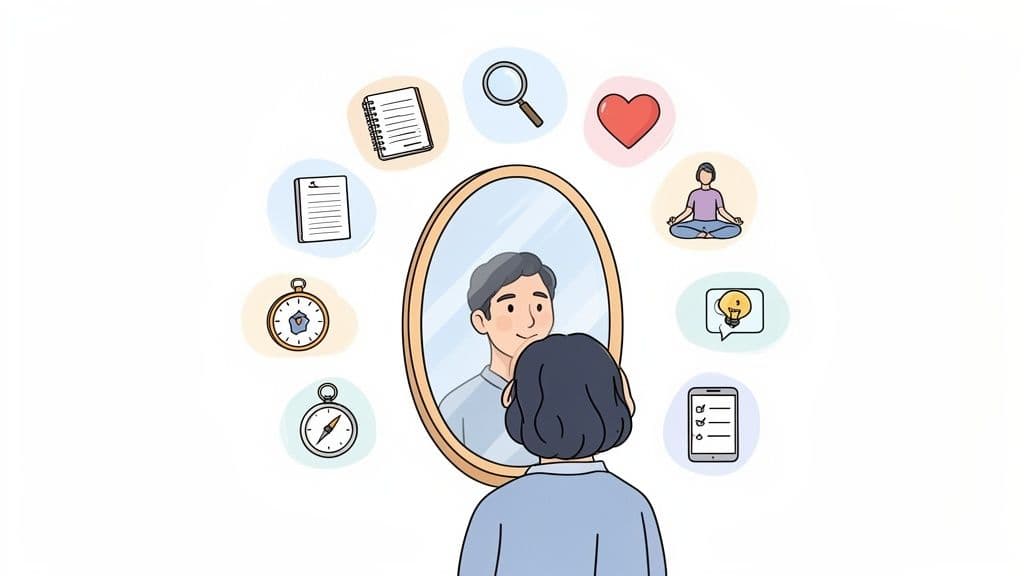
Ever feel like you’re reacting to life instead of creating it? Self-awareness is a clear, nonjudgmental view of your thoughts, feelings, patterns, and motivations. It helps you make better choices, build healthier relationships, and live with more intention. This guide gives ten concrete practices, simple steps to start, and ways to measure progress so you can begin shaping who you become. Try one practice for 30–90 days and track small changes in reactivity, clarity, and relationships.
10 Ways to Boost Self‑Awareness (2026 Guide)
Summary: Discover 10 practical, research-backed ways to deepen self-awareness—journaling, mindfulness, feedback, somatic work, life-path insight, and more—to live more authentically.
Introduction
Ever feel like you’re reacting to life instead of creating it? Self-awareness is a clear, nonjudgmental view of your thoughts, feelings, patterns, and motivations. It helps you make better choices, build healthier relationships, and live with more intention. This guide gives ten concrete practices, simple steps to start, and ways to measure progress so you can begin shaping who you become. Try one practice for 30–90 days and track small changes in reactivity, clarity, and relationships.12
1. Journaling and Reflective Writing
Journaling translates your inner life into words and helps reveal patterns in beliefs, triggers, and motivation. Regular expressive writing supports emotional processing and clearer thinking.2
How to implement journaling:
- Morning Pages: Write three pages of stream-of-consciousness each morning to clear mental clutter.
- Behavior Tracking: Use a bullet journal to log moods, triggers, and reactions to identify trends.
- Life‑Path Reflection: Use prompts that tie entries to your life-path themes.
Measure progress by reviewing entries every few months: look for recurring themes, shifts in outlook, or resolved patterns. For practical prompts, see our Journaling Guide.
2. Meditation and Mindfulness Practice
Meditation trains attention so you can observe thoughts and feelings without being swept away. Mindfulness-based programs have been shown to reduce anxiety and depression symptoms and improve attention and emotional regulation.1
How to implement meditation:
- Start Small: Begin with five minutes of guided practice daily using apps or short videos.
- Body Scan: Use a body scan to increase bodily awareness and ground attention.
- Purpose-Focused Reflection: After meditating, jot one insight tied to your life-path themes.
Measure progress by noticing reduced emotional reactivity and greater baseline calm during stress. For beginners, see our Meditation Basics.
3. Feedback and Relational Self‑Awareness
Other people’s perceptions reveal blind spots you can’t see alone. Asking for specific, behavioral feedback helps align your intentions with your impact and accelerates growth in relationships and leadership.
How to implement feedback:
- Ask Specific Questions: Request concrete examples, for example, “In our last meeting, what did I do well and what could I improve?”
- Seek Diverse Perspectives: Gather input from managers, peers, direct reports, friends, and family.
- Compare to Life‑Path Themes: Check whether feedback reflects recurring patterns in your life-path reading.
Measure progress by revisiting feedback periodically and noting whether recurring themes change as you integrate input.
4. Personality and Behavioral Assessments
Assessments (Enneagram, MBTI, CliftonStrengths, DISC) provide a shared vocabulary for tendencies and motivations. Use them as starting points for inquiry rather than fixed labels.
How to implement assessments:
- Try Multiple Frameworks: See which insights resonate and which prompt further questions.
- Combine with Life‑Path Insights: Compare assessment results with your life-number patterns for a broader view.
- Discuss Results: Share findings with friends, partners, or a coach to validate and refine your self-picture.
Measure progress by revisiting results annually and noting how deeper awareness changes how you use your strengths.
5. Therapy and Coaching Relationships
Working with a therapist or coach provides a confidential, skilled partner to unpack emotions, challenge limiting beliefs, and reveal unseen patterns. Psychotherapy and evidence-based coaching show meaningful benefits for emotional health and functioning.3
How to implement therapy and coaching:
- Define Goals: Clarify whether you want trauma work, leadership development, or life-purpose alignment.
- Interview Professionals: Have consultations to find the right fit and approach.
- Integrate Learnings: Use session insights to guide journaling, meditation, and behavior experiments.
Measure progress by setting clear goals upfront and tracking changes in behavior, relationships, and well-being. For help finding providers, see our Therapy & Coaching Resources.
6. Life‑Path Numerology and Ancient Wisdom Systems
Life-path numerology offers a reflective map—based on your birth date—describing core gifts, challenges, and cycles. Many people use this framework as language for recurring themes; modern tools adapt that tradition for practical use.
How to implement life-path exploration:
- Discover Your Life Path: Use a life-purpose app or Millman’s book to calculate and interpret your number.
- Compare Paths: Analyze how your number interacts with partners, family, and coworkers to improve communication.
- Track Cycles: Note nine-year cycles and other rhythms to anticipate themes and opportunities.
Measure progress by revisiting your life-path readings during major decisions and observing whether alignment reduces friction and increases ease.
7. Body Awareness and Somatic Practices
Our bodies store stress and memory. Somatic practices teach you to read and respond to bodily signals. Tuning into sensations can reveal emotional states before thought-based awareness catches up, which helps resolve stored tension and trauma.6
How to implement somatic practices:
- Mindful Movement: Try yoga, tai chi, or conscious dance and focus on internal sensations rather than form.
- Body Scan Meditation: Notice tension and breath patterns without judgment.
- Embodied Reflection: Watch how core challenges show up physically and practice breath or movement to release them.
Measure progress by noticing tension earlier and using breath or movement to regulate yourself.
8. Vision Quest and Retreat Experiences
A structured retreat or solo time in nature creates space for concentrated reflection and clarity. Retreats remove daily distractions so you can hear inner signals and test priorities in a protected container.
How to implement retreat work:
- Start Small: Try a weekend silent retreat or a solo day trip before committing to a longer course.
- Set Intentions: Define what you want to explore—choices, relationships, or life-path questions.
- Plan Integration: Schedule time after the retreat to journal, create action steps, and translate insights into daily habits.
Measure progress by how your daily decisions and priorities shift after the retreat and by the durability of any clarity you gained. See our Retreat Resources for options.
9. Shadow Work and Dark‑Side Integration
Shadow work invites curiosity toward parts of yourself you hide or deny. Bringing these aspects into awareness reduces projection and unlocks energy that can be redirected as strength.
How to implement shadow work:
- Notice Projections: When you react strongly to someone, ask what that reaction may reveal about you.
- Journal Disowned Parts: Write candidly about traits you reject to understand their origin and purpose.
- Reframe Challenges: Use life-path insights to see how perceived weaknesses may hold hidden gifts.
Measure progress by reduced reactivity, increased self-compassion, and greater consistency between values and actions. For practices and prompts, see Shadow Work Tools.
10. Goal Setting and Progress Tracking With Self‑Reflection
Goal setting becomes a mirror when you track both outcomes and inner process. Reviewing how you pursue goals reveals habits, avoidance patterns, and sources of motivation. Clear, specific goals improve performance and focus.4
How to implement reflective goal setting:
- Values‑Aligned Goals: Check that objectives align with your core purpose and life-path insights.
- Process Tracking: Log process notes and emotions, not just outcomes.
- Scheduled Reflection: Monthly or quarterly reviews reveal recurring strengths and obstacles.
Measure progress by your ability to anticipate reactions and adjust strategies based on self-knowledge rather than impulse.
Quick Comparison: Methods at a Glance
| Practice | Ease to Start | Resources | Primary outcome |
|---|---|---|---|
| Journaling | Easy | Notebook/app | Pattern recognition, clarity |
| Meditation | Moderate | Time, apps | Emotional regulation, focus1 |
| Feedback | Moderate | People, structure | Blind-spot reduction |
| Assessments | Easy | Tests, reflection | Shared language for tendencies |
| Therapy/Coaching | Higher commitment | Professional fees | Deep, guided change3 |
| Life‑Path Numerology | Easy–Moderate | Book/app | Purpose framing and cycles5 |
| Somatic Practices | Moderate | Classes/practice | Body–mind integration6 |
| Retreats | High | Time/space/cost | Intensified clarity |
| Shadow Work | Intensive | Support recommended | Integration and resilience |
| Goal Reflection | Moderate | Tools/time | Aligned action and insight4 |
Your Journey Starts with a Single, Conscious Step
Self-awareness isn’t a one-time achievement but an ongoing practice of turning attention inward. Start with one method that calls to you—journal for a month, try daily five-minute meditations, or ask for one piece of feedback. Notice small shifts and build from there. Practices feed one another: journaling enriches therapy, somatic work deepens meditation, and life-path insights can clarify goal choices.
The reward is greater freedom: fewer unconscious reactions, clearer choices, more authentic relationships, and a life shaped by intention rather than habit.
Quick Q&A
Q: What’s the fastest way to start building self-awareness?
A: Begin a daily five-minute journaling or meditation habit. Small, consistent practices build attention and give immediate data to reflect on.21
Q: How long before I notice change?
A: Try each method for 30–90 days and track reactivity, clarity, and relationships. Many people notice reduced reactivity within weeks of consistent meditation or journaling.12
**Q: Are life-path systems like numerology useful?**n
A: Life-path frameworks offer clarifying language for recurring patterns. Use them as reflective tools alongside evidence-based practices, not as the sole source of direction.5
1.
Goyal M., et al., “Meditation Programs for Psychological Stress and Well‑being: A Systematic Review and Meta‑analysis,” JAMA Internal Medicine. https://jamanetwork.com/journals/jamainternalmedicine/fullarticle/1809754
2.
Harvard Health Publishing, “Writing about emotions may help you heal,” Harvard Health. https://www.health.harvard.edu/mind-and-mood/writing-about-emotions-may-help-you-heal
3.
American Psychological Association, “Psychotherapy,” APA. https://www.apa.org/ptsd-guideline/treatments/psychotherapy
4.
Locke, E.A., and Latham, G.P., “Building a practically useful theory of goal setting and task motivation,” American Psychologist. https://psi.summerstudents.psy.uq.edu.au/wp-content/uploads/2015/03/Locke-Latham-2002.pdf
5.
Dan Millman, The Life You Were Born to Live, and Life Purpose App. For life-path calculations and interpretations, see the Life Purpose App: https://lifepurposeapp.com
6.
Van der Kolk, Bessel, The Body Keeps the Score: Brain, Mind, and Body in the Healing of Trauma. https://www.penguinrandomhouse.com/books/310216/the-body-keeps-the-score-by-bessel-van-der-kolk-md/
Discover your life path today
Enter your date of birth and see your life path, free.
Find your life path