What are life lessons? They’re the deep, personal truths you discover through experience—insights that shift how you see yourself and the world. This guide helps you spot repeating patterns, use journaling and a simple framework, and turn everyday experience into lasting wisdom you can act on today.

October 8, 2025 (1y ago) — last updated August 13, 2026 (2mo ago)
Find Your Life Lessons and Purpose
Spot repeating patterns, use journaling and simple frameworks to turn experience into lasting insight and clearer life purpose.
← Back to blog
What are life lessons? They’re the deep, personal truths you discover through experience—insights that shift how you see yourself and the world. This guide helps you spot repeating patterns, use journaling and a simple framework, and turn everyday experience into lasting wisdom you can act on today.
Find Your Life Lessons and Purpose
Summary: Learn what life lessons are and how to uncover yours with reflection, frameworks, journaling, and daily tools for growth.
Introduction
What are life lessons? They’re the deep, personal truths you discover through experience—insights that shift how you see yourself and the world. This guide shows where life lessons come from, how to spot repeating patterns, and practical steps to turn everyday experience into lasting wisdom you can act on. Use journaling, a simple framework, and a short timeline exercise to begin noticing patterns and making small changes today.
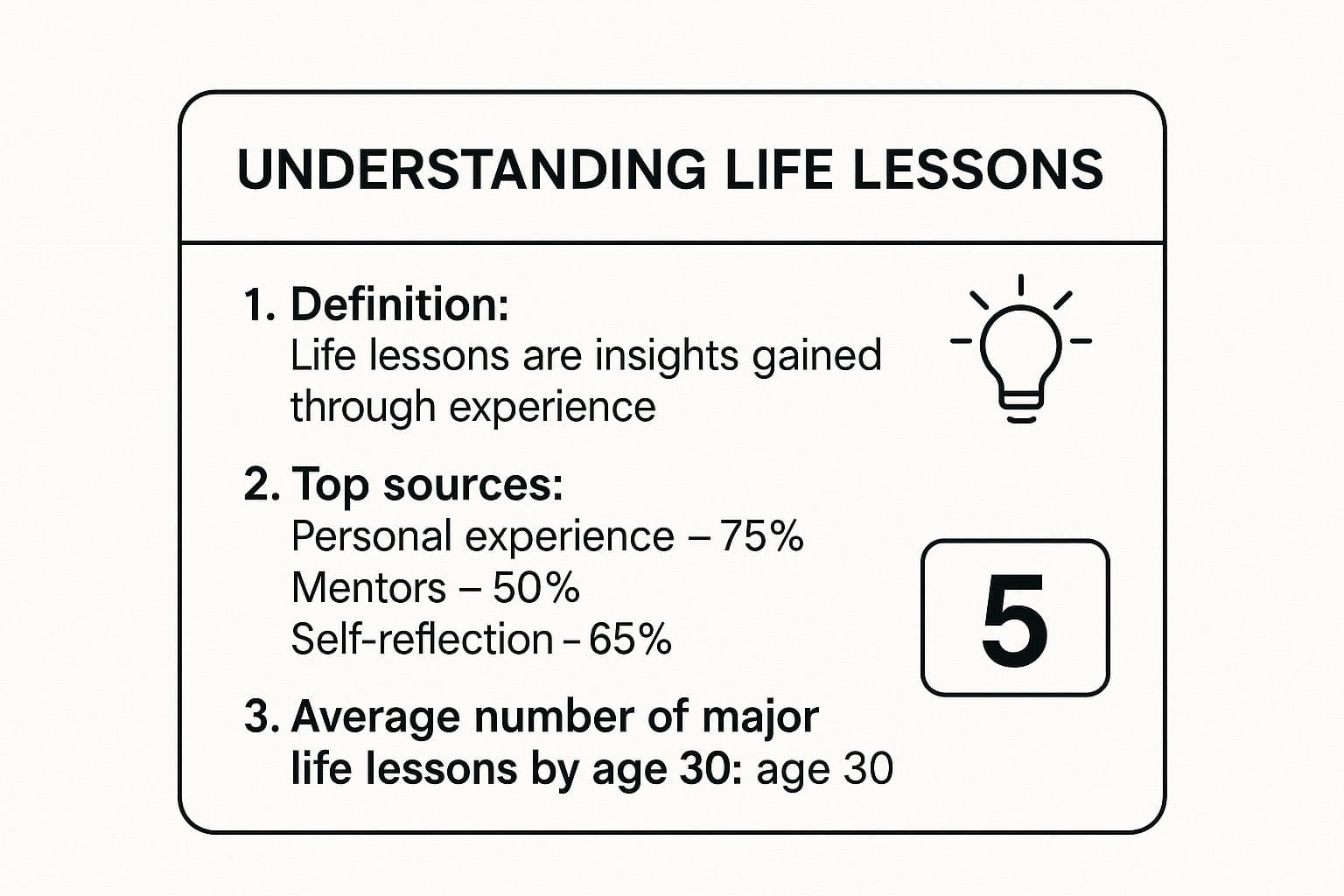
What Are Life Lessons?
Think of life lessons as the curriculum life gives through direct experience. They’re the “aha” moments after a mistake, the clarity after a hard conversation, or a shift in belief that changes how you live.
Life lessons are earned through failure, success, heartbreak, joy, and the small everyday moments that reveal who you are. They’re emotional and intuitive—felt understandings that change your perspective, beliefs, or behavior.
| Characteristic | What it means |
|---|---|
| Origin | Earned through direct personal experience—success, failure, joy, pain. |
| Nature | Emotional and intuitive; it’s a felt understanding. |
| Impact | Creates a lasting shift in perspective, beliefs, or behavior. |
| Application | Shapes character, values, and future decisions. |
| Focus | Internal—about understanding yourself and your place in the world. |
Knowledge Versus Wisdom
It’s easy to confuse collecting information with gaining wisdom. Knowledge is what you know; wisdom is how you live. A true life lesson changes your behavior and becomes part of who you are.
Why Recognizing Lessons Changes Everything
If you keep repeating the same problem, repetition is a signal to pay attention. Patterns—like a string of unsatisfying jobs or relationships that keep failing—point to lessons such as boundary setting or self-worth. When you reframe challenges as lessons, they become opportunities for growth.
Real growth happens when you pause and reflect. Reflection builds self-awareness and helps you connect actions and outcomes. When you move from reacting to reflecting, stumbling blocks become stepping stones and your choices feel more intentional.
Global life expectancy has more than doubled since 1900, showing long-term improvements in health and living standards1. At the same time, long-term trends show declines in many forms of violence, which offers perspective on larger social progress2.

Practical Frameworks to Speed Discovery
A short framework and daily prompts can make lessons easier to spot. Dan Millman’s system maps core themes and common challenges using your birth date; tools like the Life Purpose App translate that system into daily prompts and exercises to help you notice recurring patterns4.
Use frameworks as language and structure for what you already experience. Combine insights from a framework with journaling and a personal timeline to create a clear roadmap for growth. For guided exercises, try the personal development plan template and the self-discovery journal prompts.
What a Practical Framework Helps You Do
- Identify core strengths you can rely on.
- Recognize recurring challenges and test one small change at a time.
- See how your path relates to goals and relationships.
Mapping Your Own Timeline
Create a personal timeline to spot turning points and recurring themes. Pick 6–10 turning points—both highs and lows—and write one lesson for each. Journaling as you go helps archive experiences and reveal patterns over time. Research shows expressive writing and guided reflection improve emotional processing and self-awareness, supporting learning from experience3.
Common Life Lessons We Face
While each path is unique, many lessons are surprisingly universal. Recognizing shared themes reminds us that personal struggles are part of a common human experience.
The Strength in Vulnerability
True strength often looks like vulnerability. Letting someone see your real self can deepen connection and build trust.
The Peace of Letting Go of Control
A major lesson is accepting what you cannot change and focusing on what you can influence—your choices, attitude, and responses. That shift reduces anxiety and helps you move through uncertainty with more ease2.
Seeing Failure as Information
Failure isn’t a final verdict. It’s feedback. Reframe setbacks by asking, “What is this trying to teach me?” That turns mistakes into stepping stones.
How to Start Recognizing Your Life Lessons
- Make space for reflection. Journal about highs and lows, look for repeating patterns, and ask what each experience taught you.
- Create a timeline with 6–10 turning points and one lesson for each.
- Talk things through with a trusted friend or mentor when that helps.
Consistency matters. Forming a new habit often takes around two months on average, so test small changes and track results over time5.
Quick Q&A (Common Concerns)
Q: I keep repeating the same mistake—what should I do?
A: Pause, journal the pattern, identify the trigger, and test one small change. Treat the mistake as data rather than a failure.
Q: How long does it take to see progress?
A: Reflection and small habit changes can show results in weeks; deeper shifts often take months or years. Habit research finds that forming a new habit often takes around two months on average, so consistency matters5.
Q: Can a framework really help me, or is it all guesswork?
A: A framework gives language and structure to what you’re already experiencing. It’s a tool for clarity, not a prediction of fate.
Next Steps — A Simple Daily Practice
- Spend 10 minutes journaling one pattern you noticed this week.
- Add one small experiment to test a new response to that pattern.
- Review results after two weeks and adjust.
Combine journaling, a personal development plan, and short daily prompts (from an app or worksheet) to turn insight into action.
Three Concise Q&A Sections
Quick Start Q&A
Q: What’s the fastest way to spot a life lesson?
A: Look for repetition. If the same problem keeps showing up, pause and journal the pattern.
Progress & Timeframe Q&A
Q: Should I focus on pain or joy for lessons?
A: Both. Joy shows strengths to build on; pain shows areas that need attention.
Q: When will I notice change?
A: Small shifts can appear in weeks; steady practice creates lasting change over months5.
Tools & Next Steps Q&A
Q: What tools help most with this work?
A: Journaling, a personal development plan, and daily prompts or an app that gives short, actionable insights.
Q: What’s one practical step I can take today?
A: Start a simple timeline. Note 6–10 turning points and one lesson for each. That begins pattern recognition immediately.
1.
Our World in Data, “Life expectancy,” https://ourworldindata.org/life-expectancy
2.
Our World in Data, “War and Peace,” [https://ourworldindata.org/war-and-peace](https://ourworldindata.org/war-and-peace); Steven Pinker, The Better Angels of Our Nature
3.
Frattaroli, J., “Experimental disclosure and its moderators: A meta-analysis,” Psychological Bulletin, 2006; overview at [https://pubmed.ncbi.nlm.nih.gov/16649823/](https://pubmed.ncbi.nlm.nih.gov/16649823/)
4.
Dan Millman, The Life You Were Born to Live; Life Purpose App resources at [https://lifepurposeapp.com](https://lifepurposeapp.com)
5.
Lally, P., van Jaarsveld, C. H., Potts, H. W., & Wardle, J., “How are habits formed: Modelling habit formation in the real world,” European Journal of Social Psychology, 2009; overview at [https://pubmed.ncbi.nlm.nih.gov/19594263/](https://pubmed.ncbi.nlm.nih.gov/19594263/)
Discover your life path today
Enter your date of birth and see your life path, free.
Find your life path