What does Shanti Om mean? Discover its translation, spiritual significance for yoga & meditation, and how to use this peace mantra respectfully.
May 28, 2026 (2mo ago) — last updated July 18, 2026 (9d ago)
What Does Shanti Om Mean? Unpack Its Deep Significance
What does Shanti Om mean? Discover its translation, spiritual significance for yoga & meditation, and how to use this peace mantra respectfully.
← Back to blog
You hear it at the end of class. The lights are low, everyone is still, and the teacher softly says, “Om, Shanti, Shanti, Shanti.” Maybe you repeat it with the room. Maybe you stay quiet and listen. Either way, something in the sound feels calming, even if you're not fully sure what you just said.
That's a common moment of curiosity. People often ask what does Shanti Om mean because the phrase sounds simple, but it carries a lot of depth. It isn't just a pretty closing line for yoga class. It comes from old spiritual traditions and points toward something many of us are searching for right now: steadiness, relief, and a little more peace in the middle of ordinary life.
The Sound of Peace You Hear Everywhere
For many students, the first meeting with Om Shanti happens almost by accident. You sign up for yoga because your back feels tight, your mind won't slow down, or life just feels loud. Then class ends with a chant that seems to shift the mood of the whole room.
No one gives a long lecture in that moment. They just say the words, and the room changes.
Sometimes a mantra works on you before you understand it.
That's part of why this phrase stays with people. You hear it in yoga studios, meditation recordings, and chanting circles because it has a gentle, unmistakable quality. It sounds peaceful. More important, it's meant to invoke peace, not just describe it.
Many readers get stuck on one small point right away. Is it “Shanti Om” or “Om Shanti”? In practice, one often encounters Om Shanti or the longer chant Om Shanti Shanti Shanti. If you've been wondering what the phrase means, you're really asking about that family of words and sounds together.
Why people feel drawn to it
A few reasons this mantra lands so easily:
- It's simple to hear. Even if Sanskrit is new to you, the phrase isn't hard to recognize.
- It meets a real need. Many individuals don't come to yoga looking for abstract philosophy. They come because they want calm.
- It carries warmth across traditions. In Hindu, Buddhist, and Jain contexts, it's understood as an invocation for inner calm and harmony, which gives it both spiritual depth and broad resonance.
That's why it shows up so often. Not because it's trendy, but because it speaks to a human need that hasn't gone away.
Breaking Down the Literal Meaning of Shanti Om
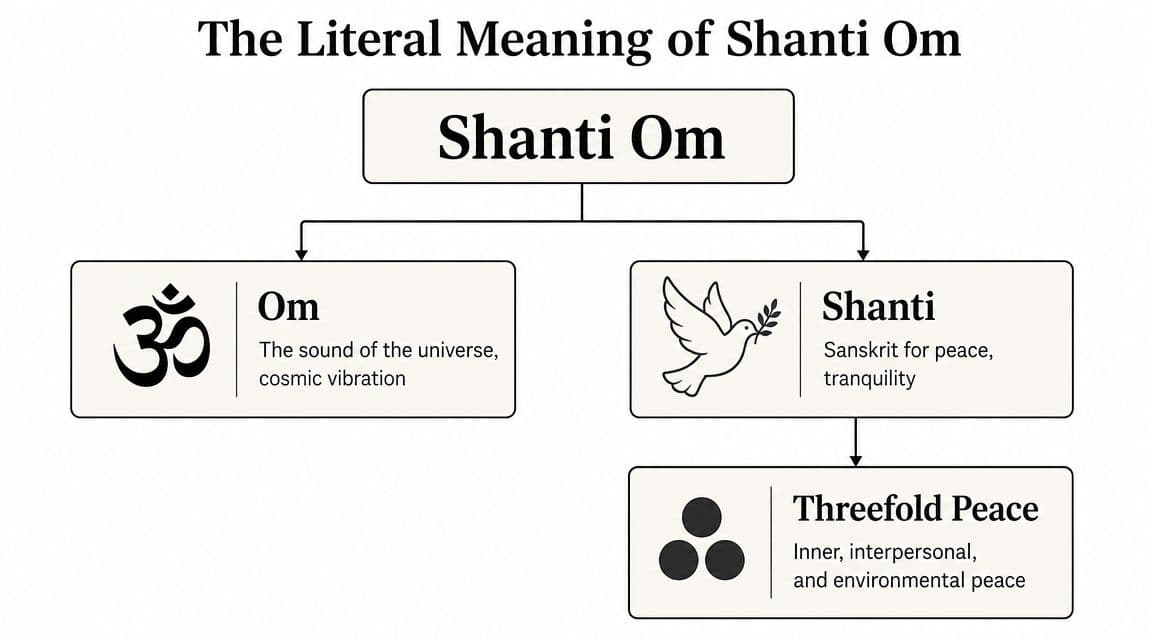
If you want the simplest answer to what does Shanti Om mean, start by separating the phrase into its parts: Om and Shanti.
What Om means
Om isn't usually treated as an ordinary dictionary word. In classical mantra interpretation, it functions more like a cosmological sound-symbol. Wildmind describes Om as the “primeval sound” and “sound of the universe,” representing reality across past, present, and future in its explanation of the Shanti mantra and Om's symbolic meaning.
That can sound lofty, so here's the plain-English version. Think of Om like the background hum of existence. Not a hum you hear with your ears all day, but a sound used to point toward the whole of life. It's less like naming an object and more like tuning to a frequency.
If you've ever heard a choir sing one note that seems to fill the room, you already know the feeling. Om works like that in practice. It gathers attention.
What Shanti means
Shanti is easier to translate. It means peace.
Not just the absence of conflict, but a felt sense of calm, quiet, and settledness. The kind of peace you notice in your breath, your thoughts, and the way you speak to other people.
Put them together and you start to sense why the phrase matters. Om points to the whole. Shanti points to peace.
A simple way to hold the meaning
You don't need to force a perfect one-line translation. It's enough to understand it like this:
- Om points to universal reality or the sound-symbol of the whole.
- Shanti means peace.
- Om Shanti is a peaceful invocation, not just a label.
Practical rule: Don't treat Om like a decorative syllable. In traditional use, it carries meaning.
One place readers get confused is by assuming the repeated peace words are only there for emphasis, like saying “very, very peaceful.” In mantra practice, the repetition has structure. It means something.
The Deeper Spiritual Significance of the Mantra
The fullest form many people hear is Om Shanti Shanti Shanti. That's where the mantra opens up.
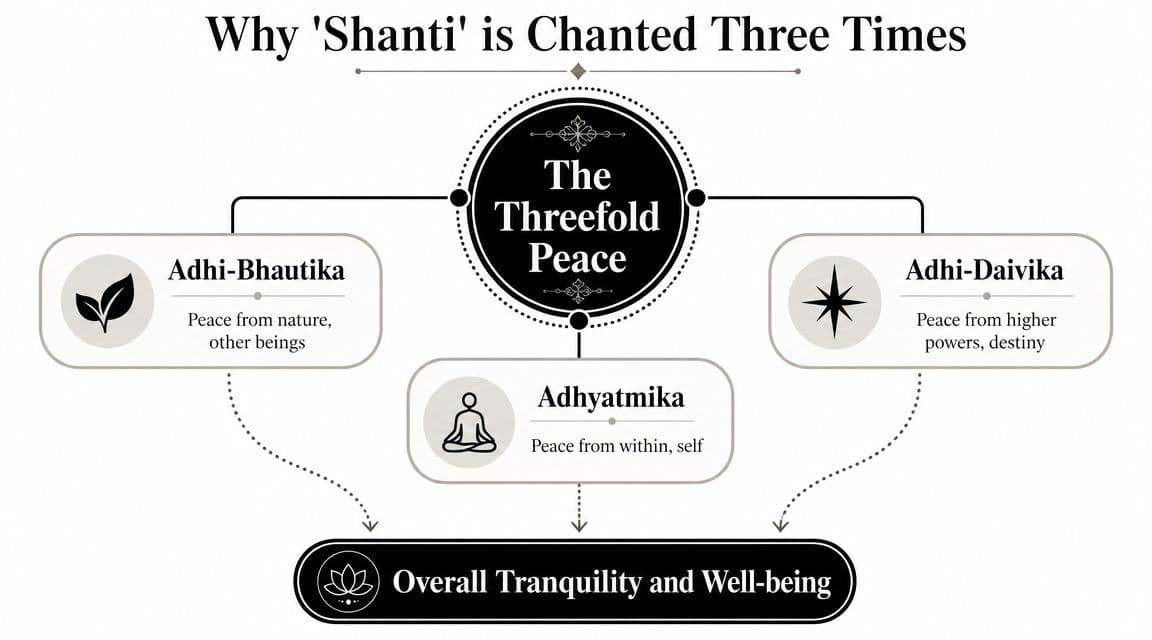
According to Brett Larkin's explanation of the Om Shanti mantra, “Shanti” means peace and is traditionally repeated three times. One major interpretation links those repetitions to peace from three categories of disturbance: divine or unseen forces, the surrounding world, and the self. The same explanation also notes that in Hindu, Buddhist, and Jain traditions, this makes Om Shanti more than a greeting. It's an invocation for inner calm and harmony.
Peace in body, speech, and mind
Another traditional interpretation sees the three repetitions as peace in body, speech, and mind. That model matters because it gives a fuller picture of what peace looks like.
A lot of people think peace is purely mental. If my thoughts calm down, I'm peaceful. But in these traditions, peace is more complete than that.
Here's an easy way to understand the three parts:
| Aspect | What it means in everyday life |
|---|---|
| Body | Your nervous system settles. Your breath softens. You feel less braced. |
| Speech | Your words become less sharp, reactive, or careless. |
| Mind | Thoughts may still arise, but they don't yank you around as much. |
That's one reason the chant resonates so profoundly. It doesn't ask for a tiny slice of calm. It asks for wholeness.
Peace from different kinds of disturbance
The other interpretation is just as useful. Life disrupts us from different directions.
- From outside forces. Noise, conflict, weather, uncertainty, other people's behavior.
- From unseen or larger forces. The parts of life that feel beyond personal control.
- From within. Anxiety, restlessness, old habits, self-criticism.
This is where the mantra becomes very human. You don't need to be a scholar to understand it. You already know what it feels like to be unsettled by the world, by circumstances, and by your own mind.
Peace isn't only something you feel inside after everything goes right. Sometimes it's what you practice while things are still messy.
That's the spiritual weight of the chant. It doesn't deny disturbance. It names peace as a response to it.
Shanti Om in Yoga and Meditation Practice
In a real class setting, Om Shanti often appears at the beginning or end of practice. A teacher may use it to set the tone, close the room, or help students carry a calmer state back into the rest of the day.
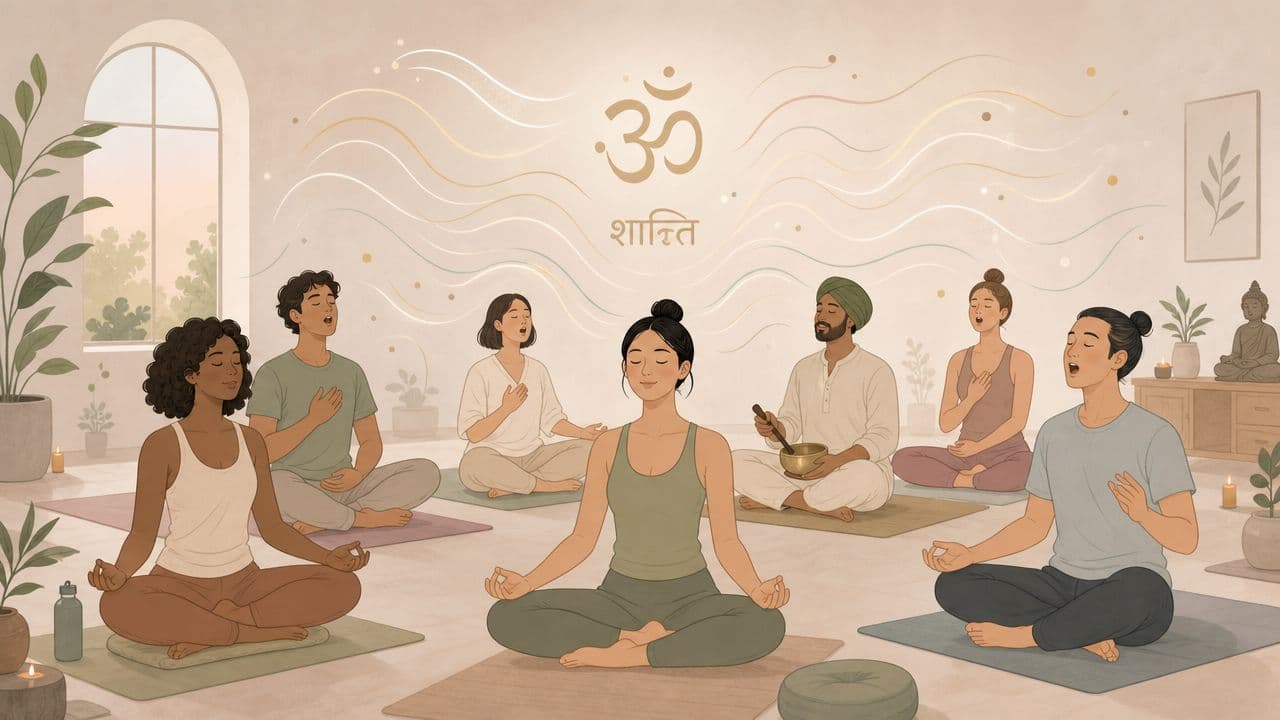
In a group, the experience can feel surprisingly grounding. You hear different voices, different confidence levels, different accents, and somehow the shared sound steadies everyone. No one has to be a singer. The point is participation and attention.
How it shows up in practice
You'll commonly find the mantra in settings like these:
- Yoga class closing. A teacher may chant it after savasana to seal the practice with a peaceful intention.
- Meditation sessions. Some people begin with Om to gather attention, then use Shanti as a gentle anchor.
- Kirtan or devotional chanting. In group chanting, simple refrains like this help people join in without feeling lost.
If you're exploring other sacred phrases and focused repetition, this guide to mantras for success gives additional context on how different mantras are used in practice.
A personal way to use it
Private practice can be very simple. Sit down. Take a breath. Say the mantra softly out loud or in your mind. Let the sound slow you down rather than trying to “perform” it correctly.
Some students like to use it:
- in the morning before checking their phone
- after a difficult conversation
- at the end of meditation
- before sleep, when the mind is still busy
What matters most is sincerity. The mantra works best as a returning point, like setting a cup down on the same table every day so you always know where to find it.
How to Use and Pronounce Shanti Om Respectfully
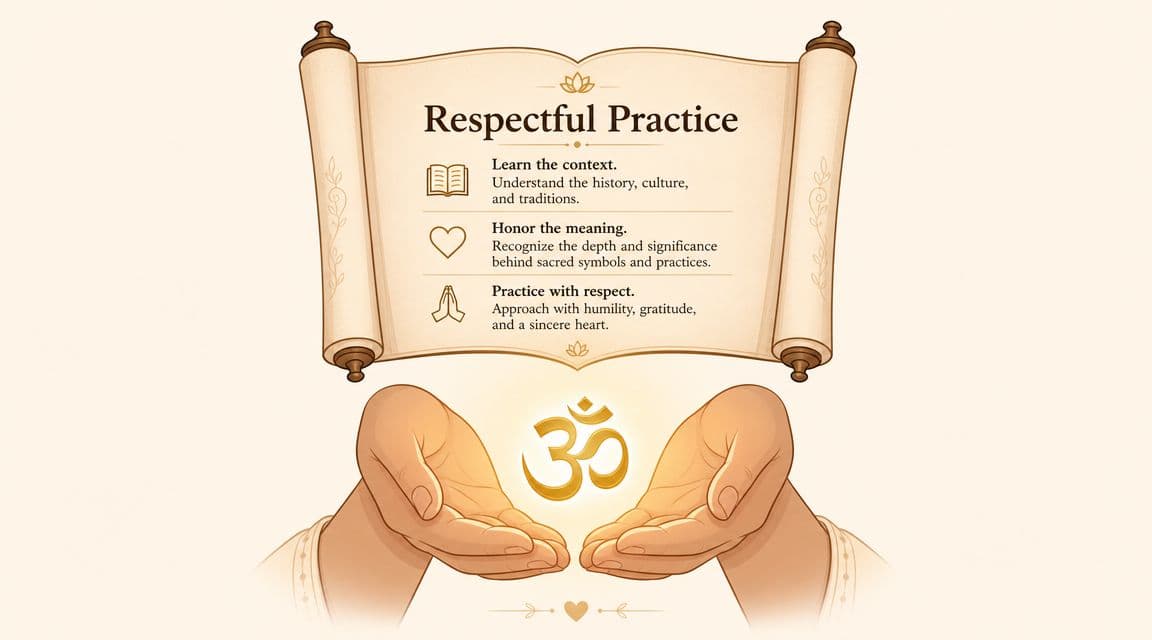
If you're going to use a sacred phrase from another language and tradition, respect matters. Not because you need to be nervous, but because understanding deepens practice.
A simple pronunciation guide
A beginner-friendly pronunciation is:
- Om sounds like a long, rounded “ohm”
- Shanti is often said like shahn-thee
You don't need a perfect accent to begin. You do need care. If you rush it, joke with it, or use it like a costume accessory, the whole thing gets flattened.
Respectful use in modern practice
A healthy approach is to remember two things at once. First, this mantra is widely used in modern yoga and meditation spaces. Second, it comes from real spiritual traditions, including Hindu, Buddhist, and Jain contexts.
That means you can use it with openness, while still honoring where it comes from.
A few grounding guidelines help:
- Learn before repeating. Even a basic understanding changes the quality of your practice.
- Use intention, not performance. A quiet, sincere chant means more than a dramatic one.
- Stay curious about roots. If you practice yoga, learning foundational ethics helps. This overview of the yamas and niyamas is a good next step.
- Let meaning shape sound. If the mantra points to peace, say it in a way that reflects peace.
Say it as a prayer for harmony, even if you think of prayer in very broad terms.
Many people worry about “doing it wrong.” Usually the bigger issue isn't imperfect pronunciation. It's casual use without care. Reverence doesn't have to look formal. It can be as simple as pausing, breathing, and remembering these words are meant to calm, not decorate.
Bringing the Essence of Shanti into Your Life
The deepest value of this mantra isn't that you learn a translation. It’s that you start noticing where peace is missing, and how often you're searching for it outside yourself.
Chanting can help. So can silence, breathwork, prayer, journaling, long walks, and honest self-study. Shanti is bigger than a sound. It's a direction.
What Shanti can look like off the mat
In daily life, peace often looks ordinary:
- A slower response instead of a quick reaction.
- A steady breath in the middle of stress.
- A clearer no when something pulls you out of alignment.
- A kinder inner voice when you make a mistake.
That's where the mantra becomes modern without losing its roots. It reminds you that peace isn't only something you feel in ideal conditions. It's something you practice in traffic, at work, in family tension, and in the quiet moments when you ask what kind of life you're building.
Peace and purpose belong together
Many people discover that they don't just want calm. They want meaningful calm. They want a life that feels aligned.
That's where reflection on purpose becomes useful. For readers drawn to ancient-wisdom frameworks for self-knowledge, Dan Millman's book The Life You Were Born to Live offers a structured way to explore life path, personal lessons, and growth themes. Its digital companion, the Life Purpose App, lets users enter a birth date to explore one of 45 unique life paths, along with spiritual laws, gifts, challenges, and life-cycle patterns described by the publisher.
If you want a gentle bridge between meditation and self-inquiry, this article on meditation for self-discovery is a helpful place to continue.
Peace and purpose aren’t separate projects. Often, people feel more settled when they stop scattering their energy and begin living in a way that matches who they are.
When you hear or say Om Shanti, you don't need to force a mystical experience. You can let it be a small, sincere act. A return. A reminder that peace in body, speech, and mind is worth practicing, even on ordinary days.
If you're exploring peace not just as a feeling but as a path, Life Purpose App is one way to continue that inquiry. It's the digital companion to Dan Millman's The Life You Were Born to Live, designed to help you explore your life path, core lessons, and personal growth themes through an ancient-wisdom framework.
Discover Your Life Purpose Today!
Unlock your true potential and find your life’s purpose.
