Discover what is a lifebook and how this structured tool helps with self-discovery, numerology, and understanding your life path with Dan Millman's system.
August 19, 2026 (1mo ago)
What Is a Lifebook? Guide to Purpose and Clarity
Discover what is a lifebook and how this structured tool helps with self-discovery, numerology, and understanding your life path with Dan Millman's system.
← Back to blog
A lifebook is a structured, chapter-style record of your life story used to build self-understanding, and in contemporary self-growth contexts it's often paired with numerology and life-path insight rather than treated only as a diary. It organizes memories, turning points, relationships, values, and future direction into a narrative you can revisit and use.
But what is a lifebook when the word can describe both a child-welfare record and an adult personal-growth practice? The answer depends on context. In foster care and adoption, it's a carefully maintained record of a child's history, identity, relationships, and experiences. In self-development, it's a reflective framework for making meaning from your own life.
This guide focuses mainly on the second meaning while explaining the first clearly, so you can recognize the difference and choose an approach that fits your needs.
What Is a Lifebook?
A lifebook is an organized account of a person's life, arranged so that experiences can be understood as connected chapters rather than scattered memories. It may include important events, family relationships, achievements, difficulties, photographs, personal reflections, and questions about identity. Unlike a casual diary, it has a deliberate structure and a purpose beyond recording what happened on a particular day.
The term has a formal meaning in child welfare. Agencies use lifebooks to help children in foster care keep track of where they've lived, who has mattered to them, and which events shaped their identity. Child-welfare guidance describes the book as a chronological record that can include placement history, school and daycare experiences, medical information, photographs, achievements, journaling prompts, and the names and pictures of siblings. Social Work Today explains the child-welfare role of lifebooks.
That version is connected to trauma-informed care. Multiple placements can interrupt a child's sense of continuous personal history, so a lifebook helps preserve information that might otherwise be lost. It can function as both a therapeutic tool and a documentation system.
For adults exploring self-growth, the same principle becomes more personal. You might divide your life into chapters such as childhood, education, first work, major relationships, loss, reinvention, or the period when your values changed. You're not trying to create a perfect autobiography. You're creating a usable map of how you became who you are and where you want to go next.
How a Lifebook Works
A lifebook works by giving your memories a narrative container. Instead of opening a blank page and wondering what to write, you identify periods of life, name them, and describe the experiences that gave each period its meaning.
Qualitative life-story research uses a similar chapter-based method. The standard approach asks a person to divide their life into chapters, assign titles, and narrate each chapter as a coherent sequence. The Cambridge supplementary protocol describes this structured life-story approach.
The basic building blocks
A practical lifebook usually contains four connected elements:
- Chapters: Each chapter represents a meaningful period, not necessarily a calendar year. “Learning to Stand Alone” may be more useful than a date range.
- Turning points: Record choices, losses, discoveries, moves, relationships, and opportunities that changed your direction.
- Themes: Look for repeated ideas, such as responsibility, independence, belonging, creativity, or fear of rejection.
- Forward meaning: End each chapter by asking what you learned, what you're carrying forward, and what you're ready to release.
The structure turns memory into reflection. A difficult career change, for example, can appear first as a painful disruption. After you place it beside earlier experiences, you might notice a recurring preference for autonomy or a pattern of staying too long in roles that no longer fit.
Practical rule: A lifebook doesn't need every detail. It needs enough context to show how events affected your choices, identity, and direction.
The process can be time-intensive when you want a faithful record. Life-history methods emphasize recording interviews, transcribing them, keeping detailed observations, and writing field notes soon after each session. A Cornell legacy interview project began with face-to-face pilot interviews of about 80 elders, then added roughly 240 additional interviews lasting 1 to 2 hours in a national sample, illustrating the substantial work involved in preserving detailed life stories. The life-history interview guidance is available through this oral-history resource.
Lifebook vs Journal, Planner, and Scrapbook
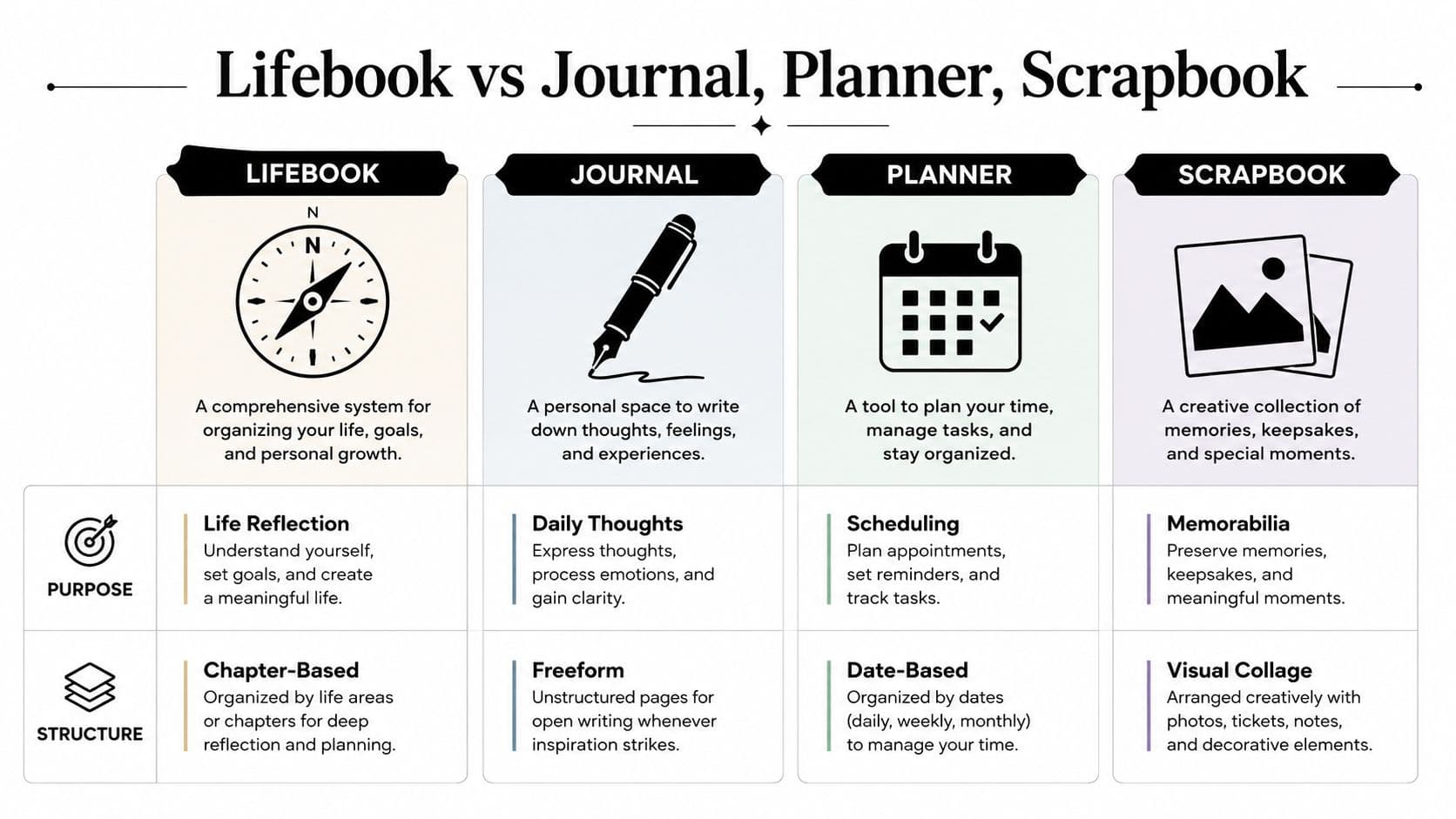
The easiest way to understand a lifebook is to compare its job with the jobs of familiar tools. A journal captures thoughts as they arise. A planner organizes upcoming actions. A scrapbook preserves visual reminders. A lifebook connects experiences across time and asks what they mean.
| Tool | Main purpose | Typical structure | Time orientation |
|---|---|---|---|
| Lifebook | Life reflection and identity | Chapter-based | Past, present, and future |
| Journal | Daily thoughts and feelings | Freeform | Present-focused |
| Planner | Scheduling and execution | Date-based | Future-focused |
| Scrapbook | Memorabilia and visual memory | Collage-based | Selected past moments |
A journal can become part of a lifebook, but the two aren't interchangeable. A journal might contain an unfiltered reaction to a difficult conversation. The lifebook later places that conversation inside a wider chapter about boundaries, communication, or a relationship's development.
A planner answers, “What do I need to do?” A lifebook asks, “Why am I choosing this, and does it belong to the life I'm building?” If you need help organizing your commitments before reflection, these block schedule examples can provide a useful planning reference, but a schedule alone won't create a personal narrative.
A scrapbook may hold photographs from a trip, while a lifebook adds the surrounding story. Why did the trip matter? Who were you becoming at the time? Which expectation changed afterward? That interpretive layer gives the lifebook its distinct value.
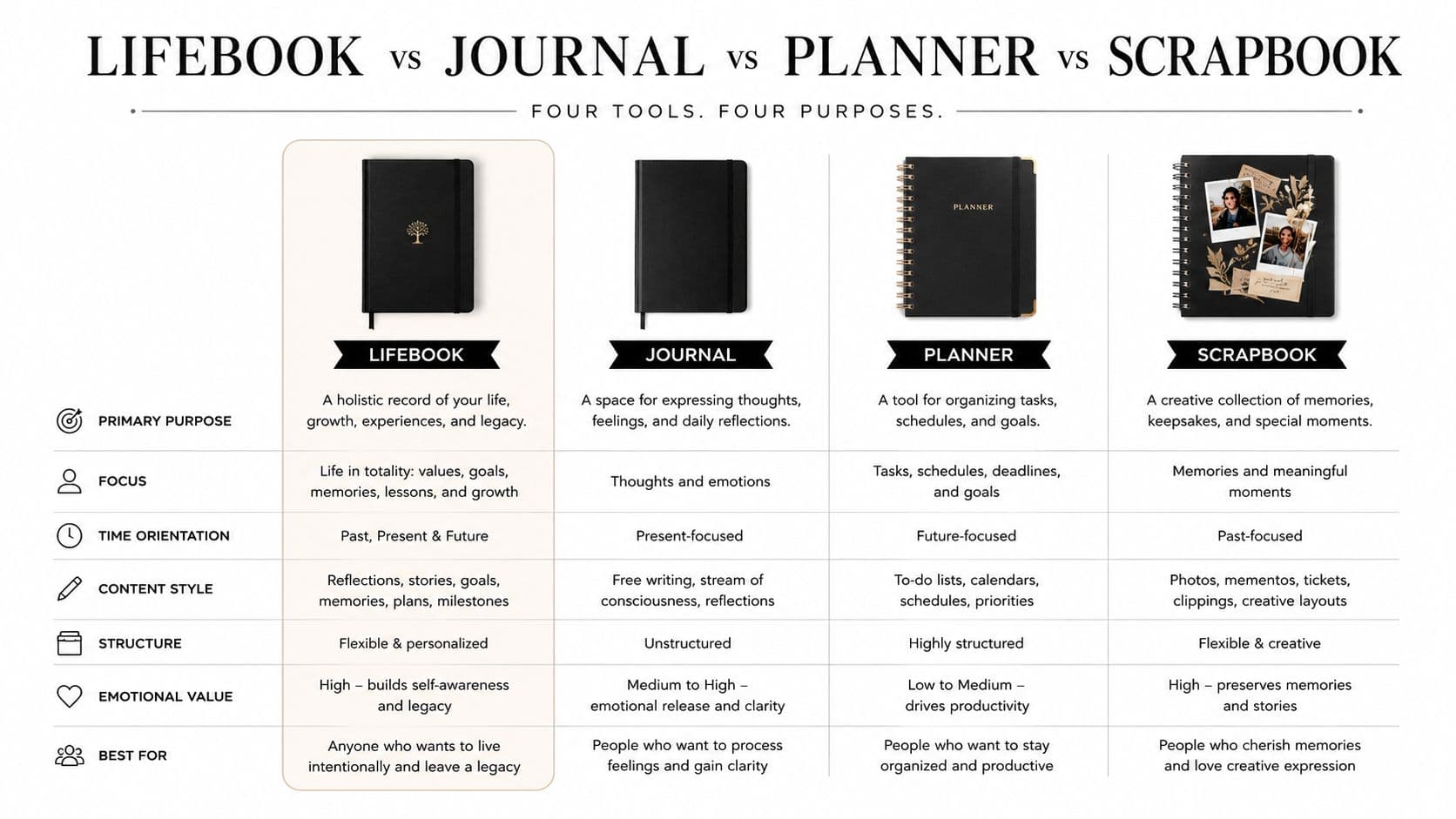
For a spiritual-growth variation, you can combine a lifebook with a dedicated resource that complements the journal material; the important distinction remains the same: the journal supplies raw material, while the lifebook helps you interpret the larger pattern.
Numerology, Life Paths, and Dan Millman's Approach
Some readers encounter the word lifebook while looking for numerology or a personal life-path reading. These practices can complement a lifebook, but they aren't identical. A lifebook is a reflective record you create from lived experience. Numerology offers a symbolic framework for interpreting birth data and recurring themes.
Dan Millman's The Life You Were Born to Live presents a system with 37 life paths and explains how to determine your own life path, as well as other people's life paths, from birth data. The book also addresses core issues, inborn talents, special needs, and relationship dynamics. The book's description outlines its life-path system.
The 25th Anniversary Edition states that the system can determine the life path of anyone born between 1750 and the present. It also describes a post-2000 rule in which some people born after 2000 can have single-digit birth numbers. Google Books provides the edition's published description.
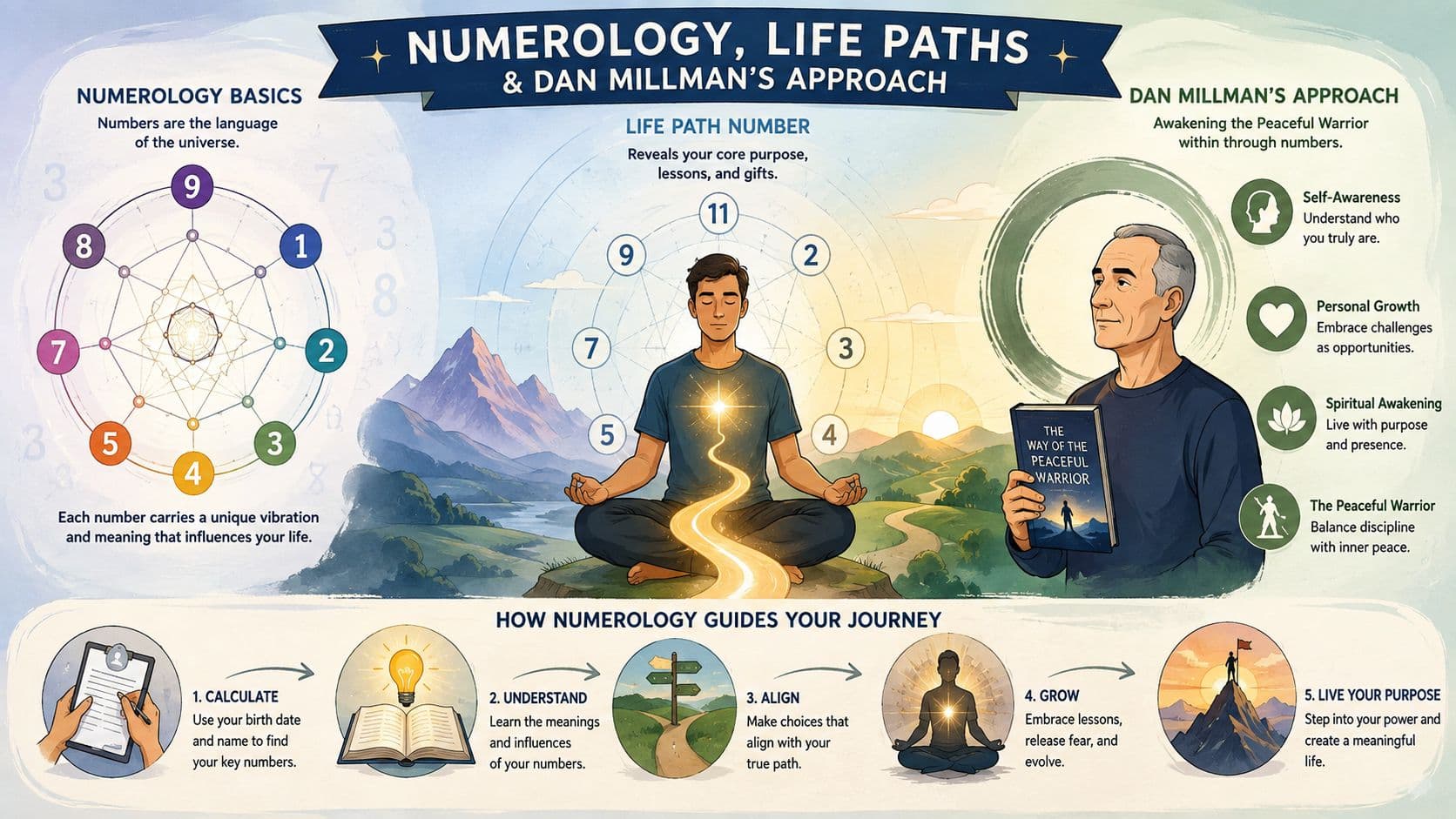
A lifebook can use these ideas as prompts rather than verdicts. If a life-path reading highlights a theme such as discipline, compassion, or responsibility, write about moments when that theme appeared in your life. Did you express it naturally, resist it, or learn it through difficulty?
The numerology guide can help readers understand the relationship between The Life You Were Born to Live and the Life Purpose App. The book offers the underlying system, while the app provides a digital way to explore life-path information and use it as a reflection prompt.
A related numerology method calculates a personal year by adding your birth month, birth day, and the current calendar year, then reducing the total to a single digit. Many numerology traditions group the resulting nine-year cycle into three phases: years 1 to 3 as expansion, years 4 to 6 as consolidation, and years 7 to 9 as reflection and completion. This personal-year explanation describes the calculation and cycle phases.
Real-Life Examples of Lifebook Use
Consider an adult leaving a long-held career. A journal might capture anxiety about interviews, and a planner might list applications. The lifebook adds a chapter called “Choosing Work That Fits,” linking the transition to earlier moments when the person felt energized by teaching, problem-solving, or independent responsibility. That broader record can make the next decision more deliberate.
Another person may use a lifebook to understand relationship patterns. They might create chapters for significant friendships and partnerships, then record what helped them feel safe, what boundaries they ignored, and which needs they struggled to express. The result isn't a scorecard against other people. It's a clearer account of the conditions that support healthy connection.
Someone with a fragmented or painful history may need a gentler approach. Missing information can be acknowledged without being filled with guesses. A blank chapter can say, “Records are incomplete,” followed by what is known, what remains uncertain, and how that uncertainty affects the person today.
A truthful lifebook can include unanswered questions. Accuracy matters more than a smooth story.
A fourth use is intentional planning for the next phase of life. You might review previous chapters, identify values that have remained steady, and write a future chapter in provisional language. The aim isn't to predict events. It's to define the choices, relationships, and habits you want to make more central.
For help with shaping memories into a coherent narrative, BarkerBooks memoir writing advice offers a useful complement. Memoir techniques can help you select meaningful scenes without turning your lifebook into an exhaustive record of every day.
How to Start a Lifebook Practice
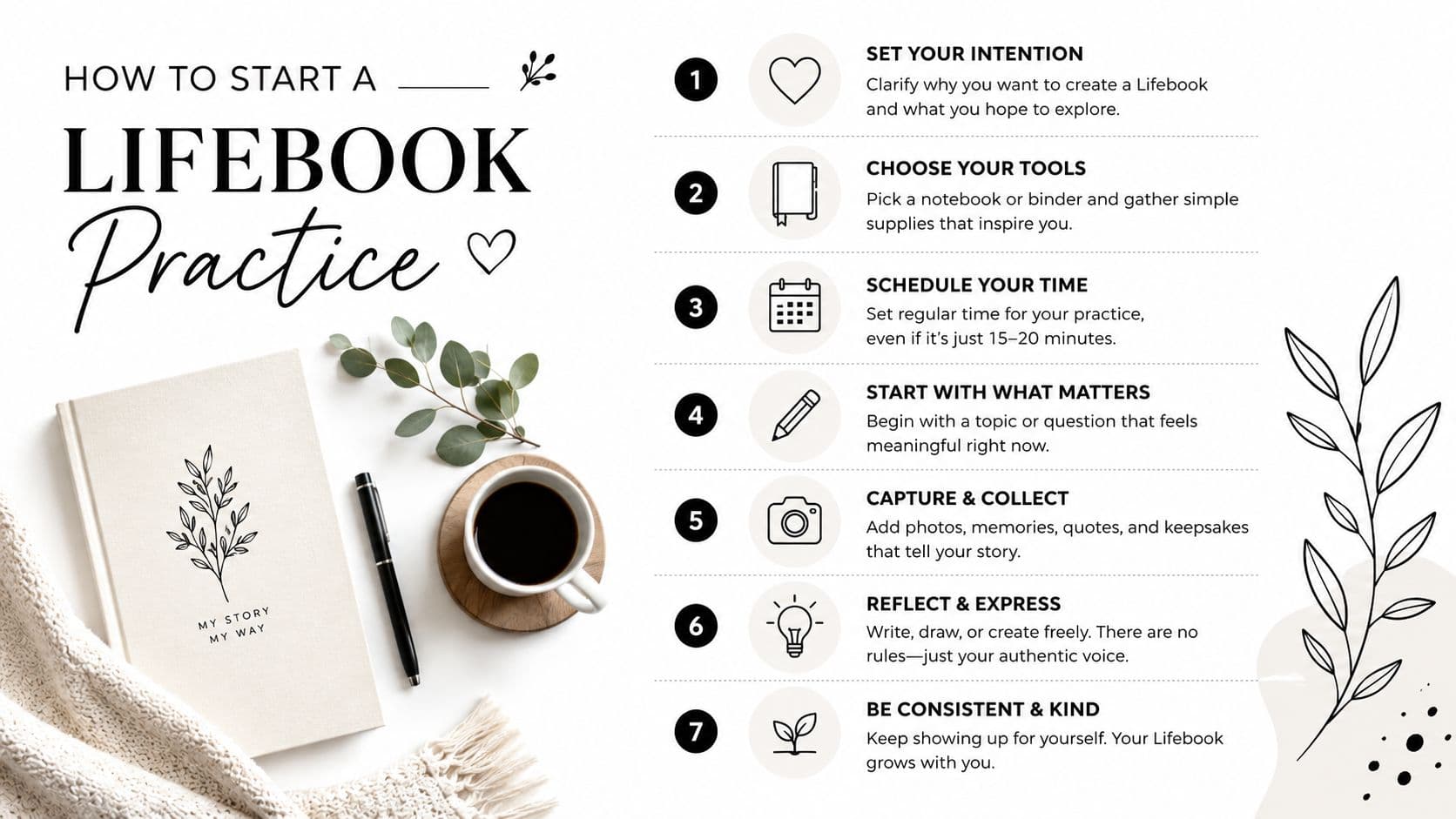
Start with a format you'll revisit. A paper notebook works well for private, tactile reflection. A digital document makes rearranging chapters and adding photographs easier. Choose one, then create a simple opening page with your name, the date you began, and the question you want the lifebook to answer.
Next, divide your life into broad chapters. Begin with a period that feels accessible, not necessarily the earliest memory. Give it a title, list the major events you remember, and write what changed inside you.
Use this starter sequence:
- Name the chapter: Choose a short title that captures its emotional meaning.
- Place the events: Add people, settings, decisions, and transitions.
- Identify the lesson: Describe what the period taught you about yourself.
- Choose the next question: End with something you want to understand or practice.
You can use 2026 self-discovery journal prompts for additional questions, while adapting them to your own history. If you explore numerology, Dan Millman's The Life You Were Born to Live and the Life Purpose App can supply birth-data insights to investigate, not rules that dictate your choices.
A values exercise can sharpen the connection between your chapters and your future. Try this exercise, then return to your lifebook and mark where those values have guided or conflicted with your decisions.
Frequently Asked Questions About Lifebooks
Is a lifebook private? It should be treated as private by default, especially when it contains sensitive experiences, family information, or reflections about other people. Decide who can access it before sharing pages.
Can I update an existing lifebook? Yes. A lifebook is a living record, not a finished artifact. Add new chapters, revise interpretations, and label uncertain information rather than presenting guesses as facts.
Does a digital lifebook work? It can. Digital tools make it easier to search, reorganize, back up, and attach recordings or photographs. Use strong privacy settings and keep a secure backup.
What if I don't remember everything? Gaps are normal. Write what you know, identify what you don't know, and avoid forcing difficult memories into a neat explanation. If a chapter brings up distress, consider working with a qualified mental-health professional.
Is a lifebook only for foster care or adoption? No. The child-welfare meaning is important, but adults can use the same chapter-based principle for identity work, personal growth, relationships, and life direction.
The Life Purpose App gives you a digital way to explore Dan Millman's The Life You Were Born to Live, including life-path insights and cycle-based reflection prompts. Visit Life Purpose App to add birth-data exploration to your lifebook practice and turn abstract questions about purpose into specific pages you can write and revisit.
Discover Your Life Purpose Today!
Unlock your true potential and find your life’s purpose.
