What is life purpose? Learn what it means, why it matters for health and happiness, and how to explore your own path with clarity.

September 19, 2026 (1mo ago)
What Is Life Purpose and How to Find Yours Today
What is life purpose? Learn what it means, why it matters for health and happiness, and how to explore your own path with clarity.
← Back to blog
What is life purpose? Learn what it means, why it matters for health and happiness, and how to explore your own path with clarity.
You might be here because your life looks fine from the outside, but inside it feels oddly blurry. You get things done. You answer messages, meet deadlines, show up for people. Still, a quiet question keeps returning: What am I doing this for?
That question doesn't mean you're failing. It usually means you're paying attention.
A lot of people think life purpose should arrive like lightning. One perfect realization. One career. One calling that explains everything. For many, it doesn't work that way. Purpose tends to show up more like a pattern than a proclamation. You notice what keeps pulling your care, your effort, your honesty, and your energy.
Introduction to What Life Purpose Really Means
A common moment goes like this: someone reaches a goal they worked hard for, then feels a strange flatness the week after. Not because the goal was wrong, but because goals answer a shorter question. They tell you what to do next. They don't always tell you why your life is pointed in that direction.
That's where purpose becomes useful.
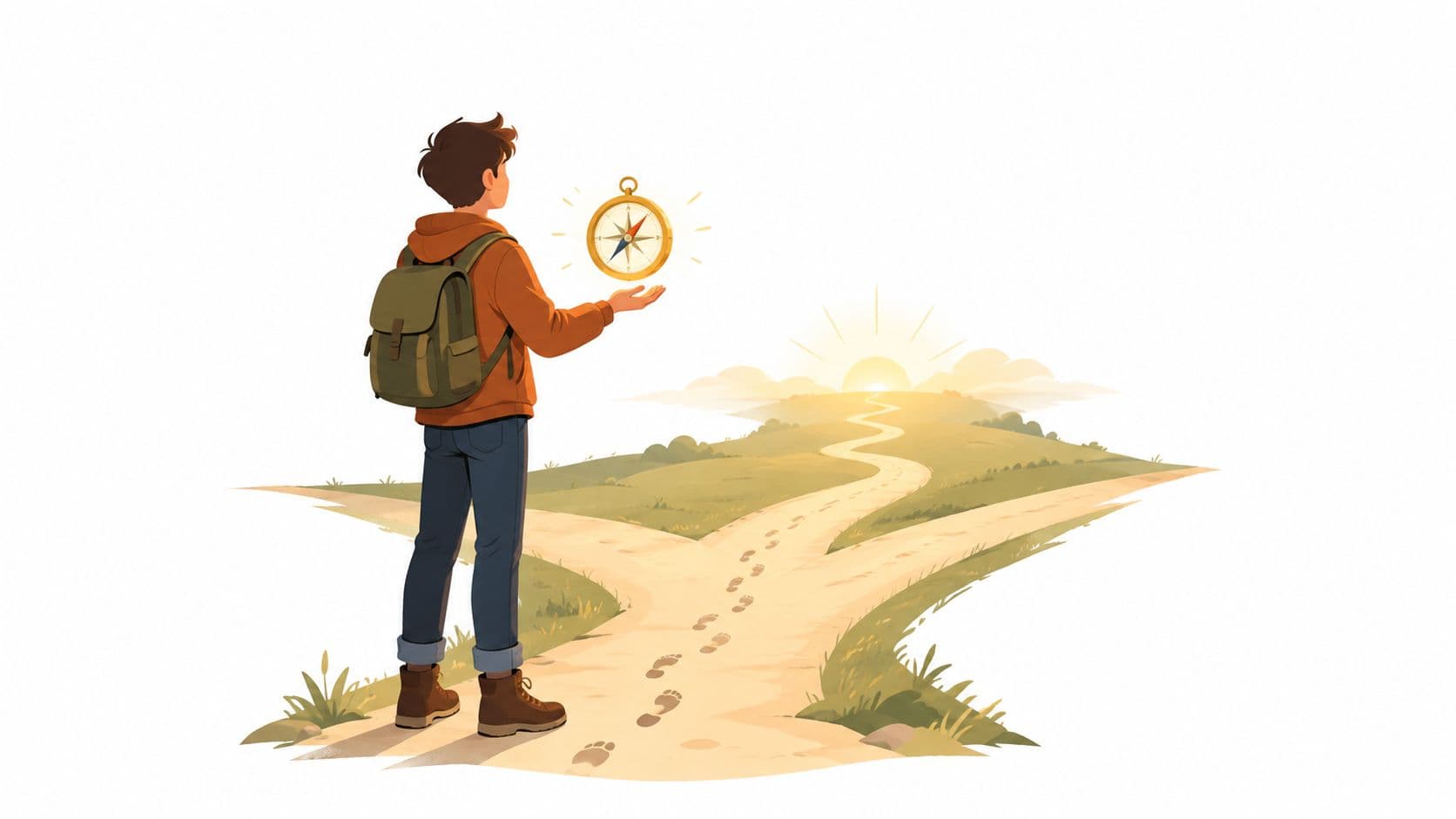
Think of two people with the same busy week. Both work, help family, and try to rest. One feels scattered and drained. The other feels stretched but anchored. The difference often isn't the schedule. It's whether their daily actions connect to something that feels worth doing.
Purpose feels small before it feels big
Life purpose doesn't always begin with a dramatic mission statement. Sometimes it starts with smaller signs:
- A repeating pull: You keep caring about a certain kind of problem, person, or contribution.
- A steadying effect: Hard choices become clearer when you ask what matters most.
- A sense of fit: You may still feel tired or challenged, but not hollow.
Purpose is less like finding a treasure map and more like learning to read your own compass.
People also get stuck because they expect certainty before action. Usually, the opposite is true. You act a little, reflect a little, and your sense of direction gets sharper.
That matters because purpose isn't only a philosophical topic. It's personal, practical, and something you can explore. Modern psychology treats it as something real enough to study, describe, and measure. Spiritual systems try to illuminate it in other ways too, including the life-path lens in Dan Millman's The Life You Were Born to Live and the Life Purpose App.
If you've been wondering what life purpose is, you don't need a grand answer by tonight. You need a clearer way to notice what gives your life direction, and how to live closer to it.
What Life Purpose Is and How It Works
A person can be busy, kind, capable, and still feel off course. That uneasy feeling often comes from a missing aim, not a missing talent. Life purpose gives your life an organizing center.
When people ask what life purpose is, they are usually reaching for something more precise than what you enjoy. They want to know what kind of aim can hold together many parts of a life, including work, love, service, growth, and hard seasons that do not feel enjoyable at all.
A practical definition
A goal has an endpoint. A mood comes and goes. A role can change with age or circumstance.
Purpose works more like a compass setting. It is a meaningful life aim that helps organize your choices over time. In psychology, purpose is often described as a life aim that is stable enough to guide behavior and broad enough to reach beyond short-term self-interest.
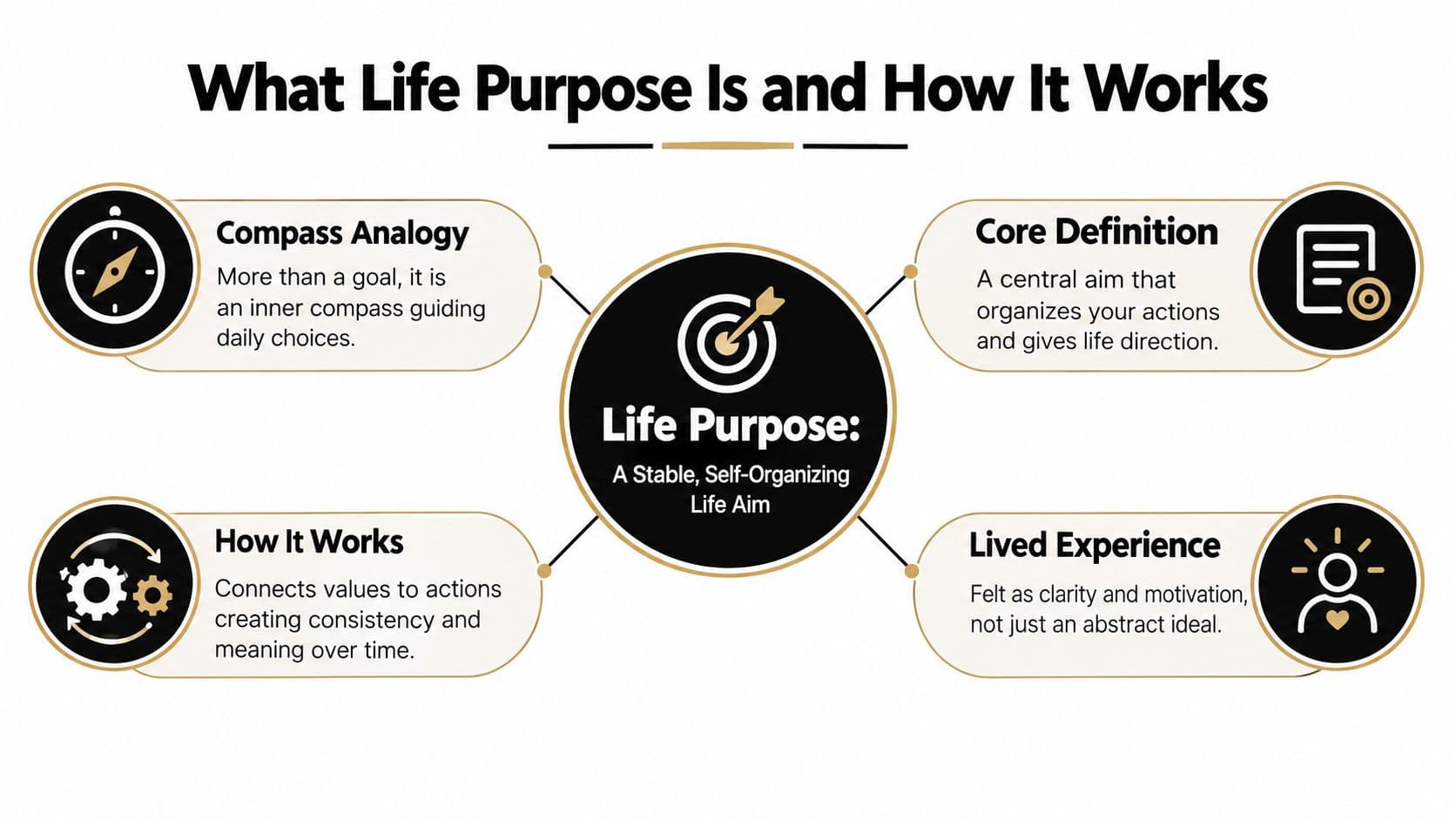
That phrase organize your choices matters. Purpose is not only an inspiring idea you write in a journal. It sorts your decisions. It shapes what you commit to, what you release, and what kind of effort feels worthwhile.
You can measure that quality, at least in part. Psychologists have developed tools to assess whether a person feels directed, meaningful, and connected to aims that matter. One early milestone was the Purpose in Life Test, developed in 1969 with the assistance of Viktor Frankl. Later measures built on that foundation, as described in this overview of the psychology of purpose.
How purpose actually works in daily life
Purpose does not usually arrive as a single lightning-bolt insight. It works more like a pattern that becomes easier to see over time.
A teacher offers a clear example. The job is teaching history. The purpose might be helping young people think clearly, tell the truth, and act with integrity. If that teacher changes schools, takes a break to care for family, or later mentors adults instead of teens, the outer role changes. The inner aim still holds.
That is why purpose can travel across stages of life. The expression may shift, but the underlying direction can remain recognizable.
This also helps explain why purpose feels more solid than passion alone. Passion can surge around an activity. Purpose links activities into a larger aim.
A wider lens than one true calling
Many people get stuck because they picture purpose as one grand destiny they must discover perfectly. That idea makes purpose feel dramatic, distant, and easy to miss.
A more useful frame is this: life purpose is learnable. It can be observed in your patterns, tested in action, and refined with language that gets more accurate over time.
That is part of what makes Dan Millman's life-path system interesting. In The Life You Were Born to Live, and in tools such as the Life Purpose App, purpose is not treated as one vague, universal message. It is approached through distinct life-path patterns, including 45 different paths, each with its own lessons, strengths, and likely growth edges. You do not have to accept that system as absolute truth to find the lens helpful. It gives people a concrete way to ask what kind of life you are learning to live well?
What purpose includes, and what it does not
Purpose can show up through a career, but it is larger than a job title.
Purpose can include joy, but it also survives ordinary days, grief, sacrifice, and slow progress.
Purpose can involve gifts and interests, yet it also includes responsibility. It asks not only what feels natural to you, but what kind of contribution you are trying to make with your life.
That is why two people can do the same work and experience it differently. One is only completing tasks. The other can feel that the same tasks serve a deeper aim.
Purpose creates coherence. A life can still be messy, changing, and unfinished while becoming more coherent. That is how life purpose works.
Why Life Purpose Matters for Health and Wellbeing
A person can know they should sleep more, move their body, call a friend back, or keep a medical appointment, and still drift away from those habits. The missing piece is often not information. It is a reason that feels personal enough to live by.
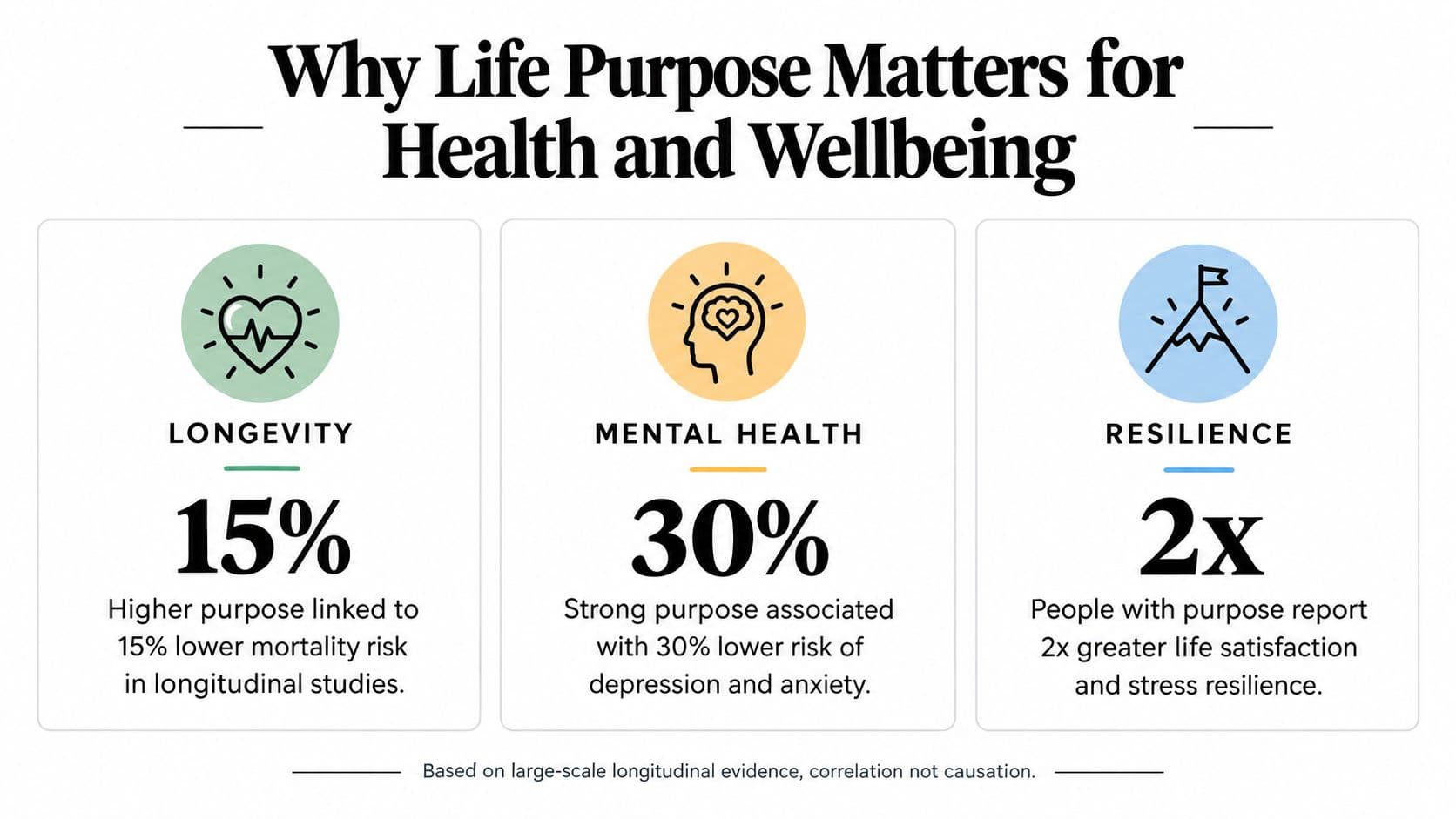
Purpose gives daily choices a direction. It works like a compass more than a finish line. You may still feel tired, discouraged, or unsure, but a clear aim can make it easier to return to habits that support your life instead of draining it.
What the research shows
Research on purpose and wellbeing keeps pointing in the same direction. People who report a stronger sense of purpose often have better mental health, stronger resilience, and healthier long-term outcomes.
A major 2026 meta-analysis in Psychological Medicine pooled data from 488,765 participants followed for up to 32 years and found that higher purpose in life was associated with an approximately 30% lower risk of earlier mortality. The meta-analytic result was HR = 0.76, 95% CI 0.70–0.83, and the combined samples included 48,928 deaths, according to the full meta-analysis in Psychological Medicine.
A separate meta-analysis found that greater purpose was associated with lower depression (r = -0.49) and lower anxiety (r = -0.36), as reported in this research summary on purpose and mental health.
Those findings do not mean purpose guarantees health or protects anyone from loss, illness, or stress.
They suggest something more realistic. A felt sense of meaning can support patterns of living that are easier to sustain over time.
How purpose may help in daily life
Purpose shapes repetition. Repetition shapes health.
When someone has a workable life aim, healthy behaviors stop feeling random or cosmetic. Rest becomes part of stewardship. Exercise becomes training for the life they want to show up for. Boundaries protect attention. Friendship and community stop looking optional.
Purpose is not only inspiring. It is organizing. It helps people decide what to do on an ordinary Tuesday, which is where wellbeing is built.
Earlier research discussed in this article also found that adults with a stronger sense of purpose tended to show better later physical, behavioral, and psychosocial outcomes over time. The pattern included things like better activity and social habits, which helps explain why purpose can matter in practical health terms.
That is one reason the idea of purpose is more useful when it becomes specific. If purpose stays vague, it cannot guide much. If it becomes measurable and learnable, people can test it against real life. They can ask, Does this aim help me care for my body, mind, relationships, and responsibilities more consistently?
For a practical extension of that idea, the Life Purpose App team offers a short piece on why life purpose matters in everyday life.
How Life Paths Illuminate Your Purpose According to Dan Millman
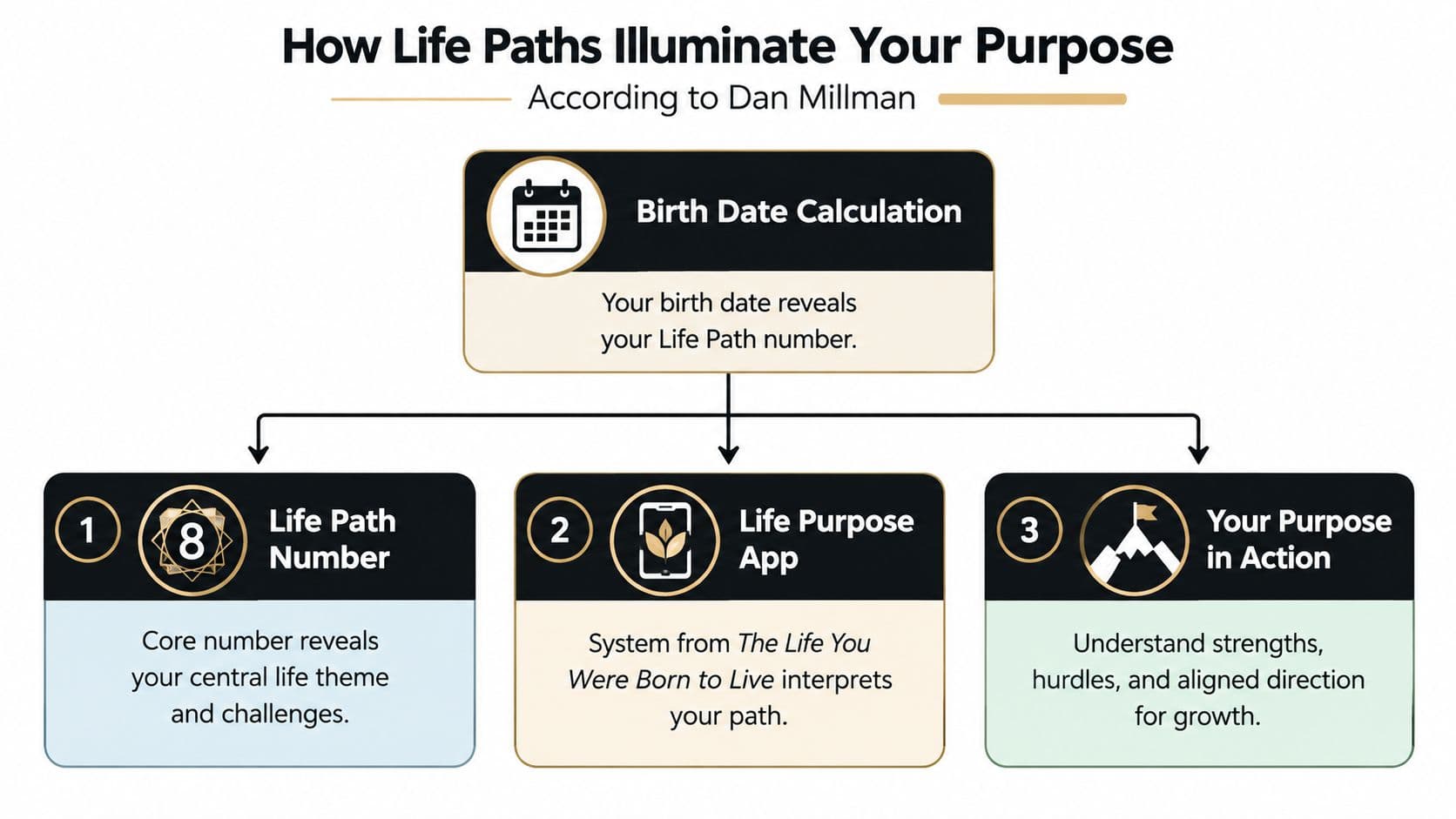
Some people explore purpose through psychology. Others also want a symbolic or spiritual lens that makes their patterns feel more personal. One of the clearest structured examples comes from Dan Millman's The Life You Were Born to Live, which the Life Purpose App is based on.
The basic life-path idea
In the revised 25th Anniversary Edition of The Life You Were Born to Live, Dan Millman says the system expanded from 37 life paths in the original edition to 45 life paths in the newer edition, including new insights, clarified language, and material for people born after 2000, as noted in this discussion of the revised edition.
The method described in the book and reflected in the Life Purpose App uses your birth date. You add the digits of the month, day, and year to produce a full total, and that total is used to identify one of 45 distinct life paths, according to the Life Purpose App overview.
This is important because the system does not treat purpose as one generic slogan. It treats purpose as a pattern with distinct challenges and strengths.
What the framework tries to reveal
According to the revised book listing, each path includes guidance about core issues, innate talents, and special needs, along with themes tied to health, money, sexuality, career guidance, relationship purpose, the nine-year cycle, and key spiritual laws in The Life You Were Born to Live revised edition.
That kind of framework can help people ask sharper questions, such as:
- Where do I predictably struggle?
- What gifts come naturally, even if I undervalue them?
- Which lessons keep repeating in relationships or work?
A good framework doesn't replace self-honesty. It gives self-honesty more shape.
If you're curious how this life-path lens is presented in relation to numerology and purpose, there's a concise overview at your life purpose with Dan Millman numerology.
Used well, a life-path reading isn't meant to trap you in a label. It gives language to themes that may already be active in your life.
Common Misunderstandings About Life Purpose
Most confusion about life purpose comes from trying to force it into a narrow story. One calling. One timeline. One permanently inspiring feeling. Real life is less tidy than that.
A person can have a steady core purpose and still change careers. Another can feel purposeful in caregiving, then later in teaching, then later in community work. The thread can stay intact even while the form changes.
Where people often get stuck
One modern pressure point is the belief that everyone should already feel clear and inspired. Yet recent Gallup reporting found that 45% of Gen Z respondents report lacking meaning, purpose, or both, which suggests uncertainty is not unusual and may reflect life stage as much as personal failure, according to Gallup's report on Gen Z and meaning.
The same report also notes that purpose may take multiple forms, including survival, religious, personal-accumulative, altruistic, self-expansive, and transpersonal. That's a useful correction to the idea that there is only one noble or valid kind of purpose.
Myths vs realities about life purpose
| Common Assumption | More Nuanced Reality |
|---|---|
| Purpose is one grand destiny | Purpose can be a steady life aim expressed in different roles and seasons |
| If I haven't found it yet, something is wrong with me | Uncertainty is common, especially during transitions, grief, early adulthood, or burnout |
| Purpose should always feel uplifting | Purpose can involve sacrifice, repair, duty, healing, or survival |
| Everyone's purpose should look service-oriented in the same way | People express purpose through different types, including practical, spiritual, relational, and growth-oriented forms |
| Once I know my purpose, I'll never doubt again | Clarity often comes in waves and needs revisiting |
Some people don't need a brand-new purpose. They need permission to recognize the one already showing up in ordinary life.
That might look like protecting a family, making beauty, mentoring younger people, telling hard truths well, building fair systems, or learning how to live with integrity after a painful chapter. None of those are small.
Practical Ways to Explore and Live Your Purpose
You don't have to solve your whole life to begin living with more purpose. The better approach is usually gentler and more concrete. Notice patterns. Run small experiments. Pay attention to what creates a sense of honest alignment.
Start with observation, not pressure
If you're overwhelmed by the question what is life purpose, shrink the question.
Ask instead:
- When do I feel most useful?
- What kind of problems do I care about even when nobody asks me to?
- What leaves me tired but satisfied, instead of tired and empty?
Write your answers down for a week. Short notes are enough. Purpose often becomes visible through repetition.
If you need help getting clearer on values first, this guide on how to connect with your values is a practical place to start because purpose tends to grow where values and action meet.
Try small purpose experiments
A purpose experiment is simple. You choose one possible direction and test it in real life.
- At work: Volunteer for the kind of task that fits your deeper motivation. If you care about mentoring, help onboard someone. If you care about clarity, improve a messy process.
- In relationships: Notice where you naturally bring steadiness, honesty, comfort, challenge, or vision.
- In health: Ask what your body needs so you can keep living the life you're trying to build.
Some experiments confirm a direction. Others rule one out. Both are useful.
Use tools that give language to patterns
Journaling helps. Honest conversation helps. So does a structured framework.
One option is the Life Purpose App, a digital companion to Dan Millman's The Life You Were Born to Live. It uses your birth date to identify one of the 45 life paths described in that system and offers material related to spiritual laws, relationship themes, and nine-year cycles. For some people, that creates a more concrete starting point than free-form reflection alone.
You can also read practical guidance on living your purpose if you want examples of how purpose shows up in daily choices rather than only in big life decisions.
Practice to try this week: Pick one action that feels quietly aligned, do it three times, and notice what changes in your energy, attention, and self-respect.
Purpose grows through expression. It gets stronger when you live it.
Bringing Your Life Purpose Into Focus
Life purpose isn't reserved for the unusually gifted, the spiritually certain, or the people with perfect five-year plans. It's a human question. It belongs to anyone who wants their life to feel more coherent, honest, and alive.
The most helpful shift is this: stop treating purpose like a hidden object you must uncover once and for all. Treat it like a relationship. You listen for it, test it, refine it, and return to it as your life changes.
Psychology gives us one useful lens by showing that purpose is measurable and connected with meaningful differences in wellbeing. Dan Millman's The Life You Were Born to Live offers another lens by framing purpose through 45 life paths, each with its own lessons and strengths. The Life Purpose App extends that framework in a practical format for people who want to explore it personally.
Both approaches point toward the same deeper truth. Purpose isn't only about answering what you should do; it's also about asking what kind of life you are shaping through your daily actions.
If you're still unsure, that's okay. Start smaller than your fear tells you to. Notice what matters. Protect it. Practice it. Let your life teach you what belongs.
Then ask one honest question and keep it close: What feels meaningful enough that I'd want to keep growing toward it?
If you want a more structured way to explore this question, Life Purpose App offers a birth-date-based life-path reading drawn from Dan Millman's The Life You Were Born to Live, along with guidance on themes like relationships, spiritual laws, and nine-year cycles. It's a practical next step if you want to turn the idea of purpose into something you can study, reflect on, and apply in daily life.
Discover your life path today
Enter your date of birth and see your life path, free.
Find your life path