What is love compatibility really? Learn the key components, how compatibility is measured, and how a birth-date reading can add reflection

October 17, 2026 (1mo ago)
What Is Love Compatibility and How to Assess It Honestly
What is love compatibility really? Learn the key components, how compatibility is measured, and how a birth-date reading can add reflection
← Back to blog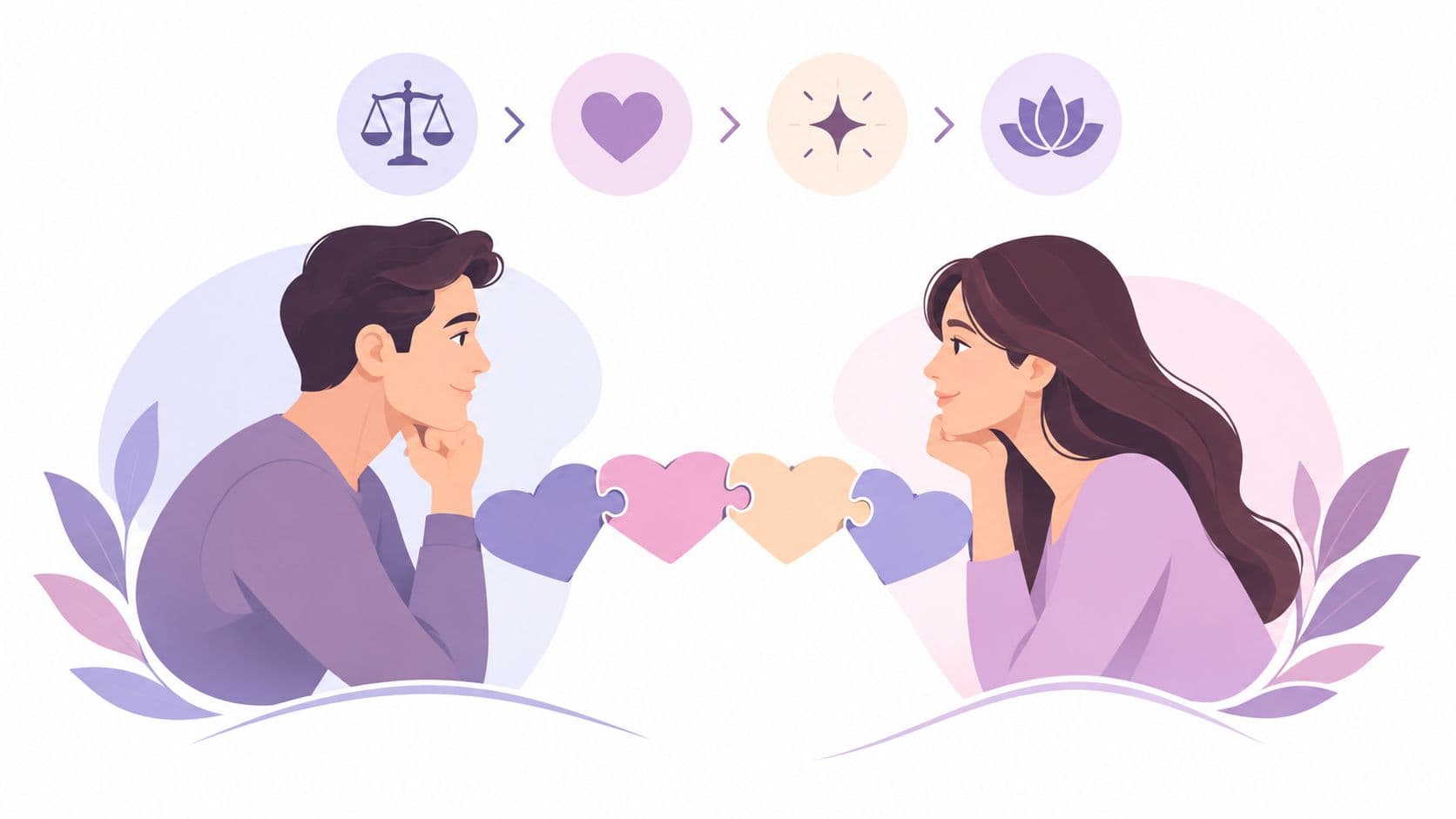
What is love compatibility really? Learn the key components, how compatibility is measured, and how a birth-date reading can add reflection
Love compatibility is the ongoing capacity of two people to sustain commitment, appreciation, sexual alignment, and constructive conflict resolution. Research on couples shows that relationship quality is better understood through these lived dynamics than through a fixed score based on two profiles.
That challenges a familiar promise: compare two personalities, zodiac signs, or birth dates, and you'll know whether a relationship can work. Similarities and symbolic frameworks can offer useful conversation starters, but they can't tell you how two people will treat each other under stress. A more honest question is whether both partners can understand their differences, make decisions together, and repair the relationship when things get difficult.
Why Compatibility Is Not a Score Between Two Profiles
The strongest clues about relationship quality come from partners' experiences together: a relationship-prediction analysis of 43 longitudinal couple datasets from 29 laboratories identified perceived partner commitment, appreciation, sexual satisfaction, perceived partner satisfaction, and conflict as the strongest relationship-specific predictors, explaining up to 45% of the variance at baseline and up to 18% at study endpoints.
Those percentages need careful interpretation. They describe how much variation in relationship quality the analysis could account for across couples. They aren't the probability that a particular couple will stay together, and they don't turn a questionnaire into a forecast. The lower figure at study endpoints also leaves considerable uncertainty about how relationships will develop.
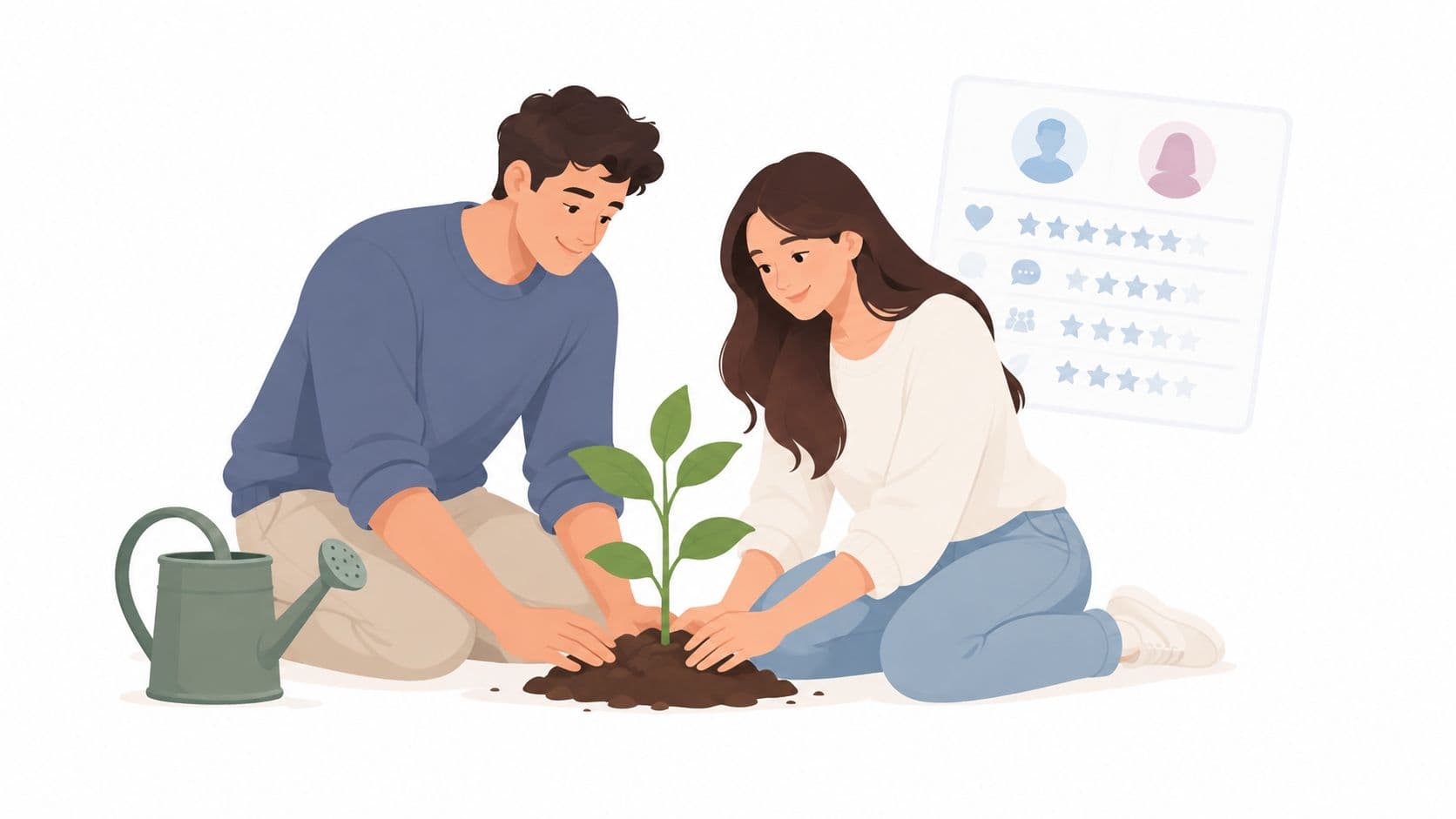
Compatibility works like tending a garden: starting conditions matter, while ongoing care changes what can grow.
For example, shared interests may make spending time together easy. They offer less insight into what happens when work pressure leaves one partner exhausted. Does the other notice, discuss responsibilities, and follow through? Repeated responses give a couple something concrete to assess. A difficult period may reveal strain, while learning to address that strain may improve how partners manage differences.
This makes compatibility an ongoing practice of observing and responding. A profile comparison cannot capture those changing interactions.
A birth-date reading can serve as a reflection prompt, inviting partners to discuss themes they recognize or question. Its usefulness depends on the conversation it starts. It cannot establish that those themes describe either person, observe their behavior, or guarantee success. Partners still need to check any interpretation against their actual experiences together.
A Working Definition of Love Compatibility
Love compatibility is the ongoing capacity to sustain commitment, appreciation, sexual alignment, and constructive conflict resolution. The useful question is how these qualities hold up in shared life. Like a bridge, a relationship needs support that remains dependable under strain, with repairs when weaknesses appear.

What the relationship feels like from the inside
Commitment means each partner experiences the other as invested in their shared future. Joint plans, reliable follow-through, and attention to shared responsibilities make that investment visible. Staying together alone gives partners less information about whether they can depend on each other.
Appreciation means each person feels seen and valued. Thanking a partner for handling a tiring family obligation acknowledges both the task and the effort behind it. When that effort goes unnoticed, the same arrangement may feel taken for granted.
Sexual alignment concerns whether intimacy is mutually workable as partners' needs and circumstances change.
Constructive conflict resolution means disagreements remain discussable and partners can work toward repair. An apology may begin that process. Following through on an agreed change helps make repair meaningful.
These qualities depend on what both partners experience.
Why perception matters
An established couple may share hopes about family life yet clash during stressful weeks. One partner wants to talk immediately; the other needs quiet before responding. They can assess this difference by asking whether a pause helps them return to the conversation or leaves one person waiting indefinitely. An agreement works only if both can rely on it.
As noted earlier, the relationship-prediction analysis found that actor-reported perceptions, meaning individuals' experiences of their own relationship, predicted two to four times more variance in relationship quality than partner-reported variables. That finding supports attending to each person's experience, without treating either account as the whole story.
A birth-date interpretation cannot settle whose account is accurate. Reflection becomes useful when partners connect a suggested theme to something they can describe and discuss together.
Practical rule: Ask whether each of you experiences the relationship as caring, committed, and safe enough for honest repair. Then identify the actions that support that experience or undermine it.
Values, Emotions, Intimacy, and Shared Meaning
Compatibility becomes clearer in ordinary decisions: how to spend money, offer comfort, or make time together. Values, emotions, intimacy, and shared meaning work like parts of a shared household. Each needs attention as circumstances change, and an agreement in one area may leave questions unresolved elsewhere.
Values alignment concerns priorities such as family, money, and the kind of life each person wants to build. A couple who both want children may still have different expectations about caregiving or finances. Naming those differences makes the shared goal more practical: who will do what, and what trade-offs can each accept? Agreement becomes useful when partners can translate it into decisions they can both support.
Emotional alignment shows up in how partners read and respond to one another. One person may want reassurance after a difficult day, while the other offers practical help. A useful question is, “Would you like comfort, help, or some time to yourself?” The answer gives care a clearer direction. For a plain-language starting point, a guide on emotional intelligence in relationships can help partners describe their needs.
Sexual alignment, defined above, shows up here in whether shifts in desire during stress or changing circumstances become discussable rather than remaining silent.
Shared meaning can grow through faith, family traditions, service, creative work, or personal growth. Partners with different beliefs can create rituals that express what they value together. A regular meal or shared creative project, for example, can give that purpose a place in everyday life. Katy Teen & Family Counseling's discussion of shared meaning offers ideas for building this connection.
Similarity deserves careful interpretation. Couples often resemble one another, yet longitudinal analyses found little evidence that similarity independently improves relationship quality after accounting for individual characteristics and partner effects (research on assortative mating and couples). Shared priorities can ease coordination; shared negative patterns can reinforce strain. A birth-date reading may prompt reflection on these areas, while daily choices show how partners handle them.
Ask three questions: Are our differences manageable? Can we make decisions jointly? Does each of us contribute care and repair?
Where Birth-Date Reflection Adds Value and Where It Does Not
Birth-date numerology can give people a structured way to reflect on relationship themes. It can't establish that two people are destined for success or failure. That difference matters: a prompt invites exploration, while a prediction claims to know what will happen.
In Dan Millman's book, The Life You Were Born to Live, the system uses a person's complete birth date, not their name, to determine a life path. It describes 45 life paths for people born from 1750 onward, with topics including core issues, innate talents, special needs, health, money, sexuality, career, primary relationships, and life cycles. The same framework is available through the Life Purpose App (book and life-path system details).
A comparison between two birth dates can be useful if it opens a candid conversation. For example, a couple might use their life-path themes to discuss how they handle responsibility, what kind of support they need, or which recurring tensions they want to understand better. The reading doesn't tell them whether they keep commitments or listen during disagreement. They still have to compare the ideas with their lived experience.
The distinction is straightforward:
- Useful as reflection: A reading suggests questions that help partners talk about needs, strengths, or challenges.
- Not evidence of destiny: A reading can't establish how a couple behaves or predict romantic success.
- Best paired with observation: Partners can use the themes as prompts, then check them against their actual choices and conversations.
Birth-date numerology hasn't been empirically established as a predictive system for relationships, character, or destiny. The responsible approach is to treat it as reflection rather than scientific proof (an overview of numerology's predictive claims). For a clearer explanation of how birth-date comparisons can be used as prompts, see this guide to compatibility by birth date.
Three Ways Compatibility Is Actually Assessed
A couple can learn different things by observing behavior, talking about what they observe, and reflecting on life-path themes. Each lens has a distinct role. None replaces the others.

| Lens | Best For | Limitation |
|---|---|---|
| Behavioral observation | Noticing what partners do when making decisions, expressing care, discussing intimacy, and handling conflict. | A short stretch of behavior may reflect temporary pressure rather than a lasting pattern. |
| Structured conversation | Clarifying needs, expectations, values, and what each person considers a fair repair after disagreement. | Good intentions can sound reassuring without showing up in everyday actions. |
| Birth-date reflection | Generating prompts about recurring themes and opening a conversation about relationship dynamics. | A reading can't establish what partners actually do or predict whether the relationship will succeed. |
Start with behavior. Notice whether promises are kept, whether appreciation is expressed, and whether disagreements get resolved or disappear from conversation. Then talk about what you've noticed and ask how each person experiences the relationship. That discussion matters most when both partners can be honest without being pressured to agree.
Birth-date reflection can be added as a way to raise questions, not settle them. People exploring how to meet a partner within a particular cultural context may also find practical context in this guide to finding a Mauritian matchmaker in 2026. A matchmaking process can introduce potential partners, but ongoing compatibility still depends on how two people relate after they meet.
Behavior without reflection can leave partners repeating patterns they haven't discussed. Conversation without observation can turn into wishful thinking. And life-path themes without real-life examples remain ideas without context. Use each lens for what it can tell you.
Common Misconceptions Worth Letting Go
Misconception one: Similarity guarantees satisfaction. Shared interests can make time together enjoyable, and agreement about priorities can make decisions easier. But resemblance on its own doesn't establish how well a relationship works. Partners can also share unhelpful habits, such as withdrawing from hard conversations or responding to stress with blame. The important question is whether similarities and differences help the couple coordinate, or keep producing the same unresolved problems.
Misconception two: Chemistry or a life-path match predicts long-term success. Initial attraction may feel compelling, and a reading may give partners language for discussing patterns. Neither tells them how they'll respond when life becomes difficult. A longitudinal study followed 300 couples for 10 years and found that stable, highly satisfied couples differed from couples whose satisfaction declined primarily through baseline negative communication and worsening dyadic coping, meaning how partners respond to stress together (longitudinal study of couples and relationship satisfaction).
Misconception three: Compatibility is fixed. Partners don't receive a permanent verdict at the start of a relationship. Their ability to coordinate can improve as they communicate and repair, or deteriorate when they avoid important subjects and stop coping as a team.
The change to look for isn't whether a couple has stress. All relationships can face strain. The more useful signal is what happens after it: do partners return to difficult conversations, adjust how they support each other, and address recurring conflict, or does the same issue keep causing distance?
A promising match on paper doesn't excuse behavior that harms trust. A difficult period doesn't automatically prove a couple can't work. Read the pattern, not just the initial impression.
A Practical Way to Monitor Compatibility Over Time
Compatibility is easier to understand when partners revisit it through observable patterns, rather than relying on a single impression. A simple check-in can focus on commitment, appreciation, intimacy, and repair. The point isn't to score each other. It's to notice what's changing and talk about it before frustration becomes the only message either person hears.

Try asking:
- Commitment: Are we making and keeping plans together, or does one person carry most of the responsibility?
- Appreciation: Do we notice each other's efforts, or has gratitude been replaced by assumption?
- Intimacy: Can we discuss closeness and boundaries respectfully, including when our needs differ?
- Conflict repair: Can we revisit a hard conversation and make a change, or does the same issue stay unresolved?
Temporary stress may make a normally caring partner less available for a while. Persistent difficulty looks different: one person repeatedly avoids meaningful conversations, repair never follows conflict, or a partner feels unable to speak safely about a sensitive subject. Reflection can help clarify what's happening, but it can't resolve a fundamental mismatch on its own.
A check-in is more useful when both people can name a specific example and make a realistic request. Instead of “You never listen,” try describing the moment that felt difficult and asking to agree on a time to talk. These exercises can help partners practice that kind of conversation.
A birth-date reading may offer themes to revisit during a major transition, but the lived relationship remains the evidence that matters. Notice what happens, talk about it, and return to the conversation after you've had time to reflect.
Putting It Together for Your Own Relationship
Start with what you can see. Do you feel valued, can you discuss differences, and do both of you take part in repairing conflict? Then talk about those patterns directly. A birth-date reading connected to Dan Millman's The Life You Were Born to Live can offer another prompt for reflection, but it can't replace behavior, honest communication, or consent.
That makes compatibility less like finding a perfect match on day one and more like learning how to build a workable relationship together. If you're planning a celebration or looking for a thoughtful present, these birthday gift list ideas can help with practical inspiration. The relationship itself still needs the attention and care that no gift or reading can supply.
Use the Life Purpose App to explore birth-date-based life-path themes and relationship dynamics as prompts for reflection, not predictions. Compare those themes with what you and your partner experience, then start a conversation about the patterns you want to understand better.
Discover your life path today
Enter your date of birth and see your life path, free.
Find your life path