Discover what is soul searching, how it differs from therapy or introspection, signs you need it, and practical exercises to uncover your true life purpose.
August 20, 2026 (1mo ago)
What Is Soul Searching and How to Do It Right
Discover what is soul searching, how it differs from therapy or introspection, signs you need it, and practical exercises to uncover your true life purpose.
← Back to blog
Most advice about soul searching begins with a comforting promise: look within, and clarity will appear. That promise is incomplete. Looking inward can reveal values, patterns, and desires, but unstructured reflection can also intensify anxiety and leave you trapped in the same questions.
So, what is soul searching when it's done well? It's a deliberate examination of your motives, values, emotions, history, and direction, followed by grounded choices. It has a purpose, a boundary, and a path back into everyday life. Spiritual wisdom may help you ask deeper questions, while psychology can help you notice when reflection has stopped producing insight and started feeding distress.
Why More Introspection Is Not Always Better
More self-reflection doesn't automatically create more self-knowledge. A 2025 meta-analysis found no significant relationship between self-reflection and overall positive mental health, including subjective well-being, life satisfaction, and self-esteem. It also found a significant positive association between self-reflection and negative mental health indicators such as depression and anxiety, as reported in this APA PsycNet research record (https://psycnet.apa.org/record/2025-77263-001).
That finding challenges a popular assumption. You can spend hours analyzing a difficult conversation, your career, a relationship, or a past mistake and still come away with no clearer answer. Sometimes the mind keeps reopening the same file because it wants certainty that life can't provide.
Reflection or rumination
Productive self-inquiry usually moves toward a question, a pattern, or a decision. You might notice that you've accepted work opportunities mainly to please others, or that your daily schedule leaves no room for a value you claim matters. The insight becomes useful when it changes what you do next.
Rumination feels different. The thoughts circle without developing. You replay the past, predict negative outcomes, criticize yourself, and search for a perfect explanation. The emotional intensity rises, but your ability to act shrinks.
Practical rule: If reflection produces a clearer value, question, boundary, or experiment, it's serving you. If it only produces more fear and repetition, pause and change the method.
A pooled sample of 647 subjects found no simple linear benefit from more introspection. The research also didn't support either extremely high or extremely low self-reflection as uniformly healthy, with a moderate level treated as the more plausible target for healthy introspection.
Give the search a container
Soul searching works better as a time-bound practice, not a permanent mental atmosphere. Choose one question, set a stopping point, record what you've learned, and identify one small action. You don't need to solve your whole identity in one sitting.
If your anxiety or depression is worsening, or if your thoughts feel uncontrollable, self-inquiry shouldn't be your only support. A therapist can help you distinguish meaningful exploration from symptoms that need professional care.
Defining Soul Searching Beyond Dictionary Meanings
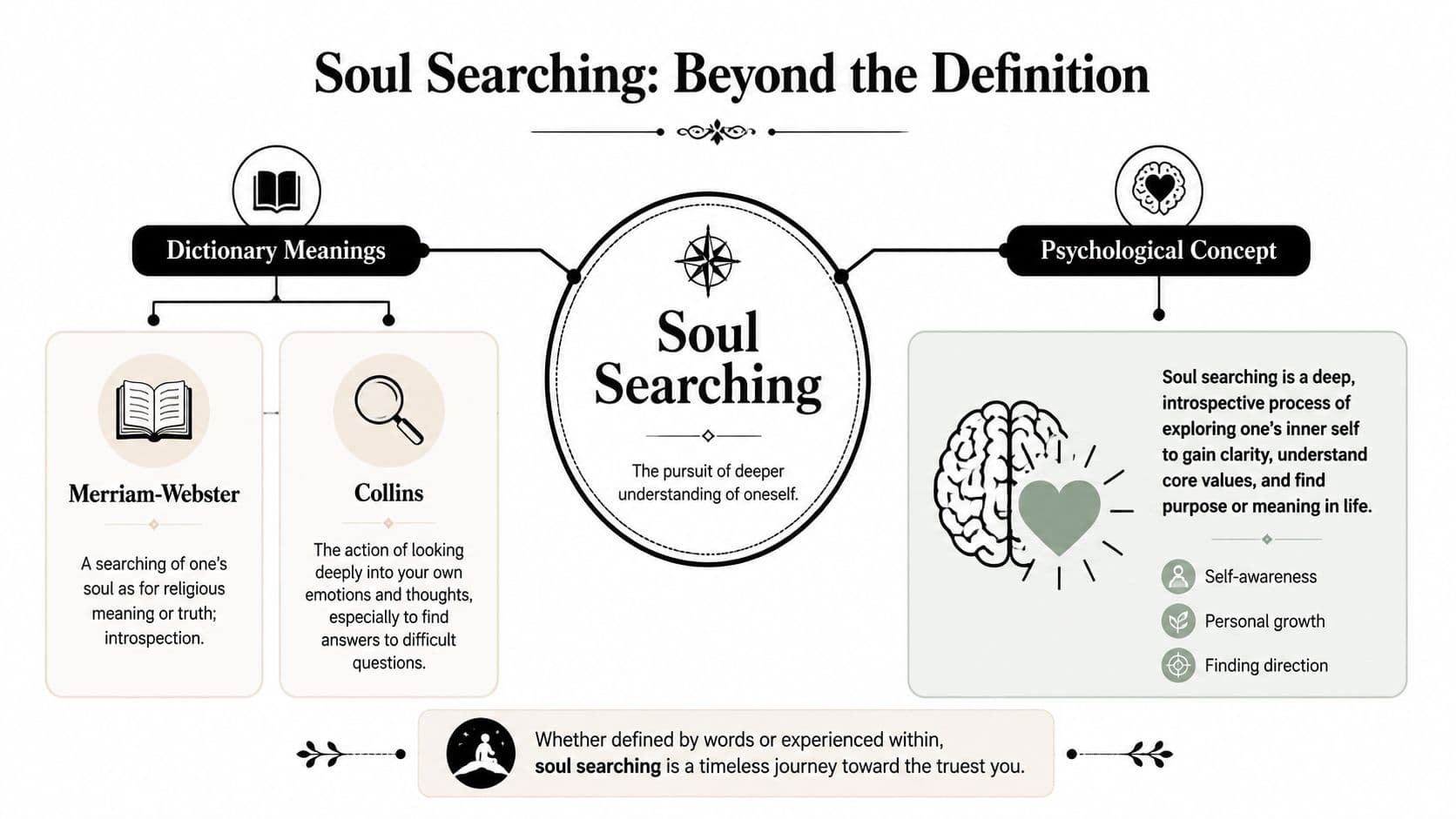
Dictionary definitions give the phrase a moral and emotional center. Merriam-Webster defines soul searching as the “examination of one's conscience especially with regard to motives and values,” while Collins describes it as a long, careful examination of thoughts and feelings during a difficult moral decision or after something has gone wrong. These definitions are summarized.
In ordinary life, soul searching often begins when your outer choices no longer match your inner convictions. You may ask whether your work reflects who you are, whether a relationship is shaped by love or fear, or whether a belief still feels honest. The phrase can carry spiritual meaning, but it doesn't require one particular religious tradition. At its heart, it concerns meaning, conscience, values, and direction.
The psychological equivalent
In psychology, the closest concepts are introspection and self-reflection. Introspection involves examining your own thoughts and feelings to understand the mind. Self-reflection is more deliberate and metacognitive, involving observation and analysis of thoughts, emotions, behavior, and personal history with the hope of gaining insight or supporting change.
The scientific history is complicated. Introspection became central to late nineteenth-century experimental psychology, especially through Wilhelm Wundt and other pioneers who used trained self-observation as a scientific method. After about 40 years of research, structuralist psychologists had cataloged roughly 50,000 mental constructs, grouped into sensations, images, and affections, with each construct described through quality, intensity, duration, and clearness.
For a practical exploration of how inward observation supports personal growth, see this guide to self-knowledge and personal understanding.
Soul Searching Versus Therapy and Casual Reflection
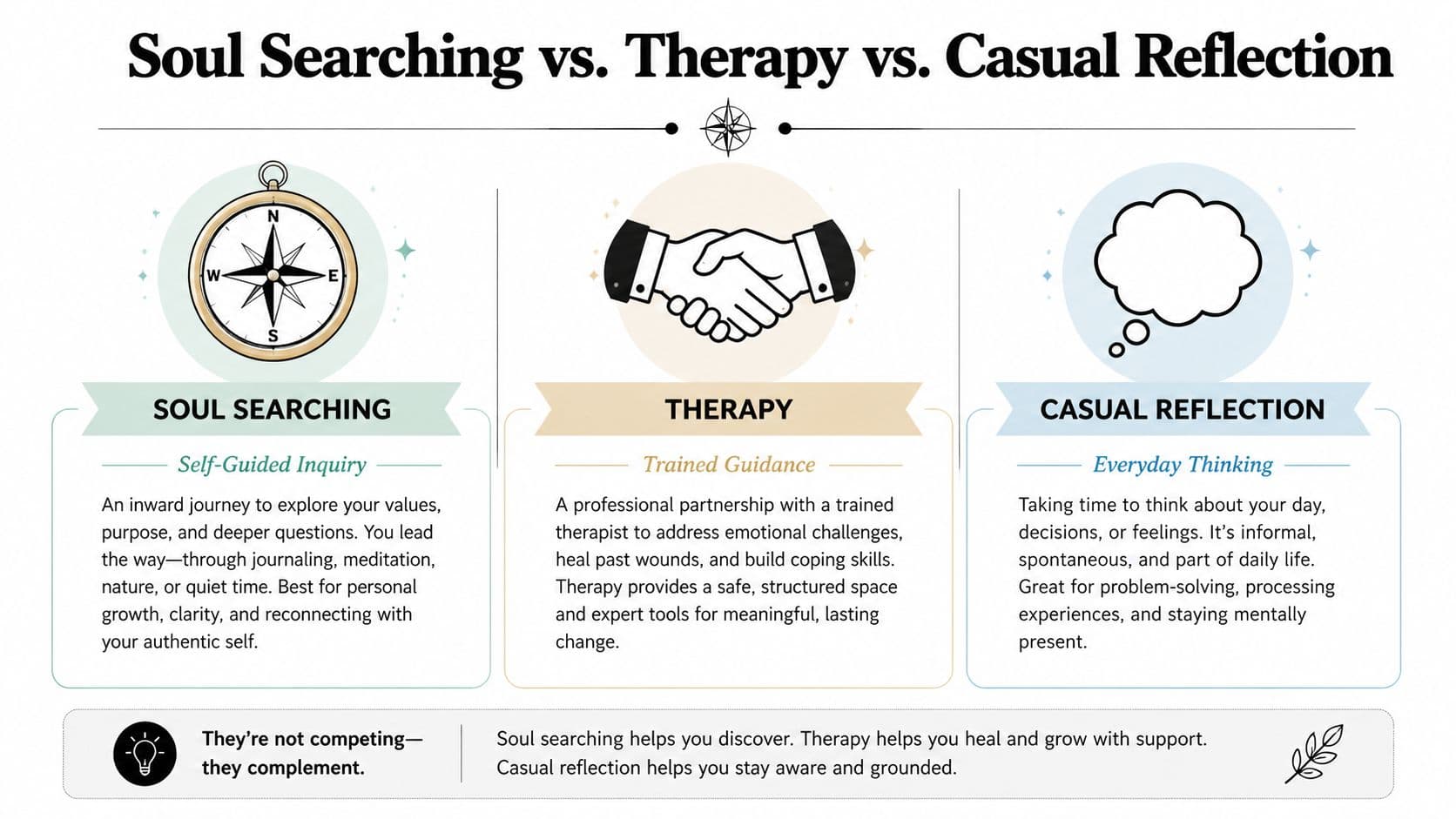
Soul searching, therapy, and casual reflection can all involve looking inward, but they serve different needs.
| Approach | Main focus | Best suited for |
|---|---|---|
| Casual reflection | Everyday awareness of thoughts, choices, and reactions | Minor decisions, routine learning, and ordinary self-awareness |
| Soul searching | Deeper examination of values, meaning, identity, and direction | Major transitions, moral uncertainty, or a persistent mismatch between life and values |
| Therapy | Structured support for emotional distress, trauma, symptoms, and mental health challenges | Problems that feel overwhelming, persistent, unsafe, or difficult to manage alone |
Casual reflection might happen while washing dishes. You notice that you snapped at someone and decide to apologize. It's brief, practical, and connected to an immediate situation.
Soul searching asks larger questions. You may be choosing between stability and creative work, reconsidering a long-held belief, or grieving a future you expected to have. The process can be self-guided through prayer, journaling, meditation, meaningful conversation, or other reflective practices.
Choosing the right level of support
Use casual reflection when the issue is contained and you can return to normal responsibilities. Try structured soul searching when the question keeps returning and concerns your purpose, values, identity, or life direction, but you remain able to function and make choices.
Seek professional help when distress is persistent, intensifying, or interfering with sleep, work, relationships, or safety. Therapy isn't a failure of spiritual strength. A trained therapist offers a different kind of support, especially when trauma, depression, anxiety, grief, or compulsive thought patterns are involved.
Soul searching can complement therapy, but it shouldn't replace it. You're allowed to explore meaning while also receiving clinical care.
Recognizing the Signs You Are Soul Searching
A marketing professional named Maya had built a career she once wanted. She was competent, financially stable, and respected, yet she felt an increasing distance from the goals that had motivated her. Her question wasn't, “Should I quit?” It was, “What kind of contribution do I want my work to make, and what am I unwilling to sacrifice for success?”
That's a soul-searching question because it connects a practical decision to values and identity. Maya might discover that she doesn't need a completely different career. She might need a different role, healthier boundaries, or work that lets her mentor others.
The questions beneath the question
Authentic soul searching often has recognizable signs:
- Persistent purpose questions: You keep asking what makes your life meaningful, not because you're bored for an afternoon, but because the question has personal weight.
- Disconnection from old goals: Achievements that once energized you no longer feel connected to the person you're becoming.
- A major transition: Relocation, parenthood, separation, illness, graduation, retirement, or loss can unsettle familiar assumptions.
- Belief examination: You're reconsidering values or beliefs inherited from family, culture, community, or earlier versions of yourself.
- Value-action tension: Your calendar, spending, relationships, or work don't reflect what you say matters most.
A parent might realize that providing for the family has gradually crowded out presence with the family. Their soul searching doesn't demand a dramatic overnight transformation. It may lead to a conversation with a partner, a revised schedule, or a decision to protect certain evenings.
Someone recovering from loss may ask, “Who am I now?” Grief can make previous ambitions feel irrelevant, while new meaning hasn't yet taken shape. That uncertainty deserves patience, but it also benefits from gentle structure.
When uncertainty becomes rumination
Uncertainty says, “I don't know yet.” Rumination says, “I must solve this perfectly before I can move.” Watch for circular thinking, rising anxiety without resolution, repeated self-criticism, and an inability to make even modest decisions.
Ask yourself three questions:
- What question am I trying to answer?
- What evidence would help me answer it?
- What small action could teach me something?
A genuine search for meaning can remain open while still moving. It doesn't require instant certainty.
Practical Exercises and Journaling Prompts for Deep Inquiry
Structured writing gives your thoughts somewhere to land. Expressive writing is a journaling method used in psychotherapy that focuses on your deepest thoughts and feelings across 3–4 sessions of about 20 minutes each. A 2025 review summarized a meta-analysis of 146 randomized studies and reported small but consistent improvements in anxiety, depression, and well-being, with effect sizes of d = 0.18–0.26.
Use the method as an invitation, not a guarantee. Writing can support emotional processing, but difficult feelings may surface, and you should stop or seek support if the exercise becomes destabilizing.
A contained writing practice
- Prepare the setting. Choose a quiet place, silence unnecessary notifications, and keep water nearby. You don't need a mystical atmosphere. You need enough privacy to write.
- Choose one subject. Focus on a transition, conflict, loss, decision, or recurring question. Avoid trying to explain your entire life at once.
- Write continuously. For a session of about 20 minutes, write what you think and feel without editing for grammar or presentation. Be specific about events, bodily sensations, fears, hopes, and meanings.
- Close deliberately. When time ends, write one sentence describing what you need next. That might be rest, a conversation, more information, prayer, or professional support.
- Review later. After the writing period, look for repeated values, emotional triggers, assumptions, and desires. Don't judge every sentence as a final truth.
Try prompts that move from memory to meaning:
- When have I felt most absorbed, useful, or alive?
- What themes keep appearing across different chapters of my life?
- Which choices have I made from love, and which have I made mainly from fear?
- What do I envy, and what might that envy reveal about an unmet value?
- If my life felt aligned, what would I be doing differently in an ordinary week?
- What would my future self thank me for beginning now?
- Which belief am I protecting, and what would happen if I questioned it?
Meditation can help you observe thoughts without immediately obeying them. Journaling can help you name patterns and values. This guide to meditation and journaling offers a related way to combine stillness with written reflection.
A useful boundary: End every session with one grounded next step, even if the step is simply scheduling another conversation.
Using Life Path Insights to Accelerate Self-Discovery
Some people gain clarity through a symbolic framework that gives their questions a language. Dan Millman's book, The Life You Were Born to Live, presents a birth-date-based life-path system with 45 unique life paths, each associated with gifts, challenges, and spiritual laws concerning areas such as health, money, sexuality, career, and relationships.
This system isn't a clinical assessment, and it shouldn't dictate your decisions. Used thoughtfully, it can function as a prompt. A life-path interpretation may suggest themes to investigate, while your lived experience, journal entries, relationships, and choices help you decide whether those themes resonate.

Turn symbolism into questions
Suppose a life-path reading highlights a recurring challenge around discipline or independence. Don't treat that statement as a fixed identity. Ask:
- Where do I avoid structure, and where does structure help me?
- Do I confuse independence with isolation?
- What behavior would show growth in this area?
- Is this pattern visible in work, money, health, or relationships?
The value lies in the conversation between the framework and your experience. A symbolic map can help you notice a road, but you still need to walk it and assess the terrain.
The Life Purpose App is a digital companion to The Life You Were Born to Live. It lets users enter a birth date to explore a life path, related gifts and challenges, spiritual laws, nine-year cycles, and relationship dynamics. It also provides a summary through its free tier, while paid options offer additional book text and more detailed analyses. You can begin by exploring the life-path numerology calculator, then bring any resonant themes into your journal.
Keep interpretation grounded
Use life-path insights as hypotheses, not verdicts. If a description doesn't fit, set it aside. If it sparks recognition, test it against your behavior and choices. Soul searching becomes more reliable when spiritual language leads to honest observation rather than a convenient excuse to avoid responsibility.
Creating a Sustainable Soul Searching Practice
Soul searching should be a phase of inquiry that leads toward living, not a permanent identity. The point isn't to become endlessly fascinated by your inner world. The point is to understand yourself well enough to choose with greater honesty.
Set boundaries before you begin. Decide how long you'll reflect, what question you'll explore, and how you'll know the session is complete. At regular check-ins, ask whether your insights are changing a conversation, habit, commitment, boundary, or next decision.
Convert insight into experiments
Big revelations can feel powerful, but small experiments reveal whether an insight works in real life. If you discover that creativity matters, protect a short period for making something. If belonging matters, contact someone who helps you feel known. If service matters, volunteer or support a cause in a way that fits your capacity.
Avoid dramatic overhauls made from emotional urgency. Let your understanding mature through action, feedback, and adjustment. A career question might require informational conversations before resignation. A relationship insight might require a clear request before a final conclusion.
Meaning also grows through connection. Talk with trusted people who can listen without taking over your decision. Spend time in communities, nature, prayer, art, or service if those practices align with your worldview. If constant digital input keeps you from hearing your own thoughts, a digital detox guide can help you plan intentional space away from screens.
Keep a simple record of what you're learning:
- Question: What am I exploring?
- Insight: What pattern or value have I noticed?
- Experiment: What will I try?
- Evidence: What did the experience teach me?
- Next choice: What deserves attention now?
Your inner life matters, but it isn't the only source of wisdom. Body sensations, trusted relationships, practical facts, spiritual convictions, and consequences all belong in the discernment process.
If reflection repeatedly increases distress, return to support rather than pushing harder. A therapist, counselor, spiritual director, or trusted mentor can offer perspective when solitude stops helping. Healthy soul searching leaves room for rest, laughter, responsibility, and ordinary joy.
The Life Purpose App offers birth-date-based life-path insights, spiritual-law themes, nine-year cycles, and relationship perspectives drawn from Dan Millman's The Life You Were Born to Live. Use it alongside structured journaling as a starting point for deeper questions, then visit Life Purpose App to explore your path and turn reflection into purposeful action.
Discover Your Life Purpose Today!
Unlock your true potential and find your life’s purpose.
