Spiritual wisdom is an inner compass that helps you make clearer choices, find deeper meaning, and stay steady through life’s ups and downs. This article defines spiritual wisdom, contrasts it with intellectual knowledge, and offers practical steps you can use today to strengthen your inner guidance and sense of purpose.

October 20, 2025 (1y ago) — last updated July 21, 2026 (3mo ago)
Spiritual Wisdom: Build Inner Guidance & Purpose
Learn how spiritual wisdom differs from knowledge and daily practices to strengthen inner guidance, purpose, and resilience.
← Back to blog
Spiritual wisdom is an inner compass that helps you make clearer choices, find deeper meaning, and stay steady through life’s ups and downs. This article defines spiritual wisdom, contrasts it with intellectual knowledge, and offers practical steps you can use today to strengthen your inner guidance and sense of purpose.
Spiritual Wisdom: Build Inner Guidance & Purpose
Summary: Discover what spiritual wisdom is, how it differs from knowledge, and simple daily practices to build inner guidance, purpose, and resilience.
Introduction
Spiritual wisdom is an inner compass that helps you make clearer choices, find deeper meaning, and stay steady through life’s ups and downs. This article defines spiritual wisdom, contrasts it with intellectual knowledge, and offers practical steps you can use today to strengthen your inner guidance and sense of purpose.
What Is Spiritual Wisdom?
Spiritual wisdom is an embodied understanding that guides action and meaning in daily life. It’s not having every answer, but learning to trust the insights that come from within and choosing from a place of clarity and care.
Defining Spiritual Wisdom in Daily Life
Intellectual knowledge gathers facts and theories. Spiritual wisdom integrates insight into lived behavior. You can study compassion, but wisdom shows up when you listen with an open heart instead of reacting with anger. Spiritual wisdom shapes how you act and how you make sense of ordinary moments.
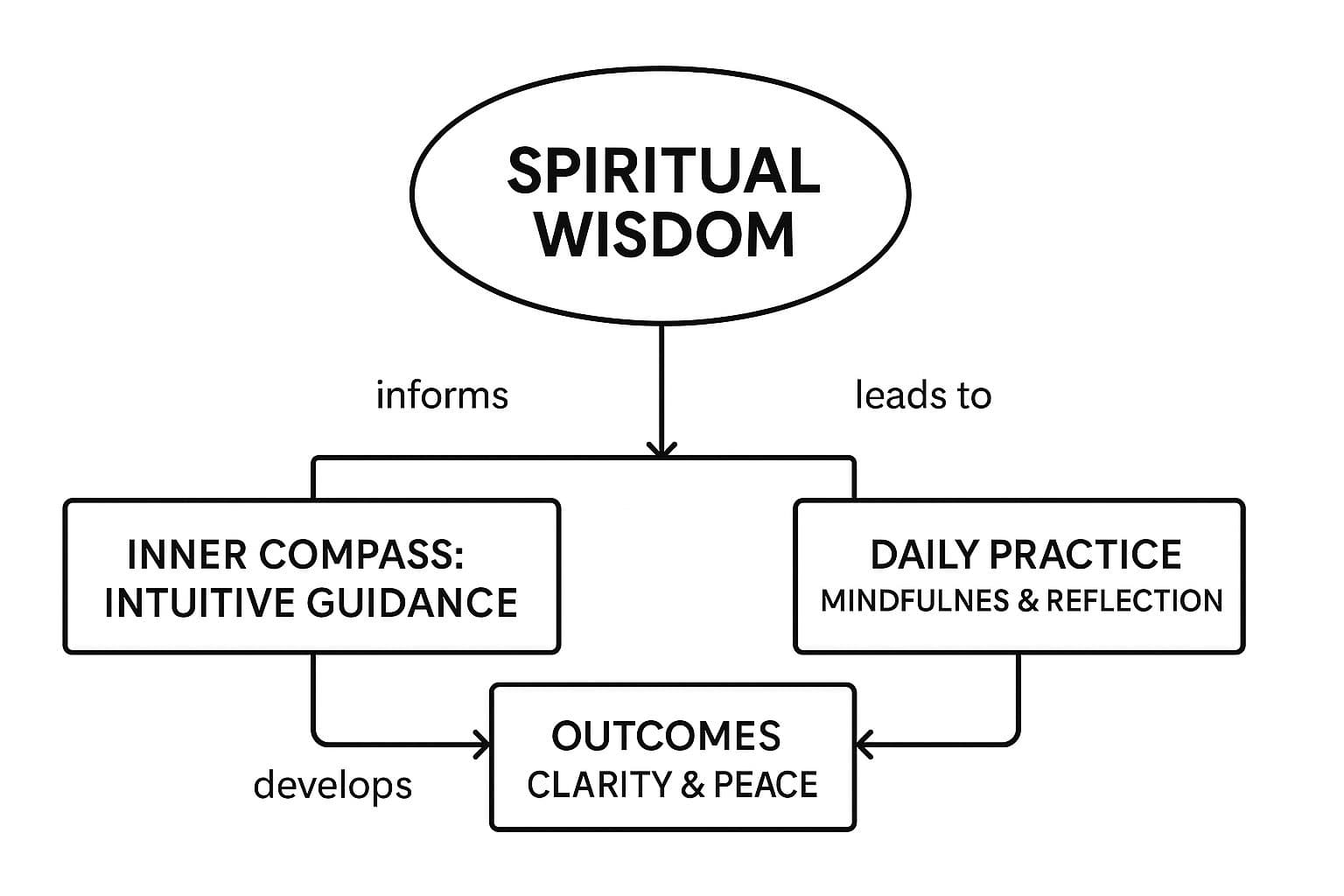
Spiritual wisdom is an active practice of reflection and discernment that grows over time.
An Inner Sense of Knowing
At its core, spiritual wisdom is discernment. It’s the ability to see situations clearly and choose in ways that align with your deepest values, separate from external pressures. This isn’t about rigid rules. It’s about cultivating a relationship with your intuition, so you can tell a fleeting desire apart from what truly serves long-term growth.
“Discretion is the begetter, guardian and moderator of all virtues.”
That idea points to balanced, insightful living. Wisdom moderates impulses and helps you act from a grounded place.
Spiritual Wisdom vs. Intellectual Knowledge
One way to see the difference is side-by-side.
| Attribute | Spiritual Wisdom | Intellectual Knowledge |
|---|---|---|
| Source | Intuition, experience, inner reflection | External sources like books, data, teachers |
| Nature | Embodied and integrated | Conceptual and abstract |
| Focus | How and why | What and when |
| Application | Lived behavior, discernment in action | Facts, theories, and analysis |
| Goal | Inner peace, alignment, purpose | Mastery of a subject or skill |
| Acquisition | Cultivated through practice | Learned through study |
Both ways of knowing matter. Knowledge helps you handle the external world. Spiritual wisdom helps you navigate your inner world with steadiness.
From Theory to Practice
Turning ideas into action is how understanding deepens. Practical application builds self-awareness and helps you lead a more integrated life. Ultimately, cultivating wisdom helps you live with integrity, resilience, and quiet confidence.
Ancient Roots of Spiritual Insight
Across cultures, people have asked the same questions: Why am I here? What is my purpose? Ancient practices from Buddhist and Taoist traditions to nature-based indigenous teachings encourage looking inward, recognizing connection, and living by core principles.
Universal Threads of Wisdom
Common ideas include:
- The power of self-knowledge: Knowing your strengths and challenges is often the first step toward wisdom.
- Living in harmony: Balance and right relationship with nature, community, or the sacred.
- The search for purpose: Discovering a sense of purpose leads to greater fulfillment.
These threads show that deeper connection is a basic human drive.
From Ancient Systems to Modern Tools
Some systems translate ancient ideas into practical maps for self-discovery. For example, Dan Millman’s numerology approach in The Life You Were Born to Live turns timeless concepts into a personal blueprint, and it informs tools like the Life Purpose App4. These frameworks are not about predicting the future; they provide structured ways to explore purpose and self-knowledge.
How Understanding Your Life Path Unlocks Wisdom
Rather than seeing life as random, some traditions suggest patterns or a life path reveal recurring strengths and challenges. Knowing this blueprint is not destiny. It’s self-knowledge that supports clearer choices.

Dan Millman’s system uses your birthdate to highlight strengths, recurring challenges, and purpose, offering a map rather than a sentence4. This clarity can answer core questions about your talents, growth opportunities, and purpose, letting you work with your nature instead of against it.
Simple Practices to Cultivate Inner Wisdom
Think of spiritual wisdom like a garden you tend each day. Knowing your life path gives a blueprint, but consistent small practices help it grow. These habits quiet external noise so you can hear your inner voice.
Embrace Mindful Presence
Mindfulness means paying attention to the present moment without judgment. Put your phone away while you eat. Listen fully instead of rehearsing a reply. Even five minutes a day of focused breath awareness trains attention and emotion regulation, with measurable benefits from brief training2.
Practice Self-Compassion
Wisdom is not harsh. It grows from compassion, starting with yourself. Treat yourself as you would a friend. Acknowledge mistakes without letting them define you. Self-compassion creates emotional space for growth and insight3.
Live with Integrity
Integrity aligns actions with values. Be honest, keep promises, and act in ways that build self-trust. Each choice that reflects your principles strengthens reliance on inner guidance.
- Be honest with yourself: Notice your feelings and motivations without sugarcoating.
- Keep your word: Follow through on commitments to others and yourself.
- Act on your values: Make conscious choices that reflect what you believe.
Some people use complementary tools, like learning about Amethyst crystal meaning and uses, to create a calm environment for reflection. Over time, small consistent actions shift how you see and respond to the world.
Finding Spiritual Wisdom in a Modern World
How do timeless principles apply when phones buzz nonstop and the world feels divided? Ancient ideas offer an anchor, helping you stay centered no matter how chaotic things get. Inner stability lets you meet external challenges with clarity.

A Shift Toward Inner Meaning
More people are searching for meaning outside traditional religious structures. The religiously unaffiliated grew by 270 million to 1.9 billion between 2010 and 2020, reflecting a broader search for personal purpose1.
Navigating Modern Challenges with Ancient Tools
Spiritual wisdom helps you know when to engage and when to unplug. It points you toward what nourishes your life and away from what drains it. Spiritual health is linked to overall well-being. Practical daily choices include:
- Mindful media consumption: Choose content that uplifts instead of doomscrolling.
- Authentic connections: Prioritize face-to-face time and meaningful conversations.
- Purposeful action: Let your life path guide career and personal choices so your work aligns with who you are.
When practiced, spiritual wisdom becomes a living reality that supports inner peace and purpose.
Common Questions About Spiritual Wisdom
Do I Need Religion to Develop Spiritual Wisdom?
No. Spiritual wisdom is a personal connection to your inner self and the world. Some find it in religion; many find it in nature, philosophy, or quiet reflection.
How Do I Know if I’m on the Right Spiritual Path?
The right path feels true and helps you grow. Look for increasing inner peace, clearer decisions, and deeper compassion. If a practice leaves you fearful or confused, it may not be right for you.
Can an App Like the Life Purpose App Truly Help?
Yes. Tools like the Life Purpose App provide a structured mirror for reflection, helping you see patterns and make conscious choices based on Dan Millman’s system4.
Quick Q&A — Fast Answers
Q: Do I need religion to be wise?
A: No. Wisdom is a skill anyone can cultivate through practice and reflection.
Q: What’s the easiest way to start?
A: Start with five minutes of daily mindfulness and one act of integrity each day.
Q: Will a life-path tool limit my freedom?
A: No. It offers guidance, not a fixed fate—use it to make more aligned choices.
Three Concise Q&A Sections
1) What is the simplest daily practice to build spiritual wisdom?
Five minutes of focused breath awareness each morning. It trains attention, grounds you, and opens space for inner guidance.
2) How quickly will I see results?
Small shifts in awareness can appear within days, while deeper clarity and resilience develop over weeks to months with consistent practice.
3) Can spiritual wisdom help my relationships and work?
Yes. Greater self-awareness, compassion, and integrity improve communication, decision-making, and purpose-driven action at work and in relationships.
1.
Pew Research Center, “How the global religious landscape changed from 2010 to 2020,” June 9, 2025, [https://www.pewresearch.org/religion/2025/06/09/how-the-global-religious-landscape-changed-from-2010-to-2020/]
2.
Zeidan, Fadel, et al., “Mindfulness meditation improves cognition: Evidence from brief training,” [https://www.ncbi.nlm.nih.gov/pmc/articles/PMC3004979/]
3.
Kristin Neff, “Self-Compassion Research,” overview and selected studies, [https://self-compassion.org/the-research/]
4.
Dan Millman, The Life You Were Born to Live (book) and related resources at Life Purpose App, [https://lifepurposeapp.com]
Discover your life path today
Enter your date of birth and see your life path, free.
Find your life path