Learn why self awareness is important for relationships, career, and growth, and how to cultivate it in 2026.
August 7, 2026 (1mo ago)
Why Self Awareness Is Important: A Practical Guide
Learn why self awareness is important for relationships, career, and growth, and how to cultivate it in 2026.
← Back to blog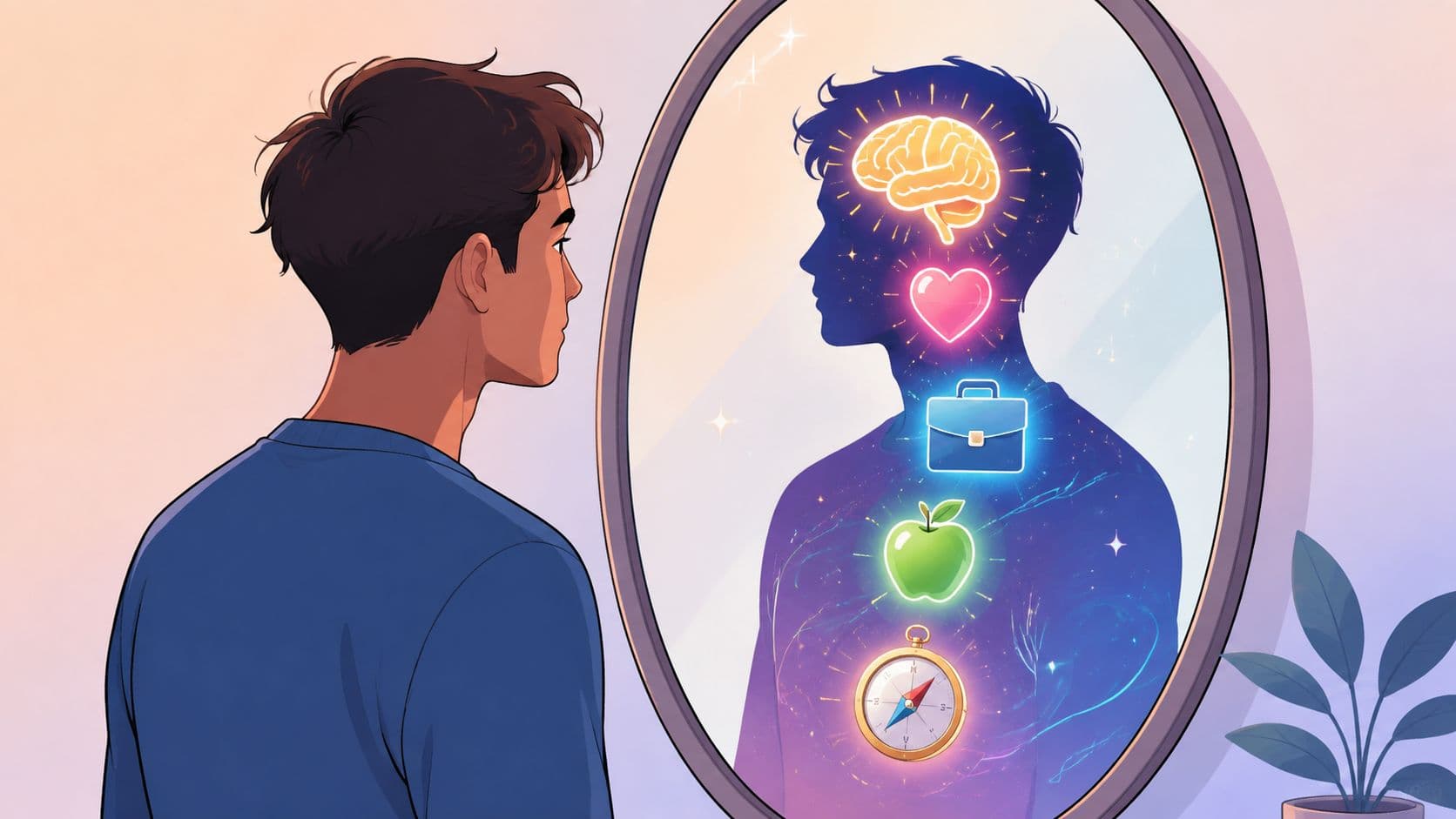
95% of people believe they're self-aware, but only 10% to 15% meet that standard, according to Tasha Eurich's research summarized by Harvard Business Review. That gap explains why so many smart, capable people keep repeating the same conflicts, the same mistakes, and the same blind spots even when they're trying hard to grow. Why self awareness is important is simple, it shapes how clearly you see yourself, how accurately you read other people, and how well you change when life gives you feedback.
Self-awareness isn't a vague personality trait or a soft, feel-good ideal. A major review describes it as an ongoing, introspective process of noticing, examining, and understanding your thoughts, feelings, convictions, and values, then using that understanding to guide behavior through conscious self-awareness. In plain language, it's the ability to catch yourself in the act of being yourself, then decide whether that version of you is helping.
What Self-Awareness Really Means and Why Most People Miss It
Many think self-awareness means “I know my personality.” That's too thin to be useful. Real self-awareness is closer to a live internal dashboard, one that shows what you feel, what you value, what you avoid, and where your reactions stop matching reality.
The reason people miss it is that the mind is very good at building a story that protects the ego. It's easy to believe you're patient, fair, or open-minded when your behavior says something different under pressure. Eurich's research found that people's actual and self-perceived competence correlated at less than 30%, which helps explain why feedback can feel surprising or even unfair when it lands in leadership settings.
What the skill actually includes
Self-awareness is not one thing. It includes your thoughts, your feelings, your convictions, and your values, and it keeps asking how those inner pieces show up in behavior. That means noticing not just “I'm upset,” but also “What exactly am I protecting, and what did I just assume?”
Practical rule: if your inner story and your outer effect don't match, start with curiosity before you start with judgment.
That distinction matters because self-awareness isn't just about feeling more introspective. It affects how you interpret feedback, how you adapt, and how you handle relationships when tension rises. In work and life, people usually don't fail because they lack intelligence. They stumble because they can't see themselves clearly enough to use their intelligence well.
| Claim | Statistic |
|---|---|
| People who believe they're self-aware | 95% |
| People who actually meet the standard | 10% to 15% |
| Actual and self-perceived competence correlation | Less than 30% |
The upside is encouraging. Self-awareness can be learned, refined, and practiced. That makes it less like a personality gift and more like a skill you can build with honest attention.
Internal and External Self-Awareness in Everyday Life
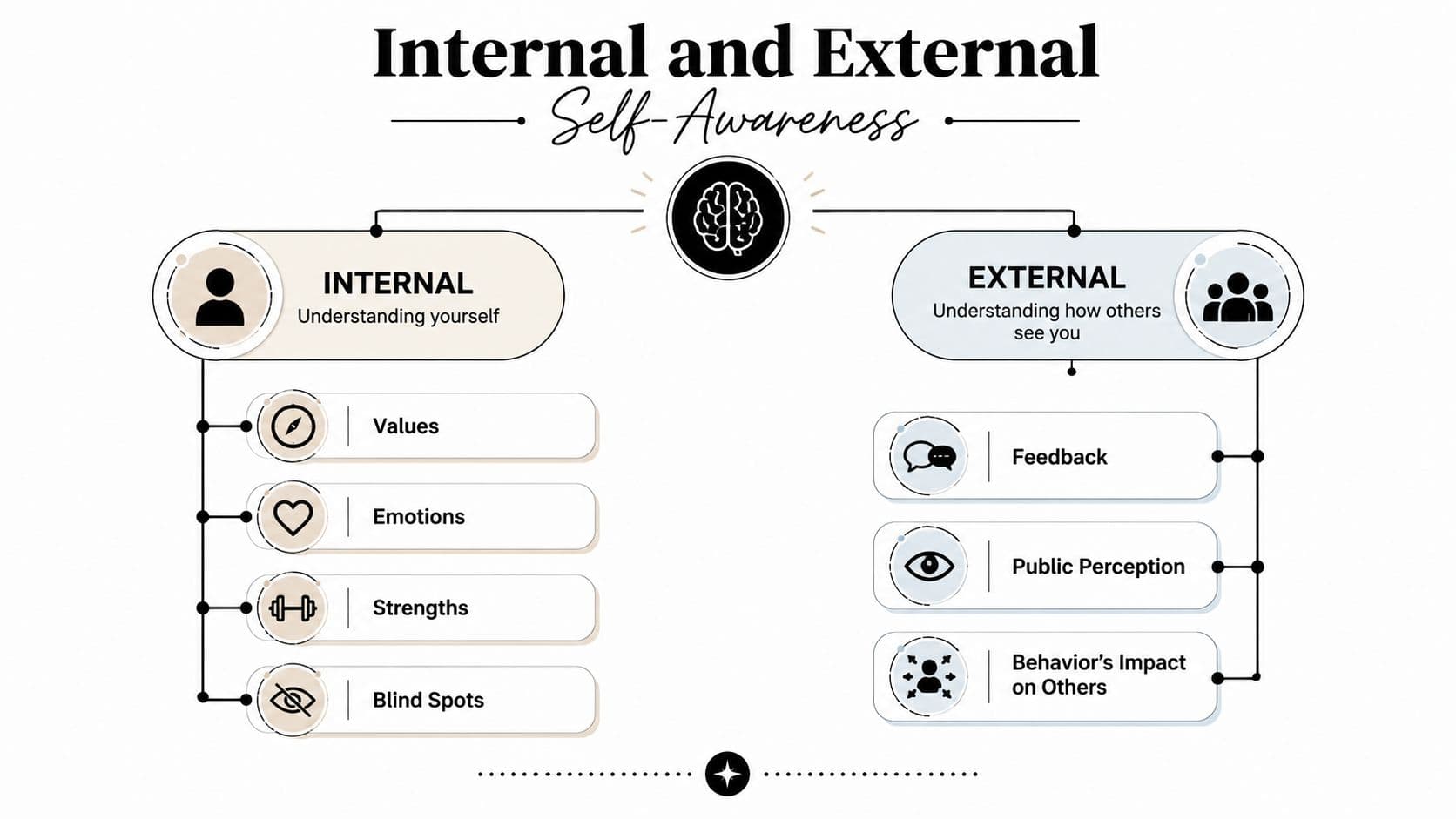
A useful way to understand self-awareness is to split it into two directions. Internal self-awareness is knowing your own values, emotions, strengths, and blind spots. External self-awareness is understanding how other people experience you.
Those two often get mixed up. Someone can be reflective but miss how they come across in a meeting. Another person can read a room well but stay disconnected from their own motives. That's why a two-way mirror works as an analogy. One side helps you see inward, the other helps you see outward, and both matter if you want a full picture.
Where the imbalance shows up
The Inter-American Development Bank's skills report links internal self-awareness with higher job and relationship satisfaction, while external self-awareness is tied more closely to empathy in social contexts. That makes sense. If you know what matters to you, you can make choices that fit. If you understand how you land on others, you can adjust before a small misunderstanding becomes a larger rupture.
A missed email, a sharp tone, or a defensive reply often comes from an imbalance between these two kinds of awareness. You might know exactly what you meant, but not how it sounded. Or you might sense that someone reacted badly, without noticing your own stress, impatience, or assumption that pushed things off course.
You don't need perfect insight. You need enough awareness to pause before your automatic reaction becomes your final answer.
If you're trying to diagnose yourself, ask two questions. First, what do I reliably notice about my own inner life? Second, what do other people tend to notice about me that I keep missing? The first points to internal awareness, the second to external awareness. Many have a stronger lane in one than the other, and growth usually starts by strengthening the weaker side.
How Self-Awareness Shapes Relationships, Career, Health, and Decisions
A clearer sense of self changes what happens before a choice, a comment, or a reaction hardens into habit. That matters because self-awareness works upstream. It shapes the small inner signals that later show up as words, body language, and decisions that other people can feel.
Research on workplace relationships found positive links between self-awareness and relationship management within professional settings. The pattern is easy to understand. When someone can notice their own irritation, fear, or pride in real time, they have a chance to slow the moment down. That pause can keep a tense exchange from turning into a power struggle, even when the topic stays difficult.
Four places it shows up fast
- Relationships: A person may hear their own criticism and realize it is carrying hurt from somewhere else. They may also notice that defensiveness is protecting an old wound, not responding to what is being said now.
- Career: Workplace data links self-awareness training with higher productivity and lower stress, and it also shows that people with higher self-awareness are more likely to set realistic goals in compiled workplace data. In practice, that means clearer priorities, fewer reactive choices, and less energy spent correcting avoidable mistakes.
- Health: A neuroscience and behavior review describes self-awareness as a way to notice internal states earlier and regulate them more steadily, which matters when stress starts to rise before a person has words for it in the body and mind. The body often signals trouble before the mind catches up, so awareness gives those signals a name sooner.
- Decisions: The same review connects self-connection with greater well-being, meaning, and progress toward goals. That suggests that when a person is in better contact with their inner life, their long-range choices are more likely to match what they value in practice.
The pattern across all four areas is simple. Self-aware people catch what is happening inside earlier, then choose a response instead of running on habit. That extra pause changes how a meeting ends, how a hard conversation is heard, and whether a decision grows out of clarity or impulse.
Ancient life-path frameworks such as Dan Millman's work point to the same idea in a different language. A person does not change just by wishing for insight, they change when reflection is joined to a structure that helps them name recurring patterns and act on them. Self-awareness gives the inner signal, and structure keeps that signal from being forgotten the moment pressure rises.
Stress makes this even clearer. Under pressure, attention narrows, and that is when people are most likely to snap, shut down, or decide too quickly. If you can name what you feel, you have a better chance of guiding your behavior before the feeling drives it for you.
For a practical bridge between emotional insight and real relationship skills, see this guide to emotional intelligence in relationships.
A Real Story of Self-Awareness Changing One Relationship
Maya and her sister kept fighting over holiday plans. On the surface, it looked like a scheduling problem. One wanted to arrive early, the other wanted a slower morning, and every conversation seemed to end with a text that felt colder than the one before.
What changed wasn't the calendar. It was Maya's willingness to notice that the argument felt bigger than the plan itself. She realized she wasn't only reacting to this year's schedule, she was reacting to a familiar family role she'd carried for years, the one where she had to prove she was responsible, flexible, and right.
That realization gave her a pause. Instead of sending the usual defensive message, she waited, wrote down what she was feeling, and then asked her sister a plain question, “What does this look like from your side?” Her sister said she felt managed, not considered. Maya hadn't intended that, but intention wasn't the issue. Impact was.
What changed in the moment
Maya stopped arguing with the feeling and started examining it. She named her trigger, admitted the old pattern, and listened for the mismatch between what she meant and what her sister experienced. That's self-awareness in motion, not abstract reflection, but a live correction while the interaction is still unfolding.
The result was not perfect harmony. It was something more realistic and more useful. They reworked the plan, spoke more directly, and left less residue behind. That's what the research points to when it says self-aware people tend to maintain more positive relationships and a stronger sense of achievement, because they can meet reality sooner instead of defending a story about themselves in everyday life.
This is the part many people miss. Self-awareness doesn't always make you calmer right away. Sometimes it makes you temporarily uncomfortable because you see your pattern clearly. But that discomfort is often the doorway to a different response.
Self-awareness is not “being hard on yourself with better vocabulary.” It's telling the truth early enough to change course.
Ancient Wisdom and Modern Tools for Structured Self-Knowledge
People have always looked for maps that help make the inner world more legible. One modern example is Dan Millman's book, The Life You Were Born to Live, which frames self-knowledge through life paths, gifts, challenges, and recurring patterns. The point isn't to replace reflection. It's to give reflection a structure so your insights don't stay vague.
The Life Purpose App is one way people work with that framework. It offers instant access to an ancient-wisdom system of self-knowledge, with one of 45 unique life paths, key spiritual laws, and insights into gifts and challenges related to health, money, sexuality, career, and relationships, all entered through a date of birth. Used well, that kind of structure can make self-observation easier to organize, especially when your thoughts are scattered or repetitive.

Where structure can help
Generic self-help often asks people to “know themselves” without giving them much shape to work with. Structured systems do the opposite. They give you language for patterns, which can be helpful when you want to compare your instincts against a clearer framework.
That doesn't mean the framework should replace judgment. It should sit beside it. If you're curious about how internal habits connect to physical state, the gut-brain axis guide is a useful adjacent read because it connects inner experience with the body's signals in a grounded way. Self-awareness gets stronger when you notice both the story you tell yourself and the signals your body keeps sending.
The internal link matters here too, because a structured map works best when paired with lived experience. For a complementary read on naming and organizing your own patterns, explore structured guides. The best use of any life-path system is not prediction. It's conversation, reflection, and better questions.
Five Practical Practices to Grow Self-Awareness This Week
Small changes matter here. Self-awareness usually grows the way a field changes after steady rain, gradually, through repeated attention that makes honesty feel ordinary instead of dramatic.
-
Unplug for a short window each day. A brief break from screens gives your mind room to notice what it has been carrying. The perspective from the University of Reading points out that less stimulation can make thoughts and reactions easier to hear clearly. A simple first move is to leave your phone in another room for ten quiet minutes and notice what rises once the noise drops.
-
Do a brief mindfulness check-in. Sit with your breath, posture, and the strongest feeling present, then name it without trying to fix it. That may sound simple, but it trains attention in the same way a mirror helps you notice a smudge on your face. You do not need a polished meditation routine for this to help.
-
Write one page by hand. Putting thoughts on paper often slows the mind enough to show what is looping, what is raw, and what is only half-formed. A meditation and journaling guide can be a useful companion if you want a gentle structure for that kind of reflection. A good prompt is, “What am I avoiding noticing today?” Writing without self-judgment helps the page become a place for truth instead of performance.
-
Ask one trusted person for honest feedback. Keep the question narrow so the answer stays usable. “When do I seem hardest to read?” is better than a broad request for an overall verdict. External self-awareness grows when someone else can reflect back the pattern you may miss from the inside.
-
Use a structured map if you like pattern-based reflection. Dan Millman's The Life You Were Born to Live and the Life Purpose App can help some people organize recurring themes, especially around values, relationships, and work. That approach fits the larger idea behind ancient wisdom systems, which treat self-knowledge as something you study, revisit, and test against lived experience. For a companion practice on reflection habits, this meditation and journaling guide is a useful next step.
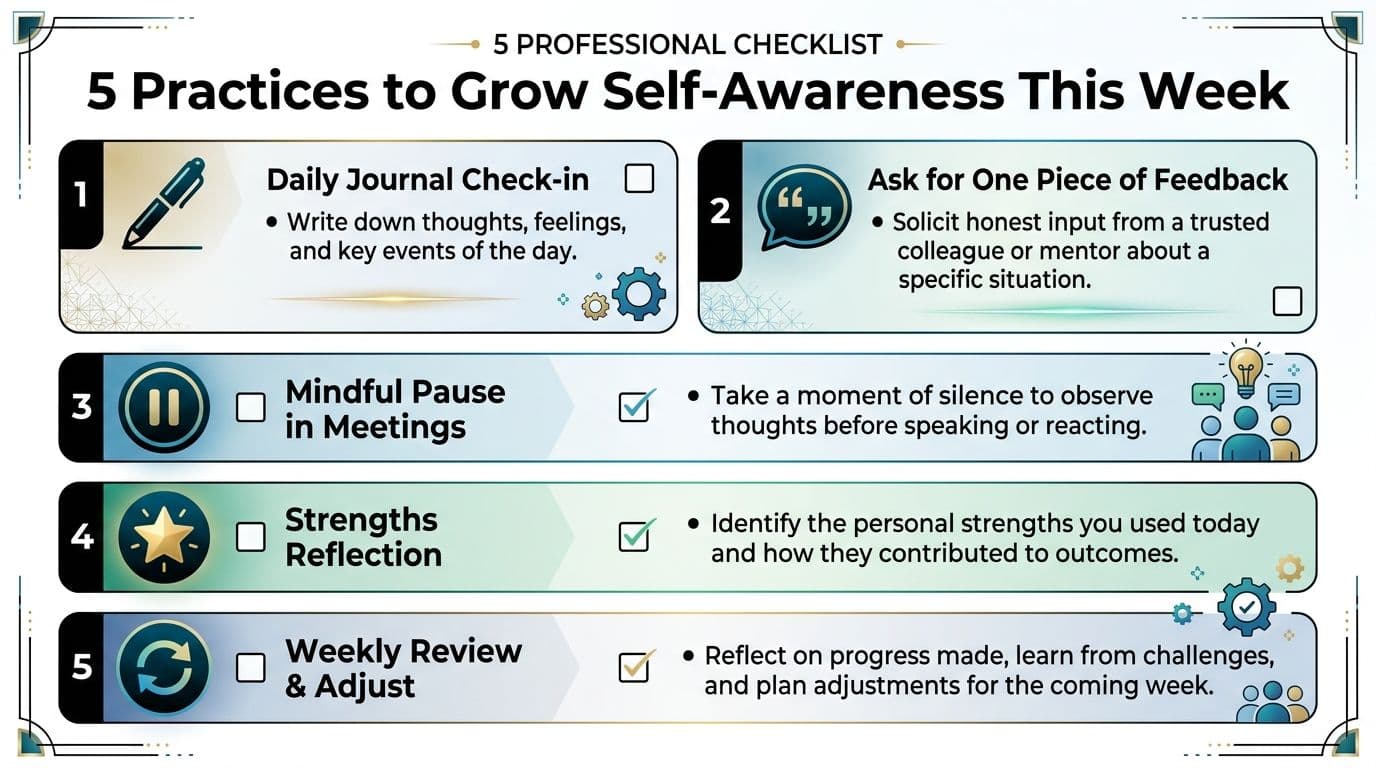
What matters most is repetition. If you try all five once and then stop, the insight fades fast. If you choose one practice and return to it with honesty every few days, you start building the habit of noticing before reacting.
Useful test: if a practice helps you name your state more clearly and choose your next move more deliberately, it is doing its job.
Bringing It All Together for a More Authentic Life
Self-awareness matters because it makes your life more accurate. It helps you notice where your reactions begin, how your behavior lands with other people, and which choices fit the person you're trying to become. That is why it belongs in relationships, work, health, and decision-making, instead of staying tucked away as a private self-help exercise.
The process rarely moves in a straight line. Some days you catch the pattern in the moment. Other days you only understand it after a conversation has already gone off course. That does not mean you have failed. It means you are working with a human mind, and human minds learn by returning to the same situations with a little more honesty each time.
A practical place to begin is simple. Choose one practice from the list above, pair it with the structured self-knowledge in Dan Millman's framework, and keep using it for thirty days. The point is not that thirty days has special power, but that repetition gives honesty a place to settle in.
Ancient wisdom systems have always treated self-knowledge as something you study, test, and refine through lived experience. Dan Millman's life-path approach fits that tradition by giving reflection a structure, so introspection has somewhere to land instead of staying vague. Used that way, self-awareness becomes less like a passing insight and more like a map you keep learning to read.
When self-awareness deepens, life becomes more authentic. You begin to tell the difference between your first reaction and your deeper truth, and that shift changes almost everything.
Discover Your Life Purpose Today!
Unlock your true potential and find your life’s purpose.
