Unlock the secrets of the wiry body type. Our guide explains traits, training, nutrition, and styling to help you embrace and empower your unique frame.
June 21, 2026 (1mo ago) — last updated July 23, 2026 (5d ago)
The Wiry Body Type Your Complete Guide for 2026
Unlock the secrets of the wiry body type. Our guide explains traits, training, nutrition, and styling to help you embrace and empower your unique frame.
← Back to blog
You look in the mirror and see the same thing you've seen for years. Narrow shoulders. Long limbs. Not much visible bulk, even when you've been active. Maybe people call you skinny, lanky, or “just naturally thin” like it's supposed to feel flattering. Meanwhile, you're the one eating, training, trying, and wondering why your body doesn't respond the way other people's seem to.
That experience is real. It can be frustrating, especially when the world treats bigger as stronger and fuller as healthier. A wiry body type can make you feel misunderstood, not because something is wrong with you, but because the usual advice often isn't built for your frame.
The good news is that wiry doesn't mean broken. It doesn't mean weak. It doesn't mean you're stuck. It means you have a particular physical blueprint, and once you understand it, you can stop fighting your body and start working with it.
Embracing Your Naturally Lean Build
A lot of people with a wiry frame grow up hearing mixed messages. One person says, “You're lucky, you can eat anything.” Another says, “You need to put some meat on your bones.” Both comments can land badly. They reduce a whole lived experience to appearance.
I've worked with people who felt embarrassed in the gym because they weren't filling out shirts the way they wanted. I've also seen those same people move with ease, pick up skills quickly, stay energetic through long sessions, and build a kind of body awareness that others spend years chasing. Their challenge wasn't that they lacked potential. It was that they were measuring themselves against the wrong standard.
A wiry build often comes with its own rhythm. Your body may not announce itself with size, but that doesn't mean it lacks ability. Some wiry people are naturally agile. Some are endurance-oriented. Some are surprisingly strong in ways that don't show up in a mirror selfie.
You don't need a different body to build confidence. You need a clearer understanding of the body you already have.
That shift matters. When you stop treating your frame like a mistake, your choices change. You train more intelligently. You eat with purpose instead of panic. You dress in ways that support confidence. You stop wasting emotional energy wishing you were built like someone else.
Self-acceptance isn't giving up. It's seeing clearly. And with a wiry body type, clear seeing changes everything.
Defining The Wiry Body Type
You catch your reflection in a gym mirror and wonder why your body looks athletic in one light, almost slight in another, even though you train hard and stay active. That experience is common with a wiry frame. The body can be capable, coordinated, and resilient while still appearing lean and lightly built.
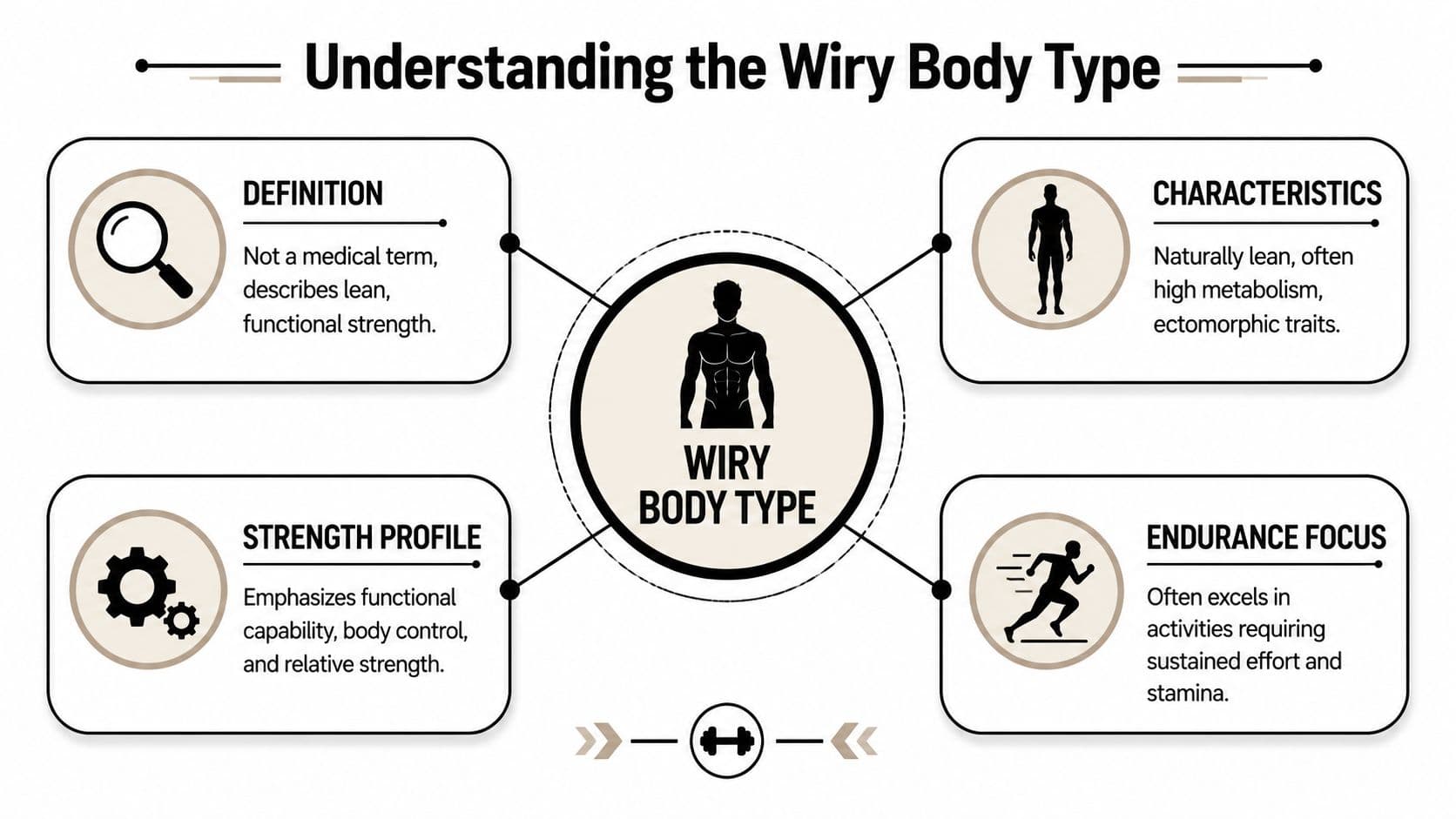
When people use the phrase wiry body type, they are usually describing a visible pattern, not giving a diagnosis. In fitness writing, the closest established category is the ectomorph.
According to Mindvalley's explanation of body types, the ectomorph is described as lean, narrow-framed, and long-limbed, with low body fat and a tendency to gain muscle more slowly. That idea comes from the older somatotype model, which grouped bodies into ectomorph, mesomorph, and endomorph categories. The model is imperfect, but it still gives people a practical starting point for understanding broad body tendencies.
What people usually mean by wiry
A wiry build often includes several of these traits:
- Lean appearance. You may look slim even when you eat enough.
- Lighter-looking frame. Your shoulders, wrists, or overall structure may appear narrower.
- Longer-looking limbs. Arms and legs can look elongated compared with the torso.
- Slower visual muscle gain. Strength may improve before size does.
The easiest way to understand it is through energy use. Some bodies seem to hold onto extra fuel quickly. A wiry body often works more like a high-revving engine, using fuel fast and showing less visual “padding.” That does not make the body better or worse. It means your body has its own rhythm, and your choices work best when they respect that rhythm.
A broader mind-body perspective can help here too. Traditions such as Ayurveda also describe people in terms of natural tendencies rather than defects. If that lens speaks to you, it offers another way to understand how your body and temperament may fit together.
Shape matters more than one magic number
A lot of people want a single measurement that settles the question. They ask for a target weight, a body-fat range, or some exact marker that proves they are wiry. Bodies do not work that neatly.
What usually defines a wiry frame is the overall pattern. You tend to stay lean. Your structure looks lighter. Muscle fullness may be harder to build, even with consistent effort. You may look sleek and compact rather than thick or bulky.
That is why the label can be useful without becoming your identity. It gives you language for what you are working with. The label itself isn't what matters. What matters is using it to make smarter choices that fit your body, your goals, and the life you want to build inside this body.
The Truth About Wiry Strength and Common Myths
The biggest myth about a wiry body type is simple. Thin means weak. It sounds obvious, but it isn't true.
A person can look light and still perform at a very high level. You see that in climbers, martial artists, runners, gymnasts, dancers, and many field athletes. Their strength doesn't always show up as mass. It shows up as control, precision, endurance, coordination, and force applied efficiently.

Why people confuse size with ability
Strength is often judged visually. The sight of bigger arms or thicker legs often leads to an assumption of greater athletic capacity. Sometimes that assumption holds up. Sometimes it doesn't. Performance depends on more than appearance.
The idea of wiry strength speaks to that gap. A recent discussion of the topic notes that someone can look thin yet be strong or athletic, and that this often points to the difference between appearance and function, including factors like tendon or fascial efficiency and sport-specific performance in this video on wiry strength.
That matters because a wiry person may not look imposing, but they may still move exceptionally well under load, recover skillfully between efforts, or produce strong output relative to body size.
Common myths worth dropping
Here are a few beliefs that hold people back:
- “If I'm wiry, I can't build muscle.” You can. It may take more patience and precision, but progress is still possible.
- “If I'm not bulky, I'm not athletic.” Athleticism includes speed, stamina, coordination, balance, and body control.
- “I need to look stronger before I am stronger.” Usually it works the other way around. Consistent practice builds function first.
A wiry frame can also be an advantage. If you carry less nonfunctional mass, certain movements feel smoother. Pull-ups, climbing, sprint mechanics, and long-duration efforts may feel more natural for some people in this category.
Your body doesn't have to look heavy to handle hard things.
The deeper shift is mental. Stop asking, “Why don't I look stronger?” Start asking, “What kind of strength does my body express best, and what do I want to develop next?” That question opens far more doors.
Nutrition Strategies for Your Wiry Frame
Food can feel confusing when you have a wiry build. You may eat a decent amount and still feel like your body burns through it. Or you may swing between two extremes: barely thinking about food, then trying to force-feed yourself when you get frustrated about size.
A better approach is steadier and kinder. Eat to support your real goal. That might be maintaining energy, improving training performance, adding muscle, or feeling less depleted by the end of the day.
The core idea is enough fuel
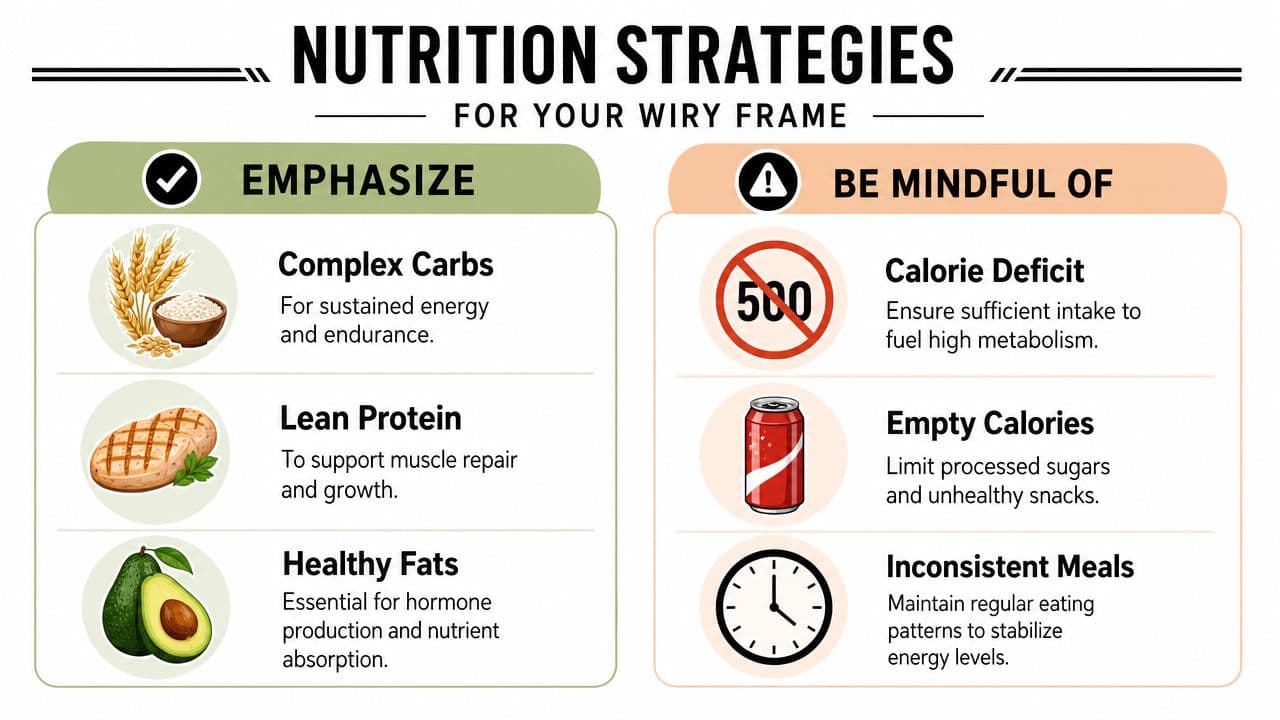
For ectomorphic or wiry clients, NASM recommends a calorie surplus with higher protein intake if the goal is muscle gain. It gives a protein range of 1.2 to 1.6 g/kg/day, with some individuals needing up to 2.2 g/kg/day, and notes that keeping cardio lower can help avoid offsetting energy balance when the goal is mass gain, as explained in NASM's guide to body types.
That guidance is useful because it gives structure without turning eating into a math obsession. If you're under-eating for your activity level, your body doesn't have much extra material to build with.
What to emphasize on your plate
Think in layers rather than rules.
- Protein first. Eggs, Greek yogurt, fish, chicken, tofu, lentils, cottage cheese, or a protein snack that's easy to keep around. If convenience is your weak spot, these snack smarter protein options can help fill the gap between meals.
- Carbs that fuel you. Rice, potatoes, oats, fruit, pasta, beans, and whole-grain breads can make a huge difference if your energy tends to crash.
- Fats that add staying power. Avocado, olive oil, nuts, seeds, nut butters, and full-fat dairy can help make meals more satisfying and more supportive of a surplus.
A simple meal doesn't need to be fancy. A bowl with rice, salmon, olive oil, and roasted vegetables works. So does yogurt with fruit, oats, and nut butter. So does toast with eggs and avocado.
Small habits that help wiry eaters
Many wiry people do better with rhythm than with giant meals. Try this:
| Habit | Why it helps |
|---|---|
| Eat consistently | Long gaps make it easier to fall short without noticing |
| Add calories to meals you already eat | Olive oil, nuts, cheese, tahini, or avocado can increase intake without huge volume |
| Have a post-workout plan | Training without refueling makes progress slower |
| Keep portable food nearby | Busy days can erase a surplus fast |
If your energy feels scattered or your digestion gets affected by stress, it can also help to look at your eating style, not just your macros. In traditional systems, fast-burning, airy constitutions are often associated with irregular appetite and energy. That overview of Vata in Ayurveda is one way to explore that connection.
Simple test: If you finish most days feeling drained, hungry, and under-recovered, the problem may not be discipline. It may be under-fueling.
Nutrition for a wiry body type works best when it feels sustainable. You're not trying to win a week. You're trying to support a body that needs steady input.
Training That Builds and Sculpts a Wiry Body
You finish a workout sweaty and tired, yet a few weeks later your body looks almost the same. That experience can make a wiry frame feel confusing. The problem usually is not effort. It is signal.
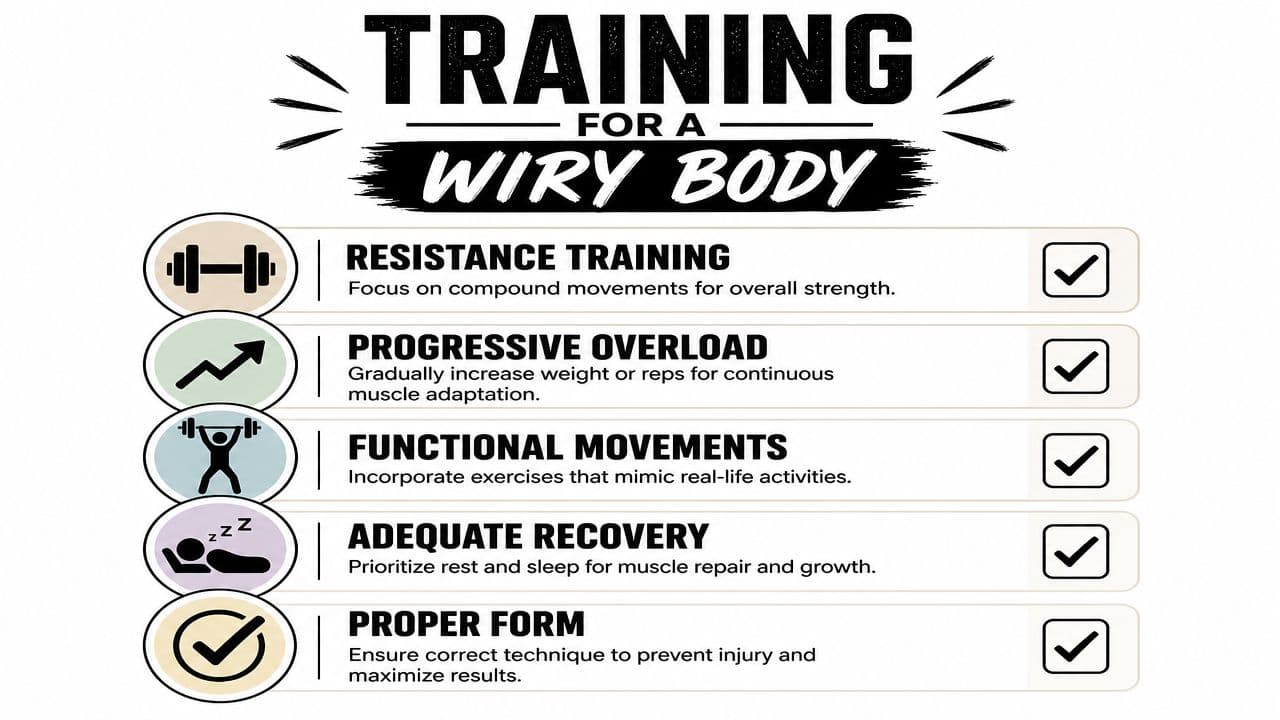
Your body responds best when training gives it a clear reason to adapt. For a naturally lean person, that often means strength work with enough challenge, enough repetition of the basics, and enough recovery to build from it. A wiry body is a bit like a finely tuned instrument. It responds quickly to tension, coordination, and practice, but it still needs consistent input to produce a fuller sound.
Train for adaptation, not exhaustion
Wiry people often notice strength gains before obvious size gains. That can feel discouraging if you only judge progress by the mirror, but it is often a good sign. Your nervous system is learning first. Your body is getting better at recruiting muscle, stabilizing joints, and producing force with control.
That is why smart programming matters so much.
Long, random workouts can burn energy without giving your body a strong growth message. A smaller menu of repeatable lifts usually works better. You practice them, track them, and gradually improve them. Over time, those steady inputs shape your frame in a visible way.
Build around movement patterns that add shape and strength
Instead of chasing dozens of isolated exercises, center your plan on a few patterns that train the whole body well:
- Squat patterns such as goblet squats, front squats, or split squats
- Hip hinge patterns like deadlifts, Romanian deadlifts, or kettlebell swings
- Push patterns including bench press, push-ups, and overhead press
- Pull patterns such as rows, pull-ups, and lat pulldowns
- Carry and core work like farmer carries, planks, and anti-rotation drills
These patterns do more than add muscle. They teach your body how to organize itself. Squats and hinges build the lower half and help you feel grounded. Pushes and pulls give your shoulders, chest, and back more structure. Carries and core work create the kind of tension that makes a wiry frame look more solid, not just slimmer.
If you train at home or want to build a simple setup, quality tools matter. A curated collection like MONFIT strength equipment can make it easier to assemble a space around the basics without overcomplicating things.
A simple weekly rhythm works well
You do not need an advanced bodybuilding split to make progress. A clear weekly pattern is often easier to recover from and easier to stick with.
| Day | Focus |
|---|---|
| Day 1 | Lower body and core |
| Day 2 | Upper body push and pull |
| Day 3 | Rest or gentle mobility |
| Day 4 | Full-body strength |
| Day 5 | Accessory work and carries |
| Day 6 | Light movement |
| Day 7 | Rest |
The magic is in progression. Add a rep. Improve your form. Slow down the lowering phase. Increase the load when your technique stays clean. Keep notes, because wiry lifters often underestimate progress when change happens gradually.
Recovery shapes the body too
A wiry build usually does not need more punishment. It needs enough recovery for training to leave a mark.
Cardio still has value, but keep it in proportion to your goal. If you want more muscle and strength, long draining sessions can make it harder to recover and eat enough. Easy walks, short bike rides, or brief conditioning sessions often support health without pulling resources away from growth.
Recovery also includes your internal state. If stress keeps your body braced and restless, it becomes harder to train with quality. These chi gong exercises are a good place to start.
A strong training plan should help you build muscle, but it should also help you build trust with your body. That matters. The goal is not to force your frame to become someone else's. The goal is to develop the body you were born with so it can carry your purpose with more strength, stability, and presence.
Styling Your Frame Dressing for a Wiry Body
Clothing can change how you feel in your body long before your training results catch up. If you've ever put on a shirt that made you look smaller than you feel, you know this already.
The trick isn't hiding your frame. It's adding shape, structure, and balance.
Build visual presence with fabric and layers
Thin, clingy fabrics often exaggerate narrowness. Heavier materials tend to work better. Denim, twill, corduroy, wool blends, flannel, and structured cotton create cleaner lines and more substance.
Layering helps too. A T-shirt under an overshirt. A knit under a chore jacket. A hoodie under a structured coat. These combinations create depth across the chest and shoulders without looking forced.
Try these principles:
- Use structure. Jackets with some shape through the shoulder can add presence.
- Choose texture. Ribbed knits and sturdier weaves create visual weight.
- Aim for skim, not squeeze. Super-skinny fits can make limbs look even slimmer.
Tailoring beats bagginess
A common mistake is sizing way up in hopes of looking bigger. Usually it just makes the body look swallowed. The better move is clean tailoring with a little room where it counts.
Pants should sit well at the waist and fall cleanly through the leg. Shirts should follow your frame without clinging. If you wear suiting, details like lapel width, button stance, and jacket structure matter more than people think. If you want a practical starting point, this guide on how to pick a suit helps explain how different styles shape the silhouette.
Small style moves that make a difference
A few easy choices can shift proportions:
- Horizontal elements like striped knits or chest pockets can broaden the look of the torso
- Lighter colors up top often create more visual fullness than very dark, flat tones
- Boots or sturdier shoes can ground a slim frame better than ultra-minimal footwear
Style won't replace self-acceptance. But it can support it. When your clothes work with your proportions, you stop feeling like you need to apologize for taking up the space you already deserve.
Embracing The Body You Were Born to Live In
There's a deeper lesson in all of this. Understanding your wiry body type isn't only about muscle, food, or clothing. It's also about identity.
Many people spend years trying to earn peace with themselves by changing their outer form first. Sometimes change helps. Often it does. But real peace usually begins when you stop treating your natural design like a personal failure.
A wiry frame asks for cooperation. It asks you to listen more closely. To notice what energizes you, what drains you, how you recover, how you move, what kind of strength feels most honest in your body. That kind of attention is physical, but it's also emotional and spiritual.
Dan Millman's book The Life You Were Born to Live has helped many readers see life as a path of self-knowledge rather than self-rejection. Its spirit applies here too. Your challenges and gifts often arrive together. What frustrates you can also teach you. What makes you different can become part of your purpose.
The body you have is not separate from the life you're here to live. It's part of it.
So if you've been trying to “fix” your wiry build, consider a gentler question. What if your task isn't to become someone else? What if your task is to understand yourself well enough that your body, habits, and inner life begin working in the same direction?
That's when strength becomes more than appearance. It becomes alignment.
If you want a deeper path of self-understanding that connects your natural traits, challenges, and life direction, explore the Life Purpose App. It's a digital companion to Dan Millman's The Life You Were Born to Live, designed to help you understand the life you were born to live with more clarity, self-acceptance, and purpose.
Discover Your Life Purpose Today!
Unlock your true potential and find your life’s purpose.
