Wise or intelligent? Discover the real difference, how each is built, and practical ways to grow both for clearer decisions in work, love, and life.

October 20, 2026 (29d ago) — last updated October 20, 2026 (28d ago)
Wise or Intelligent: What Sets Them Apart and Why It Matters
Wise or intelligent? Discover the real difference, how each is built, and practical ways to grow both for clearer decisions in work, love, and life.
← Back to blog
Wise or intelligent? Discover the real difference, how each is built, and practical ways to grow both for clearer decisions in work, love, and life.
“Just be smarter about it” is poor advice when the actual problem is judgment. You can research a decision carefully, defend it logically, and still choose something that damages a relationship or pulls you away from the life you want.
Being bright doesn't mean being wise. The useful question isn't which label describes you. It's what your next decision requires that cleverness alone can't provide.
Why the Wise or Intelligent Question Is Often Misunderstood
People often treat wisdom as intelligence that has had time to mature. That sounds reasonable until you meet someone who can untangle a complicated technical problem but won't admit a mistake, or someone with little formal schooling who handles a family disagreement with remarkable care.
For this discussion, intelligence means the ability to learn, reason, recognize patterns, and solve problems. Wisdom means using what you know with attention to context, uncertainty, values, and consequences. These are working definitions, not competing personality types.
An intelligent person might identify the fastest route to a destination. A wise person also asks whether the trip is necessary, whether the driver is exhausted, and who will be affected by leaving. Neither question replaces the other.
Education isn't a measure of someone's worth
Access to learning matters. The global adult literacy rate rose from 65% in 1975 to 88% in 2024, while youth literacy rose from 75% to 93%, according to UNESCO's literacy overview. Those figures show a substantial expansion in access to foundational educational skills.
They don't establish that people have become wiser, and they shouldn't be used to rank anyone's human worth. Reading ability, reasoning ability, and judgment aren't interchangeable. A person may have limited educational opportunities yet offer thoughtful guidance grounded in close attention to others.
A useful distinction: Intelligence helps you work out what you can do. Wisdom asks what deserves doing, under these circumstances.
Why the distinction becomes personal
Consider accepting a demanding job because you can handle the work. That answers a question about ability, but it leaves questions about priorities unresolved.
- Capacity asks whether you can perform the role.
- Fit asks whether its demands suit your responsibilities and values.
- Judgment asks which trade-offs you're prepared to make and explain.
Confusing these questions can leave you successful by someone else's standards and dissatisfied by your own. Self-knowledge begins when you stop treating every available achievement as a necessary one.
You don't need to decide whether you're wise or intelligent. You need to recognize which kind of thinking you're using and which you've left out.
A Side-by-Side Look at Wisdom and Intelligence
A comparison helps, provided we don't turn it into a contest. Intelligence isn't coldness, and wisdom isn't a rejection of evidence. The strongest decisions make room for both.
Wisdom vs Intelligence at a Glance
| Dimension | Intelligence | Wisdom |
|---|---|---|
| Main focus | Understanding and solving a problem | Judging how to respond in context |
| Typical question | What works? | What is appropriate, and for whom? |
| Useful practices | Learning, analysis, experimentation | Reflection, perspective-taking, examining values |
| Where it shines | Finding patterns and comparing options | Navigating ambiguity and competing obligations |
| Possible failure | Optimizing an incomplete goal | Becoming vague or overly cautious |
| Relationship to time | Can solve immediate or long-range problems | Considers how consequences unfold |
Think of intelligence as skill with a map. You can read the symbols, compare routes, and estimate obstacles. Wisdom includes noticing that a travelling companion needs rest or that arriving sooner isn't worth taking an unacceptable risk.
The table's distinctions are tendencies, not strict boundaries. Long-term planning can demand substantial intelligence. Wise judgment can require an immediate response.
Don't make intelligence smaller than it is
It's tempting to define intelligence as test performance and assign every practical strength to wisdom. That makes the comparison too neat. For a broader perspective, Orange Neurosciences' triarchic theory of intelligence guide offers a useful companion resource.
Another distinction concerns information itself. Knowing many facts isn't the same as reasoning well with them. The discussion of intelligence versus knowledge can help you separate what you've learned from how you use it.
Notice the question you're answering
Suppose you're planning a difficult conversation. You might prepare a precise explanation, anticipate objections, and choose persuasive examples. That's useful analytical work.
Wisdom adds another layer:
- Purpose matters more than winning the exchange.
- Timing affects whether the other person can participate constructively.
- Fairness requires leaving room for information you haven't heard.
You may discover that your carefully prepared argument answers the wrong question. Perhaps you were preparing to prove that your schedule was reasonable when the underlying issue was that your partner felt excluded from making it.
The practical difference isn't “thinking versus feeling.” It's solving the stated problem versus checking whether you've understood the whole situation.
Real Decisions That Separate the Two Smart Choices
The following situations are hypothetical teaching examples, not reported case studies. Each shows how a defensible choice can become wiser when the person making it considers something their original analysis omitted.
The promotion that costs trust
An employee wants a management position. They identify a struggling project, take control, and present a polished recovery plan to leadership. The strategy demonstrates initiative, but they leave their colleagues' contributions out of the presentation.
The intelligent analysis concerns visibility, execution, and advancement. The unwise choice is treating colleagues as obstacles to recognition rather than people whose trust matters.
A wiser approach wouldn't require abandoning ambition. The employee could name contributors, explain their own leadership clearly, and discuss responsibilities openly. They'd pursue the promotion without making cooperation harder afterward.
The relationship that looks right on paper
Someone is considering a deeper commitment to a partner. Their lifestyles align, their families get along, and their practical plans seem compatible. Yet difficult conversations consistently end with dismissal or silence.
A checklist can organize relevant information, but it can't make an uncomfortable interaction irrelevant. A wiser response would examine what happens during disagreement before assuming that shared preferences will carry the relationship.
The choice isn't necessarily to leave. It may be to speak plainly, seek appropriate support, and observe whether both people participate in change.
A relationship isn't a spreadsheet error to be corrected until the answer becomes yes.
The financial gain that consumes the life it funds
A freelancer considers a lucrative assignment that would occupy nearly all their available time. Their calculation correctly identifies the financial benefit. It doesn't yet account for an existing caregiving commitment or the recovery time they need.
A wiser choice might be negotiating the scope, delaying the start, or declining. It could also be accepting, if the person deliberately arranges support and decides the temporary demands are worthwhile.
The point isn't that earning more is unwise. It's that a complete decision includes the life around the transaction.
When you're facing a similar trade-off, a guide to making better decisions can provide a place to organize your thinking. Try naming the benefit, the omitted cost, and the person who will carry that cost. That small exercise makes a polished justification easier to distinguish from an honest decision.
How Self-Knowledge Maps Your Strengths and Blind Spots
A blind spot isn't something you don't know. It's something you aren't noticing about how you interpret events. You might describe yourself as decisive while others experience you as unwilling to listen.
Start with observable behavior rather than a flattering description. Recall a recent disagreement and ask whether you checked your understanding, acknowledged uncertainty, or changed your position when the evidence changed.
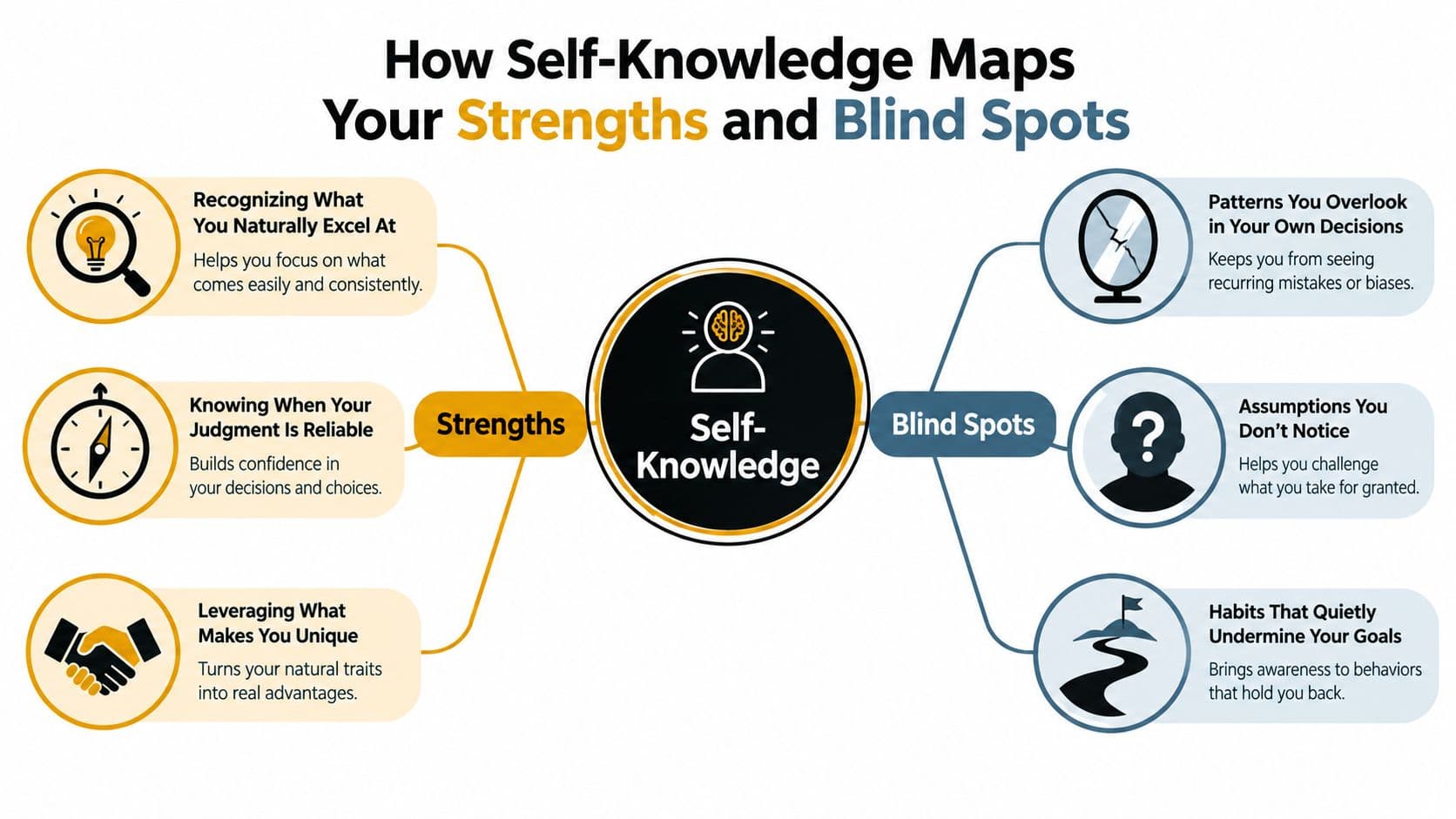
Look for evidence in your own decisions
Useful markers are concrete enough to examine afterward:
- Revisability means you can identify what would change your mind.
- Emotional restraint means you can feel offended without immediately retaliating.
- Perspective-taking means you can describe another person's concern fairly.
- Accountability means you acknowledge your part without explaining it away.
Keep the standard realistic. You aren't looking for flawless behavior. You're looking for a pattern you can recognize while there's still time to respond differently.
The discussion of why self-awareness matters offers a useful starting point for this kind of observation.
Use an interpretive framework as a mirror
The 2018 revised 25th Anniversary Edition of Dan Millman's The Life You Were Born to Live describes 45 distinct life paths, with interpretations involving core issues, talents, and needs across health, money, sexuality, career, and relationships, as outlined in the book's edition description. The Life Purpose App is its digital companion and should be used alongside the book.
The calculation in Dan Millman's The Life You Were Born to Live and the Life Purpose App uses every digit of the complete birth date rather than separately reducing the month, day, and year, as explained in the calculation walkthrough.
Treat this as an interpretive self-reflection framework, not a measurement of intelligence or proof of wisdom. A description becomes useful when you compare it with lived evidence rather than accept it as a verdict.
If a theme seems relevant, write down a situation that supports it and another that complicates it. Ask a trusted person what they notice. That approach lets you explore meaning without allowing a profile to excuse a habit or dictate a consequential choice.
Where AI Advice Is Smart but Not Yet Wise
An answer can sound balanced without being well suited to your circumstances. That makes AI-generated advice a useful test of the wisdom-intelligence distinction: a fluent explanation isn't enough to establish that you should follow it.
In an Australian survey of 2,004 adults in August 2025, 68% trusted AI for information lookup, compared with 43% for general life advice; 84% said it should never replace decisions in certain professions, while the report also discusses a global study covering more than 48,000 people across 47 countries, according to the public-attitudes report.
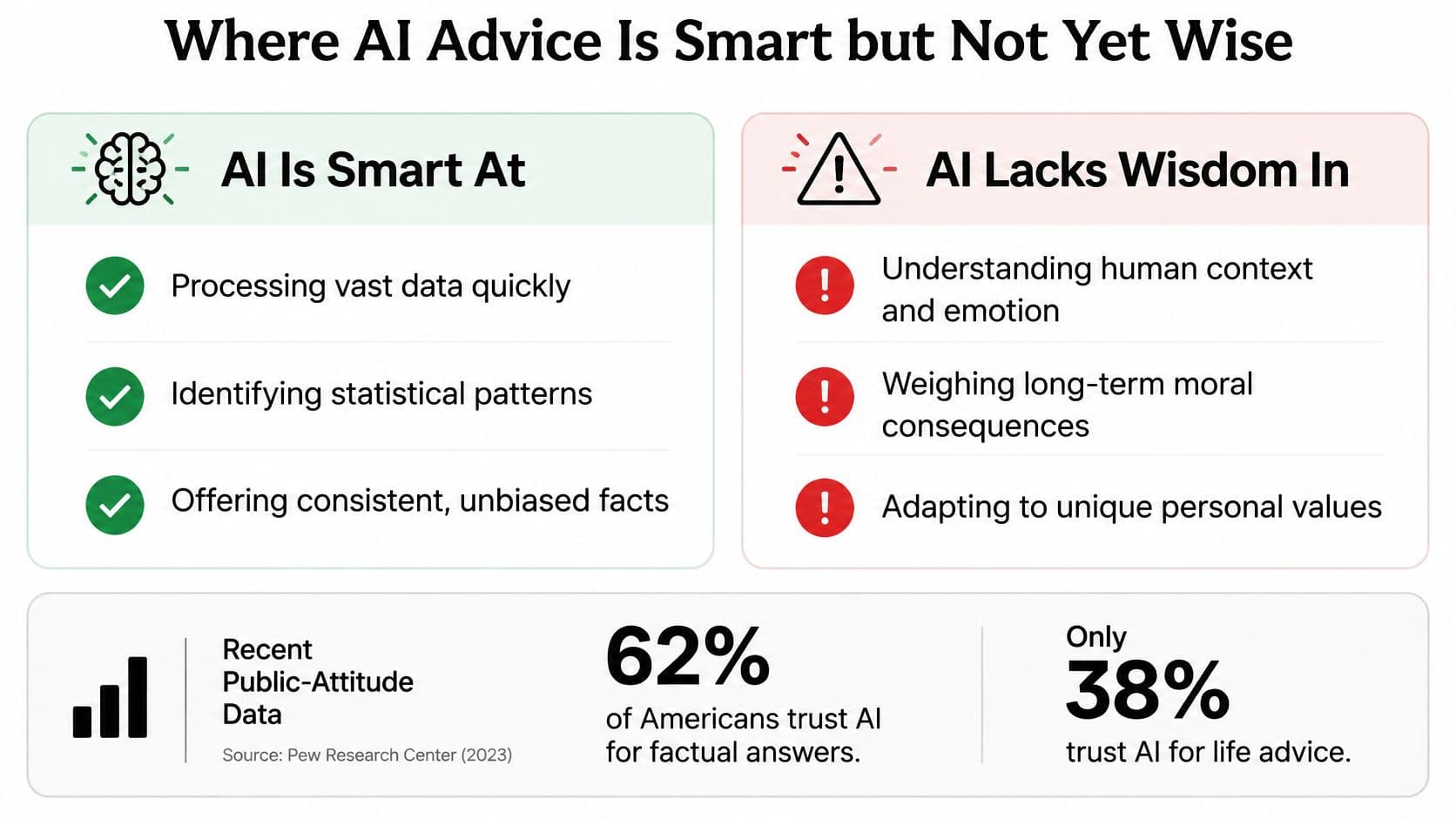
Read the graphic cautiously: any alternative survey figures displayed in it aren't established by the evidence cited above. Its suggestion that AI offers consistently unbiased facts should also not be treated as a guarantee.
Separate assistance from authority
A sensible role for AI is helping you prepare questions, organize considerations, or draft alternatives for review. You might ask it to identify assumptions in your reasoning rather than decide whether you should end a relationship.
Those are different assignments. In the first, you retain responsibility for assessing its output. In the second, you risk treating a generated recommendation as permission to avoid an uncomfortable judgment.
For further reading about reliability, Igneous AI, LLC's ChatGPT error explanations can serve as a companion resource. Keep the practical standard simple: verify consequential factual claims rather than accepting confident wording as evidence.
Keep responsibility visible: Use an automated answer to prepare for a decision, not to make the consequences someone else's responsibility.
A checklist before you rely on advice
The trust gap doesn't prove that AI can never contribute to a personal decision. Public attitudes describe people's confidence, not the correctness of a particular answer.
Before acting, ask:
- Verification Can I check the facts through an appropriate source?
- Missing context What haven't I disclosed or understood myself?
- Human stakes Who should be consulted because they'll be affected?
- Professional boundaries Does this require qualified medical, legal, financial, or mental-health guidance?
- Ownership Can I explain my choice without saying that a tool told me to do it?
Keep sensitive information out of a prompt unless you've assessed the relevant privacy arrangements. Above all, don't let a polished response replace a necessary conversation with someone who knows the situation.
Daily Habits That Build Intelligence and Downward Wisdom
The most useful practice isn't collecting habits until self-development becomes another source of pressure. Choose activities that let you notice the difference between acquiring understanding and applying it responsibly.
Think of downward wisdom here as bringing reflection down into ordinary conduct. It's the movement from a good idea about patience to a different response when someone interrupts you.
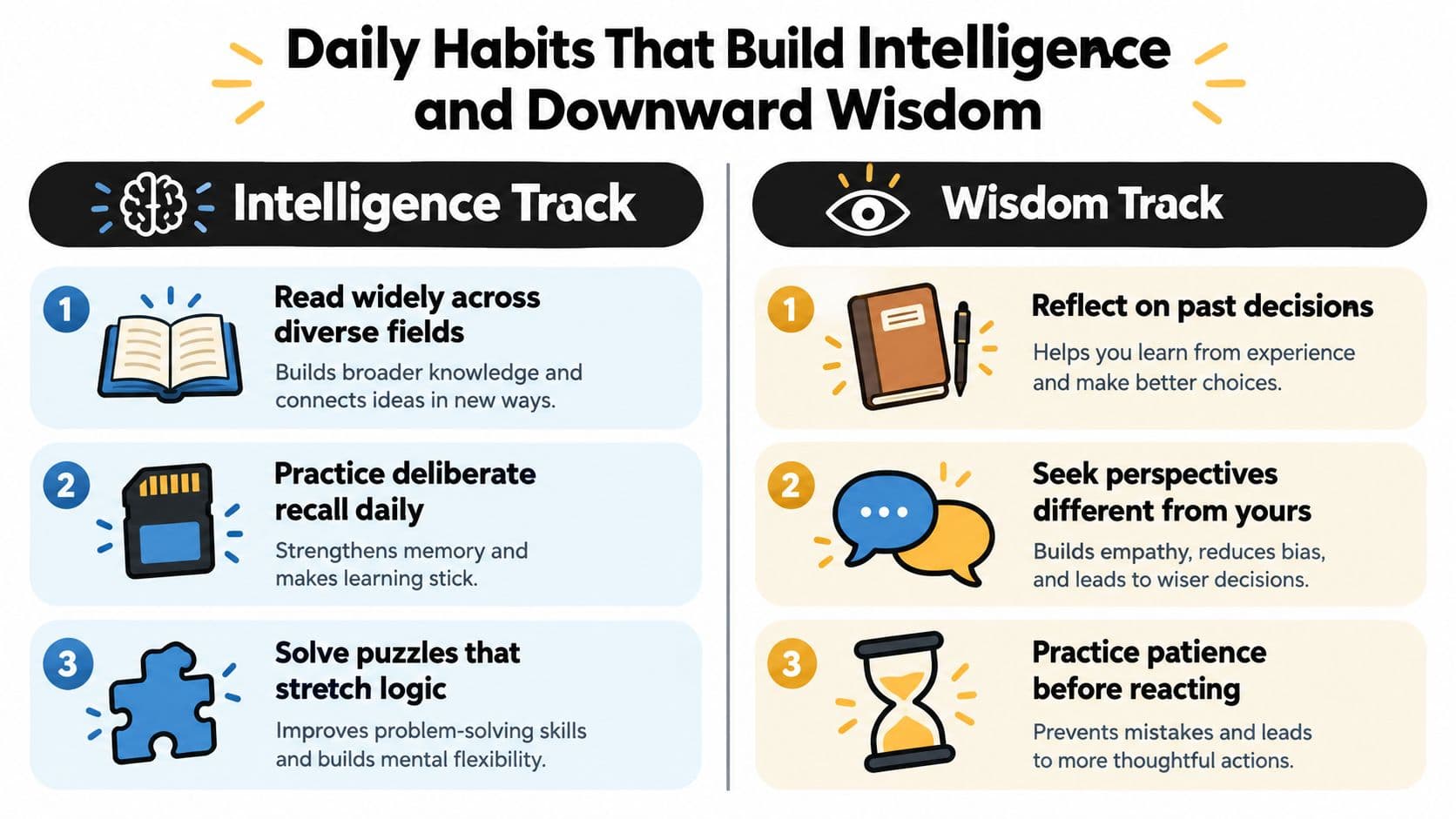
Practice understanding actively
Read something that requires attention, then close it and explain the central idea in plain language. Treat deliberate recall as a check on your understanding, not as a performance.
When learning a skill, choose work that produces inspectable feedback. A spreadsheet formula can be tested. A piece of writing can be discussed with a reader. An explanation can be checked against the material you used.
- Read across subjects to encounter unfamiliar questions and approaches.
- Explain without notes to discover where your understanding becomes vague.
- Seek specific feedback by asking what was unclear or incorrect.
- Respect rest rather than making every spare moment another learning assignment.
Puzzles can offer enjoyable practice with particular kinds of reasoning. Don't assume that doing well at them settles how you'll handle a difficult conversation or an unfamiliar real-world problem.
Practice reflection without self-punishment
For wisdom, keep a decision journal rather than a list of daily accomplishments. Record what you expected, what concerned you, and what you chose not to investigate.
Afterward, separate the quality of your process from the outcome. A careful decision can still end badly. A careless decision can turn out well.
Try these prompts:
- Examine defensiveness by noting where you wanted to dismiss criticism immediately.
- Invite disagreement from someone who can challenge your reasoning respectfully.
- Create a pause before responding to a message that provokes you.
- Consider your future self and the obligations they'll inherit.
- Review an assumption that events have given you reason to question.
You don't have to turn every experience into a lesson. Some evenings, a brief honest note is enough.
A workable weekly mix includes learning, feedback, reflection, and an actual conversation. If your routine produces more information but no changes in behavior, adjust the reflection side. If it produces endless introspection without clearer understanding, return to evidence, skill practice, and action.
A 30-Day Plan to Grow Both Qualities Together
Use this 30-day plan as a practice schedule, not a promise of measurable transformation. Pair learning with reflection, then judge the month by the decisions you can explain with greater honesty.
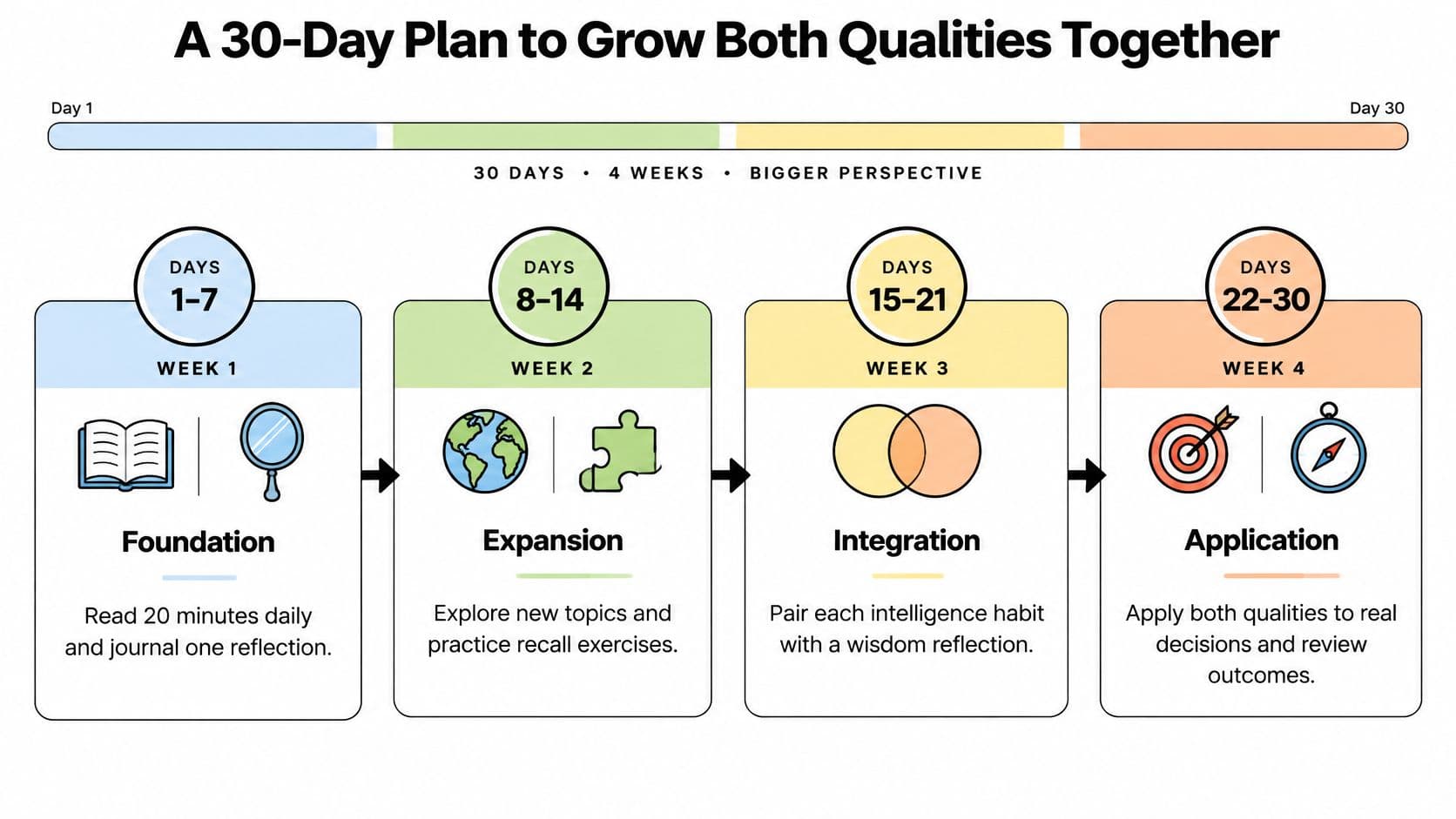
Build a foundation and test it
- Opening week Read something challenging each day, summarize it without looking, and record a decision that deserves attention.
- Following week Explore an unfamiliar subject and ask someone to challenge an assumption connected to your recorded decision.
- Integration week Apply what you've learned to a live choice. Separate factual questions from questions about values.
- Application week and closing days Act where appropriate, review your reasoning, and identify what remains uncertain.
At each weekly checkpoint, log a decision and describe how the process felt different. Notice whether you asked a better question, consulted someone affected, or recognized a limit sooner.
Add a reflective timing prompt
Dan Millman's The Life You Were Born to Live and the Life Purpose App describe recurring nine-year cycles, with year 1 emphasizing beginnings, year 5 change and freedom, and year 9 completion and release, as explained in the cycle framework overview.
If you use Dan Millman's The Life You Were Born to Live and the Life Purpose App, revisit their profile and cycle themes as journaling prompts, not deadlines or predictions. Tomorrow morning, choose a reading task and write down a decision you're avoiding. That's a concrete beginning without requiring you to reinvent your life.
Questions People Still Ask About Being Wise or Intelligent
Can someone be intelligent without being wise?
Yes. Someone can reason effectively while overlooking responsibilities or refusing to examine their motives. It's more useful to identify that missing behavior than to label the whole person.
Does wisdom come with age?
Age offers experience, but experience isn't the same as thoughtful reflection. Ask what someone has learned from being mistaken and how they've changed their conduct.
How long does development take?
There's no universal timetable established here. Look for observable changes: clearer explanations, more appropriate questions, less defensiveness, and greater willingness to repair a mistake.
What if the smart and wise answers conflict?
Check whether you've defined the goal too narrowly. An apparently optimal answer may serve convenience while neglecting a responsibility you consider important.
If the conflict remains, make the trade-off explicit:
- Name what you gain without exaggerating it.
- Acknowledge what you sacrifice without hiding behind necessity.
- Seek appropriate input before acting on a consequential choice.
Being wise or intelligent isn't a permanent status you earn. Your next decision is another opportunity to practice both, with enough humility to recognize what you still don't know.
The Life Purpose App offers a digital companion to Dan Millman's The Life You Were Born to Live, with life-path interpretations that can support reflection on recurring gifts and challenges. Visit Life Purpose App, explore a theme alongside the book, and compare it with a real decision in your journal rather than treating it as an answer you must follow.
Discover your life path today
Enter your date of birth and see your life path, free.
Find your life path