Explore the link between yoga and anger. Learn practical sequences, breathing, and mindfulness tools to manage emotions and find inner peace.
June 9, 2026 (1mo ago) — last updated July 24, 2026 (1d ago)
Yoga and Anger: A Guide to Managing Emotions
Explore the link between yoga and anger. Learn practical sequences, breathing, and mindfulness tools to manage emotions and find inner peace.
← Back to blog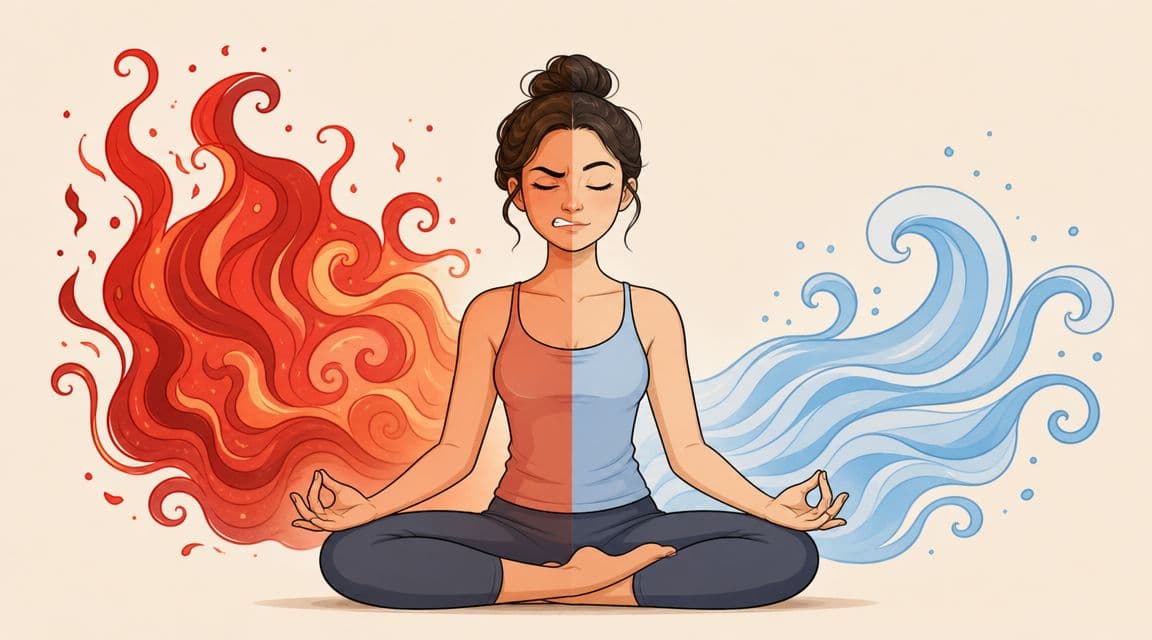
Your jaw is tight. Your chest feels hot. A conversation keeps replaying in your head, and every time it does, your body reacts as if the argument is still happening. That's often what anger feels like before it becomes words or actions. It lands in the body first.
Many individuals don't need another lecture about “calming down.” They need something that works when they're flooded, tense, restless, or one sentence away from saying something they'll regret. That's where yoga can help. Not as a moral practice. Not as a demand to become soft, quiet, or endlessly patient. As a set of tools that changes what your nervous system is doing in real time.
Yoga and anger belong in the same conversation because anger is not just a thought problem. It's a whole-body state. Heart rate rises, breathing changes, muscles brace, attention narrows. If you only try to think your way out of that state, you're working uphill. When you use posture, breath, and focused awareness together, you give the body another instruction.
Meeting Anger on the Mat
I've seen anger show up on the mat in familiar ways. A student arrives already carrying the day in their shoulders. Someone snaps at themselves for wobbling in a pose. Another person lies down for rest and realizes they aren't relaxed at all. They're simmering.
That matters, because anger isn't always loud. Sometimes it looks like irritation, impatience, sarcasm, clenching, doom-scrolling, or a strong urge to get up and do something intense. Many people think they've failed at yoga when these feelings appear. They haven't. They've noticed what was already there.
Anger is a body signal
Anger often starts as protection. The body senses threat, unfairness, overload, or crossed boundaries, then prepares for action. That preparation can feel powerful, but it can also feel frightening. If you're already stressed, tired, hungry, overstimulated, or carrying old hurt, the body can move into that state very quickly.
You do not have to suppress anger to work with it. You have to notice when your body has shifted into attack mode.
This is why yoga can be so useful. A good anger practice doesn't ask you to pretend everything is fine. It helps you create enough space between the surge and the reaction. That space might be one breath. It might be two minutes on the floor. It might be a simple posture that tells your nervous system, “We are not fighting right now.”
What the mat can teach
On the mat, anger becomes easier to study because the moment is contained. You notice heat in the face. Breath that's too fast. A stomach that hardens. Thoughts that become absolute. From there, the work is practical.
- Name the signal: “My body is activated.”
- Reduce the fuel: less speed, less strain, less stimulation.
- Stay present: not with the story alone, but with the sensations under it.
That's the shift. Yoga and anger work well together when yoga is used as regulation, not performance.
Why Yoga Works on a Raging Mind
Anger raises physiological arousal. In simple terms, it turns up your internal heat. Muscles tighten, breathing gets shallow or forceful, and the body prepares to confront, defend, or push through. If you answer that state with more intensity, you can end up feeding it.
That's why “just go blow off steam” doesn't always help. Some people do feel temporary relief after hard exertion, but anger isn't only energy that needs an outlet. It's also a nervous system state that often needs downshifting.
Heat up versus cool down
Think of anger management in two categories.
Heat-up strategies tend to increase activation:
- Arguing in your head: replaying the event and building your case
- Venting aggressively: saying everything at full intensity
- Pushing hard physically: choosing intensity when you're already flooded
Cool-down strategies decrease activation:
- Slow yoga: steady movement with deliberate breathing
- Breathwork: especially longer, softer exhales
- Mindfulness: noticing sensations and thoughts without feeding them
A large review cited by Ohio State University looked at over 150 studies and found that activities that decrease physiological arousal, including yoga, deep breathing, and mindfulness, were more effective at reducing anger than arousal-raising activities such as jogging, which was sometimes found to increase anger, according to Ohio State University's report on anger and arousal.
Why slower practices help
The goal is not to “get rid of” anger instantly. The goal is to stop adding fuel. Slow movement and slower breathing give the body a different rhythm to follow. Attention narrows in a useful way. You feel your feet. You lengthen an exhale. You unclench the jaw. Those aren't small changes. They are direct signals to a system that has gone into alarm.
Practical rule: If your anger feels hot, sharp, and impulsive, choose practices that make you slower, heavier, quieter, and more grounded.
This is also why not every yoga class is ideal for anger. Fast-paced, competitive, overheated practice can leave some people more agitated. For anger, gentler usually works better than harder.
When anger and overwhelm overlap
For some people, anger arrives alongside rejection sensitivity, emotional flooding, or rapid shifts in attention. In those cases, the nervous system may already be working overtime before the triggering moment even happens. If that sounds familiar, this overview of the deep connection between ADHD and emotions is a helpful way to understand why reactions can feel so immediate and physical.
What works best is often simple:
- lower the intensity
- lengthen the exhale
- stay with direct sensation instead of the argument in your head
That combination is where yoga becomes more than stretching. It becomes regulation.
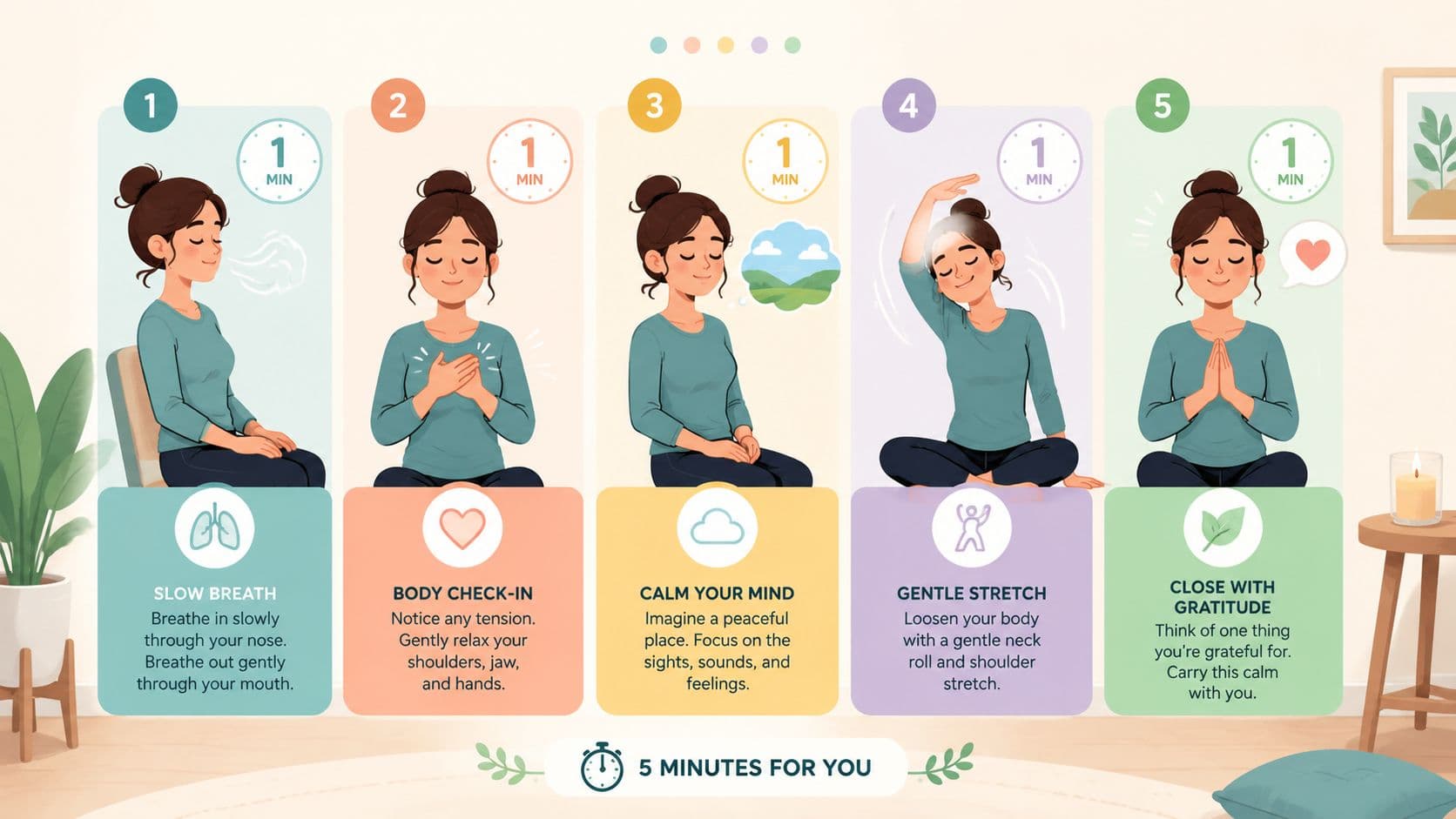
Immediate Relief A 5-Minute Calming Sequence
When anger is rising, you need something short enough to do. Not a full class. Not a perfect routine. Just a sequence that interrupts the spiral and gives your body another direction.
A useful sequence is structured, repeatable, and simple. That matters because anger narrows your thinking. You won't want ten options. You'll want one thing that you can remember.
Research on adolescents supports this idea. A school-based yoga module for anger management was developed, expert-reviewed, and pilot-tested, with 16 of 18 yogic techniques retained in the final protocol, and the pilot reported a significant reduction in anger scores, as described in the PubMed summary of the adolescent yoga module. Structure helps.
A short sequence for acute anger
Try this in order. Move gently. If any shape makes you feel trapped or more agitated, come out of it.
-
Child's Pose
Kneel, bring your hips toward your heels, and fold forward. Rest your forehead on stacked hands, a cushion, or the floor. Breathe into the back of the ribs. Stay long enough to feel your belly soften a little. -
Cat-Cow
Come onto hands and knees. Inhale as you lift the chest slightly. Exhale as you round and press the floor away. Keep it small. This isn't about flexibility. It's about moving tension out of the spine and giving the breath a rhythm. -
Standing Forward Fold with bent knees
Stand up slowly, then fold forward with your knees bent as much as needed. Let your head hang. Rest your hands on thighs, a chair, blocks, or the floor. Soften the back of the neck. This can reduce the sense that everything is charging upward. -
Seated twist or simple seated pause
Sit on a chair or on the floor. Gently rotate to one side, then the other. Keep it mild. If twisting feels like too much, sit upright and place one hand on the chest and one on the belly instead.
How to breathe through it
Use a soft pattern:
- Inhale naturally
- Exhale more slowly
- Pause briefly only if it feels easy
If your breath becomes forced, you're back in effort. Anger rarely needs more effort. It needs less pressure.
A few practical notes make this sequence work better:
- Keep your eyes soft: a hard stare tends to keep the body on alert.
- Drop your shoulders on the exhale: don't wait for them to relax on their own.
- Use support: a chair, couch, wall, or cushions count. Regulation matters more than shape.
If you want more ideas in the same spirit, cooling yoga poses for settling the body fit well with an anger practice because they emphasize grounding over performance.
What not to do in the first five minutes
Some choices sound healthy but usually backfire when you're flooded.
- Don't force a deep stretch: strain can make the body brace.
- Don't pick a power flow: intensity often keeps the anger loop going.
- Don't rehearse the argument while moving: you're trying to reduce activation, not sharpen your case.
Five minutes won't solve every pattern. It can stop one bad moment from becoming a worse one.
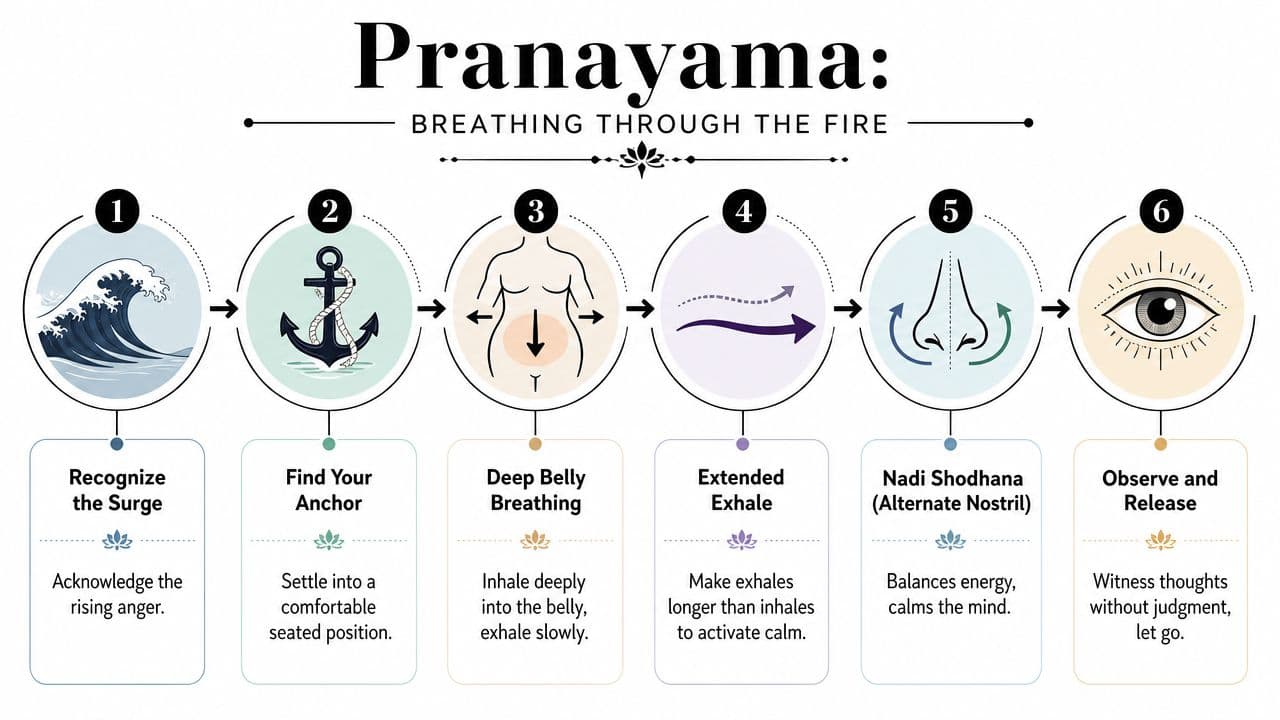
Breathing Through the Fire With Pranayama
If I had to choose one portable tool for yoga and anger, it would be breathwork. You can use it in a parked car, in a bathroom stall, at your desk, or before answering a text you should not answer yet.
Breath is unusually powerful because it sits at the border of automatic and intentional processes. Anger changes breathing on its own. You can also change breathing on purpose. That makes pranayama one of the fastest ways to influence your state without needing much space or time.
A review in Frontiers in Psychology describes yogic breathing as linked to reduced anxiety and more positive emotions, and discusses how yoga may support emotion regulation through attention control and autonomic down-regulation in this Frontiers review on yoga and emotion regulation.
Pranayama techniques for anger management
| Technique | How to Do It | Best For |
|---|---|---|
| Extended Exhale Breathing | Inhale comfortably, then make the exhale a little longer than the inhale. Keep the breath smooth, not dramatic. | Moments when anger feels hot, fast, or impulsive |
| Box Breathing | Inhale, pause, exhale, pause in an even rhythm that feels manageable. Keep the cycle gentle. | Situations where you need steadiness and focus, not just calming |
| Alternate Nostril Breathing | Use your fingers to alternate which nostril you breathe through, moving slowly and evenly. | Mental agitation, looping thoughts, and emotional imbalance |
How to choose the right one
Use sensation as your guide.
If you feel like you could snap, start with extended exhale breathing. It's the least complicated and often the most soothing. If your mind is scattered and reactive, box breathing can create a sense of containment. If you feel split between racing thoughts and body tension, alternate nostril breathing can be surprisingly settling.
For a simple guided starting point, this explanation of expert insights on stress reduction offers a clear look at box breathing in everyday terms.
Keep the breath kind
People often make two mistakes with pranayama when angry. They breathe too hard, or they try to fix themselves too fast. Neither helps.
Soft breathing changes state more reliably than forceful breathing when the nervous system is already overactivated.
A few reminders:
- Sit in a position you can sustain: chair, couch, floor, or even standing with your back to a wall.
- Relax the mouth and tongue: many people hold anger there.
- Stop if you feel dizzy or more activated: return to normal breathing and ground through your feet.
If you want a guide to fuller, steadier breathing without adding intensity, this provides a practical next step.
Going Deeper Understanding Your Anger Patterns
The immediate tools matter. They keep anger from running the whole show. But long-term change usually comes from learning your patterns well enough to interrupt them earlier.
Anger has a surface and a root. The surface might be the comment, delay, insult, noise, traffic, email, or misunderstanding. The root is often more personal. Feeling dismissed. Feeling trapped. Feeling exposed. Feeling unseen. Feeling overloaded for too long.
The body usually knows first
Before anger becomes a story, it often shows up as a sensation pattern. Heat in the face. Pressure behind the eyes. Tightness in the throat. A push in the chest. Fists, jaw, belly, shoulders. When you learn your early signs, you gain time.
That's the main advantage of mindfulness here. Not passive observation. Earlier detection.
Try asking:
- Where does anger begin in my body?
- What happens to my breath when I'm triggered?
- Do I move toward attack, shutdown, or control?
- What am I trying to protect in that moment?
Anger often enters as armor. If you only argue with the armor, you miss the wound underneath it.

Journaling that actually helps
A blank page can be surprisingly clarifying if you use specific prompts. Don't write to sound wise. Write to catch what repeats.
Try prompts like these:
- What happened right before I got angry? Keep it concrete.
- What did I tell myself it meant? This reveals interpretation.
- What did my body want to do? Leave, yell, freeze, prove, fix, punish.
- What was the softer feeling under the anger? Hurt, fear, shame, helplessness, grief.
- What boundary, value, or need felt threatened?
- What would regulation have looked like one minute earlier?
Write in short bursts. Two or three honest sentences are more useful than a page of analysis.
Patterns worth noticing
Over time, individuals find that their anger follows familiar routes.
Some common ones:
- Overload anger: too much stimulation, too little rest
- Boundary anger: saying yes too often, then exploding later
- Shame anger: feeling exposed, corrected, or inadequate
- Control anger: reacting hard when plans change
- Old-pain anger: current situations waking up older hurt
When you know your route, you can build practices around it. Overload anger may need quieter transitions and less sensory input. Boundary anger may need clearer communication much earlier. Shame anger often needs slower self-talk and less self-attack.
Reflection after the wave
After the intensity passes, ask one final question: “What was this anger trying to do for me?” Not because every angry reaction was wise. Some aren't. But anger usually arrives with an intention. Protect. Defend. stop. push back. restore dignity. create distance.
That question softens shame and sharpens insight. It helps you move from “Why am I like this?” to “What does this pattern need from me?”
That's a much more workable place to practice from.
Building a Practice and When to Seek Professional Help
The most helpful anger practice is one you'll repeat. That usually means shorter, gentler, and less ambitious than people expect. A few minutes of breathwork in the morning. A brief reset after work. One familiar pose when you feel yourself hardening. Consistency matters more than mood.
There is also good reason to trust steady practice. A randomized controlled trial of an eight-week integrated yoga program found a significant decrease in verbal aggressiveness in the yoga group, with P = 0.01, while the physical-exercise comparison group showed a nonsignificant increase, according to the published trial on yoga and verbal aggressiveness. That tells us change doesn't require years before it becomes noticeable.
A realistic way to begin
Keep it simple.
- Choose one pose: Child's Pose or a supported forward fold
- Choose one breath: extended exhale or box breathing
- Choose one check-in time: morning, commute, lunch break, or before bed
That's enough to build a pattern. If you need a gentler framework, these ideas on trauma-informed yoga practices can help you approach regulation with more safety and less pressure.
When yoga isn't enough by itself
Yoga can support anger work beautifully. It is not the whole answer for everyone.
Please consider professional help if:
- Your anger feels frightening or hard to control
- You're damaging relationships regularly
- You feel ashamed after outbursts and keep repeating them
- Anger is tied to trauma, panic, dissociation, or persistent emotional numbness
- You worry you might hurt yourself or someone else
In those cases, yoga works best as a complement to therapy, not a substitute for it. If trauma is part of the picture, targeted support matters. Resources like specialized therapy for trauma survivors can be useful because unresolved trauma often shows up as reactivity, vigilance, and a body that doesn't feel safe enough to downshift on its own.
Strong self-regulation is not about handling everything alone. It's about getting the right kind of support and using your tools well.
Anger is workable. Not because it's simple, and not because yoga makes you immune to being human. It's workable because the body can learn new responses. With practice, the surge still comes, but it doesn't have to drive.
If you're drawn to the deeper self-inquiry side of emotional patterns, the Life Purpose App is a thoughtful companion to Dan Millman's The Life You Were Born to Live. It offers a structured way to explore life-path themes, recurring challenges, and growth patterns, which can add useful perspective when anger keeps showing up in familiar forms.
REQUIREMENTS:
- Remove each broken blog link completely (both the markdown link syntax and the descriptive text)
- Rewrite sentences naturally after removing references
- Preserve all other markdown formatting
- Only remove references to the specific broken blog links, don't change other content
- Process all broken URLs in a single pass
Example: After: "...for your small business."
Please return your response in the following JSON format: { "updatedContent": "the full content with all broken links removed", "removals": [ { "brokenUrl": "the broken blog URL", "explanation": "brief explanation of what was removed and how the text was adjusted" } ] }
REQUIREMENTS:
- Remove each broken blog link completely (both the markdown link syntax and the descriptive text)
- Rewrite sentences naturally after removing references
- Preserve all other markdown formatting
- Only remove references to the specific broken blog links, don't change other content
- Process all broken URLs in a single pass
Example: After: "...for your small business."
Please return your response in the following JSON format: { "updatedContent": "the full content with all broken links removed", "removals": [ { "brokenUrl": "the broken blog URL", "explanation": "brief explanation of what was removed and how the text was adjusted" } ] }
Discover Your Life Purpose Today!
Unlock your true potential and find your life’s purpose.
