Start your zazen at home practice with this simple guide. Learn posture, breathing, and how to create a routine for finding quiet clarity in your daily life.
June 4, 2026 (1mo ago) — last updated July 24, 2026 (4d ago)
Zazen at Home: A Beginner's Guide to Finding Stillness
Start your zazen at home practice with this simple guide. Learn posture, breathing, and how to create a routine for finding quiet clarity in your daily life.
← Back to blog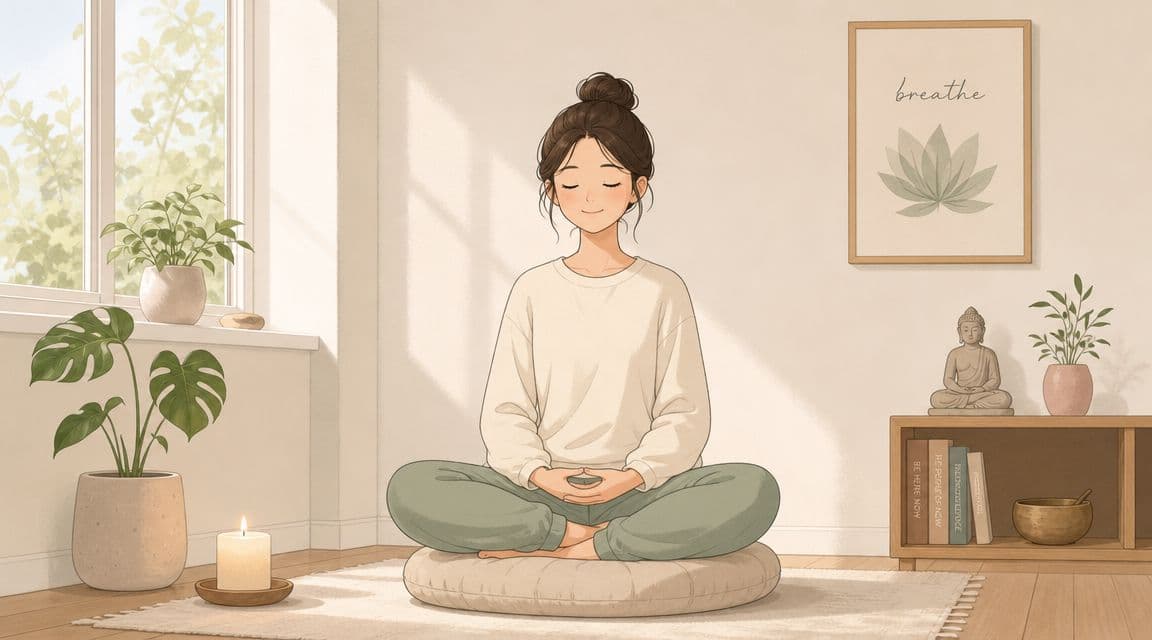
You may be sitting at your kitchen table right now, wanting a practice that helps you settle down without requiring a temple, robes, incense, or a perfect spine. That's a good place to begin. Zazen at home works precisely because it can fit into ordinary life.
Historically, zazen is a seated discipline central to Zen, but modern descriptions make clear that it can be practiced in a quiet home setting rather than only in a formal temple environment, and some traditions even suggest a small home altar and chanting a sutra for just five minutes daily to support regularity. That matters because the prevailing need isn't for more spiritual theater. Rather, it's for a simple, repeatable way to sit still and come back to oneself.
A common obstacle for beginners usually isn't philosophy. It's friction. Where do I sit? What if my knees hurt? What am I supposed to do with my mind? And what happens if my house is noisy and my meditation doesn't look anything like the serene photos?
Those are practical questions, and zazen gives practical answers.
Finding Quiet in a Noisy World
People don't come to zazen because life is already calm. They come because the day feels crowded. Notifications, unfinished conversations, dishes in the sink, the low hum of worry in the background. In that setting, zazen at home isn't an exotic spiritual project. It's a way to stop feeding agitation for a little while.
Zazen means seated meditation. In Zen, it has deep roots, but at home it becomes very plain. You sit down, take a stable posture, and stop adding more noise to the mind than is already there. That simplicity is one reason it lasts.
A home practice also removes a common excuse. You don't need special architecture, a retreat schedule, or someone ringing a bell in the next room. You need a place to sit and the willingness to return tomorrow.
You don't need a dramatic experience. You need a chair, a cushion, or a corner of the room where you can stop rehearsing your life for a few minutes.
Some people like a small ritual that helps the mind shift gears. A candle, a flower, a bow, or a cup of tea before sitting can all work. If that appeals to you, a practical resource like Jeeves & Jericho's tea guide can help you choose something calming without turning the tea itself into the practice.
The point is not to build a mood. The point is to make sitting easier to begin.
Creating Your Personal Practice Space
A good practice space doesn't need to look sacred. It needs to be usable. The best spot in the house is usually the one you'll return to without negotiation.
Choose a place that asks little of you
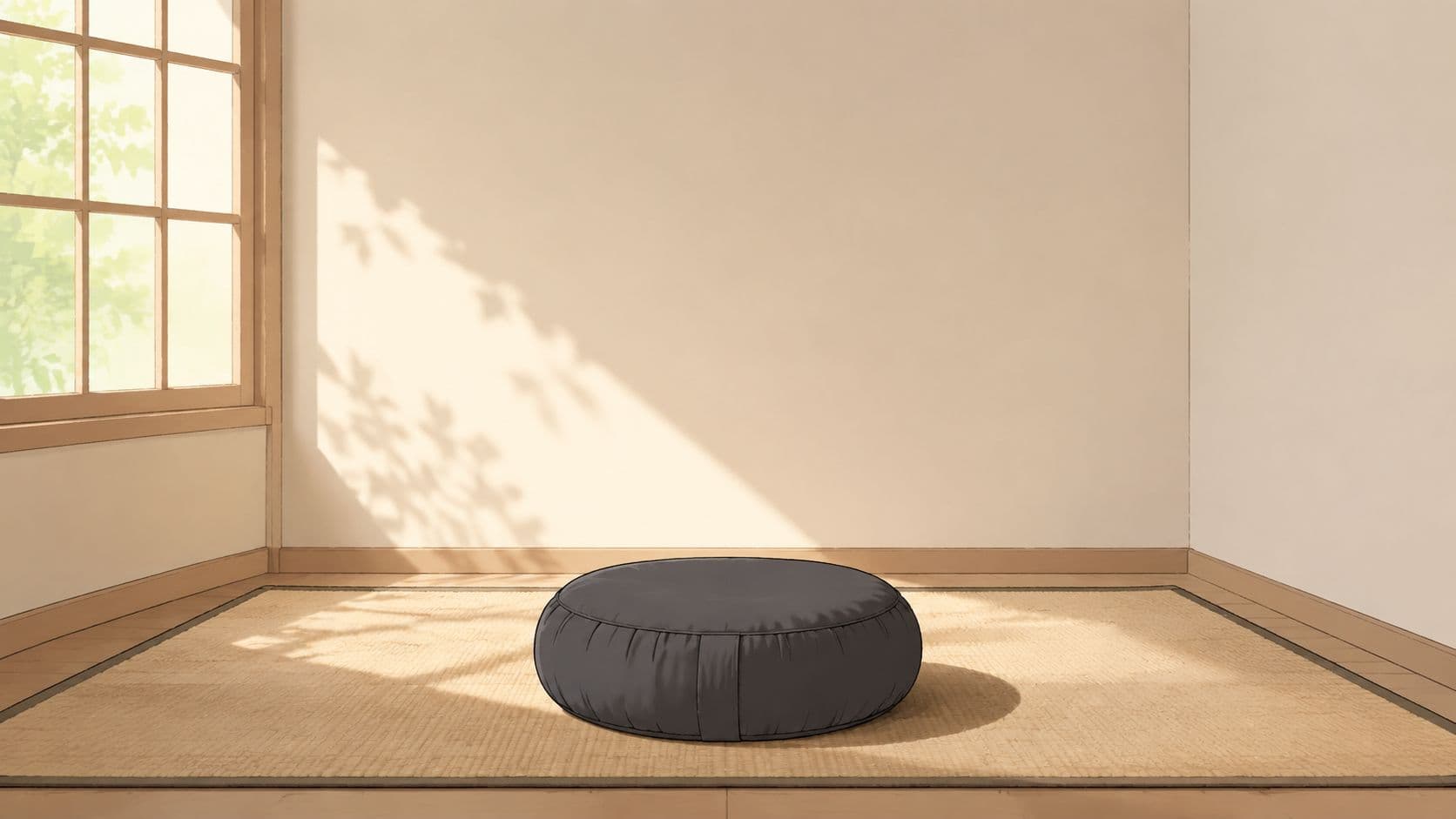
Pick a corner with low traffic. That may be a bedroom floor, the side of a living room, or even a space beside your desk. If the area is easy to enter and leave, you're more likely to sit when you're tired or busy.
Keep the setup spare. A cushion or folded blanket is enough. If you like a visual cue, add one object that indicates your stopping point. A candle, a small bowl, or a single branch in a jar is plenty.
A few things help more than people expect:
- Less visual clutter: clear the immediate area so your attention isn't pulled outward before you even sit.
- Consistent placement: leave the cushion, chair, or mat in the same spot if you can.
- Manageable light: harsh glare makes settling harder. Soft natural light often helps.
If your room gets blasted by afternoon sun or feels visually busy because of large windows, ideas from Lewis and Sheron custom window designs can help you make the space calmer and less distracting.
Build meaning through repetition
What makes a space feel steady isn't decoration. It's use. When you sit in the same place day after day, your body starts to recognize it. The threshold gets lower.
Some people also care about the emotional feel of the room. If that matters to you, simple household resets can help before practice, like tidying surfaces or opening a window. A broader reflection on this appears in a guide on removing negative energy from a house, though for zazen the standard is modest. Clean enough. Quiet enough. Ready enough.
Practical rule: make the space so simple that your future tired self won't avoid it.
Finding Your Seat Posture and Presence
Posture matters in zazen, but not because you're trying to look traditional. Posture matters because the body affects the mind. A balanced seat makes it easier to stay awake, breathe naturally, and sit without constant fidgeting.
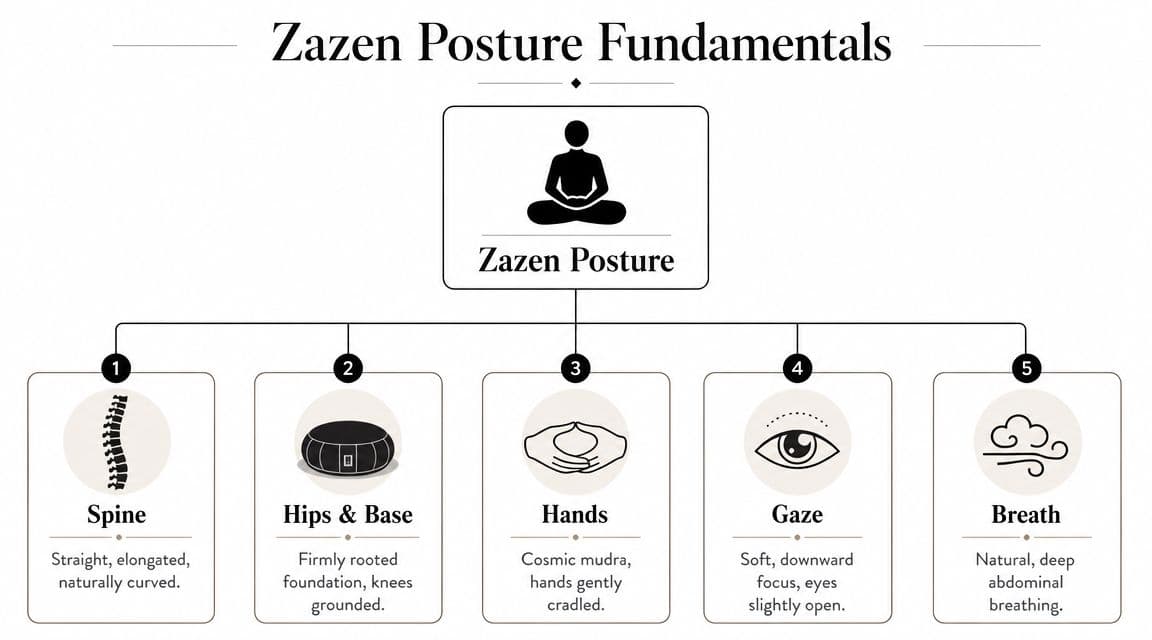
According to Soto Zen instructions for zazen, a sound setup starts with a stable base. Put a zafu on a zabuton if you have them, let the pelvis be slightly raised, and arrange the body so the knees and base of the spine create a stable triangular support. The spine stays upright, the chin is slightly tucked, the shoulders relax, the eyes remain half-open with a downward gaze, and the hands rest in the cosmic mudra. If floor sitting isn't workable, the same guidance says a chair is fine if you sit forward on the seat so the spine can stay vertical rather than slumping against the backrest.
If you can sit on the floor
Floor sitting works well when the hips are slightly higher than the knees. That tilt helps the lower back support itself. Without it, many beginners collapse in the lumbar spine and start fighting discomfort within minutes.
A basic setup looks like this:
- Place support under the pelvis. Use a zafu, a firm cushion, or folded blankets.
- Ground the knees if possible. Contact with the floor increases stability.
- Lengthen upward, don't stiffen. The spine should feel alive, not military.
- Set the head lightly. Chin slightly in, crown gently rising.
- Let the hands settle. The cosmic mudra gives the arms and shoulders a place to rest.
People often make two mistakes here. They either sit too low and round the back, or they force a dramatic upright pose that becomes rigid. Neither helps.
If floor sitting doesn't work
It is at this critical stage that many beginners give up, yet there is no need to. If your knees, hips, lower back, or ankles protest, use a chair. If a bench helps, use a bench. If extra support lets you stay present instead of enduring pain, that support belongs in your practice.
The best posture is the one you can maintain consistently without distraction.
Chair zazen is straightforward. Sit toward the front edge of the chair so your feet are planted and your spine supports itself. Don't lounge back. Let the knees be about hip width, rest the hands comfortably, and keep the same soft downward gaze used on the cushion.
A simple comparison helps:
| Posture option | Best for | Watch out for |
|---|---|---|
| Zafu on zabuton | People with enough hip mobility for floor sitting | Rounding the lower back |
| Meditation bench | Those who prefer kneeling support | Pressure in knees or ankles |
| Chair | Pain, injury, limited mobility, long workday stiffness | Leaning into the chair back and collapsing |
Presence is physical before it becomes mental
Many people try to solve meditation with the mind alone. They sit in a strained position and then wonder why attention feels scattered. Start with the body instead. A steady base, an upright spine, relaxed shoulders, and a soft gaze create the conditions for attention to settle.
If pain builds sharply, adjust mindfully. Zazen isn't a contest in endurance. It's a practice of embodied wakefulness.
Working with Breath and Attention
Once the body is reasonably settled, the next question appears fast. What do I do with my attention?
Beginners frequently encounter conflicting advice. Some are told to count the breath. Others hear that “real” zazen means no technique at all. In practice, both approaches can be useful. They just do different jobs.
Breath counting for a restless mind
A common beginner method is breath-counting. In this introductory zazen guidance, the instruction is clear: breathe naturally through the nose, count only on the exhalation from 1 to 10, and then return to 1. If you get distracted or lose the count, begin again. The point is to stabilize attention, not to manipulate the breath.
That last part matters. Many new meditators start trying to breathe correctly. Then the breath becomes loud, forced, or theatrical. Don't do that. Let it remain natural.
Breath counting is especially helpful when:
- Your thoughts are jumping: counting gives the mind one plain task.
- You're new to sitting alone: structure prevents drift.
- You're tired but wired: the count is enough to gather attention without creating strain.
If you're interested in breath mechanics more broadly, the explanation of the 3-part breath can be useful background.
Just sitting for open awareness
The other broad approach is often called shikantaza, or “just sitting.” Instead of counting, you sit upright and aware, without chasing thoughts and without picking a single object to control the mind. You notice what arises and let it pass.
This sounds simpler than it feels. For some people it opens the field of awareness immediately. For others it becomes a disguised form of daydreaming.
A practical way to choose:
- Start with counting if your mind is noisy and you need traction.
- Try open awareness when counting feels steady and a little too narrow.
- Return to counting any time “just sitting” becomes spacing out.
If you can't tell whether you're practicing or just thinking, go back to the exhale and count.
What doesn't work well is mixing instructions every few breaths. Pick one method for the whole session. Consistency inside the sit matters just as much as consistency across the week.
Structuring Your Zazen Session
A home sit works better when it has a clear container. Otherwise, practice turns vague and easy to postpone.
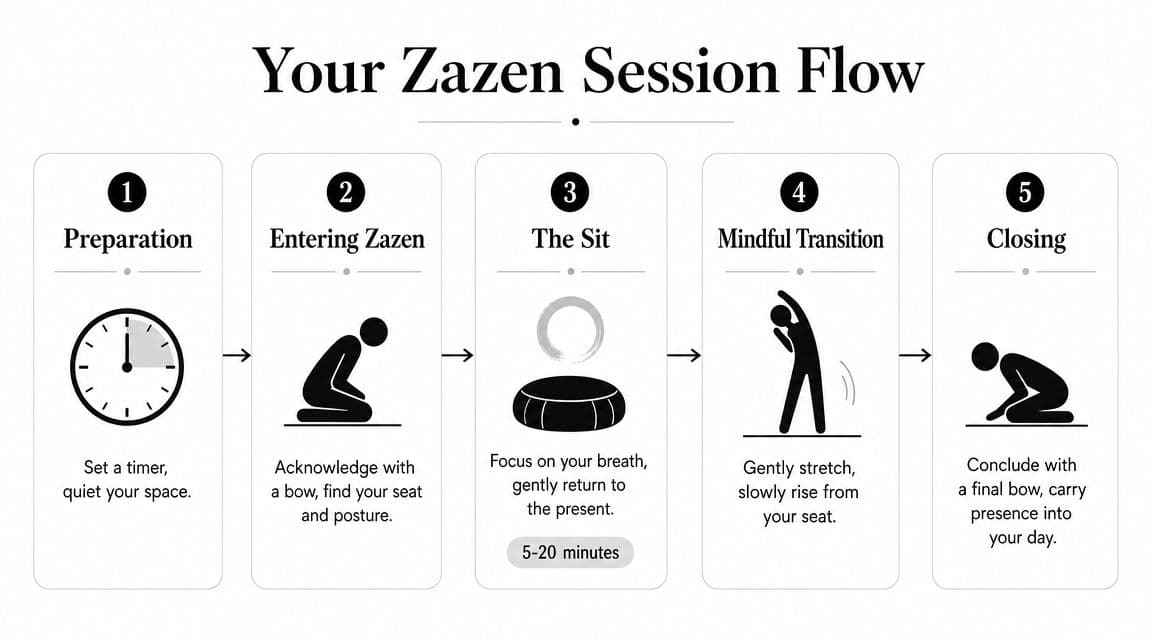
A simple shape for the session
You don't need ceremony, but you do need sequence. A timer helps because it removes the temptation to peek at the clock.
A simple session might look like this:
- Prepare the space. Silence the phone, set a timer, straighten the seat.
- Arrive physically. Sit down, settle the hands, feel the base under you.
- Begin with a small gesture. A bow or gassho can mark the shift into practice.
- Sit for the full period. Use breath counting or open awareness and keep returning.
- End slowly. Let the bell ring, bow again, and stand up without rushing.
For beginners, shorter sits are usually smarter than heroic ones. It is better to end with some steadiness than to build a daily association with strain.
Don't make the transition abrupt
The end of zazen matters. If you jump up and grab your phone, you cut the practice off at the knees. Let the body unfold gradually. Wiggle the fingers, stretch lightly, and stand with some care.
A little closing ritual helps here too. Palms together, one breath, then back into the day. That simple pause teaches continuity. You're not leaving practice behind. You're carrying some of its texture into whatever comes next.
Weaving Zazen into Your Life's Journey
Zazen doesn't always produce dramatic insight on schedule. Often the shift is quieter. You react a little less quickly. You notice your own habits sooner. A conversation lands differently because you weren't already racing ahead in your head.
Over time, what matters most seems to be frequency of practice. In a peer-reviewed study of long-term Sōtō Zen meditators, higher weekly meditation frequency was significantly associated with changes in brain activity, including positive correlations with theta/beta ratio during passive observation tasks (ρ = 0.36, p = 0.048 at 18 Hz and ρ = 0.36, p = 0.049 at 25 Hz), while greater meditation time and weekly frequency were also associated with a lower alpha peak frequency in a focused-attention task (ρ = −0.52, p = 0.003 for time and ρ = −0.41, p = 0.021 for weekly frequency), as reported in this study on long-term meditators. For anyone practicing zazen at home, the practical takeaway is plain. Regular sitting matters more than waiting for ideal conditions.
Inner stillness and outer reflection
The cushion gives you direct contact with your mind. It doesn't always tell you what to do with the larger questions that surface there. Questions about work, relationship patterns, timing, strengths, repeating difficulties. For that, some people like a reflective framework alongside meditation.
Dan Millman's book The Life You Were Born to Live offers one such framework, and the Life Purpose App is a digital companion built around that system. It lets users enter a birth date to explore one of 45 unique life paths, along with related themes and cycles described in the book.

Zazen and that kind of framework do different things. Zazen helps you observe directly. A structured system can help you name what you're observing and journal about it with more precision. If you want to pair sitting with written reflection, an article on meditation and journaling is a sensible place to start.
A home practice becomes part of your life when the insight from sitting changes how you listen, decide, and respond.
Common Questions About Home Practice
My legs fall asleep. Should I push through?
Usually, no. Mild discomfort is one thing. Numbness that pulls all your attention away is another. Adjust your seat, add support under the hips, or move to a chair.
I keep thinking the whole time. Am I doing it wrong?
No. Thinking is what minds do. The practice is noticing that you've drifted and returning. That return is the work.
What if I get sleepy?
Check posture first. Sleepiness often follows collapse. Open the chest, let the spine rise, and keep the eyes softly open. If you're exhausted, shorten the sit and come back earlier next time.
What if sitting hurts?
Many practitioners deal with physical constraints. Guidance from Ocean Gate Zen on home practice emphasizes that the best posture is the one you can maintain consistently without distraction, and that if pain arises it's fine to adjust mindfully or switch to a chair. That's not cheating. That's good judgment.
Should I wait until I can do it properly?
No. Start with the posture you can sustain, the space you already have, and the time you can consistently keep. Home practice grows from repetition, not from ideal conditions.
If you want a companion for the reflective side of practice, the Life Purpose App is a practical next step. It works alongside Dan Millman's The Life You Were Born to Live, giving you a structured way to explore life paths, themes, and journal-worthy patterns that may become clearer as your zazen at home deepens.
Discover Your Life Purpose Today!
Unlock your true potential and find your life’s purpose.
