If you’ve tried meditation and thought “this isn’t for me,” you’re not alone. The 6-Phase Meditation is a short, structured practice that builds clarity, calm, and purpose in 15–20 minutes — ideal for busy days.

March 23, 2026 (7mo ago) — zuletzt aktualisiert August 6, 2026 (2mo ago)
6-Phase Meditation: Clarity in 15 Minutes
Learn the 6 Phase Meditation — a 15–20 minute guided practice with six focused steps to build clarity, calm, and purpose.
← Zurück zum Blog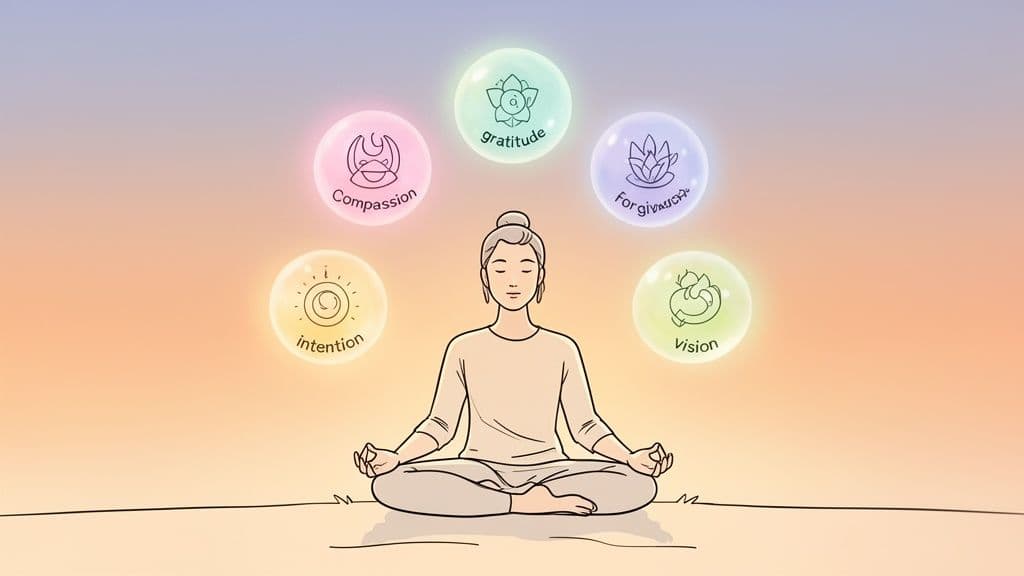
If you’ve tried meditation and thought “this isn’t for me,” you’re not alone. The 6-Phase Meditation is a short, structured practice that builds clarity, calm, and purpose in 15–20 minutes — ideal for busy days.
6-Phase Meditation: Clarity in 15 Minutes
Discover how the 6-Phase Meditation can reshape your day with a short, structured practice that builds clarity, calm, and purpose.
Introduction
If you’ve tried meditation and thought “this isn’t for me,” you’re not alone. The 6-Phase Meditation is an active, structured practice designed for busy lives. In 15–20 minutes you move through six focused stages that fill your mind with purpose instead of asking you to empty it. This guide explains each phase, why it works, and how to make it a lasting habit.
What is the 6-Phase Meditation and why it works
Popularized by Vishen Lakhiani and Mindvalley, the 6-Phase Meditation is a daily ritual that guides attention through specific emotional states rather than asking you simply to observe your thoughts3. It’s an intentional mental routine that helps reduce stress, strengthen focus, and prime your brain for creativity and purpose. Meditation practice is associated with neuroplastic changes in brain regions linked to attention, emotion regulation, and self-awareness1. Clinical reviews also report that mindfulness programs produce small-to-moderate improvements in anxiety and depression symptoms2.
The six core pillars of the practice
Each phase builds on the last to guide your mind from connection and clearance into future-focused creativity and intention. Use the quick reference below to follow the sequence.
The 6 phases at a glance
| Phase | Focus | Core benefit |
|---|---|---|
| 1. Compassion | Extend love and connection outward | Builds empathy and a sense of belonging |
| 2. Gratitude | Appreciate what you already have | Shifts perspective toward abundance |
| 3. Forgiveness | Release resentments and negative charge | Frees mental energy for growth |
| 4. Future Visioning | Create a vivid picture of your ideal future | Aligns subconscious focus with goals |
| 5. Daily Intention | Visualize your current day unfolding well | Sets a productive, positive tone for the day |
| 6. Blessing | Sense of support from something larger | Cultivates trust and guidance |
This sequence turns meditation into active mental training that prepares you to show up with clarity and purpose.
The six phases in practice
-
Compassion — Begin with deep, grounding breaths. Imagine a warm light in your chest and let that feeling expand: around your body, your room, your community, and eventually the whole planet. Let the sense of connection ground you.
-
Gratitude — Bring that light back to your heart and focus on specific things you’re grateful for. Aim for three personal items, three career or external items, and three qualities about yourself. Stay with each item for 20–30 seconds and feel the appreciation.
-
Forgiveness — Bring to mind a person or situation that still carries emotional charge. Say, “I forgive you,” and “I release you,” visualizing the energetic tie dissolving. If nothing specific comes up, practice forgiving yourself for past mistakes.
-
Future Visioning — Create a clear, emotionally vivid picture of your ideal future (commonly 2–3 years ahead). If you struggle to visualize, focus on the feelings you want in that future: satisfaction, freedom, pride.
-
Daily Intention — Zoom into today. Picture this day unfolding with ease and focus. See key interactions and tasks going well and notice how you feel while they happen.
-
Blessing — Close by feeling supported and guided. Connect to a sense of safety, whether that’s a higher power, the universe, or your own inner wisdom.
Each phase can take 2–3 minutes; adjust timing to fit your schedule. Even 1 minute per phase is better than skipping.
Rewiring your brain for real results
Regular practice helps move the brain from high-alert stress states into calmer, more intuitive states. Neuroimaging and psychological research link meditation to measurable shifts in areas responsible for attention and emotion regulation1. Clinical reviews show meditation programs can reduce anxiety and depressive symptoms, reinforcing the practice as a tool for mental well-being2.
When you feel stuck, the 6 phases give a reliable framework for reconnecting with purpose. The guided, step-by-step nature reduces uncertainty and makes the practice accessible, even for people who find traditional silent meditation difficult3.
How to personalize the practice
The 6-Phase Meditation becomes more powerful when aligned with your goals and values. Tools and apps that help clarify purpose can deepen future-visioning and intention work4. Examples:
- If your path emphasizes creative expression, use Future Visioning to rehearse finishing a project.
- If your path is leadership, shape Daily Intention around clarity, confidence, and service.
This combination of inner clarity and outer action makes the practice directly relevant to your life.
Practical tips to make it stick
- Start small: one minute per phase on busy days.
- Consistency beats perfection: a messy five-minute session is better than waiting for the perfect quiet.
- Use guided audio until you’re comfortable leading yourself.
- If visualization is hard, focus on how you want to feel; emotion drives change more than imagery.
- If forgiveness feels heavy, reframe it as releasing a small bit of tension.
Common bumps and how to handle them
- Wandering mind: Notice distraction without judgment and gently return to the phase. This is the practice.
- “Am I doing it right?”: Aim for feeling over flawless visualization. The emotion is what matters.
- Missed days: Don’t punish yourself. Start again the next day.
Q&A — Quick answers to common questions
Q: How is this different from mindfulness?
A: Mindfulness often emphasizes open, nonjudgmental awareness. The 6-Phase Meditation is active and directive — you move intentionally through compassion, gratitude, forgiveness, visioning, intention, and blessing to shape emotional states and goals3.
Q: I’m bad at visualization. Is this practice still for me?
A: Yes. Focus on the feelings you want — energized, calm, accomplished — rather than cinematic images. Guided meditations can help you build the skill.
Q: When will I notice benefits?
A: Many people feel calmer right away. Meaningful shifts in perspective and behavior tend to emerge with daily practice over weeks to months; consistency matters most2.
Three concise Q&A sections (bottom of article)
Q: How long should each phase take?
A: Aim for 2–3 minutes per phase for a full 15–20 minute session. On busy days, do 1 minute per phase — consistency is more important than length.
Q: What if I can’t visualize a future clearly?
A: Focus on the feelings you want in that future. Emotion and bodily sensations are effective anchors when images are weak.
Q: Can this help anxiety and focus?
A: Yes. Research links regular meditation to reduced anxiety symptoms and improved attention over time2.
Resources and next steps
Explore guided versions of the 6-Phase Meditation and tools that help align daily intentions with long-term purpose, such as the Life Purpose App4. For related reading, see our articles on mindfulness and daily rituals: Mindfulness for Busy People and Daily Rituals to Boost Focus.
1.
Hölzel, Britta K., et al. “How Does Mindfulness Meditation Work? Proposing Mechanisms of Action From a Conceptual and Neural Perspective,” Perspectives on Psychological Science 6, no. 6 (2011): 537–59. https://www.ncbi.nlm.nih.gov/pmc/articles/PMC4253124/
2.
Goyal, Madhav, et al. “Meditation Programs for Psychological Stress and Well‑Being: A Systematic Review and Meta‑analysis,” JAMA Internal Medicine 174, no. 3 (2014): 357–68. https://jamanetwork.com/journals/jamainternalmedicine/fullarticle/1809754
3.
Mindvalley and Vishen Lakhiani popularized the 6-Phase Meditation through guided programs and public talks. See Mindvalley resources: https://www.mindvalley.com
4.
Life Purpose App and related guides provide frameworks for aligning meditation with personal life paths and goals. https://lifepurposeapp.com
Entdecken Sie noch heute Ihren Lebensweg
Geben Sie Ihr Geburtsdatum ein und sehen Sie Ihren Lebensweg – kostenlos.
Finden Sie Ihren Lebensweg