Somewhere between a birthday dinner and an ordinary Tuesday, a question often shows up: Why am I wired this way? Dan Millman’s system treats your birthdate as a practical map for growth rather than a fortune‑teller’s headline. Use your Lebensweg to understand gifts, challenges, and timing with tools like the Lebenssinn‑App.

June 29, 2026 (3mo ago) — zuletzt aktualisiert August 12, 2026 (2mo ago)
Lebensweg-Nummer: Persönlichkeitsmerkmale aus Geburtsdatum
Berechne deine Lebensweg‑Nummer nach Dan Millman. Erhalte Einblicke in Lebenssinn, Karriere, Beziehungen und neun‑jährige Zyklen mit der Lebenssinn‑App.
← Zurück zum Blog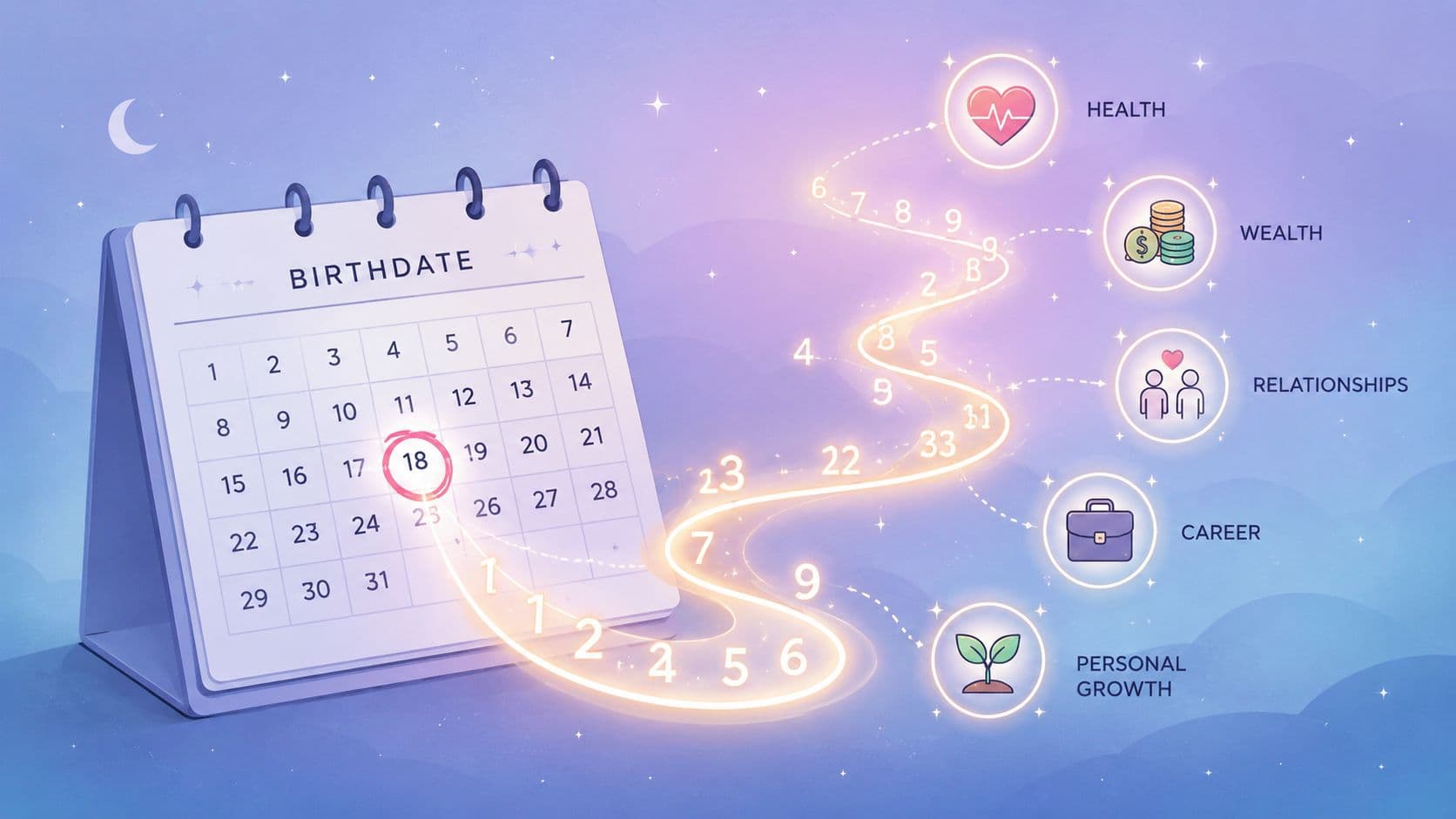
Somewhere between a birthday dinner and an ordinary Tuesday, a question often shows up: Why am I wired this way? Dan Millman’s system treats your birthdate as a practical map for growth rather than a fortune‑teller’s headline. Use your Lebensweg to understand gifts, challenges, and timing with tools like the Lebenssinn‑App.
Geburtsdatum-Persönlichkeitsmerkmale: Entdecke Dein Wahres Selbst
Summary: Entdecke deine Lebensweg-Nummer nach Dan Millman. Berechne deine Nummer, um Einblicke in Lebenssinn, Karriere, Beziehungen und 9‑Jahres‑Zyklen zu gewinnen.
Introduction
Somewhere between a birthday dinner and an ordinary Tuesday, a question often shows up: Why am I wired this way? Why do certain patterns repeat in love, work, money, or health? Why do some strengths feel effortless while other lessons keep circling back until we finally face them?
If you’ve tried astrology, generic numerology, or social media labels, you may have felt more confused than clarified. Dan Millman’s The Life You Were Born to Live offers a different approach. It treats your birthdate as a meaningful pattern—a practical map for growth rather than a fortune‑teller’s headline. The Lebenssinn‑App is a modern way to work with that framework in daily life.1
Your Birthdate Is More Than Just a Number
Many people arrive at this work because something in life no longer fits.
You may be successful on paper and still feel off. You may keep encountering the same relationship tension, money stress, or the same push and pull between freedom and stability. In that moment, “birthdate personality traits” stops sounding like a curiosity and starts sounding like a search for a map.
Millman’s system asks a different question: “What am I here to learn, express, and refine?” That question opens the door to self‑understanding rather than prediction. Readers often find relief when they stop squeezing themselves into vague labels and start noticing patterns that actually show up in daily life.
Your birthdate in Millman’s system functions less like a verdict and more like a blueprint.
The framework gives language for gifts, recurring tests, and the laws that shape development. The Lebenssinn‑App brings that material into a format you can use when reflecting on relationships, career choices, or difficult seasons. For a direct exploration, see the Lebenssinn‑App page or Millman’s book page for details and tools./lebenssinn-app/the-life-you-were-born-to-live
The Life Purpose System Explained
Millman’s work is often grouped with numerology, but that shorthand can blur what makes it useful. In The Life You Were Born to Live and the Lebenssinn‑App, the birthdate isn’t used to hand out flattering traits. It’s used to identify a Lebensweg with a distinct set of lessons and practices.1
What makes this system different
According to Millman, a birth date maps to one of 45 unique Lebenswege, each associated with core gifts, challenges, and practical laws that shape health, money, sexuality, career, and relationships. The system treats the birth pattern as a curriculum rather than a label.1
That structure matters. It means the system isn’t saying, “You were born on a certain day, so you’re always this way.” It’s saying your life has a curriculum. You come in with tendencies, strengths, blind spots, and recurring themes. Awareness gives you choice.
What readers often confuse
People usually mix up three different ideas:
- Astrology focuses on symbolic timing and planetary cycles.
- Generic numerology often reduces everyone to a single simplified label.
- Millman’s Lebensweg system focuses on growth, life lessons, and practical application through his book and companion tools.
The last point is why many readers find it useful in real life. The framework increases responsibility by describing what you’re here to develop, not what you’re doomed to repeat.
Practical rule: Treat your Lebensweg as a field of practice. It describes what you’re here to develop, not what you’re doomed to repeat.
Why spiritual laws matter
Millman uses the language of spiritual laws to show how gifts and challenges relate. A gift without discipline can become chaos. Sensitivity without boundaries can become overwhelm. Independence without trust can become isolation. The challenge is often the unfinished side of the strength.
Readers who stay with Millman’s work tend to come away with more compassion for themselves. They can see that what frustrates them most may be directly linked to what they’re here to master.
How to Determine Your Lebensweg Number
Once you understand the framework, the next question is simple: How do you calculate your number in Millman’s system and in the Lebenssinn‑App?
The key point is this: Millman’s method pays attention to the full birth number, not only the final reduced digit. That’s why a result such as 26/8 carries more texture than a bare final number alone.1
The basic calculation
Millman’s approach reduces a full birthdate by adding each digit individually to form a total, then reducing that total to a single digit when needed. For example, February 22, 1946 becomes 2+2+2+1+9+4+6 = 26, recorded as 26/8 where both 26 and the reduced 8 matter in interpretation.1
Here’s the process in plain language:
- Write out your full birthdate in digits: month, day, and year.
- Add every digit together. Add the individual digits rather than combining month and day separately.
- Keep the full total. That gives you the first part of your path.
- Reduce that total by adding its digits to get the final reduced number.
A worked example
Take May 23, 1985.
- Month: 5
- Day: 2 + 3
- Year: 1 + 9 + 8 + 5
Add them all: 5 + 2 + 3 + 1 + 9 + 8 + 5 = 33
Then reduce: 3 + 3 = 6
That birth path is written as 33/6 in Millman’s style. The full number gives nuance that a simple single digit does not.1
Why the full number matters
Generic calculators often return only the reduced digit. In Millman’s system, the full pattern matters because it explains how similar outer themes can express differently in people who share the same reduced number.
If you want a quick check of your number in the same spirit, try the Lebenssinn‑App or Millman’s resources on calculating the birth path./lebenssinn-app
Understanding Your Core Gifts and Challenges
Once you know your path, the work begins. The point isn’t to memorize traits. It’s to notice how your gifts and challenges travel together.
That pairing is one of Millman’s system’s wisest features. A strength that helps you can also create friction when it’s unconscious. The same intensity that fuels achievement can create pressure. The same sensitivity that makes you perceptive can make criticism hit harder.
Two sides of one pattern
People often call one side of themselves “true” and the other side “a flaw.” Millman invites a more accurate view: both belong to the same lesson.
Examples:
- Creative energy can bring expression and joy but also distraction or inconsistency.
- Cooperative energy supports teamwork and empathy but can slide into people‑pleasing.
- Independent energy supports leadership and initiative but can become resistance to support.
These aren’t separate identities. They’re different expressions of the same underlying current.
A challenge in this system isn’t a punishment. It’s the exact place where a gift asks for maturity.
Reading your path with honesty
Read your path slowly. If a description stings a little, pay attention. That discomfort often points to a pattern you already know from experience.
A simple practice is journaling in two columns:
| Gift side | Challenge side |
|---|---|
| Where does this come naturally to me? | Where does this become excess or avoidance? |
| How does it help me in work or love? | How does it complicate those same areas? |
| What would a mature expression look like? | What habit keeps me from that expression? |
If you want a wider lens on how inner strengths show up in spiritual practice, explore resources on spiritual gifts and integrate them with your Lebensweg./the-life-you-were-born-to-live
Why this becomes practical fast
Birthdate personality traits become useful when they stop being abstract. If your challenge tends toward impatience, you can catch it during conflict. If your gift is compassion, you can ask whether you’re offering help freely or taking on burdens that aren’t yours.
That shift turns self‑knowledge into behavior, and that’s where real change starts.
Applying Your Lebensweg to Key Life Areas
A Lebensweg becomes easier to trust when you can see it in ordinary decisions. Millman’s book and the Lebenssinn‑App connect the path to the areas where people struggle and grow.
Career and work
Your path can clarify the type of work environment that brings out your strengths. Someone with a cooperative tone may thrive in partnership and team roles. Someone with a freedom‑oriented pattern may need variety and room to improvise. A more expressive path may need communication, artistry, teaching, or visibility.
Ask not “What job am I destined for?” but “What conditions help my nature work cleanly?”
Money and material life
Money often reveals the challenge side of a path faster than anything else. A person who values freedom may resist budgeting because structure feels restrictive. Someone who values service may give too much and undercharge. Someone driven by achievement may appear financially competent while carrying anxiety underneath.
These are patterns you can change once you see them.
Some people don’t have a money problem first. They have a pattern problem that keeps showing up through money.
Health and well‑being
Millman treats health as part of personal development. Stress often lands where your lessons are active. A path marked by intensity may need pacing. A path marked by sensitivity may need quiet, sleep, and firmer boundaries. A path that leans toward expression may feel better when emotion has a healthy outlet.
This perspective is an adjunct to medical care, not a replacement.
Relationships and sexuality
The same Lebensweg traits that shape your work also shape attachment, conflict, attraction, and communication. An independent theme may need closeness and space at the same time. Deep sensitivity may long for connection but pull back when misunderstood. Expressive energy can draw people in while still needing emotional depth.
Sexuality, in Millman’s approach, reflects trust, power, vulnerability, and the way you inhabit your body and heart.
A quick practical lens
Try this short weekly review:
- At work, notice where you feel energized versus constrained.
- With money, notice what feeling drives your decisions.
- In health, track where stress shows up first.
- In relationships, name the recurring tension you keep meeting.
- In intimacy, ask what helps you feel open, safe, and honest.
Used this way, your path becomes less mystical and more diagnostic.
Lebensweg Examples and Nine‑Year Cycles
A single example can make this system feel alive. Millman describes people with 3 energy as expressive, adventurous, and easily bored by sameness. They bring creativity and joy but may struggle with follow‑through and depth if they don’t cultivate focus.1
A lived example of 3 energy
Think of someone who lights up in fresh environments. They’re funny, imaginative, and easy to be around. What others may miss is inner restlessness. Routine flattens them. If they haven’t developed depth and follow‑through, they may keep chasing novelty instead of finishing what matters.
The gift of expression becomes stable only when the person also learns focus.
The rhythm of nine‑year cycles
Millman’s system adds timing through a repeating nine‑year cycle. Broadly, cycles return to similar themes every nine years, with expansion and new projects often emphasized in years 1 through 3, relationship focus in years 4 through 6, and review or introspection in years 7 through 9. This cyclical view can be reassuring when a phase feels difficult rather than failed.3
For an overview of nine‑year cycle ideas in numerology, see numerology resources that explain cycle timing and application./numerology-nine-year-cycles
Relationship timing changes too
Cycles affect how your path shows up with others. During one period you may move toward partnership and repair; during another you may need solitude, skill building, or a cleaner sense of self. Timing matters.
Begin Your Journey of Self‑Discovery Today
If you’ve been searching for meaning in your birthdate, start with a system that has depth. Dan Millman’s The Life You Were Born to Live treats birthdate personality traits as part of a larger human journey involving purpose, spiritual law, and real‑life practice.1
Self‑knowledge should make you more honest and more compassionate. It shouldn’t box you in. A Lebensweg is not a sentence. It’s a pattern you can work with consciously.
If you’re in transition, explore resources that support growth in community and connect reflection with action. Read your path carefully, sit with the parts that feel accurate, and notice where your gifts and challenges appear in work, love, health, money, and timing. The system deepens as your honesty deepens.
If you want a practical next step, explore the Lebenssinn‑App. It’s the digital companion to Dan Millman’s The Life You Were Born to Live, and it lets you enter your birthdate to view your Lebensweg, core themes, relationship dynamics, and nine‑year cycle in one place./lebenssinn-app
Frequently Asked Questions
Q: How do I calculate my Lebensweg number?
A: Write your full birthdate in digits, add each digit to get the full total, then reduce that total by adding its digits. Record both the full total and the reduced digit (for example, 33/6). This gives more nuance than a single reduced digit.1
Q: Is this the same as astrology or generic numerology?
A: Not exactly. Astrology focuses on planetary timing; generic numerology often reduces people to a single label. Millman’s Lebensweg system emphasizes growth, lessons, and practical application in everyday life.2
Q: Will this change my life immediately?
A: The system offers clarity and actionable insight. Change happens when you notice patterns and apply small, consistent practices. Use your Lebensweg as a diagnostic map, then experiment with habits that support a mature expression of your gifts.
1.
Dan Millman, The Life You Were Born to Live: A Guide to Finding Your Life Purpose (25th Anniversary Edition). For details on the system, calculations, and the Lebenssinn‑App, see Millman’s official site and book resources. https://www.danmillman.com/
2.
See background on numerology as a tradition and how it’s commonly applied: "Numerology," Encyclopaedia Britannica. https://www.britannica.com/topic/numerology
3.
For explanation of nine‑year cycle ideas in numerology and how cycles are used in life planning, see Numerologist resources: https://www.numerologist.com/numerology/nine-year-cycle/
Entdecken Sie noch heute Ihren Lebensweg
Geben Sie Ihr Geburtsdatum ein und sehen Sie Ihren Lebensweg – kostenlos.
Finden Sie Ihren Lebensweg