Fühlen Sie sich festgefahren? Diese Anleitung zeigt konkrete Schritte für einen erfolgreichen Karrierewechsel: Selbstanalyse, Marktrecherche, Fähigkeitsaufbau, finanzielle Planung und Networking.
November 28, 2025 (5mo ago) — zuletzt aktualisiert March 4, 2026 (1mo ago)
Erfolicher Karrierewechsel: Praktischer 7‑Schritte‑Plan
Praktische Schritte für einen erfolgreichen Karrierewechsel: Selbstanalyse, Marktrecherche, Qualifikationen, Finanzen und Networking.
← Zurück zum Blog
How to Make a Career Transition That Works
Feeling stuck? This guide shows a clear, practical path to a career change that actually works. You’ll find steps for self-assessment, market research, skills building, financial planning, networking, and storytelling so you can move toward work that fits who you are.
Finding Your Direction When You Feel Stuck

That nagging feeling of being stuck is a signal: something needs to change. Before you rewrite your LinkedIn profile or scroll job boards, pause and look inward. Honest self-assessment builds the foundation for what comes next.
This isn’t just listing skills. It’s digging deeper to uncover core motivations, pinpoint what drains your energy, and identify what truly lights you up. That discomfort is often the catalyst for meaningful change.
Get Clear on What Needs to Change
Define what’s actually not working. Is it the industry, your role, company culture, or the day-to-day grind? Be specific.
For example, if you’re drawn to tech, map a realistic beginner’s roadmap for an IT career so you can see what skills and timelines are required. Explore online learning platforms and introductory roadmaps to test whether that path fits you.
“Don’t run away from a job you hate. Move toward work that aligns with who you are.”
This process is about focused introspection. Our career-planning guide includes practical exercises for this kind of work. Before you look at job postings, get your internal compass pointing the right way.
Career Transition Starting Checklist
| Action Item | Key Question to Ask Yourself | Tool/Resource |
|---|---|---|
| Pinpoint the dissatisfaction | What specifically about my current job makes me unhappy? | Journaling, mentor conversations |
| Identify your energizers | What tasks make me feel engaged and motivated? | Project lists, hobby inventory |
| Assess your core values | What matters to me at work (autonomy, impact, stability)? | Values exercises, online assessments |
| Understand life patterns | What are my innate talents and recurring patterns? | The Life Purpose App and Dan Millman’s framework1 |
Completing this internal work ensures your external search is focused and aligned with long-term satisfaction.
Discovering Innate Talents and Patterns
A structured self-discovery framework can be a game-changer. Dan Millman’s system and the Life Purpose App help you identify core gifts, challenges, and repeating patterns that affect career choices1.
By understanding recurring strengths and patterns you can:
- Identify core gifts and inherent challenges.
- See which career environments suit your temperament.
- Spot repeating patterns that may have held you back.
This lens helps you steer toward work that offers satisfaction and a sense of purpose.
Grounding Purpose in Market Reality
You’ve done the internal work. Now connect those discoveries to real jobs and industries. Think of this as building a bridge from knowing yourself to knowing your options.
A life-purpose lens isn’t a magic bullet. It’s a compass that points to environments and tasks where you’ll feel energized—creative temperaments may lean toward marketing or design, while order-oriented people may enjoy project management or engineering1.
Timing and Personal Cycles
Map your personal cycles. Some years are for planting new seeds; others are for planning or finishing. Aligning a transition with a natural “new beginning” year can make the process feel smoother and more intuitive.
Time for a Reality Check
Shift from introspection to investigation. What industries are growing? Is there demand for the roles that excite you? Start with data and first-hand conversations.
- Follow the growth: check the Bureau of Labor Statistics’ Occupational Outlook Handbook for projections and job descriptions2.
- Analyze job postings on LinkedIn and Indeed to find recurring skills and responsibilities.
- Know your worth: use Glassdoor and PayScale to get realistic salary ranges for target roles3.
Data gets you part of the way. The most powerful insights come from talking to people already doing the work. Informational interviews are your secret weapon. They’re not job interviews; they’re insider conversations that help you confirm whether a path fits and begin building a community. A strong professional community improves transition outcomes significantly4.
Building Skills and a Financial Runway
A great idea is just an idea until it’s backed by the right skills and enough savings to get you through the change. Start with a skills-gap analysis: compare job-description requirements to your resume and note the gaps.
Bridging the Skill Gap
Knowing what you don’t know is progress. The working world is changing fast; by 2030 many core job skills will shift, so lifelong learning is essential5. Many employers are already retraining staff to meet new demands6.
Practical ways to build skills:
- Take online courses on platforms like Coursera to learn a coding language or a marketing tool.
- Earn professional certifications that demonstrate practical expertise.
- Use volunteer or freelance gigs to build a portfolio and get real-world experience.
Use a personal development plan to map learning goals and timelines. For resume examples, see career-change resume examples.
Calculating Your Financial Runway
Figure out how much you need to live while you study, job hunt, or accept an initial pay cut. Add non-negotiable monthly expenses and multiply by the number of months you expect the transition to take. Aim for at least six months if possible, but tailor this to your situation.
Having a financial cushion gives you the mental space to make clear decisions instead of panicked ones.
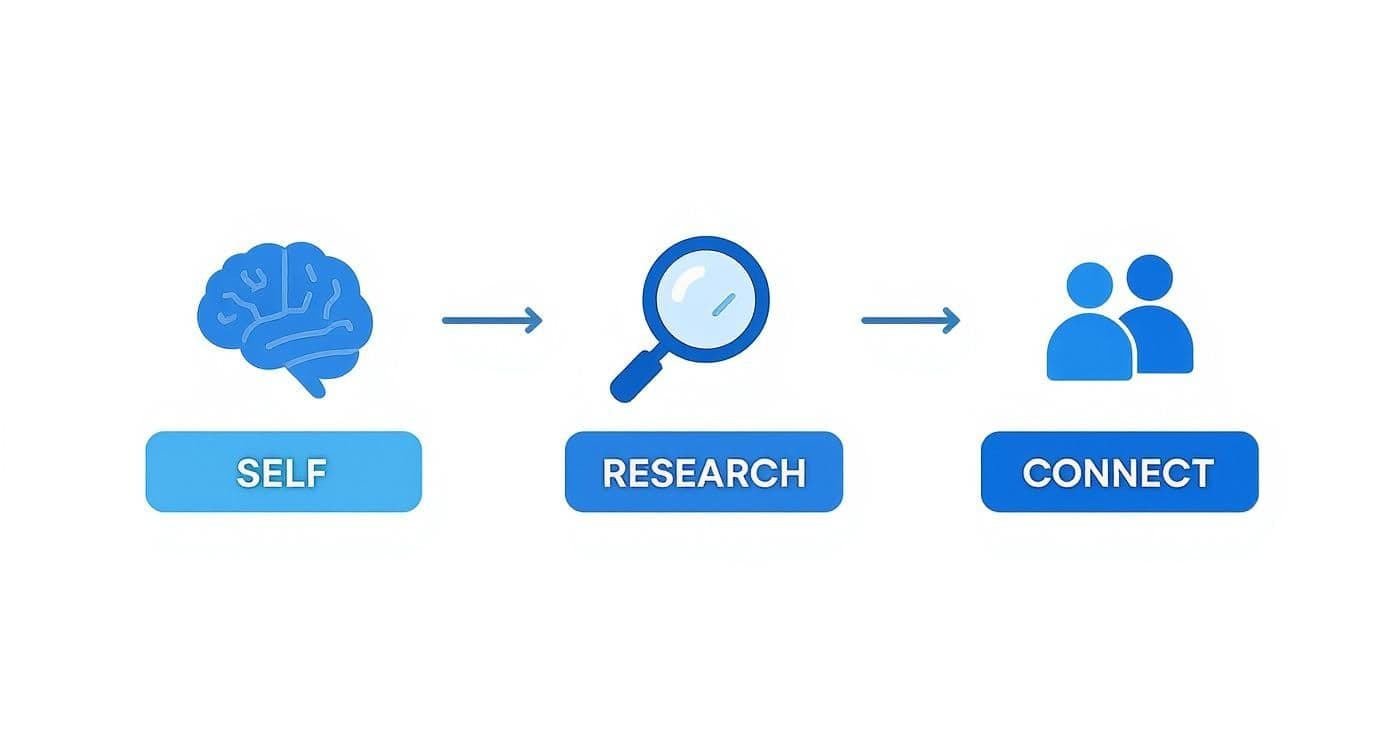
This flow starts with you (self-reflection), moves to the outside world (research), and ends with people (connecting). Building skills and a financial runway grounds your plans in reality.
Telling Your New Career Story

Your resume and LinkedIn profile are the script for your next chapter. They need to show where you’re headed, not just where you’ve been. This is a strategic rebrand: translate your history so hiring managers see how your experience fits the new role.
Crafting a Forward-Looking Narrative
Recruiters first read your resume summary and LinkedIn About section. Replace old objective statements with a clear, forward-looking summary that states the target role or industry and highlights your most relevant transferable skills.
“Your new professional story should be a compelling argument for why your background makes you a great fit for this new role.”
Translating Skills and Experience
Describe your skills in the language of your target industry. Convert stakeholder management to client relationship building, or curriculum development to instructional design.
Start by:
- Auditing your wins and adding numbers—“managed a $50,000 budget” or “boosted team efficiency by 15%.”
- Becoming a job-description detective: mirror the keywords and action verbs employers use.
- Focusing on impact, not just tasks.
Explore career-change resume examples to see how others highlight transferable skills.
Networking and Interviewing as a Career Changer
Your network and interview presence are crucial. Building relationships in your new field is more valuable than hoarding contacts. Many workers change roles frequently; understanding industry trends helps you position yourself effectively7.
Building Your New Professional Circle
Expand your network with intention. Search LinkedIn for people in the roles you want and approach them with curiosity. Ask for informational interviews—short, low-pressure conversations where you ask about their experience, not for a job.
A simple outreach works best:
“Hi [Name], I’m exploring a career change into [Industry] and was impressed by your work at [Company]. Would you be open to a 15-minute chat so I can learn about your experience?”
These conversations give insider information, build relationships, and put you on people’s radars before jobs are posted. See our guide on informational interviews.
Nailing the “Why the Change” Question
Interviewers will ask why you’re changing careers. Frame your answer as a deliberate move toward something new, not an escape from something old. Connect your past experience to future ambitions.
For example: “I loved developing young minds, but my passion is creating learning systems for adults. My curriculum design and classroom management experience gives me a foundation to build effective corporate training programs.”
This shows self-awareness and intent.
Common Interview Questions for Career Changers
| Question | What They’re Really Asking | How to Frame Your Answer |
|---|---|---|
| “Why are you changing careers?” | Are you running from something or toward something? | Emphasize the pull of the new industry and the logical link to your skills. |
| “Why our company/industry?” | How much do you know about this field? | Show research: mention projects, company values, or trends that excite you. |
| “How will your past experience apply here?” | Can you prove your skills are relevant? | Use Situation–Action–Result examples to connect past wins to future needs. |
| “What’s your biggest weakness in this new role?” | Do you know your gaps, and can you close them? | Acknowledge one gap and show the plan you’re using to bridge it. |
Show adaptability, passion, and transferable skills with concrete examples to move from a risky hire to a memorable candidate.
Common Concerns and Short Answers
“What if I feel like a total fraud?” (Imposter syndrome)
Feeling like an imposter is common. Reframe how you see yourself: every expert was once a beginner. Your unique background is an advantage. To push back:
- Keep a win journal of small victories.
- Embrace the learner mindset—focus on growth, not perfection.
- Talk to a mentor or trusted friend to shrink self-doubt.
“Am I too old to make a change?”
No. Changing careers later in life means starting from experience. You bring transferable skills—communication, leadership, problem solving—and clarity about what you want. Use that foundation to make smarter choices.
“How do I explain this to family and friends?”
Have a simple, confident story. Focus on your why and the steps you’re taking: building a financial cushion, taking courses, and talking to people in the field. Ask for support and set boundaries when needed.
Quick Q&A: Common Career-Change Questions
Q: What’s the first step in making a career change?
A: Do honest self-assessment: clarify what’s not working, identify energizers, and define your values. Use exercises and tools to get specific.
Q: How do I know if a new field is viable?
A: Research industry growth (BLS), analyze job postings for recurring skills, and talk to people in the field through informational interviews2.
Q: How can I bridge skill gaps without quitting my job?
A: Take online courses, earn targeted certifications, and pick up freelance or volunteer projects to build a portfolio.
Top 3 Concise FAQs
Q: What’s the single most important step?
A: Honest self-assessment—know what you want and why—before chasing job postings.
Q: How long should I prepare before switching?
A: It depends, but plan for 3–12 months of learning and networking, and aim for a financial cushion of at least six months when possible.
Q: What convinces employers most?
A: Clear evidence of transferable impact, matched keywords, and real-world practice such as freelance work or certifications.
Ready to uncover your innate talents and find a career that truly aligns with your purpose? The Life Purpose App is a digital guide to Dan Millman’s system, helping you get clarity for your next move: https://lifepurposeapp.com
1.
Dan Millman, The Life You Were Born to Live, and the Life Purpose App [https://www.lifepurposeapp.com](https://www.lifepurposeapp.com)
2.
U.S. Bureau of Labor Statistics, Occupational Outlook Handbook [https://www.bls.gov/ooh/](https://www.bls.gov/ooh/)
3.
Salary research resources: Glassdoor https://www.glassdoor.com and PayScale https://www.payscale.com
4.
O.C. Tanner, 2025 Global Culture Report [https://www.octanner.com/global-culture-report.html](https://www.octanner.com/global-culture-report.html)
5.
World Economic Forum, Future of Jobs Report (skills shifts and reskilling projections) [https://www.weforum.org/reports/future-of-jobs-2020](https://www.weforum.org/reports/future-of-jobs-2020)
6.
Global hiring trends analysis (employer retraining and upskilling): https://www.hireborderless.com/post/global-hiring-trends-report-2025-mid-year-analysis
7.
OECD, Employment Outlook 2025 [https://www.oecd.org/en/publications/2025/07/oecd-employment-outlook-2025_5345f034/full-report/component-9.html](https://www.oecd.org/en/publications/2025/07/oecd-employment-outlook-2025_5345f034/full-report/component-9.html)
Discover Your Life Purpose Today!
Unlock your true potential and find your life’s purpose.
