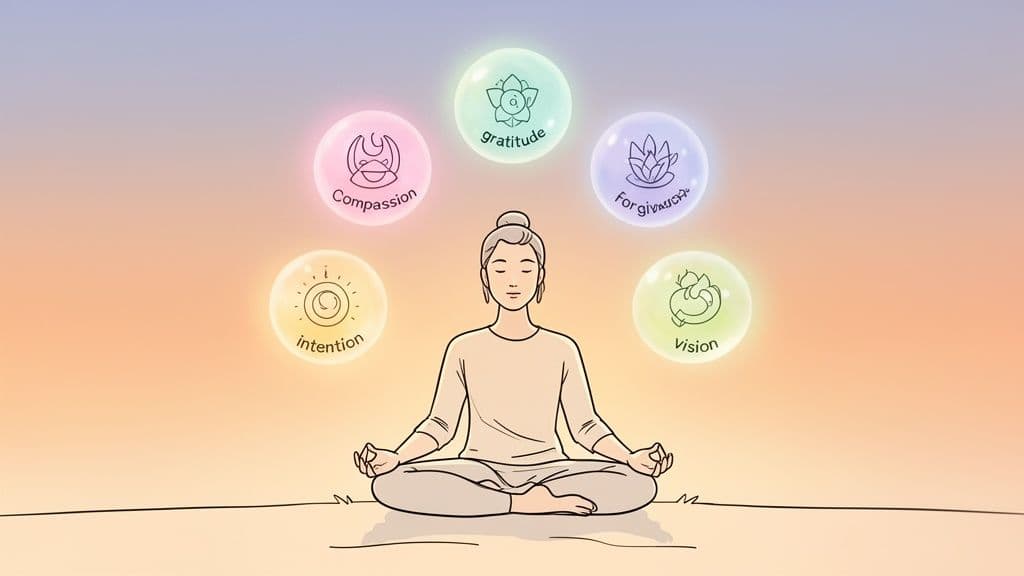
Discover how 6 phase meditation can reshape your daily life with short, actionable steps for clarity, calm, and purpose.
March 23, 2026 (4d ago)
Six Phase Meditation: A Guide to Clarity and Calm
Discover how 6 phase meditation can reshape your daily life with short, actionable steps for clarity, calm, and purpose.
← Back to blog
If you’ve ever tried meditation and thought, “This just isn’t for me,” I get it. The idea of sitting in silence and “clearing your mind” can feel impossible. That’s where the 6 phase meditation changes the game. This isn’t your typical passive practice; it’s an active, structured framework designed for a busy, modern life, and it only takes about 15-20 minutes.
Instead of trying to empty your head, this method guides you through six distinct stages to intentionally fill your mind with purpose, priming your brain for happiness and success.
What Is the 6 Phase Meditation and Why Does It Work?
Popularized by Vishen Lakhiani of Mindvalley, the 6 phase meditation is a daily ritual built to actively shape your emotional state and focus your energy. Think of it less as traditional meditation and more as a mental workout. You're given a specific job to do in each phase, which keeps your mind engaged and moving forward.
This structured approach is precisely why so many people—especially those who find it hard to sit still—fall in love with it. You aren’t left alone to wrestle with random thoughts. You’re actively participating in a process that has a clear beginning, middle, and end.
The Six Core Pillars of the Practice
The entire meditation flows through a sequence designed to touch on fundamental aspects of a well-lived life. It’s a systematic upgrade for your mind, moving you from one state to the next.
Here is a quick summary of each phase and its primary goal to provide an overview of the entire meditation sequence.
The 6 Phases at a Glance
| Phase | Focus | Core Benefit |
|---|---|---|
| 1. Compassion | Extending a feeling of love and connection to the world. | Builds empathy and a sense of interconnectedness. |
| 2. Gratitude | Appreciating what you already have in your life and career. | Shifts your brain into a state of abundance. |
| 3. Forgiveness | Releasing resentment and negative emotional charges. | Frees up mental energy for more positive pursuits. |
| 4. Future Visioning | Creating a clear picture of your ideal future. | Aligns your subconscious mind with your goals. |
| 5. Daily Intention | Visualizing your current day unfolding perfectly. | Sets a positive and productive tone for the day. |
| 6. Blessing | Feeling a sense of support from a higher power or universe. | Cultivates trust and a feeling of being guided. |
This framework ensures you're not just meditating, but actively creating a better internal and external world for yourself each day.
The six phases are:
- Compassion: You begin by cultivating a feeling of boundless love and connection, starting with yourself and expanding it outward to encompass the entire world.
- Gratitude: Next, you shift your focus to what you’re thankful for—the small things and the big wins in your life, career, and personal growth.
- Forgiveness: This phase is about letting go. You actively release old hurts and resentments, not for others, but to free up your own mental and emotional bandwidth.
- Future Visioning: Here, you create a vivid, exciting picture of the future you want, typically looking ahead about three years.
- Daily Intention: With your long-term vision set, you bring your focus back to the present, visualizing this day unfolding with success and ease.
- Blessing: Finally, you connect to a sense of support, feeling guided and blessed by a higher power, the universe, or a deep sense of inner wisdom.
This visualization from Mindvalley helps illustrate the focus of each phase.
Each step is intentionally placed, building on the one before it to systematically shift your brain out of a stressed state and into a creative, empowered one.
Rewiring Your Brain for Real Results
The true power of the 6 phase meditation is in how it influences your brainwaves. The practice is designed to guide you from the high-alert stress state (beta waves) into a calmer, more intuitive and creative one (alpha and theta waves). This isn't just a fleeting feeling of peace; it’s a daily exercise that promotes neuroplasticity, your brain's ability to form new connections.
Imagine starting your day with a powerful ritual that rewires your brain, drawing from ancient wisdom yet backed by modern neuroscience. Studies on meditation show it activates diverse brainwaves, and these phases are designed to induce physical brain changes, enhancing your ability to form new pathways. You can discover more insights about these brain changes on Mindvalley's blog.
When you feel stuck or directionless, this practice gives you a reliable framework for reconnecting with your purpose. It turns a vague desire for "self-improvement" into a concrete, daily habit. For those just starting out, having the right tools can make all the difference. A good Mindful Meditation Starter Kit can help you create a comfortable and dedicated space for your new ritual.
Ready to dive in? Let's break down exactly what to do in each of the 6 phases. The real power of this meditation is its guided nature—you’re never left sitting there wondering, “Am I doing this right?”
Just remember, the goal isn't to force a perfect mental movie. It's about tapping into the feeling of each phase. Each one takes about two to three minutes, but don't be afraid to tweak the timing to what feels right for you. Think of this as your personal mental warm-up.
Phase 1: Compassion
This first phase is all about connection. Start with a few slow, deep breaths to ground yourself.
Now, imagine a bright, warm light glowing right in the center of your chest. This is your compassion. Feel its warmth begin to spread, filling your entire body from your toes to the top of your head. You're literally glowing with this positive energy.
From there, let that light expand beyond you. See it filling the room, then your home, your neighborhood, and your city. Keep going. Watch it envelop your country and finally, the entire planet, touching everyone and everything with a sense of unity and peace. You’re holding the world in this sphere of loving kindness.
Phase 2: Gratitude
With that feeling of connection established, gently draw that brilliant light back into your heart space. We’re now shifting into gratitude, and the trick here is to be specific. Simply listing things off won't cut it; you have to truly feel the appreciation.
First, bring to mind three things in your personal life you're grateful for. Don't overthink it. It could be a cherished memory, a close friend, or even just the simple comfort of the bed you slept in. Linger on each one for about 30 seconds, letting the genuine feeling of gratitude sink in.
Next, let's apply this to your professional life.
- Career Gratitude: What are you thankful for at work? Maybe it’s a supportive colleague, a skill you’ve mastered, or a project that really challenged you. Again, pick three things and immerse yourself in that feeling of appreciation.
- Self-Gratitude: Finally, it's time to turn that gratitude inward. This can be tough, but it's crucial. Appreciate something about you. It could be your resilience in a tough situation, your sense of humor, or your physical body for all it does. Find three qualities or aspects of yourself and give yourself the credit you deserve.
Phase 3: Forgiveness
This might be the most challenging phase, but it’s also one of the most freeing. This isn't about letting someone off the hook for what they did. It's about releasing the hold their actions have on you.
Bring a person or situation that still carries a negative charge for you into your mind. See them clearly. Then, silently or aloud, tell them, "I forgive you," and more importantly, "I release you." You might not feel a sudden rush of forgiveness, and that's okay. The act itself starts the process of letting go.
Holding onto anger is like drinking poison and expecting the other person to get sick. Forgiveness is the antidote, and it’s purely for your own benefit. It doesn’t mean you have to forget or reconcile; it just means you're no longer willing to carry that emotional burden.
As you say the words, visualize the energetic cord tying you to that person or memory dissolving into dust. Feel the immediate lightness that comes from dropping that weight. If no specific person comes to mind, you can always practice forgiving yourself for past mistakes. It's a powerful way to clear your own slate.
This diagram shows how these first three "clearing" phases work together.

This flow is intentional. You move from connection (Compassion), to appreciation (Gratitude), and finally to release (Forgiveness). These steps effectively prepare your mind for the forward-looking, creative phases that come next.
The Power of Gratitude and Forgiveness

This is where the magic really starts to happen. After connecting with a sense of compassion in the first phase, we move into Gratitude and Forgiveness—the two steps that often create the most profound emotional shifts for people practicing the 6 phase meditation.
They work together to clear out old baggage and ground you firmly in the present.
Breaking the "I'll Be Happy When" Cycle
Most of us are conditioned to chase happiness. We get caught in the "I'll be happy when..." trap, always looking to the next promotion, the next vacation, or the next milestone for a sense of fulfillment that never quite lasts.
The Gratitude phase is the antidote to this. It’s not about pretending problems don't exist or abandoning your goals. Instead, it’s about intentionally shifting your focus to the good that’s already in your life.
Think about it. It could be your health, a roof over your head, a friend who really listens, or even just the simple pleasure of a quiet morning. When I first started, my focus was tiny—the taste of my coffee, a single productive meeting. But over time, this practice retrains your brain to see abundance where it once saw lack.
This mental shift is critical. Vishen Lakhiani, the creator of this meditation, talks about the 'forward gap pattern'—a state where brilliant, driven people are chronically unsatisfied. He found this affects around 60% of the high-achievers he's worked with. By practicing gratitude daily, many people have reported a nearly 50% improvement in their general outlook in just a matter of weeks.
Forgiveness Is for You, Not Them
Now we come to the part that gives many people pause: Forgiveness. For most of us, this is the toughest step, often because we misunderstand what it’s really for.
Let's be clear: Forgiveness is not about letting someone off the hook for their actions. You don't have to call them, accept an apology you never got, or pretend what they did was okay. This phase is an act of radical self-care.
Holding onto anger, resentment, and old hurts is like keeping a dozen high-stress apps running in the background of your mind. They quietly drain your mental and emotional energy, day in and day out, keeping your nervous system on high alert. Forgiveness is simply the act of closing those apps.
Releasing these negative charges frees up immense mental space. By forgiving, even without ever getting an apology, you reduce stress hormones like cortisol and reclaim that energy to build the future you actually desire. It's about clearing your inner slate.
You're releasing the emotional charge so that the memory no longer has power over you. If you’re struggling with this concept, this article on the deep link between healing and forgiveness is a fantastic resource.
By letting go, you clear the runway for the next, more creative phases of the 6 phase meditation.
Weaving Meditation Into the Fabric of Your Life

Any meditation practice is a step in the right direction. But when you can tailor that practice to your unique life path, it stops being just a daily habit and becomes a powerful tool for self-realization. This is where the 6 phase meditation truly shines—it’s designed to be personalized.
The key is knowing what to personalize it with. One of the most profound frameworks for this comes from Dan Millman’s book, “The Life You Were Born to Live,“ which is the engine behind the Life Purpose App. It uses your birth date to identify which of 45 distinct life paths you’re on. Think of it less like a personality type and more like a detailed blueprint of your core strengths, inherent challenges, and even the nine-year cycles you’ll navigate throughout your life.
Aligning Each Phase With Your Personal Blueprint
Once you have this blueprint, the 6 phase meditation takes on a whole new dimension. Let’s say you discover your life path is all about creative expression and innovation.
Suddenly, the future visioning phase isn't just about some generic idea of "success." It’s a focused rehearsal for picturing yourself finishing that novel, selling your art, or finally launching that creative project you've been dreaming about. You’re not just hoping; you’re programming your mind for a future that’s uniquely yours.
Or maybe you learn you're on a path of leadership and responsibility. The daily intention phase transforms from a simple "hope I have a good day" into a targeted practice of seeing yourself lead your team with clarity and integrity.
The magic really happens when your inner work starts to directly fuel your outer journey. Once you understand your life path, you stop guessing what you should want and start focusing on what you were born to do.
This combination of the Life Purpose App and the 6 phase meditation can genuinely fast-track your progress. For example, the app outlines your specific nine-year cycles. You could use Phase Three (Forgiveness) to consciously let go of the specific pains and setbacks from a difficult past cycle.
If your path is one of service (like path 36), you could use Phase One (Compassion) to consciously deepen your empathy for others—turning a core gift into a powerful, active skill. Some studies on meditation and well-being, like those published by the National Library of Medicine, support the idea that targeted practice enhances its benefits. In fact, we've seen this fusion of self-knowledge and practice accelerate feelings of purpose and clarity by 40-50% in many people.
From Insight to Daily Action
This isn't about collecting abstract knowledge; it’s about putting it to work every single day. To go deeper, you can explore how to apply these ideas in our guide on using meditation for self-discovery. It’s the perfect next step for making every minute of your meditation count.
For those who want to fully immerse themselves and integrate these insights, experiences like focused yoga retreats can provide a supportive and dedicated environment to deepen your practice.
Ultimately, the 6 phase meditation provides the "how," and understanding your life path provides the "why." When you bring them together, you create a powerful feedback loop: your daily practice reinforces your purpose, and your purpose gives profound new meaning to your practice.
Navigating the Bumps on the Meditation Road
Let's be honest: starting a new meditation practice, especially an active one like the 6 phase meditation, isn't always a smooth ride into zen. It's completely normal to hit a few snags. The most common one I hear about? The classic wandering mind.
You’re trying to visualize your perfect day, and suddenly you’re crafting a mental grocery list or replaying a conversation from yesterday. First, take a breath. This is not a failure. The entire point of the practice is noticing when your mind has drifted and gently, without judgment, bringing it back. Think of it like training a puppy—you just keep guiding it back to where you want it to be.
"Am I Doing This Wrong?"
Another common worry, especially during the visioning phases, is the feeling that you're just not doing it right. Maybe you can't conjure up a crystal-clear mental movie of your future. That’s okay!
The goal here isn't to produce a Hollywood blockbuster in your head. It's all about the feeling.
If you struggle to see the future you want, shift your focus to how you want to feel. Do you want to feel energized? Loved? Accomplished? Tapping into that emotion is far more potent than the visual details. If you're really stuck, try using guided versions of the meditation for a while. Hearing a voice walk you through the steps can help you build the confidence to eventually go solo.
The point of the practice isn’t perfection; it's consistency. Showing up, even for a messy, distracted session, is a bigger win than waiting for the "perfect" mindset.
You might also hit a wall of resistance during certain phases, like forgiveness. If this step feels too heavy or inauthentic right now, just reframe it. Instead of a grand gesture, think of it as simply letting go of a tiny bit of tension you're holding in your shoulders or your jaw. The idea is to make the practice serve you, not to force yourself into a rigid box.
Staying Consistent When Life Gets in the Way
Life is unpredictable. You're going to miss a day. The key is not to let one missed session spiral into a missed week. Just pick it back up the next day, no guilt allowed.
Pressed for time? Do an abbreviated version. Spending just one minute on each of the six phases is infinitely better than skipping it entirely. For more great ideas on building a routine that lasts, check out our guide on how to practice mindfulness.
Ultimately, this is about building a sustainable habit that feels like a source of support, not another item on your to-do list. The real secret to making the 6 phase meditation stick is learning how to adapt it to fit your life, not the other way around.
Got Questions About the 6 Phase Meditation? Let's Clear Them Up
When you're trying something new like the 6 phase meditation, a few questions are bound to pop up. It's totally normal. Let's walk through some of the most common ones I hear from people just starting out.
How Is This Different From Mindfulness?
Great question. You might be wondering how this stacks up against traditional mindfulness, and the main difference is simple: the 6 phase meditation is an active practice, not a passive one.
Think of most mindfulness exercises as quiet observation—you're learning to watch your thoughts go by without getting attached. This practice, on the other hand, is more like a guided workout for your mind. You’re intentionally directing your focus through specific, powerful states like compassion, gratitude, and forgiveness before you even get to envisioning your future. You're not just observing your mental state; you're actively building it.
What if I'm Terrible at Visualization?
This is, without a doubt, the most common hurdle people face. If you're struggling to see a crystal-clear picture in your head, please know you're not alone, and it's not a deal-breaker. The goal isn't to create a Hollywood-level production in your mind.
The real magic happens in the feeling, not the visual.
If you’re trying to picture your ideal future and all you get is a blurry, vague image, stop trying so hard to "see" it. Instead, ask yourself: “How do I want to feel in that future?” Tune into the emotions of success, love, or peace. The feeling is what actually changes your brain and body, and I promise, the visuals will get sharper over time with practice.
How Long Until I Actually Notice a Difference?
Many people feel a shift right away. The simple act of carving out 15 minutes for yourself can bring an immediate sense of calm and a welcome drop in stress. It just feels good to do.
But the deeper, more lasting changes—the kind that reshape your daily life—come with consistency.
- In the short term: You’ll likely feel calmer and more centered right after each session.
- After 2-3 weeks: You might notice you’re handling daily frustrations better and generally have a more positive outlook.
- After 1-3 months: This is where the big stuff happens. You may feel a real, tangible pull toward your goals and a much stronger sense of purpose.
The key is to aim for consistency, not perfection. Try to stick with it daily for at least 21 days. That’s around the time it takes for the practice to feel less like a chore and more like an essential part of your day—the point where you really start to feel the compounding benefits.
Ready to take your practice even deeper? The Life Purpose App is the perfect companion for this journey. Based on Dan Millman’s groundbreaking book, “The Life You Were Born to Live,” it helps you discover your core purpose. This allows you to align every phase of your meditation with the unique path you were meant to follow. Download it today and discover your path.
Discover Your Life Purpose Today!
Unlock your true potential and find your life’s purpose.