Explore the power of archetypes in mythology. Discover how these ancient patterns reveal your life's purpose and how to find your own archetypal path.
March 25, 2026 (1mo ago)
Archetypes in Mythology and Your Life Story
Explore the power of archetypes in mythology. Discover how these ancient patterns reveal your life's purpose and how to find your own archetypal path.
← Back to blog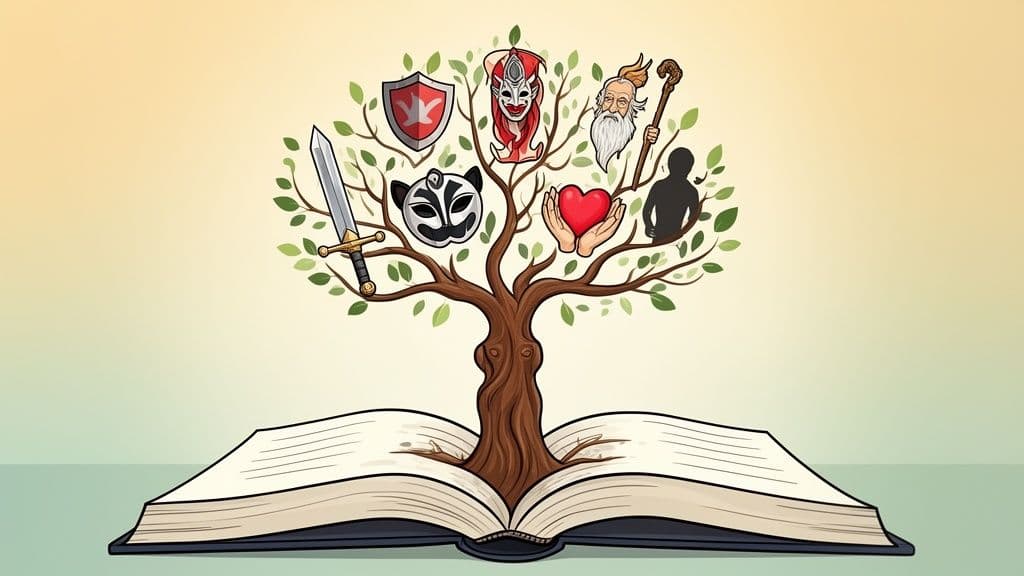
Have you ever watched a movie or read a book and felt an instant connection to a character? That feeling of familiarity with the wise old mentor, the reluctant hero, or the clever trickster isn't an accident.
These recurring figures aren't just story-telling clichés; they are modern echoes of ancient patterns known as archetypes in mythology. Think of them as the original blueprints for human experience—universal symbols and roles that are woven into the very fabric of our shared consciousness.
What Are Archetypes and Why Do They Matter?
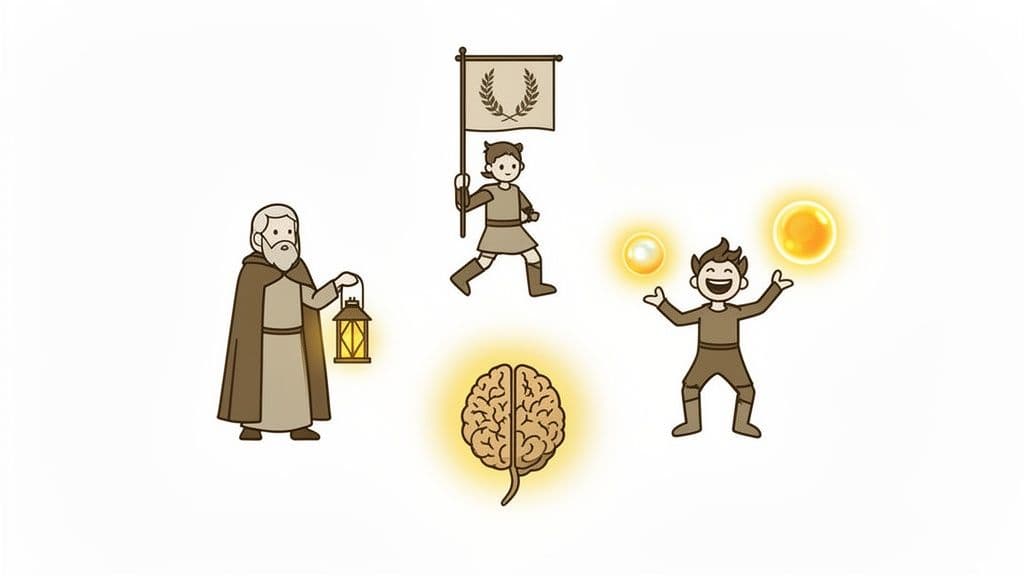
At their core, archetypes are the foundational characters, situations, and symbols that show up again and again in myths, dreams, and art across every culture and era. They feel timeless because they represent the most fundamental parts of being human: birth, love, conflict, death, and the search for meaning.
But these patterns aren't just dusty relics from ancient history. They are living, breathing forces that quietly influence our modern world, and more importantly, our own lives. Once you learn to recognize archetypes, you start to see the invisible script that guides our personal stories, relationships, and even our biggest struggles.
The Psychological Roots of Myth
The link between these ancient myths and our modern minds was famously charted by the Swiss psychiatrist Carl Jung. He had a groundbreaking idea: that these universal patterns come from a part of the mind he named the collective unconscious.
This isn't your personal memory bank. It's more like a shared, inherited reservoir of human experience. Jung believed we don't invent these figures like the Hero or the Shadow; we are born with the templates for them already inside us.
Archetypes are like deep riverbeds in the human psyche, carved out by the endless repetition of human experiences over millennia. A story resonates so deeply because it flows along these pre-existing channels within our own minds.
This is exactly why a 2,000-year-old Greek myth can feel just as powerful and relevant as a new blockbuster film. Both are pulling from the same deep well of archetypal patterns. By understanding them, we don't just understand stories—we begin to understand the architecture of our own minds.
Connecting Archetypes to Your Life Purpose
So, what does this ancient wisdom have to do with you and your life right now? Everything. Seeing which archetypes are active in your life is a powerful key to self-discovery. It helps you reframe your personal journey, seeing it not as a series of random events but as a meaningful, mythic story.
This is where practical, modern systems can help bridge the gap. For instance, in his book The Life You Were Born to Live, author Dan Millman outlines a framework that connects our birth dates to specific life purposes—which are essentially detailed archetypal paths. This is a system of numerology that can be incredibly insightful.
This system, now easily accessible through tools like the Life Purpose App, can help you identify your own primary archetypal journey. By exploring frameworks like the one found in Millman's book and the app, you can uncover:
- The core archetype that shapes your life's purpose and its inherent challenges.
- How other archetypes influence your career choices, relationships, and personal growth.
- The deep-seated patterns that guide your emotional responses and major life decisions.
When you start to connect with these ancient symbols, you gain a profound sense of clarity. Your life begins to look less like a random collection of events and more like a mythic journey that you are actively creating.
The Ancient Roots of Our Modern Stories
The character patterns we see everywhere—the hero, the trickster, the wise old guide—feel so familiar they seem almost instinctual. But they didn't just spring fully formed from our collective psyche. They are ancient travelers, stories carried across the globe in the minds and mouths of our ancestors.
Think about it. When early humans migrated, they packed more than just tools and seeds. They brought their stories. As they journeyed, these myths and the characters within them adapted to new climates and cultures, yet their core structures stayed surprisingly consistent. It’s a powerful reminder that the hero’s journey isn't just a modern writing trope; it's a shared human inheritance.
This isn't some romantic notion, either. Modern research has uncovered a fascinating trail of evidence, tracing these narrative patterns back thousands of years. It completely reframes how we see archetypes—not just as psychological functions, but as living history.
The Scientific Trail of Myth
One of the most powerful tools for tracking this story-DNA is the Aarne-Thompson-Uther (ATU) Index. Imagine a massive, detailed library catalog, but for the world's folktales. First created back in 1910, the index has been updated for over a century and now classifies more than 2,500 basic folktale plots, revealing how the same core stories pop up across vastly different cultures.
For instance, the index shows how a fairytale from the Brothers Grimm might share the exact same plot and character structure as a story told in India.
This screenshot gives you a glimpse of how scholars systematically connect these threads, proving that a story is more than just its surface details.
What’s truly mind-blowing is what the ATU Index tells us about the age of these stories. In 2016, a study used phylogenetic analysis—a method normally used in biology to trace evolutionary history—to map the "ancestry" of certain tales. The researchers focused on 'Tales of Magic' (ATU 300-749) and made a startling discovery. At least four of our core archetypal stories can be traced back 6,000 to 8,000 years, to the Proto-Indo-European era.
One such tale, 'The Grateful Animals' (ATU 554), which appears in the Grimm’s collection as 'The White Snake', was likely being told around campfires long before the first pyramids were even conceived. You can learn more about this incredible classification system over on the Wikipedia page for the Aarne–Thompson–Uther Index, which is a high authority source for this kind of information.
A Tapestry of Shared Beliefs
The fact that these archetypes have survived for millennia, crossing every cultural and geographical barrier, points to a fundamental human need: to make sense of our world through stories. These narratives are how we codify our deepest hopes, our greatest fears, and our moral compass. They help us grapple with big questions about justice, compassion, and our place in the cosmos.
This same impulse is what gives rise to our spiritual traditions. While they may look different on the surface, most religions draw from the same deep well of archetypal patterns to explain the human condition. If you're curious about this, you can explore the connections in our guide on what all religions have in common.
Realizing that these stories have traveled with us for so long does more than just satisfy a historical curiosity. It connects us to every human who came before us and reminds us that the stories we tell ourselves today are part of a grand, unbroken conversation that started thousands of years ago.
Meet the Major Mythological Archetypes
Now that we’ve touched on where archetypes come from, let’s get to know the all-star cast of our collective human story. Think of these not as dusty old characters, but as recurring patterns of motivation and energy that show up everywhere—from ancient myths to the movies you watched last weekend.
Once you learn to spot them, you’ll start seeing their echoes in books, in the people around you, and even within yourself. Each one has its own core drives, signature strengths, and a potential shadow side that can take over when things get out of balance.
The Hero: The One Who Ventures Forth
The Hero is probably the first one that comes to mind. This is the figure driven to prove their worth by taking on some great challenge. They leave the familiar world behind, face down incredible odds, and return forever changed. At its heart, the Hero's journey is a story of courage, growth, and sacrifice.
But there's a flip side. The Hero’s shadow can manifest as arrogance, entitlement, or even a victim complex. Lost in their own quest, they might neglect the people they claim to protect or feel the world owes them something for their bravery.
- Greek Mythology: Heracles (Hercules) and his impossible Twelve Labors.
- Sumerian Mythology: Gilgamesh on his epic, heart-wrenching quest for immortality.
- Modern Pop Culture: Luke Skywalker in Star Wars or Katniss Everdeen in The Hunger Games.
The Mentor: The Wise Old Guide
Right behind the Hero, you’ll often find the Mentor. This is the voice of wisdom and experience, usually an older figure who gives the Hero crucial training, a piece of advice, or a special tool—that one thing they'll desperately need later. The Mentor's job is to unlock the Hero’s hidden potential.
But even a wise guide can have a shadow. A Mentor's dark side might involve manipulation, leading the hero astray for some hidden purpose. Or they might simply be too rigid, stuck in old ways of thinking that can't solve new problems.
- Arthurian Legend: Merlin, the quintessential wizard guiding a young King Arthur.
- Greek Mythology: Chiron, the noble centaur who trained countless legendary heroes.
- Modern Pop Culture: Albus Dumbledore in Harry Potter or Obi-Wan Kenobi in Star Wars.
This lineage—from ancient myth to modern story—isn't just a vague idea. It has been studied and mapped out.
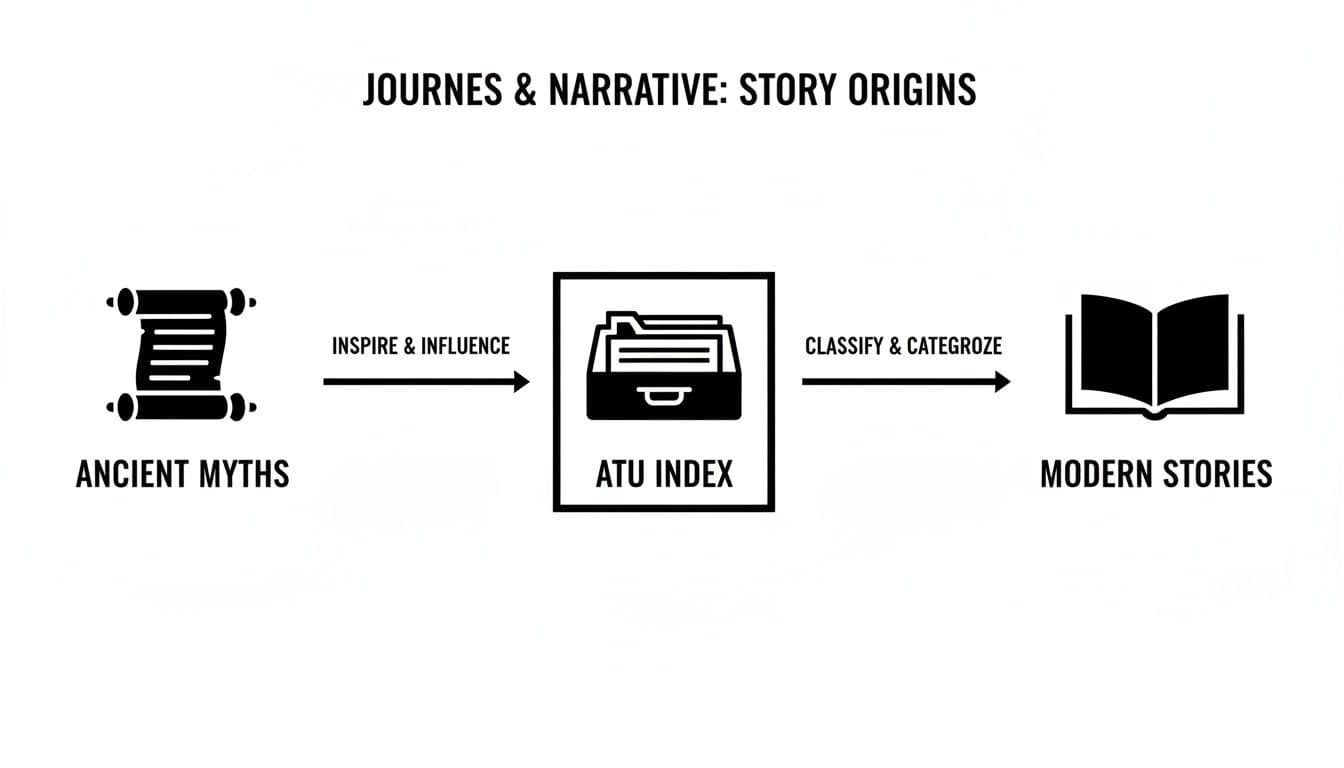
As you can see, the characters in our favorite films are direct descendants of figures born from humanity's oldest tales, with classification systems like the ATU Index helping us trace the family tree.
To show just how universal these patterns are, here’s a quick look at how some of the most common archetypes appear across different cultures.
Common Archetypes and Their Cross-Cultural Manifestations
| Archetype | Core Function & Motivation | Mythological Examples |
|---|---|---|
| The Hero | To prove one's worth through courage and overcome great challenges. | Gilgamesh (Sumerian), Beowulf (Norse), Mwindo (Nyanga), Heracles (Greek) |
| The Trickster | To challenge norms and create change through mischief and wit. | Anansi (West African), Loki (Norse), Coyote (Native American), Hermes (Greek) |
| The Great Mother | To nurture, create, and provide, but also to destroy or control. | Gaia (Greek), Isis (Egyptian), Papatūānuku (Māori), Kali (Hindu) |
| The Wise Old Man | To offer wisdom, guidance, and mentorship to the protagonist. | Merlin (Arthurian), Chiron (Greek), Utnapishtim (Sumerian), Tiresias (Greek) |
| The Shadow | To represent the repressed, unacknowledged, or "dark" side of a personality. | Grendel (Norse), The Hydra (Greek), Ravana (Hindu), Set (Egyptian) |
This table only scratches the surface, but it highlights how these fundamental human stories have been told and retold in countless ways around the globe.
The Trickster: The Agent of Chaos and Change
The Trickster is one of the most dynamic and complex archetypes. They are the rule-breakers, the jesters, and the boundary-crossers who poke holes in authority and laugh at convention. Their antics often stir up chaos, but they're also a powerful catalyst for growth, forcing individuals and societies to look at their own absurdities.
Tricksters are the cosmic jokers who remind us not to take ourselves too seriously. They shatter illusions and open the door for necessary transformation, often through laughter and chaos.
But when a Trickster's energy sours, their playful mischief becomes purely destructive malice. A shadow Trickster creates chaos just for the sake of it, with no lesson learned and no potential for renewal.
- Norse Mythology: Loki, the god of mischief whose pranks escalate to cosmic threats.
- West African Folklore: Anansi, the clever spider who constantly outsmarts more powerful creatures.
- Native American Tales: Coyote, a figure who is by turns a creator, a fool, and a cultural hero.
The Great Mother: The Nurturer and Destroyer
The Great Mother archetype embodies the two faces of creation itself. On one hand, she is the source of all life—the symbol of unconditional love, fertility, and comfort. She provides safety and sustenance.
On the other hand, she has a terrifying shadow aspect: the "devouring" mother who smothers, controls, or consumes. This duality perfectly mirrors the natural world, which gives us gentle rain and life-giving harvests but also hurricanes and droughts.
- Greek Mythology: Demeter, the goddess of the harvest, and Gaia, the primordial earth mother.
- Hindu Mythology: Kali, who is at once a loving mother and a fierce, terrifying destroyer of evil.
- Ancient Egypt: Isis, the maternal goddess who resurrected her husband, Osiris.
The Shadow: The Unacknowledged Self
Finally, we arrive at the Shadow. This powerful archetype represents everything we’ve pushed down, denied, or repressed about ourselves. It's the "dark side" of our personality that holds our fears, insecurities, and impulses we deem unacceptable. In stories, the Shadow often appears as the villain, monster, or antagonist.
Confronting and integrating the Shadow is a cornerstone of personal growth. It isn’t about indulging our worst impulses, but about understanding and accepting them so they lose their power over us. When we ignore the Shadow, it only grows stronger in the dark.
While these archetypes are universal, local cultures also have their own unique figures that embody these deep-seated fears and ideas. For a fantastic local example, you can read about the legendary Basilisk of Vienna, a creature personifying mortal danger.
- Literary Example: Mr. Hyde, the monstrous alter ego of the respectable Dr. Jekyll.
- Film Example: Darth Vader is the ultimate embodiment of Anakin Skywalker’s Shadow.
Recognizing these key figures is your first step. But as you'll see, these patterns didn’t just stay in one place—they traveled with humanity across every continent.
How Archetypes Followed Us Across the Globe
Have you ever wondered how figures like the Hero or the Trickster managed to pop up in myths all over the world? It’s a fascinating puzzle. The easy answer is that we all just have the same basic human psychology, but that doesn't quite capture the whole picture. A growing body of research shows something far more incredible: these archetypes traveled with us, carried in the minds of our ancestors as they spread out from Africa and across the planet.
These patterns aren't just fuzzy psychological ideas; they're a direct, tangible link to our most distant past. The stories, and the archetypes in mythology they hold, didn't just appear out of thin air. They migrated, evolved, and branched off, just like our own family trees.
Mapping the Journeys of Myth
This completely changes how we think about myths. It suggests that while every culture adds its own unique flavor, many of the core story structures have been on an unbelievably long journey. Researchers can now actually trace the "family trees" of myths, uncovering shocking connections between stories from cultures separated by vast oceans and thousands of years.
One of the most powerful examples is the "Cosmic Hunt" motif. This is a very specific story about hunters pursuing an animal that becomes a constellation. Remarkably, this exact myth appears in cultures from Siberia all the way to North America, strongly suggesting it was carried across the Bering Strait by the first people to enter the Americas.
These shared myths act as a kind of narrative DNA, proving that stories were among the most essential survival tools our ancestors packed. They carried not just practical knowledge but a shared way of understanding the world and our place in it.
This perspective elevates archetypes from being purely psychological concepts to being actual artifacts of human history. They aren't just in our heads; they are echoes of the real, physical journey our species took across the globe.
Science Reveals the Great Story Clusters
And that's where things get really interesting. Modern analytical methods are giving us a stunningly clear view of how these ancient stories spread. By treating mythological traditions like biological data, researchers can map their relationships and see how they cluster geographically. The results line up almost perfectly with what we know about ancient human migration.
A groundbreaking 2024 analysis did exactly this, studying mythologies from every corner of the world. The researchers found that, at the highest level, global myths form two massive, distinct clusters: one for the Old World (Eurasia and Africa) and one for the New World (the Americas). This fundamental split directly reflects the "Out of Africa" migration that began around 60,000 years ago. You can dive into the fascinating data yourself in the full research published on arXiv, a high authority source for scientific pre-prints.
What this tells us is that the foundational archetypes of European, African, and Asian myths share a deeper, older ancestry with each other than they do with the myths of Indigenous American cultures. That second group’s stories branched off and evolved in isolation after their ancestors crossed into a new continent.
Your Story in a Larger Human Epic
So, what does this all mean for you? It means your personal life story is part of a much larger, more ancient human epic. The challenges you face, the roles you step into, and the search for meaning that defines your life are all connected to these timeless patterns that have journeyed with humanity for tens of thousands of years.
The archetypes firing in your own life—maybe a deep-seated drive for justice, a need to create, or a call to mentor others—are echoes of impulses that have guided people for millennia. This connection isn't just a poetic idea; it's a demonstrable part of our shared heritage.
When you start exploring your life path, whether through quiet self-reflection or a structured system of numerology like the one in Dan Millman's book, The Life You Were Born to Live, you're tapping into this incredibly deep well. Tools like the Life Purpose App, which makes this system accessible, help you identify the core archetypal patterns shaping your journey. In doing so, you’re not just learning about yourself—you’re finding your place in a story that began a long, long time ago.
Using Archetypes for Your Personal Growth
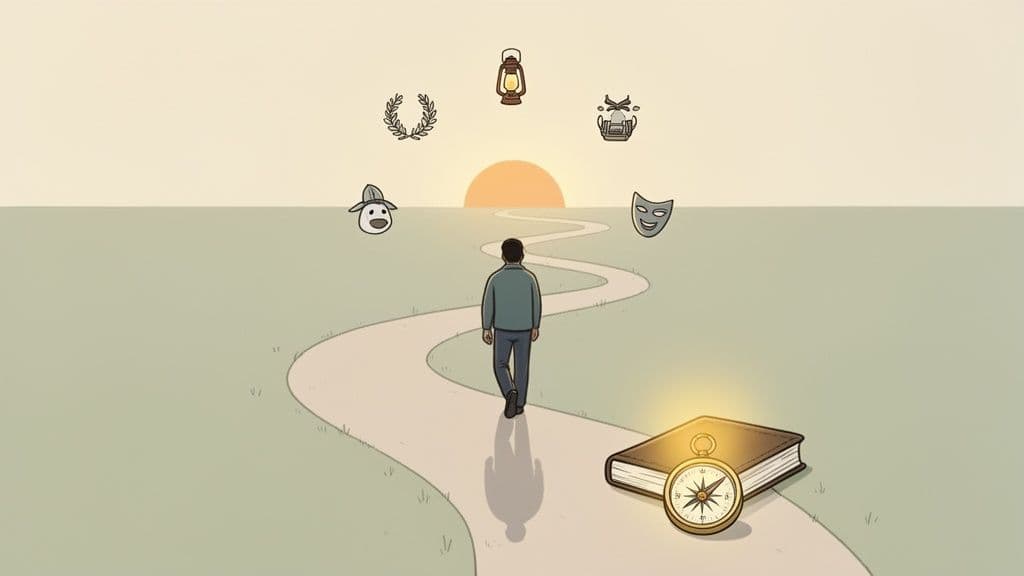
We've explored the ancient roots of archetypes and met the classic characters who fill our myths and dreams. But this isn't just a fascinating history lesson. This is where the real work—and the real magic—begins. It’s time to take this powerful concept of archetypes in mythology and use it as a practical tool for your own life.
Think of it this way: recognizing the archetypes at play within you is like getting a personalized map to your own psyche. Suddenly, the hidden motivations behind your passions, decisions, and even your most stubborn challenges start to make sense. Your life story stops feeling like a random sequence of events and begins to reveal itself as a coherent, meaningful journey.
Identifying Your Active Archetypes
None of us are just one single archetype. We are a dynamic mix of many, with different energies stepping into the spotlight during different chapters of our lives. Right now, your inner Hero might be pushing you to take on a new challenge at work, while your Shadow whispers fears of failure in your ear.
The first step is simply to notice which archetypes are currently active. This isn't about labeling them "good" or "bad"—it's about getting curious.
Seeing your inner landscape through an archetypal lens allows you to work with these powerful energies instead of being unconsciously controlled by them. You become the author of your story, not just a character reacting to the plot.
Are you in a Mentor phase, finding deep satisfaction in guiding others? Or do you feel the Trickster’s rebellious itch, wanting to shake things up and question the rules? Just putting a name to the energy helps you understand the why behind what you're feeling and doing.
Connecting Archetypes to Your Life Path
While different archetypes move through us, many wisdom traditions believe we each have a core archetypal path—one that defines our life’s main purpose and lessons. This is the central idea behind Dan Millman's groundbreaking book, The Life You Were Born to Live. His work offers a detailed roadmap for your unique journey based on numerology, not a box to put you in.
Millman's system outlines 45 distinct life paths, each one a unique archetypal blueprint. By using a simple calculation based on your birthdate, you can pinpoint your primary life path number. This reveals the core archetype that shapes your life, highlighting your greatest gifts, most common obstacles, and ultimate purpose.
The Life Purpose App was built to make this profound system easy to use. The app instantly calculates your life number and lets you dive into the archetype that defines your journey. It provides a clear framework for understanding your strengths and struggles in key areas like career, relationships, and well-being.
This link between our personal journey and humanity's oldest stories runs surprisingly deep. A 2024 analysis of mythological family trees across the globe found that these motifs likely spread through ancient human migration, supporting an out-of-Africa model. This ancient tapestry of stories, some echoing back 60,000 years, finds a modern parallel in tools like the Life Purpose App, which uses 9-year cycles and the 45 life paths from Dan Millman's work to map our personal quests. This research statistically aligns our individual archetypes with humanity’s shared heritage, helping us find our place in a very old story.
Getting Started with Archetypal Self-Reflection
Ready to start tuning into your own archetypal patterns? The best place to begin is with honest reflection, and there's no better tool for that than a journal. It creates a quiet space where you can spot patterns that get lost in the noise of daily life.
Here are a few prompts to get you started:
- Which character from a movie, book, or myth do you strongly connect with right now? What do you admire or see of yourself in them? This often points directly to an active archetype in your life.
- What is a recurring challenge you face? If you imagined this obstacle as a mythical creature or a guardian at a gate, what would it look like? What might it be protecting?
- Think about a recent success, big or small. What archetypal energy were you using? Were you the focused Warrior, the inventive Creator, or the charismatic Performer?
You don't need perfect answers. The goal is simply to open a dialogue with the deeper parts of yourself. For more ideas, you might find our guide to self-discovery journal prompts helpful. By asking these questions, you begin turning ancient wisdom into a practical compass for a more meaningful life.
Your Story in the Great Mythic Cycle
We’ve traveled a long way together, from the very roots of ancient myth to the psychological blueprints that quietly guide our lives today. But this journey isn't just an intellectual deep-dive. It’s about learning to hear the living language of the human soul.
Now, all of this comes back to you. Your life, with all its personal victories, private heartaches, and deep connections, isn’t just a random string of events. It’s a meaningful chapter in a story that’s been told for millennia, connecting you to every person who has ever lived and dreamed. When you start to see your struggles as a Hero’s trial or recognize a mentor’s wisdom in a friend, your own experiences take on a profound new depth.
Writing Your Own Myth
This is where the real power of archetypes comes alive: they empower you to become the conscious author of your own story. Frameworks like narrative therapy, a technique from a high authority source in the therapy space, show just how beautifully our personal lives are woven into this larger human tapestry. Once you recognize the ancient patterns at play, you gain the clarity to choose your next step with intention.
Getting started can be as simple as noticing which stories and characters you’re drawn to. What resonates? When you're ready to dig a bit deeper, you can uncover the specific archetypal blueprint for your life. Dan Millman’s groundbreaking book, The Life You Were Born to Live, offers an incredible system of numerology for this, and the companion Life Purpose App makes his wisdom easily accessible.
By understanding the great myths of humanity, you gain the tools and the wisdom to better write your own. The story isn't over; you are holding the pen.
Using your birth date, the app helps you find your primary life number, which points to the core archetype that shapes your purpose, gifts, and challenges. Think of it as a practical guide for navigating your own personal myth. To better understand how this unfolds, you can explore the stages of spiritual awakening and see how they map to your own journey.
Consider this your personal invitation to begin. Your story matters. It’s a vital part of a grand, beautiful, and unfolding human epic.
Got Questions? We've Got Answers
As you start to see these ancient patterns in your own life, a lot of questions naturally come up. Let's dig into a few of the most common ones to clear things up.
Are Archetypes the Same as Stereotypes?
That's a great question, and the answer is a firm no. They are fundamentally different.
A stereotype is a flat, one-dimensional label we stick on people. It's usually limiting, often negative, and tends to be a product of a specific culture or time. Think of it as a lazy shortcut.
An archetype, on the other hand, is a deep, universal blueprint of human potential. It's complex, holding both light and shadow, and it resonates across all cultures and throughout history.
An archetype is a blueprint; a stereotype is a caricature.
For example, the Wise Old Man is an archetype representing profound wisdom, mentorship, and spiritual insight. The stereotype is just a "grumpy old man"—a simple, dismissive caricature that misses the depth entirely.
How Do I Find My Personal Archetype?
Discovering your core archetype is a process of paying attention. It’s about noticing the recurring themes, roles, and even the fictional characters you’ve always been drawn to. Those connections are often powerful clues.
A great place to start is with your journal. Who are the heroes or villains in books and movies that you secretly root for or identify with? Exploring why you connect with them can reveal which archetypes are most active in your life right now.
For a more guided path, you might look into a system of numerology like the one in Dan Millman's book, The Life You Were Born to Live. This framework is the foundation for the Life Purpose App, which uses your birth date to help you uncover your core life number and the specific archetypal journey tied to it.
Can My Main Archetype Change Over Time?
This is where it gets interesting. In the context of the numerology found in Dan Millman’s work and the Life Purpose App, your core life path archetype—the one linked to your birth date—is constant. Think of it as the central theme of your life's story. It defines your fundamental purpose, your biggest challenges, and your most powerful gifts.
However, that doesn't mean you're stuck in one role. We all call upon different archetypes as we navigate life's seasons. You might activate your Warrior archetype when fighting for a promotion, then step into the Mentor role when guiding a younger colleague or raising your kids. These are just temporary roles you play on the stage of your primary life purpose.
Ready to discover your own archetypal blueprint? Download the Life Purpose App and start exploring the unique story you were born to live. Get started for free.
Discover Your Life Purpose Today!
Unlock your true potential and find your life’s purpose.
