What do all religions have in common? We explore the shared principles of morality, purpose, and community that connect diverse faiths across the globe.
March 18, 2026 (Today)
What Do All Religions Have in Common? Finding Universal Truths
What do all religions have in common? We explore the shared principles of morality, purpose, and community that connect diverse faiths across the globe.
← Back to blog
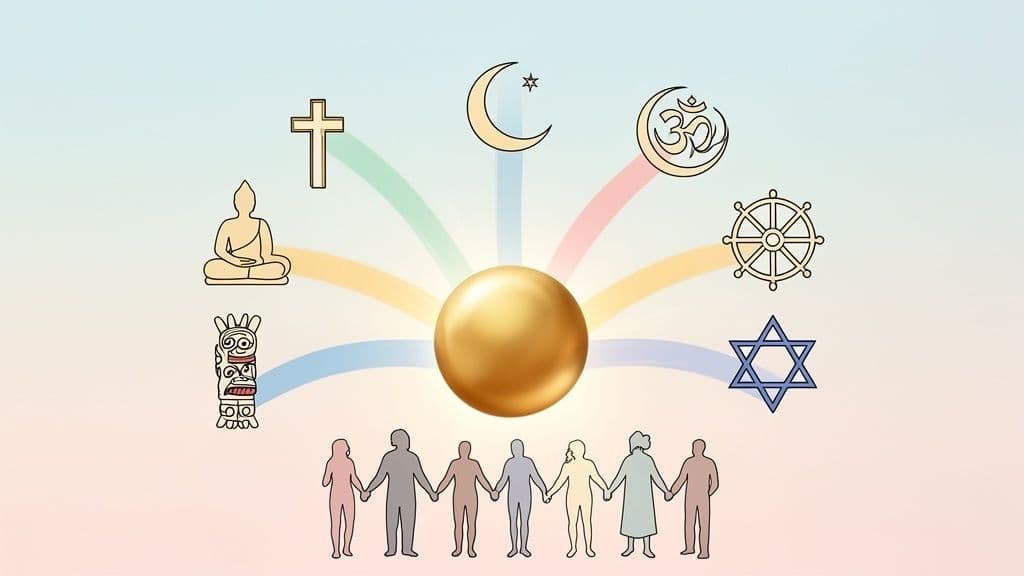
At their core, if you peel back the layers of diverse customs and specific doctrines, you’ll find that every religion is fundamentally about the human search for meaning. From the world's largest faiths to the smallest indigenous traditions, each offers a unique language to explore the same big questions about our purpose and place in the cosmos. They all provide frameworks for morality, community, and ritual to help guide us on that journey.
To kick things off, this table gives a quick snapshot of the core elements we'll be exploring. Think of it as a map of the common ground shared by the world's spiritual traditions.
Core Commonalities in Major World Religions at a Glance
| Shared Element | Brief Description | Example Faiths |
|---|---|---|
| Sacred Dimension | A belief in a reality beyond the ordinary, physical world. | Christianity (God), Buddhism (Nirvana), Indigenous traditions (Spirit World) |
| Moral Framework | A set of ethical principles or codes that guide human behavior. | Judaism (The Ten Commandments), Islam (Sharia law), Hinduism (Dharma) |
| Ritual & Practice | Symbolic actions and ceremonies that connect believers to the sacred. | Catholicism (Mass), Islam (Salah prayers), Shinto (Shrine visits) |
| Community | A sense of belonging and shared identity among followers. | Buddhism (Sangha), Judaism (Kehilla), Christianity (Church) |
| Myths & Symbols | Foundational stories and symbols that convey core truths and values. | Christianity (The Cross), Hinduism (The Aum), Aboriginal Dreamtime stories |
| Life-Cycle Rites | Ceremonies marking significant life transitions like birth, adulthood, and death. | Jewish Bar/Bat Mitzvah, Christian Baptism, Hindu funeral rites (Antyesti) |
| Transformative Experience | The potential for a profound personal encounter that changes one’s life. | Christian "born again" experience, Buddhist enlightenment (Satori), Sufi ecstatic states |
These shared building blocks are the focus of our guide. We'll unpack each one to give you a clearer understanding of how different faiths approach the same fundamental human needs.
The Universal Quest for Purpose That Unites Us
Have you ever looked up at the stars and felt a pull to understand your place in the grand scheme of things? That deep, personal search for meaning is perhaps the single most powerful thread connecting every religion on Earth. It’s a core part of the human experience—this drive to find answers that go beyond our daily routines.
This isn't just a philosophical observation; it's a global reality. A staggering 85% of the world's 8 billion people identify with a religion, each one offering a path to those answers. You can dig into more of the numbers by exploring global religious statistics on WorldPopulationReview.com. This tells us that the desire for a structured way to navigate life's biggest questions is nearly universal.
Whether it's framed as answering a divine call in Christianity, submitting to the will of Allah in Islam, or walking the path to enlightenment in Buddhism, every faith provides a kind of roadmap for this quest.
Mapping the Common Ground
While the destinations and the specific routes on those roadmaps vary, the core elements of the journey are remarkably similar. These shared pillars help bring structure to the human experience and give us a sense of direction.
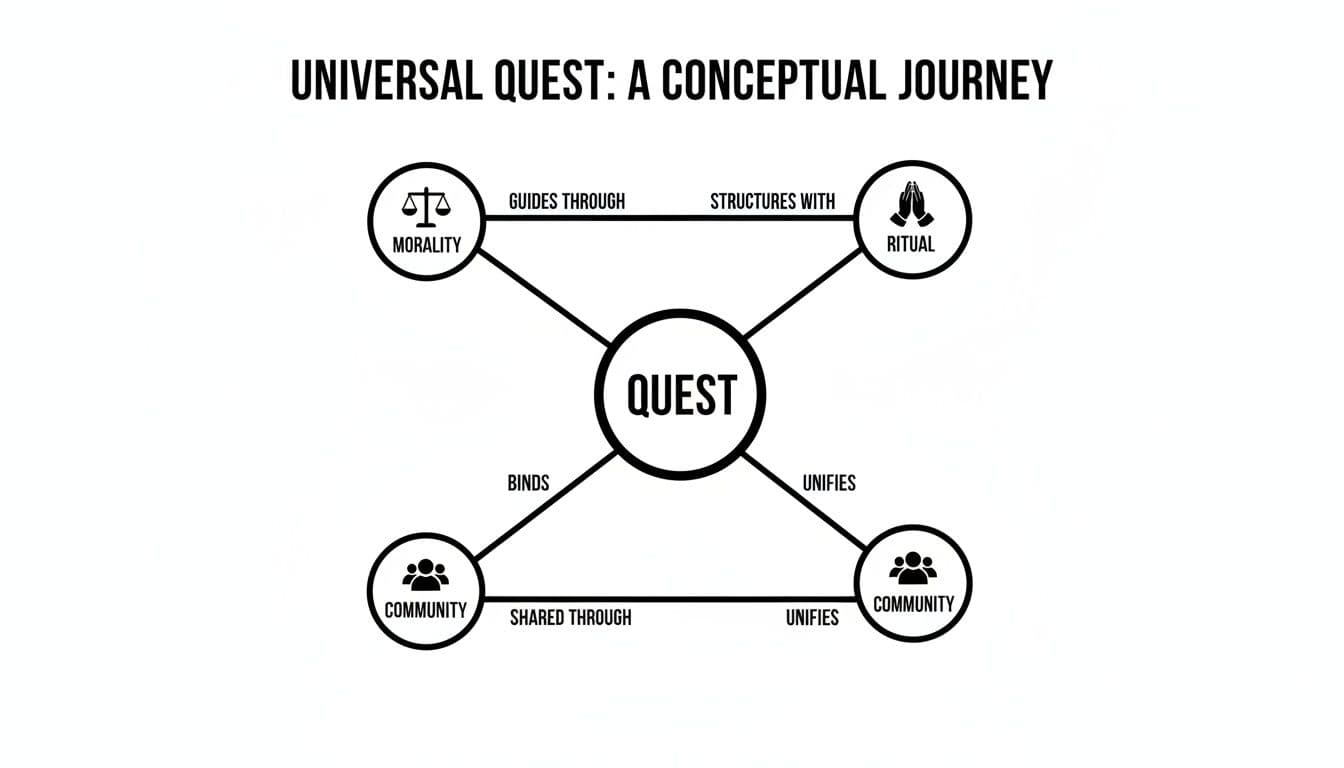
This simple diagram shows how the central Quest for meaning is built on the foundations of Morality, Ritual, and Community.

As the image shows, these three pillars are what support the entire spiritual journey. Think of them as the essential tools every tradition gives its followers to help them along the way.
The real journey isn't just about finding a belief system to follow, but about discovering how these universal truths resonate within your own life. It’s about personalizing the quest.
In this guide, we’ll move beyond surface-level comparisons to really unpack these shared foundations. Instead of seeing them as identical beliefs, we’ll look at them as different dialects expressing the same deep-seated human need for a meaningful life.
To help you connect these broad ideas to your own life, we'll also touch on practical self-knowledge systems. For instance, Dan Millman’s book, "The Life You Were Born to Live", and its companion Life Purpose App can act as a personal compass. They offer a modern way to explore your unique path within this ancient, universal search, helping you connect the dots between your own life and these timeless spiritual themes.
A Shared Belief in a Transcendent Reality
If you peel back the layers of the world's religions, you’ll find a common thread running through almost all of them: a deep-seated belief in a reality beyond our everyday, tangible world. This is what we call the transcendent—a cornerstone of spiritual life that provides a profound source of meaning, comfort, and awe.
But what does that actually look like? For some, it’s a personal, all-knowing God who listens to prayers and guides humanity. For others, it's more of an impersonal cosmic force, an interconnected web of existence. This idea of a pervasive, sacred energy is a fascinating one, and if you're curious, our article on the meaning of divine energy digs into it much deeper.
This belief isn’t just some lofty, abstract idea. It has the power to completely reframe a person’s worldview and shape their daily life.
From the Divine to the Sacred
How people perceive this transcendent reality varies wildly, but its role is often strikingly similar. It offers answers to life’s biggest questions—Why are we here? What happens after we die?—and brings a sense of order to what can feel like a chaotic world. It’s that universal human impulse to look both upward and inward for something greater than ourselves.
- In Christianity, this takes the form of a personal relationship with God, nurtured through prayer and worship.
- In Buddhism, the ultimate transcendent state is Nirvana—a profound liberation from suffering achieved through disciplined meditation and practice.
- In many indigenous spiritualities, the sacred isn't "out there" at all. It's found in the living world itself, where every river, mountain, and animal is alive with spirit.
Across many faiths, this connection between the everyday and the sacred is often made visible. The special vestment for clergy worn during religious services is a perfect example, acting as a tangible symbol that sets apart a sacred time and space within the community.
Manifesting the Sacred in Daily Life
The real power of this belief is how it shows up in the lives of ordinary people. It’s not just about complex theology; it's about forging a personal connection to what feels holy.
This connection to the transcendent is what turns a simple action into a sacred ritual. It transforms a building into a holy place and a set of beliefs into a living faith.
Think about how this plays out. It's the same fundamental impulse expressed in countless different ways, all designed to connect the individual to that higher reality:
- A grand cathedral service: The soaring architecture, the resonant music, the ancient ceremony—it’s all carefully crafted to inspire a sense of awe and draw the mind toward God.
- A silent meditation in a forest: Here, the goal is to connect with the sacredness of the natural world and the quiet, centering stillness of the universe.
- A simple prayer whispered on a mat: In this intimate act, a person creates a direct, personal line of communication with the divine, no matter where they are.
Each of these experiences, while so different on the surface, ultimately serves the exact same purpose: to build a bridge between our ordinary world and the transcendent reality that gives it meaning.
The Moral Compass of a Shared Human Ethic

When you peel back the unique cultural layers of the world’s spiritual traditions, you find a remarkably consistent moral core. It's an idea you’ve likely heard before, often called the Golden Rule: “Do unto others as you would have them do unto you.” This isn't just a quaint saying; it's a foundational piece of human ethics that surfaces again and again, across nearly every faith and philosophy.
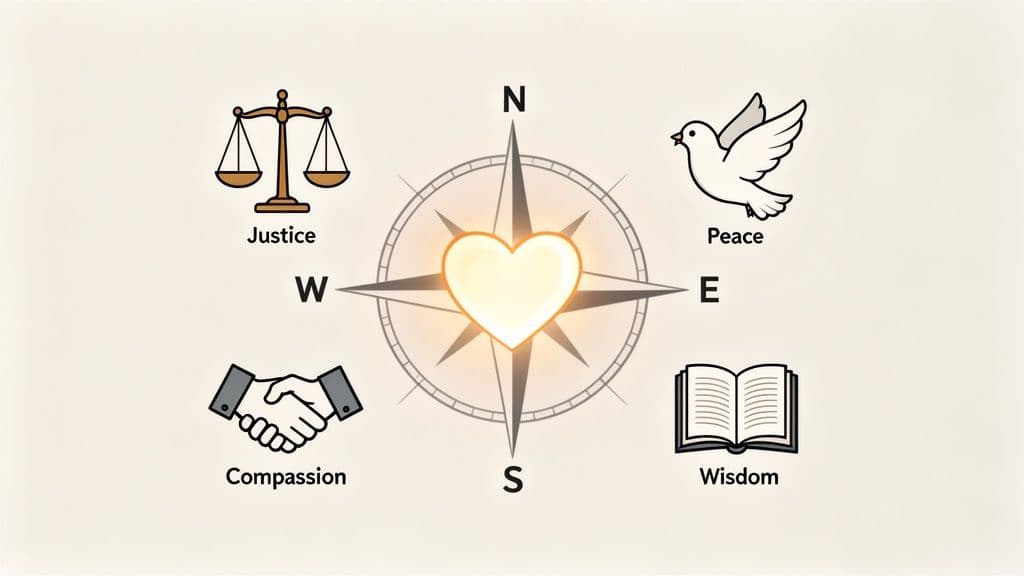
Think of it as an inner compass. While the specific directives and social codes might look different on the surface, the needle almost always points toward a shared set of values. Core principles like compassion, honesty, and justice are universal constants. So, when people ask, "what do all religions have in common," one of the most powerful answers is that they all offer a practical roadmap for living a good and decent life.
This shared ethical code isn't a dusty set of rules from antiquity. It’s a living, breathing framework for creating harmony in our communities and forging a deeper connection to our own spiritual source.
Core Virtues Across Traditions
No matter where you look, you'll find that spiritual paths place a huge emphasis on cultivating specific inner virtues. These aren’t just abstract ideals to ponder; they are tangible qualities meant to guide our day-to-day interactions and help us build a more just and loving world.
- Compassion and Mercy: The Christian call to "love your neighbor" finds a beautiful echo in the Buddhist ideal of Karuna, which is a profound sense of compassion for all living things.
- Honesty and Truthfulness: Islam places a strong emphasis on truthfulness in all aspects of life, a value that runs parallel to the Hindu concept of Satya (truth) as a sacred duty.
- Justice and Fairness: The Jewish pursuit of Tzedek (justice) is a passionate and powerful call to build a righteous society, a theme that resonates through almost every spiritual tradition in one form or another.
It’s as if these values are woven into our shared human DNA. They provide a blueprint for how to act with integrity, honor the dignity of others, and contribute to a better world for everyone.
The real point of a spiritual moral code isn't just to check off a list of rules. It’s about aligning your everyday actions with a higher purpose and letting your life become an expression of these timeless virtues.
Aligning Your Life with Universal Ethics
This very idea—living a life aligned with a deeper purpose—is a cornerstone of Dan Millman's work. His book, "The Life You Were Born to Live," and the accompanying Life Purpose App offer a fascinating system for illuminating your personal life path. By discovering your unique life number, you can gain insight into how these universal ethical principles apply specifically to your own journey, including your innate strengths and challenges.
This approach helps you take these broad, global values and translate them into a personal code that feels authentic to you. For example, many Eastern paths like yoga offer explicit ethical guides for living a more conscious life. You can explore some of these practical principles in our article on the Yamas and Niyamas.
At the end of the day, these moral frameworks aren’t meant to be chains that bind you. They are tools of liberation, designed to help you navigate the complexities of life with integrity, cultivate richer relationships, and live in greater harmony with yourself and the world.
The Living Language of Ritual and Practice
When you strip away the complex theology and philosophy, what do people of faith actually do? The answer, almost universally, is that they engage in rituals. Prayer, meditation, fasting, pilgrimage—these aren't just quaint habits. They are the active, physical language of belief.
Think of it this way: if a core belief is the sheet music, then ritual is the act of playing the instrument. It’s the disciplined practice that turns an abstract idea on a page into a living, breathing experience you can feel. It’s what makes faith tangible. From the solemnity of a Catholic Mass to the ecstatic spinning of a Sufi dervish, ritual is a language understood across cultures.
This is a fundamental answer to the question, what do all religions have in common? They all share structured practices that connect believers to something sacred.
The ‘Doing’ That Defines Belief
Rituals give abstract beliefs a foothold in the real world, marking significant moments and grounding us in physical action. They create a predictable, often comforting, framework for interacting with the divine, which in turn strengthens both our personal identity and our sense of community.
For example, many faiths incorporate the public reading of scripture as a central ritual. This isn't just about hearing words; it's a shared act of devotion that reinforces a community's commitment to its foundational teachings.
These practices often fall into a few key categories:
- Rites of Passage: These are ceremonies that honor life’s biggest transitions. Think of a Christian baptism welcoming a newborn, a Jewish Bar or Bat Mitzvah celebrating the move into adulthood, or Hindu funeral rites guiding a soul’s journey onward.
- Communal Worship: This is the rhythm of weekly services, like a Sunday church sermon or Friday prayers at a mosque. These regular gatherings are the heartbeat of a community, reinforcing shared purpose and belonging.
- Personal Devotion: These are the quiet, daily practices that build an intimate connection to the divine. This could be morning prayer, silent meditation, or simply reading a sacred text alone.
Rituals are the bridge between our inner world of belief and our outer world of action. They are how faith is lived out, day by day, connecting us to our community and creating a direct line to the sacred.
Creating Order and Meaning from Chaos
On a much deeper level, rituals help us carve out a sense of order in a world that often feels chaotic. They give a rhythm to our lives—daily, weekly, and seasonal—that keeps us anchored to our spiritual center.
Even outside a formal religious context, we instinctively create rituals to give our lives meaning, from a specific morning coffee routine to an annual birthday celebration. Spiritual traditions simply elevate this human need, infusing these structured actions with a connection to something much greater than ourselves.
This is how the mundane can become sacred. The simple act of setting an intention or creating a personal ceremony can bring powerful structure into your life. If you're curious about this, our guide on creating a powerful New Year's ritual shows just how effective this can be.
Finding Support Through Community and Belonging

While we often picture the spiritual path as a solitary one—a lone seeker meditating on a mountaintop—that’s only half the story. If you look at almost any faith tradition on the planet, you’ll find that the journey is almost never meant to be taken alone. The role of community is one of the most powerful threads connecting them all, weaving individual believers into a resilient, supportive whole.
Every tradition has its own name for this spiritual family. It might be the Christian church, the Buddhist sangha, the Islamic ummah, or the Jewish kehilla. The name changes, but the core purpose doesn't: to create a space where people with shared beliefs can guide, teach, and genuinely lift each other up.
This isn't just about socializing. It’s how beliefs are reinforced, how traditions and sacred stories are passed down, and how people find a safety net when life gets hard.
The Power of a Shared Identity
Being part of a religious community gives people a profound sense of identity and place. It’s a powerful feeling to know you belong to something larger and more lasting than your own individual life. This is far more than a social club; it’s a shared expedition toward a common purpose.
This is also where spiritual ideals get their hands dirty. Community is where abstract virtues like compassion, service, and forgiveness move from theory into the messy, beautiful reality of human interaction.
You can see it in action everywhere:
- Weekly Gatherings: A Sunday service or a Friday prayer provides a steady rhythm, a touchstone for connection and reflection.
- Shared Meals: From Christian potlucks to Jewish Shabbat dinners, the simple act of breaking bread together has built spiritual bonds for millennia.
- Support Networks: When someone gets sick or faces a loss, the community often rallies, providing everything from meals to a shoulder to cry on.
It’s a constant, living reminder that you are not walking your path alone.
A spiritual community acts as both an anchor and a sail. It grounds us in shared tradition while propelling us forward in our personal growth, reminding us that the human connection is essential for a meaningful life.
From Community to Self-Discovery
This deep-seated need for belonging is a fundamental part of being human. Understanding how these communities work shows us what all religions have in common on a practical, day-to-day level. It’s about people helping other people navigate life’s biggest questions, together.
Interestingly, this same idea of finding your place within a larger structure is echoed in many systems of self-discovery. Take the work in Dan Millman's book, "The Life You Were Born to Live", which offers a framework for understanding your unique life path. Using tools like the Life Purpose App, you can get a clearer picture of how you fit into the world, helping you find the specific ways you can best contribute to your own community—whether it’s spiritual or secular.
Finding Your Unique Path in the Universal Search
So, we've explored the common threads that weave through most spiritual traditions—things like morality, ritual, and community. They're the bedrock, the powerful answer to the question, what do all religions have in common. But knowing this often leads to a more pressing, personal question: How do I take these big, universal ideas and actually use them in my own life?
While established religions provide well-trodden paths, the search for meaning is, at its core, a journey you take alone. It’s about self-discovery, about figuring out how those broad principles fit your unique life. And this is where some modern approaches to self-knowledge can be surprisingly helpful.
Decoding Your Personal Blueprint
Think of those universal religious themes as a large-scale map of the spiritual world. It shows you the terrain, but you still need a compass to find your own place on it. A system of self-knowledge can act as that personal compass, pointing you toward your own "true north."
A fantastic example is the system laid out in Dan Millman's classic book, "The Life You Were Born to Live," and its digital companion, the Life Purpose App. This framework offers a secular, practical way to get in touch with your own spiritual blueprint. By using your birth date to calculate a specific life number, it sheds light on the particular path you're here to walk.
This isn't about telling your future; it’s about deepening your self-awareness. It gives you a structured way to examine your core purpose, your innate gifts, and the specific hurdles you're meant to overcome.
The most powerful spiritual journey isn’t about finding the 'right' religion, but about discovering the unique way universal truths apply to your personal path.
Making Universal Themes Personal
Once you have a clearer picture of your own life path, you can start to see how those universal concepts—morality, community, purpose—apply directly to you. It’s like being handed a personalized field guide to your own human experience.
For instance, your life path might highlight that:
- Your primary moral lesson involves learning to set and maintain healthy boundaries.
- Your greatest gift to a community might flow from your natural ability to lead or to nurture.
- The core challenge you're here to master is about balancing your head with your heart—logic with intuition.
The system detailed in "The Life You Were Born to Live" is designed to help you tune into these personal dynamics. With the Life Purpose App, you can see precisely how your own journey intersects with these timeless spiritual laws. This empowers you to build a life of genuine meaning and harmony, entirely on your own terms.
Frequently Asked Questions About World Religions
Whenever you start comparing different spiritual paths, a few key questions always seem to pop up. It's only natural. Let's dig into some of the most common ones that come up as we try to understand this shared human experience.
Do All Religions Have a Single God?
No, and that’s actually a really common misconception. The idea of a single, all-powerful God—what we call monotheism—is central to faiths like Christianity, Islam, and Judaism, but it's by no means the only model.
Plenty of religions are polytheistic, which means they honor many gods and goddesses. A perfect example is Hinduism, with its rich and expansive pantheon where each deity often represents a different facet of the ultimate reality.
And then you have traditions that are non-theistic. Paths like certain schools of Buddhism or Taoism don't focus on a creator God at all. For them, the heart of the practice is about a spiritual discipline, a clear path to enlightenment, or living in harmony with a fundamental principle of the universe, like the Tao.
Is an Afterlife a Universal Religious Belief?
Belief in some kind of existence after we die is incredibly widespread, but the details are wildly different from one tradition to the next. This is a perfect example of how religions often grapple with the same big questions but come up with profoundly different answers.
- Abrahamic Faiths: Christianity, Judaism, and Islam generally share a belief in a final judgment that leads to an eternal afterlife, often conceived as heaven or hell.
- Eastern Religions: Hinduism and Buddhism, on the other hand, embrace the concept of reincarnation, or samsara. This is the ongoing cycle of death and rebirth, where your actions in this life (karma) directly influence the circumstances of your next one.
In fact, the ultimate goal in these Eastern paths is often to break free from that cycle. For Hindus, this liberation is called moksha, and for Buddhists, the state of ultimate peace and enlightenment is known as Nirvana. So while almost everyone asks "what's next?", the answers are beautifully diverse.
The search for purpose is a human journey, not just a religious one. You can find the core principles of religion—a moral code, community, and a search for meaning—in secular life, too.
How Can I Find My Life Purpose if I Am Not Religious?
That's a fantastic and deeply important question. The drive to find purpose is fundamentally human, and you absolutely don't need to subscribe to a formal religion to find it. Many people build their own powerful moral codes, find supportive communities, and discover a profound sense of meaning entirely outside of traditional religious structures.
This is where systems of self-knowledge can be incredibly powerful. For example, Dan Millman’s groundbreaking book, “The Life You Were Born to Live,” and the Life Purpose App based on it, provide a structured way to discover your own unique path. This system uses your birth date to offer deep insights into your innate talents and personal challenges, all without being tied to any specific spiritual doctrine.
Are you ready to discover your unique life path? Download the Life Purpose App today and unlock a deeper understanding of your purpose, talents, and challenges. Start your journey of self-discovery at https://lifepurposeapp.com.
Discover Your Life Purpose Today!
Unlock your true potential and find your life’s purpose.