Take our Ayurveda dosha test to understand your unique mind-body type. Learn which qualities—Vata, Pitta, or Kapha—shape your energy, digestion, sleep, and mood, and get practical tips to restore balance.
April 14, 2026 (4mo ago) — last updated August 15, 2026 (8d ago)
Ayurveda Dosha Test: Find Your Dosha
Take a quick Ayurveda dosha test to discover your Vata, Pitta, or Kapha tendencies and get practical tips to restore balance.
← Back to blog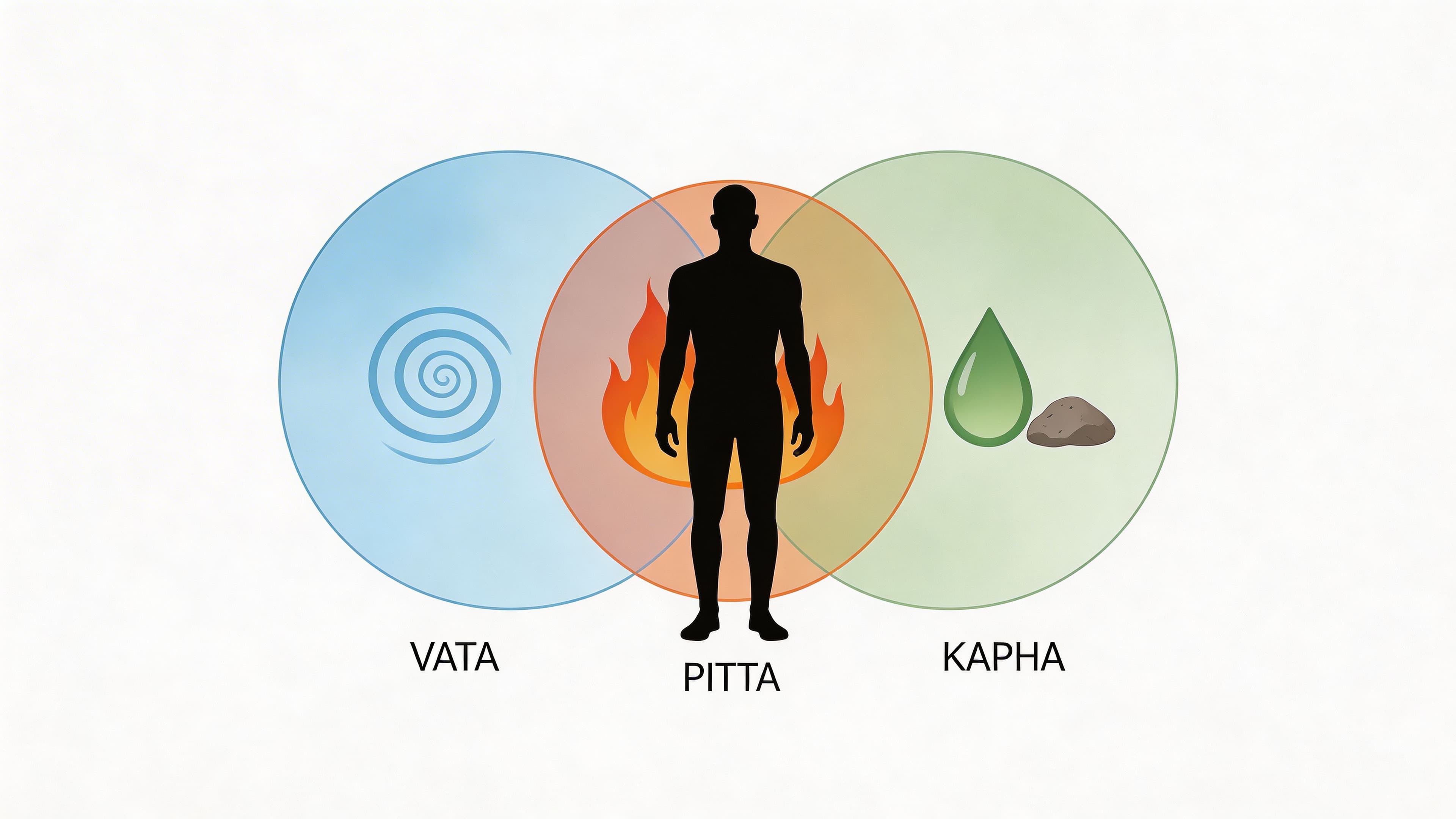
Title: Ayurveda Dosha Test: Find Your Dosha
Summary: Take a quick Ayurveda dosha test to discover your Vata, Pitta, or Kapha tendencies and get practical tips to restore balance.
Introduction: Take our Ayurveda dosha test to understand your unique mind-body type. Learn about Vata, Pitta, and Kapha and get practical tips for balance and well-being.
Tags: ayurveda dosha test, ayurvedic doshas, find your dosha, vata pitta kapha, holistic wellness
Some days you wake up clear, hungry, and ready to move. Other days your mind races, your digestion feels off, or your body feels heavy for no obvious reason. You might notice that your friend can skip meals and stay cheerful, while you become irritable fast. Or spicy food seems harmless to someone else and completely overwhelms you.
An Ayurveda dosha test gives language to those differences. It’s not a label meant to limit you. It’s a practical lens for noticing which qualities are strongest in your body and mind so you can make simple adjustments that support balance.
Discovering Your Personal Blueprint
You’ve probably already done informal testing: travel energizes you or scrambles you; missing lunch is no big deal or a guaranteed recipe for irritability; you calm down by resting, cooling off, or moving. Ayurveda treats those details as meaningful.
An Ayurveda dosha test is less like a pass-fail quiz and more like a mirror. It asks, “What qualities show up in you most often?” Light or heavy. Quick or steady. Cool or hot. Dry or oily. Regular or changeable.
Why this approach resonates
Most wellness advice assumes everyone needs the same routine. Ayurveda starts from the opposite idea. Two people can eat the same meal and have very different outcomes. A dosha test helps explain why and makes advice easier to personalize.
A good self-knowledge system doesn’t hand you an identity. It helps you ask better questions.
If you’re already using reflective practices to increase self-awareness, an Ayurveda dosha test gives body-based clues that complement those efforts.
What to keep in mind before you take one
A dosha result isn’t a verdict. It’s a starting point.
- It reflects patterns, not perfection.
- It can shift with stress, season, sleep, and food.
- Answer based on your usual state, not your ideal self.
Approach the test with curiosity and honesty, and it becomes useful fast. You stop asking, “What’s wrong with me?” and start asking, “What qualities need balancing right now?”
The Three Doshas Explained
Ayurveda traces the idea of the doshas to ancient Indian texts such as the Charaka Samhita, compiled around 100 BCE1. In practice, the concept is straightforward: the doshas describe recurring qualities that shape how your body and mind function.
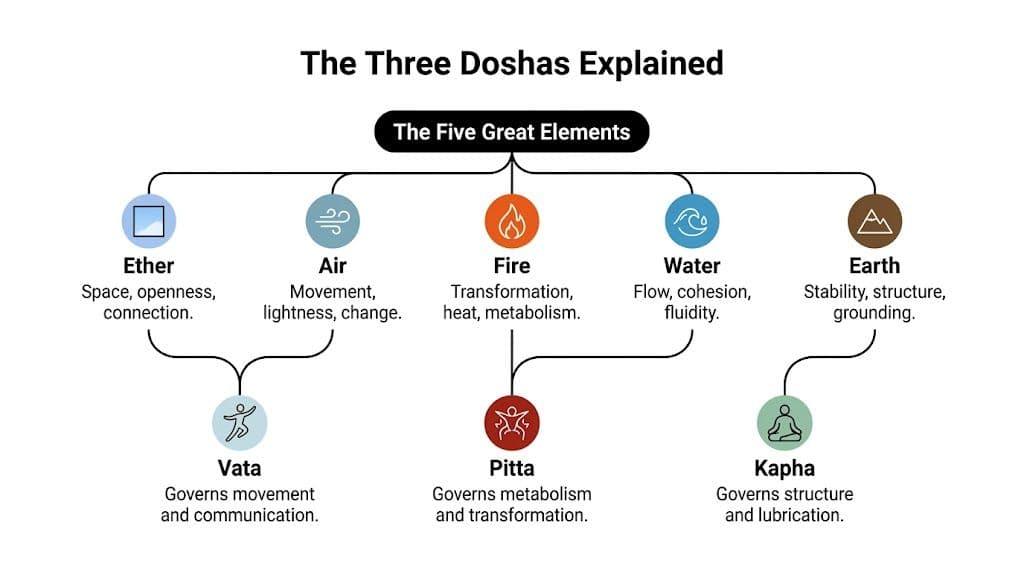
Ayurveda maps qualities to five great elements: ether, air, fire, water, and earth. The three doshas are combinations of those elements2.
The elemental logic
Think of the doshas as patterns of qualities:
- Vata combines air and ether: movement, communication, change.
- Pitta combines fire and water: digestion, metabolism, transformation.
- Kapha combines earth and water: structure, stability, lubrication.
If that feels abstract, use everyday images. Vata is like wind—quick and changeable. Pitta is like fire—sharp and heating. Kapha is like rich soil after rain—steady and nourishing.
Vata, Pitta, and Kapha at a glance
| Attribute | Vata (Air + Ether) | Pitta (Fire + Water) | Kapha (Earth + Water) |
|---|---|---|---|
| Core function | Movement and communication | Metabolism and transformation | Structure and lubrication |
| Typical body frame | Slender or light | Medium or moderate | Solid or heavier |
| Skin tendency | Dry | Sensitive or warm | Oily or smooth |
| Appetite pattern | Irregular | Strong and steady | Slow or heavier |
| Mental tendency | Quick, changeable, imaginative | Focused, sharp, driven | Calm, steady, patient |
| When out of balance | Scattered, dry, anxious | Irritable, hot, inflamed | Sluggish, heavy, stuck |
How each dosha feels in real life
Vata: When balanced, Vata brings creativity, alertness, and liveliness. When high, thoughts speed up, sleep gets light, digestion becomes irregular, and you may feel cold, dry, or ungrounded.
Pitta: Balanced Pitta supports clarity, purpose, and steady digestion. Too much Pitta can feel like overheating—irritability, impatience, inflammation, and skin sensitivity.
Kapha: Balanced Kapha brings stability, endurance, and calm. Excess Kapha can feel heavy, slow motivation, congestion, and resistance to change.
Practical lens: Don’t ask, “Which dosha am I?” first. Ask, “Which qualities are strongest in me, and are they helping or burdening me right now?”
That question keeps Ayurveda useful. It turns theory into practical observation you can test on a Tuesday morning.
How an Ayurveda Dosha Test Works
Most online dosha quizzes look for repeated patterns across physical, mental, and behavioral traits. A typical test asks about body frame, temperature preference, appetite, sleep, and mental style. One source for a dosha assessment notes high agreement with practitioner assessments for many users3</sup.

Common quiz questions
Quizzes typically ask about baseline tendencies such as:
- Natural body build
- Weight patterns
- Skin and hair texture
- Digestion and appetite
- Energy rhythm and sleep style
Some quizzes use multiple-choice answers; others use a rating scale.
Scoring and interpretation
If most answers align with Vata traits, Vata may be dominant. Split answers may indicate a dual-dosha like Vata-Pitta. Online quizzes are useful for awareness but don’t diagnose medical conditions.
A trained Ayurvedic practitioner offers deeper context by assessing long-term constitution (prakriti) and current imbalance (vikriti). Treat an online result like a snapshot: helpful and often accurate, but incomplete.
Your Mini Ayurveda Dosha Quiz
Try this short version to feel how a dosha test works. Pick the answer that fits you most of the time across your life, not just this week. Keep a count of A, B, and C answers.
-
My natural body frame is usually
A. Light, narrow, or fine-boned
B. Medium, proportionate, or athletic
C. Broad, solid, or sturdy -
My weight tends to
A. Stay low or be hard to gain
B. Stay fairly moderate
C. Increase easily and be harder to lose -
My skin is more often
A. Dry or rough
B. Warm, sensitive, or prone to redness
C. Smooth, cool, or oily -
My appetite is usually
A. Irregular. I may forget to eat or get hungry at odd times
B. Strong and dependable
C. Slow, steady, or I can skip meals without much fuss -
My energy tends to be
A. Changeable. Bursts, then dips
B. Strong and focused
C. Stable but sometimes slow to get going -
In cold weather, I usually
A. Feel uncomfortable quickly
B. Don’t mind it too much unless I’m already stressed
C. Tolerate it fairly well -
When I’m under stress, I’m more likely to become
A. Worried, scattered, or restless
B. Irritable, sharp, or impatient
C. Withdrawn, sluggish, or resistant -
My sleep is usually
A. Light or easily interrupted
B. Fairly solid, but I may wake if overworked
C. Deep and long -
My way of learning is often
A. Quick to grasp, quick to forget
B. Sharp, organized, and goal-focused
C. Slow and steady, but long-lasting -
My pace in life is generally
A. Fast, irregular, or always changing
B. Direct, efficient, and intentional
C. Calm, measured, and consistent -
My hair tends to be
A. Dry, frizzy, or fine
B. Soft, straight, or prone to early thinning
C. Thick, heavy, or oily -
If a day is unstructured, I usually feel
A. Unsettled or all over the place
B. Productive if I set goals
C. Comfortable, but maybe too relaxed
Scoring
- Mostly A: stronger Vata qualities
- Mostly B: stronger Pitta qualities
- Mostly C: stronger Kapha qualities
- Mixed: a dual or balanced constitution
Answer based on long-term patterns—childhood and early adult tendencies matter. Ignore temporary trends.
Interpreting Your Dosha Test Results
After the quiz, resist pinning yourself down. Use the result as a compass, not an identity. Read your score through two ideas: prakriti (inborn constitution) and vikriti (current state). Prakriti is your home base; vikriti is the weather today.
Ask:
- Does this describe me across many seasons of life?
- Or does it describe the current season I’m in?
- Which traits feel stable, and which are recent?
Dual-dosha results often match real life better than a single label. They let you notice which qualities need balancing right now.
What to avoid
Avoid turning a dosha into a story that limits you. Don’t say, “I’m Vata, so I’m anxious.” Instead, notice which qualities are strongest, whether they’re lifelong or recent, and test small adjustments.
Next Steps After Finding Your Dosha
A dosha result helps most when you treat it like a map key. It points to qualities that may be running high and invites small, testable changes.
Start with one simple principle: if a quality feels excessive, choose its opposite gently and consistently.
- Dry, cold, scattered states respond to warmth, moisture, and rhythm.
- Hot, sharp, pressured states settle with cooling, softness, and space.
- Heavy, slow, stuck states shift with movement, lightness, and novelty.
If Vata feels high
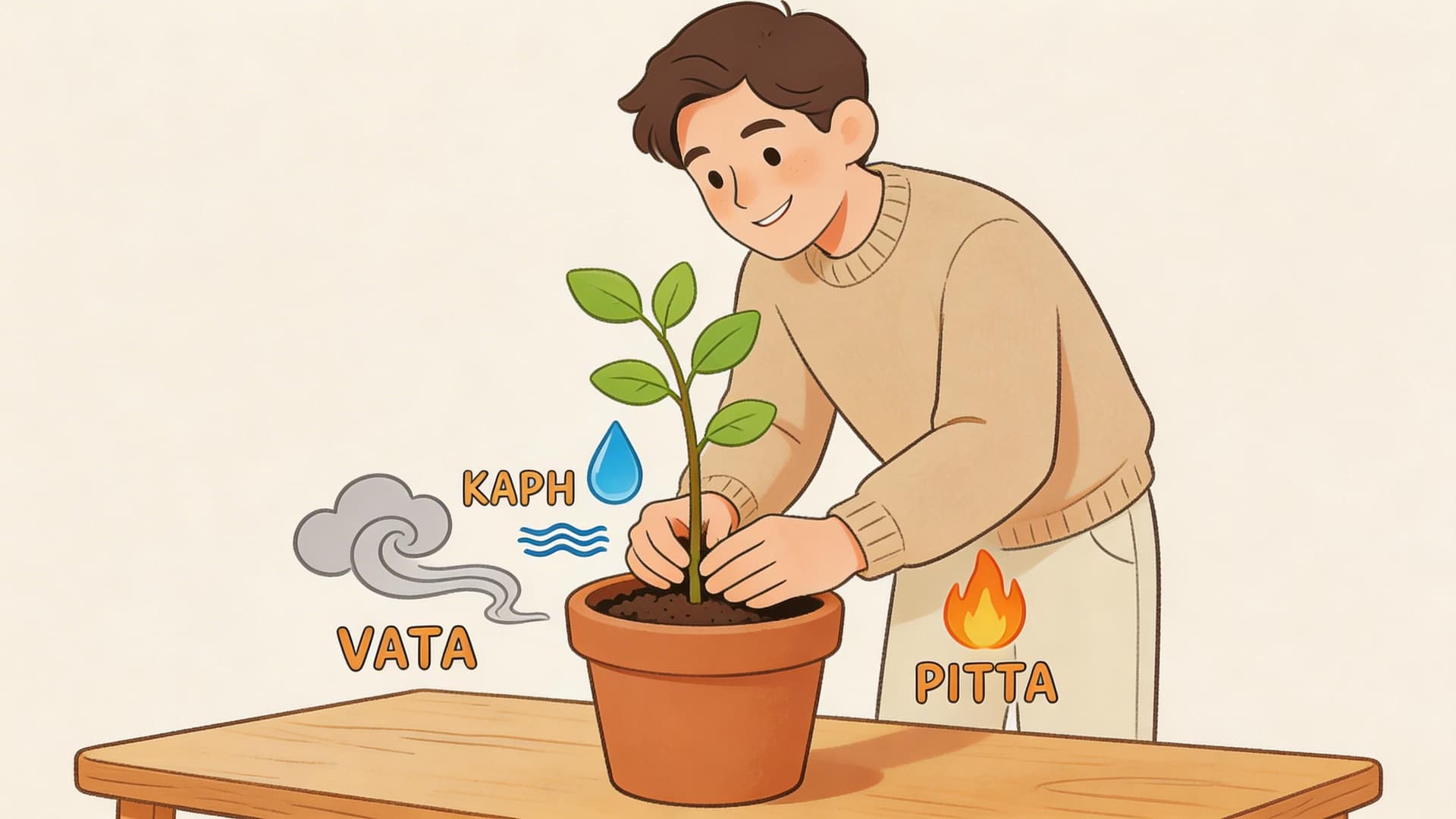
Vata imbalance often feels like too much wind. Try for steadiness:
- Warm breakfasts instead of cold or skipped meals
- More cooked foods: soups, stews, grains, root vegetables
- Regular mealtimes and bedtime
- Warm oil massage before a shower if it feels grounding
If Pitta feels high
Pitta overheating needs cooling and space:
- Favor less spicy, less fried, and less heating foods
- Swap one intense workout for walking, swimming, or gentle yoga
- Build short pauses between tasks to reduce pressure
- Spend time in cooler, quieter environments when irritability rises
If Kapha feels high
Kapha excess needs stimulation and movement:
- Move early in the day, even a brisk 15-minute walk
- Eat lighter meals and reduce very heavy foods for a few days
- Add novelty, music, fresh air, or a change of setting when you feel stuck
- Choose energizing practices that create momentum rather than more stillness
Keep experiments small. Try one or two changes for a week and notice what shifts.
| What to notice | Questions to ask |
|---|---|
| Energy | Do I feel steadier, lighter, or less agitated? |
| Digestion | Do meals feel easier to process? |
| Mood | Am I less reactive, scattered, or sluggish? |
| Sleep | Am I settling more easily and waking with better rhythm? |
Embracing Balance and Seeking Deeper Guidance
An online Ayurveda dosha test is a doorway. It helps you notice long-standing patterns you may have ignored. It’s not a medical diagnosis. If you have persistent digestive issues, ongoing insomnia, significant mood changes, pain, or any serious health concern, talk with a qualified healthcare professional4.</n If you want deeper Ayurvedic guidance, work with a trained practitioner who can distinguish prakriti from vikriti and create a tailored plan.
Curiosity is enough to begin. Compassion makes the insight useful.
If you enjoy self-knowledge tools that make ancient wisdom practical, the Life Purpose App is worth exploring. It’s built around Dan Millman’s The Life You Were Born to Live and helps you reflect on life path, core gifts, challenges, and cycles.
Quick Q&A
What is an Ayurveda dosha test?
An Ayurveda dosha test is a questionnaire that identifies recurring physical and mental qualities—Vata, Pitta, and Kapha—so you can tailor daily habits to support balance.
How accurate are online dosha quizzes?
Quizzes are useful for awareness and commonly align with practitioner assessments, but they aren’t medical tools and can miss context. For personalized care, consult a trained practitioner.3
What should I do after finding my dosha?
Use the result as a starting point. Test one small change for a week—adjust meals, sleep, or activity—and observe what improves. Seek professional advice for persistent health issues.4
1.
Britannica entry on Charaka Samhita. https://www.britannica.com/topic/Charaka-Samhita
2.
National Center for Complementary and Integrative Health, overview of Ayurveda. https://www.nccih.nih.gov/health/ayurveda
3.
Asivana Yoga, Ayurvedic dosha assessment test information. https://asivanayoga.com/pages/ayurvedic-dosha-assessment-test
4.
World Health Organization, traditional, complementary and integrative medicine. https://www.who.int/health-topics/traditional-complementary-and-integrative-medicine
Discover Your Life Purpose Today!
Unlock your true potential and find your life’s purpose.
