Feeling lost? This life purpose meditation guide offers a step-by-step script and journaling prompts to help you connect insights with your true path in 2026.
May 12, 2026 (4mo ago) — last updated June 30, 2026 (2mo ago)
Find Your Path With Life Purpose Meditation
Feeling lost? This life purpose meditation guide offers a step-by-step script and journaling prompts to help you connect insights with your true path in 2026.
← Back to blog
Some people come to life purpose meditation after a quiet ache has been building for years. Others arrive because something cracked. A job that looks fine on paper feels deadening. A relationship ends and takes an old identity with it. You keep doing what used to make sense, but the inner signal is gone.
That state can feel dramatic, but it often shows up in ordinary ways. You scroll too much. You second-guess simple decisions. You tell yourself you need a big answer, when what you really need first is enough inner stillness to hear your own life again.
A life purpose meditation won't hand you a perfect five-year plan. It also won't solve confusion by force. What it can do is quiet the noise long enough for deeper patterns to surface. That matters because purpose usually arrives as recognition before it becomes a strategy. You feel the truth of something before you can explain it.
Finding Your Inner Compass When You Feel Lost
You might be in a season where your outer life still functions, but your inner life feels scattered. You get through the day. You answer messages. You show up. But underneath all of that, there's a repeated question: Is this really my path?
That question deserves respect. It isn't a sign that you're failing. It often means your deeper values have started speaking louder than your habits.

Meditation has moved well beyond the edge of wellness culture and into ordinary life. In the US, adult meditation use rose from 4.1% in 2012 to 14.2% in 2017, and by 2022 an estimated 17.3% of adults were practicing. The same research notes a global range of 200 to 500 million practitioners, reflecting broad interest in stress reduction, concentration, and self-awareness that support purpose work (peer-reviewed overview of meditation adoption and use).
What life purpose meditation actually does
A useful session doesn't try to manufacture a calling. It helps you notice three things:
- What gives you energy. Not what looks impressive, but what leaves you feeling more alive.
- What keeps repeating. Certain themes come back through work, relationships, and longings for a reason.
- What feels misaligned. Restlessness can be information, not a flaw.
I've seen people expect fireworks from this practice and miss the quieter truth. Purpose often comes through small, persistent signals. Relief. A clear no. A memory that won't leave. A future image that feels more like recognition than fantasy.
Purpose rarely arrives as a speech. It usually comes as a pattern.
A grounded way to begin
If you feel lost, start here. Don't ask, “What am I meant to do forever?” Ask, “What feels profoundly true when everything else gets quiet?”
That question is workable. It invites honesty instead of performance.
A good life purpose meditation is less about escaping your life and more about returning to it with cleaner perception. Later, those insights can be tested against a structured framework such as Dan Millman's book The Life You Were Born to Live, which gives language for recurring gifts and challenges. But first, you need the direct experience. Before interpretation, there has to be listening.
How to Prepare for Your Life Purpose Meditation
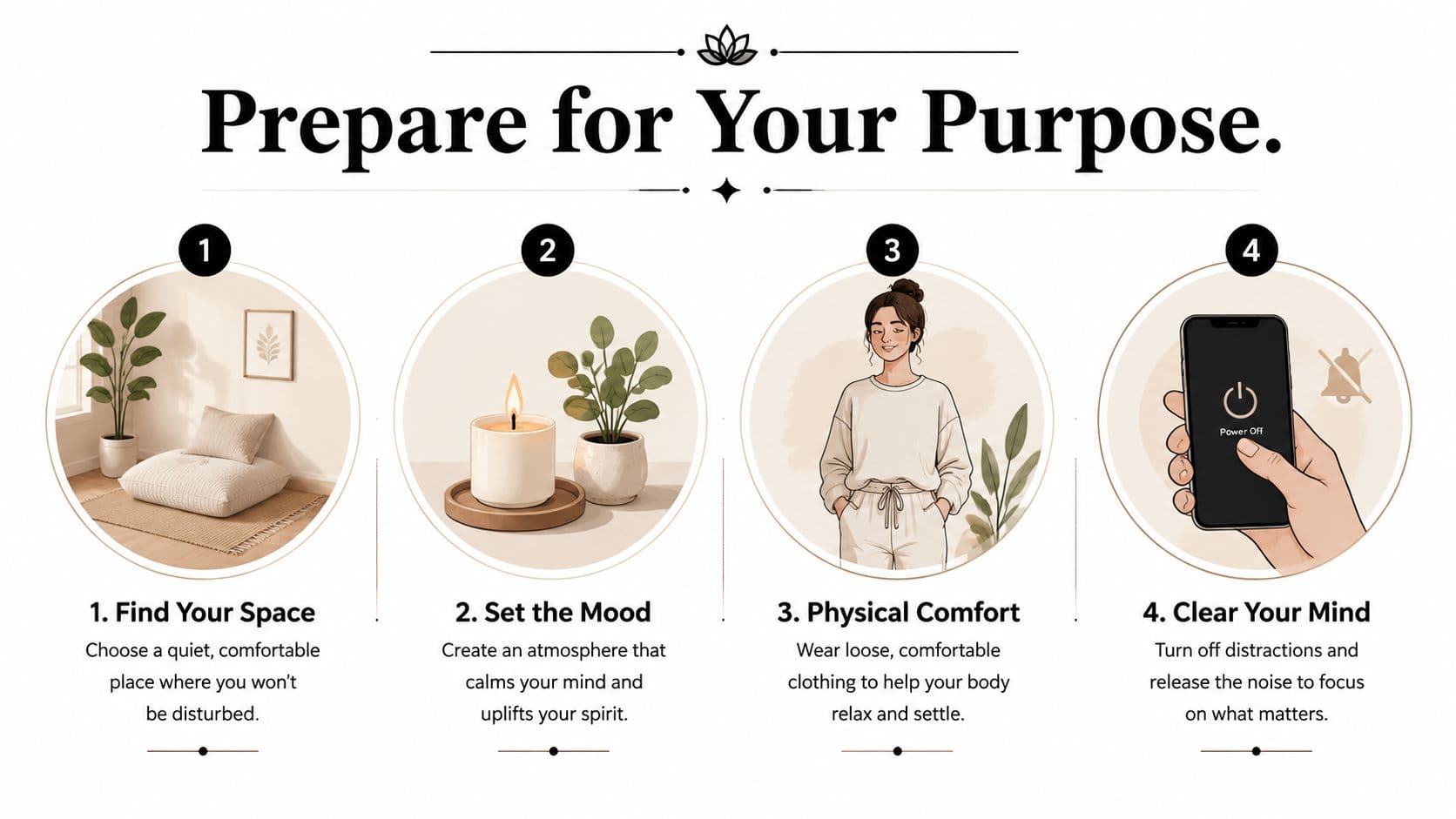
Preparation matters more than many realize. If your body is tense, your phone is buzzing, and your mind is still in task mode, the meditation often turns into another thinking session. The point is to lower the volume of the day before you ask deeper questions.
Creating that calm state isn't just a nice ritual. Research summarized by the National Center for Complementary and Integrative Health notes that an 8-week mindfulness program significantly reduced anxiety symptoms, partly by boosting positive self-statements, and reviews involving over 3,500 adults found mindfulness meditation improved symptoms of depression and supported a more positive outlook (NCCIH on meditation and mindfulness effectiveness and safety).
Set up the room before you sit down
Keep it simple. You don't need a special altar or rare tools. You need a space that tells your nervous system it can stop bracing.
- Choose one spot. A chair, cushion, or corner of the room that you use only for quiet practice if possible.
- Lower sensory friction. Dim the light, soften noise, and put your phone in another room.
- Use sound deliberately. If silence makes your mind louder, low-key non-lyrical audio can help. A practical option is this guide to calm music downloads, which can help you build a steady background without lyrical distraction.
Pick a time that matches your actual capacity
A shorter session done sincerely beats a longer one you resent.
| Experience level | Suggested session length | Best use |
|---|---|---|
| New to meditation | 10 minutes | Settling the body and asking one clear question |
| Some experience | 20 minutes | Reflection, visualization, and journaling right after |
| Established practice | 30 minutes | A fuller inward process with space for silence |
If you're inconsistent, start with the shortest version. Purpose work becomes muddy when people turn it into an endurance test.
Set an intention, not a demand
A common pitfall in many sessions is when people sit down and secretly demand a revelation. That creates pressure, and pressure blocks listening.
Try one of these instead:
- “Show me what I've been ignoring.”
- “Help me see where my energy naturally flows.”
- “Let me notice what feels true, even if it's inconvenient.”
Practical rule: ask open questions. Closed questions force mental answers.
If you want a simple way to settle your breathing before the meditation begins, a three-part breath practice is a useful lead-in.
A Guided Meditation Script to Discover Your Purpose
This practice works best when you read it slowly into a voice memo and play it back, or have someone read it to you with long pauses. Don't rush the silent spaces. Insight often lands after the words stop.

One reason this style of meditation helps is that the body needs to feel safe enough to loosen its grip. In an advanced protocol, the 4-7-8 pranayama method has been reported to reduce cortisol by an average of 23% per session in a meta-analysis of 15 studies, making the body more receptive to intuition and reflection (guided explanation of 4-7-8 use in life purpose meditation).
Begin with the body
Sit comfortably. Let your spine rise without strain. Rest your hands somewhere easy. You don't need to perform stillness. You only need to be here.
Close your eyes if that feels safe. If not, soften your gaze and let the room blur.
Notice the points where your body meets support. Your feet on the floor. Your legs on the chair or cushion. Your hands resting. Your jaw. Your brow. Your shoulders.
Let your next exhale be longer than your inhale. Then again.
Now breathe in for a count of 4. Hold for 7. Exhale for 8.
Inhale 4. Hold 7. Exhale 8.
Continue at your own pace for a few rounds.
With each exhale, let go of the day's outer voices. Other people's plans. Other people's fears. Other people's timelines.
Pause here for a minute or two if you're recording this.
Return to moments when you felt most alive
Purpose leaves traces in your past. Not every meaningful moment was successful in the public sense. Some were quiet. Some were strange. Some made no sense at the time.
Bring to mind a moment from your life when you felt deeply alive. Not necessarily praised. Not necessarily safe. Just alive.
See where you were. Notice the light, the season, the room, the landscape.
What were you doing?
Were you building something, helping someone, teaching, listening, creating, organizing, exploring, repairing, leading, learning, calming, speaking, tending?
Let another moment come. Then another.
Don't analyze yet. Just notice what these moments have in common.
Ask softly, “What quality of being was present in these moments?”
Was it freedom? Devotion? Beauty? Courage? Service? Mastery? Connection? Truth?
Stay here long enough for real memory to replace idealized memory. If your mind brings up moments from childhood, pay attention. Early joy often points to a native orientation before adaptation took over.
Listen to the present
The next part is less romantic and often more useful. You're not only looking for what inspires you. You're listening for what your life is telling you now.
Bring awareness to your body again.
Scan slowly from your forehead to your throat, chest, belly, hips, and legs.
Notice where there is openness. Notice where there is contraction.
Ask, “Where in my current life do I feel spacious?”
Ask, “Where do I feel heavy, numb, resentful, or split?”
Let the answers come as sensations first. Tightness. Warmth. Pulling forward. Sinking back. Expansion. Dullness.
If a relationship, job, creative impulse, or decision comes to mind, don't push it away.
Ask, “What is asking for honesty?”
The tendency is often to drift back into problem-solving. Don't. Stay with the body. A thought can be clever and still be false. The body is often slower, but it usually tells the truth sooner.
If nothing seems to happen, remain still and keep listening. Silence is not failure. Silence is part of the conversation.
Meet the future without forcing it
Future visioning works when you stop treating it like fantasy production. You are not trying to script your whole life. You are sensing the emotional texture of alignment.
Imagine yourself waking up in a life that fits.
You don't need every detail. Let one scene form naturally.
Where are you?
What fills your day?
Who benefits from the way you live?
What do you no longer tolerate in this future life?
What have you stopped apologizing for?
Notice your face in this future. Notice your posture. Notice your breathing.
Ask, “What am I devoted to here?”
Ask, “What fear had to loosen for this life to become possible?”
Let the scene stay simple. If your mind starts designing a perfect identity, come back to the felt sense.
Now bring one hand to your chest or heart area.
Ask one final question. “What is one step I can take in the next few days that honors this truth?”
Wait.
Take the first answer that feels clean and direct.
Close the meditation well
Don't jump up the second you get an insight. Give it a place to land.
Feel your body again. The room. The chair. The air on your skin.
Take one ordinary breath.
Thank yourself for showing up honestly, even if the answers are partial.
When you're ready, open your eyes.
Keep the silence for another minute before you speak, check your phone, or move into the next task.
Some sessions bring clarity. Others clear debris. Both are useful.
Journaling Prompts to Capture Your Insights
The minutes right after meditation are unusually valuable. That's when subtle impressions are still close to the surface. If you wait until later, the mind tends to rewrite the experience into something cleaner, flatter, and more socially acceptable.
Write before you interpret. Don't worry about complete sentences. Fragments are often better because they preserve the original feeling.

Start with raw capture
For the first few minutes, collect without editing.
- List the images that appeared, even if they seem random.
- Name the feelings that were strongest in the meditation.
- Write any repeated words or phrases that came to mind.
- Note body signals such as warmth, tightness, lightness, or resistance.
Write what happened, not what you think should have happened.
Then move into meaning
Once the raw material is on paper, use prompts that pull out themes instead of forcing conclusions.
- Which past moments made me feel most alive, and what were their shared qualities?
- What activity, role, or environment from the meditation is missing from my current life?
- Where did my body feel open, and what does that part of my life have in common?
- Where did I feel contraction or heaviness, and what truth might that discomfort be protecting?
- If the future version of my life had a single emotional tone, what word names it best?
- What fear showed up when I imagined living more fully in alignment?
- What tiny action would make my current life more honest this week?
Look for themes, not declarations
A lot of people make the same mistake here. They get one strong meditation and immediately try to convert it into a grand identity statement. That's usually premature.
Instead, review your notes and mark recurring threads:
| What to notice | What it might signal |
|---|---|
| Repeated memories of helping, teaching, or guiding | A pull toward contribution and shared wisdom |
| Images of solitude, nature, or spaciousness | A need for simplicity, recovery, or contemplative work |
| Strong body tension around specific commitments | A likely area of misalignment that needs honest review |
| Future scenes with calm rather than excitement | Purpose rooted in steadiness, not constant stimulation |
If you want more prompts for this kind of reflective writing, this collection of self-discovery prompts is a good next step. Use it after the meditation, not before. Reflection works better when it grows out of direct experience.
Connect Your Insights to Your Unique Life Path
Meditation gives you lived data. It shows you symbols, desires, resistances, and recurring emotional truths. The challenge is that many people stop there. They have a meaningful experience, but no structure for testing it.
That's one reason generic life purpose content often disappoints. A cited trend claim tied to this topic says 68% of meditators desire personalized purpose tools, and the same discussion points to a major gap in generic meditations that never connect insight to a framework. Dan Millman's The Life You Were Born to Live addresses that gap through 45 distinct life paths based on birth date, giving people a more individualized way to explore gifts, challenges, and direction.
Use meditation as discovery, not final proof
Meditation is excellent for surfacing material. It is not always excellent at interpreting that material on its own.
For example, a session may bring up repeated images of speaking, mentoring, or explaining difficult things clearly. Another person may repeatedly see conflict, boundaries, and the need to stop abandoning their own center. Those are important clues, but clues still need context.
That's where Dan Millman's The Life You Were Born to Live can be useful. The book gives a vocabulary for patterns that otherwise stay vague. Instead of saying, “I keep sensing that I'm supposed to help people somehow,” you can compare your notes against a life-path framework and ask a better question: “Does my path describe a gift for teaching, leadership, service, discipline, creativity, or healing, and what challenge tends to distort that gift?”
A practical way to connect the two
Try this simple process after you journal:
- Pull out three themes from your meditation notes. Examples might be teaching, truth-telling, craft, steadiness, care, or courage.
- Read your relevant sections in Dan Millman's The Life You Were Born to Live and look for resonance, not forced matches.
- Compare gifts and challenges. If your meditation highlights leadership but your pattern shows fear of visibility, hold both as true.
- Check your life path details with a calculator. This can help you orient yourself before going deeper into the book's framework.
A useful framework shouldn't replace intuition. It should sharpen it.
This combination is where life purpose meditation becomes practical. The meditation reveals what your deeper self is trying to say. Dan Millman's The Life You Were Born to Live helps you organize that message into something you can work with over time.
Common Roadblocks and How to Stay on Track
The biggest obstacle usually isn't lack of insight. It's lack of continuity. People have one meaningful session, then disappear from the practice for a week and wonder why the clarity faded.
Structured program data on this topic points to overthinking as a major hurdle, with a 52% dropout rate in some studies. The same source notes that micro-habits such as 2-minute purpose affirmations and app-based support can increase adherence by 2.1 times, helping with the 43% insight fade reported when there's no daily reinforcement (structured-program findings on overthinking, micro-habits, and adherence).
What tends not to work
- Waiting for the perfect mood. If you only meditate when you feel inspired, practice becomes rare.
- Interrogating every session. Not every sit will produce a breakthrough.
- Trying to solve your whole life in one go. That usually turns meditation into rumination.
What works better
- Keep the rhythm modest. Five to ten minutes done consistently beats occasional marathon sessions.
- Use one anchor phrase. Something simple like “show me what's true now” keeps the practice focused.
- End with one action. Send the email. Block out quiet time. Say no. Sign up. Rest. Purpose gets clearer when lived.
If consistency is hard for you, this guide to mastering lasting habit formation is a helpful companion. The best spiritual practice in the world won't help much if it never becomes part of your actual week.
Some days the practice gives you insight. Some days it gives you discipline. Both matter.
If you want a practical bridge between meditation insights and Dan Millman's The Life You Were Born to Live, explore the Life Purpose App. It helps you identify your life path, reflect on your gifts and challenges, and turn vague inner signals into a clearer map for daily life.
Discover Your Life Purpose Today!
Unlock your true potential and find your life’s purpose.
