Some seasons of life feel like a hallway with too many doors and no signs. Life purpose oracle cards can’t hand you a final answer, but they can slow you down long enough to notice what’s calling. This practical guide shows how to prepare, pull, and interpret purpose-focused cards, use simple spreads, and pair moments of insight with Dan Millman’s Life Path framework.

May 17, 2026 (5mo ago) — last updated September 3, 2026 (1mo ago)
Life Purpose Oracle Cards: A Practical Guide
Use life purpose oracle cards for self-discovery. Learn spreads, ethical reading, preparation, and how to pair cards with Dan Millman’s life path system.
← Back to blog
Some seasons of life feel like a hallway with too many doors and no signs. Life purpose oracle cards can’t hand you a final answer, but they can slow you down long enough to notice what’s calling. This practical guide shows how to prepare, pull, and interpret purpose-focused cards, use simple spreads, and pair moments of insight with Dan Millman’s Life Path framework.
Title: How to Use Life Purpose Oracle Cards
Summary: Discover how life purpose oracle cards aid self-discovery. Learn spreads, ethics, and integration with Dan Millman's life path system.
Introduction: Discover how life purpose oracle cards aid self-discovery. Learn spreads, ethics, and integration with Dan Millman's life path system.
Tags: life purpose oracle cards, oracle cards, dan millman, life purpose, self discovery
Content:
Some seasons of life feel like a hallway with too many doors and no signs. You might be doing everything “right” on paper — working, caring for people, keeping up — and still carry a quiet question underneath it all: What am I meant to do with my life?
I’ve sat with that question myself, and I’ve sat with many people asking it in softer or sharper forms. Some say, “I’m bored and I don’t know why.” Others say, “I have gifts, but I can’t tell where to place them.” That’s often the moment when life purpose oracle cards become helpful. Not because they hand down a perfect answer from the sky, but because they slow you down enough to hear your own deeper knowing.
Feeling lost is a starting point, not a destination
A woman once told me she had three notebooks full of plans and still felt stuck. She had ideas for creative work, healing work, and teaching, but every path seemed to cancel the others out. What she needed wasn’t more pressure. She needed a way to listen inward without spiraling.
That’s the actual value of life purpose oracle cards. They can open an inner conversation when your mind keeps looping. They don’t replace discernment, effort, or honest self-examination. They give your intuition something to respond to.

When you feel lost, the first task isn’t to force a final answer. It’s to create enough calm to notice what keeps calling you. If you want a gentle companion for that stage, guidance like this can meet people where they are instead of pretending uncertainty is a failure.
Why confusion often comes before clarity
Many readers think feeling lost means they’ve missed their purpose. I don’t see it that way. I see it as a threshold.
A few signs you may be at that threshold:
- You’ve outgrown an old identity and your usual goals no longer feel alive.
- You keep circling the same themes like healing, writing, service, leadership, or creativity.
- You want confirmation that the longing you feel is worth trusting.
“Feeling lost can be a form of listening. Something in you is asking for a truer direction.”
If you’re supporting a younger person through that same kind of questioning, That’s Okay’s guide to child self-discovery is a thoughtful resource. The language is grounded and kind, which matters when someone is still forming a sense of self.
What exactly are Life Purpose Oracle Cards
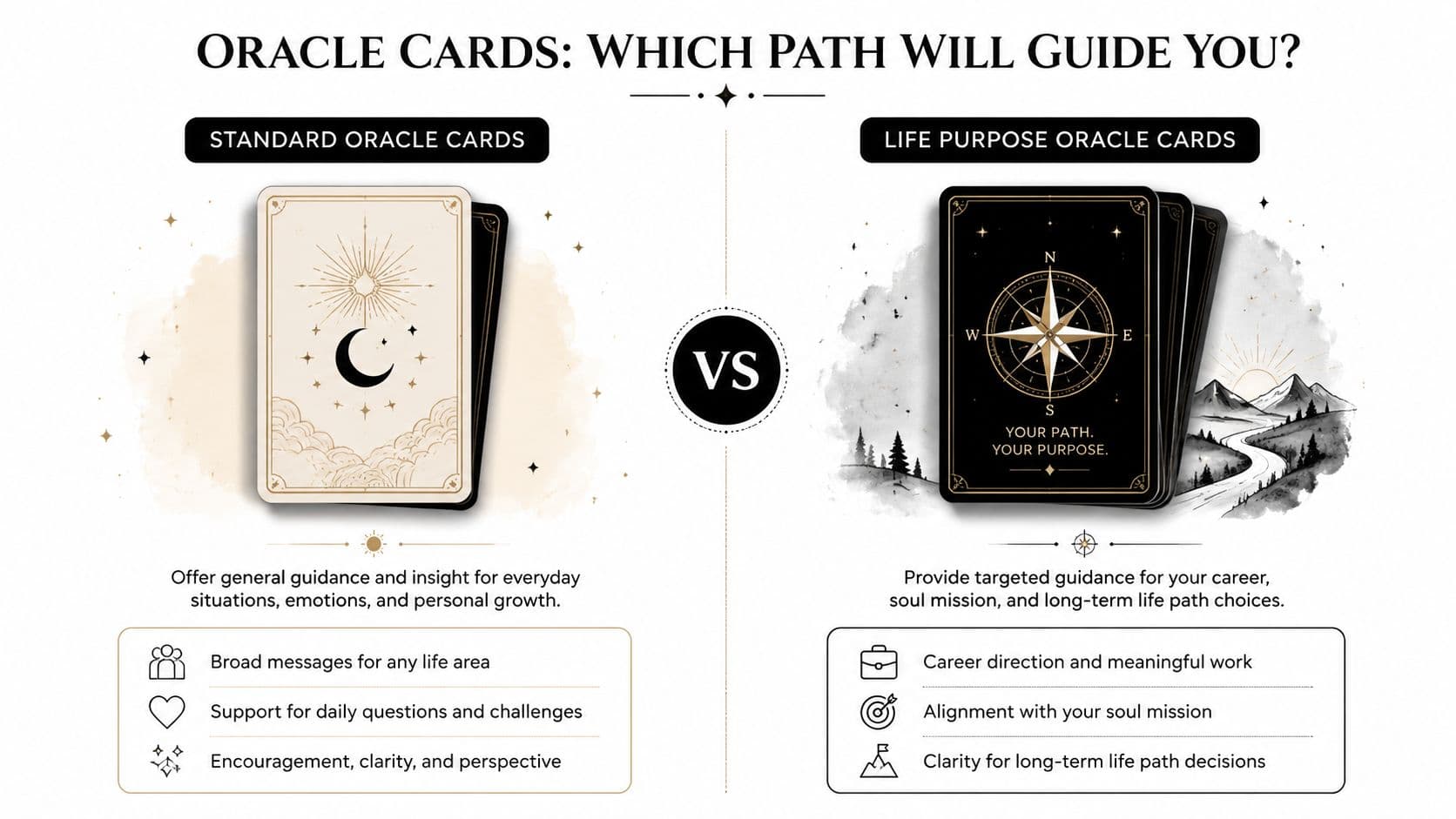
Not all oracle decks are the same. Life Purpose Oracle Cards are a specific deck, created as a 44-card set by Doreen Virtue and published with a guidebook, with a reading focus on life purpose, career, and spiritual direction1. For beginners, that specificity helps. You’re not reaching for a deck meant for broad symbolism and then trying to squeeze a career question out of it. You’re using a tool built for that lane.
Why this deck feels easier than tarot for many people
People often get confused by this. They hear “cards” and assume oracle and tarot work the same way. They don’t.
The Life Purpose Oracle Cards deck prints direct messages such as “Healer” or “Writing,” which makes first-pass interpretation much more straightforward than image-only symbolic systems2.
I often explain it this way:
- Tarot is like a novel. It has a larger symbolic structure, more layers, and a longer learning curve.
- Life purpose oracle cards are more like a book of direct prompts or short poems. They meet you quickly.
That directness matters when you’re emotionally tired or at a decision point. You don’t always need a deep symbolic maze. Sometimes you need a clear phrase that your body immediately recognizes.
Oracle cards versus tarot at a glance
| Aspect | Oracle Cards | Tarot Cards |
|---|---|---|
| Structure | Flexible, deck-specific | More standardized system |
| Reading style | Direct, intuitive prompts | Symbolic, layered interpretation |
| Best for beginners | Often easier to start with | Can take longer to learn |
| Focus | Depends on the deck’s theme | Broad life themes and archetypes |
| Life purpose questions | Strong fit when the deck is purpose-focused | Useful, but often less direct |
“Practical rule: If you want reflection with less decoding, start with a purpose-specific oracle deck.”
What makes this deck distinct
The broader oracle-card world treats these tools as supports for intuition, self-reflection, and validation rather than rigid divination. Oracle decks are often used on their own or alongside tarot, and many readers sort cards into topic-based piles to focus a session2. That shows how modular they can be in personal guidance work.
This deck isn’t asking you to surrender your judgment. It’s inviting you to engage a themed reflection system with a clear purpose.
Preparing yourself and your cards for a reading
People often focus on pulling cards and skip the quieter part that makes the reading usable. Preparation doesn’t have to be dramatic. It just needs to be sincere.
If your mind is racing, your reading usually reflects that scattered state. If your question is muddy, the message often feels muddy too. A little setup changes a lot.
Start with your state, not the deck
Before you touch the cards, pause. Sit down. Breathe normally. Let your shoulders drop.
You don’t need to become perfectly peaceful. You only need to become present enough to notice what you’re asking.
If stress is sitting heavily in your body, simple sensory supports can help. Some people like breathwork, some like a candle, and some like scent. Research on meditation and focused attention shows measurable benefits for decision making and reduced cognitive bias, which supports using short centering practices before a reading4.
A simple preparation ritual
Try this sequence before your reading:
- Clear the space
Open a window, tidy the table, or place your deck somewhere clean and undisturbed.
- Settle your nervous system
A short centering practice can help you arrive. If you want a guided option, a meditation or breathing track can be a supportive way to shift from mental noise to inner attention5.
- Clear the deck with intention
Some people use sound, moonlight, prayer, or their own breath. The method matters less than the intention. You’re marking a transition from ordinary activity to focused reflection.
- Ask one clean question
Good questions invite insight. Poor questions corner the cards into giving certainty they aren’t built to give.
Here are stronger question styles:
-
Open and reflective
“What am I being asked to develop in my work right now?” -
Grounded in action
“What quality would help me move forward with integrity?” -
Too narrow to be useful
“Will I get exactly this job by this date?”
A reading begins before the first card appears. It begins when you decide to become honest.
A simple workflow for drawing your first cards
You sit down with your deck, ask a sincere question, and then wonder, “Am I supposed to do this in a special way?” That uncertainty is common. A first reading goes better when you follow a simple sequence, the way you would follow a recipe the first time you cook a new dish.
The goal is not to predict your whole future in one spread. The goal is to create a clear moment of contact between the card, your inner response, and the larger pattern of your life purpose. This is also where a two-layer approach becomes helpful. The cards show the living energy of the moment. Dan Millman’s Life Path framework gives that moment a stable structure, so the reading does not float away into vague inspiration3.
Your first one-card pull
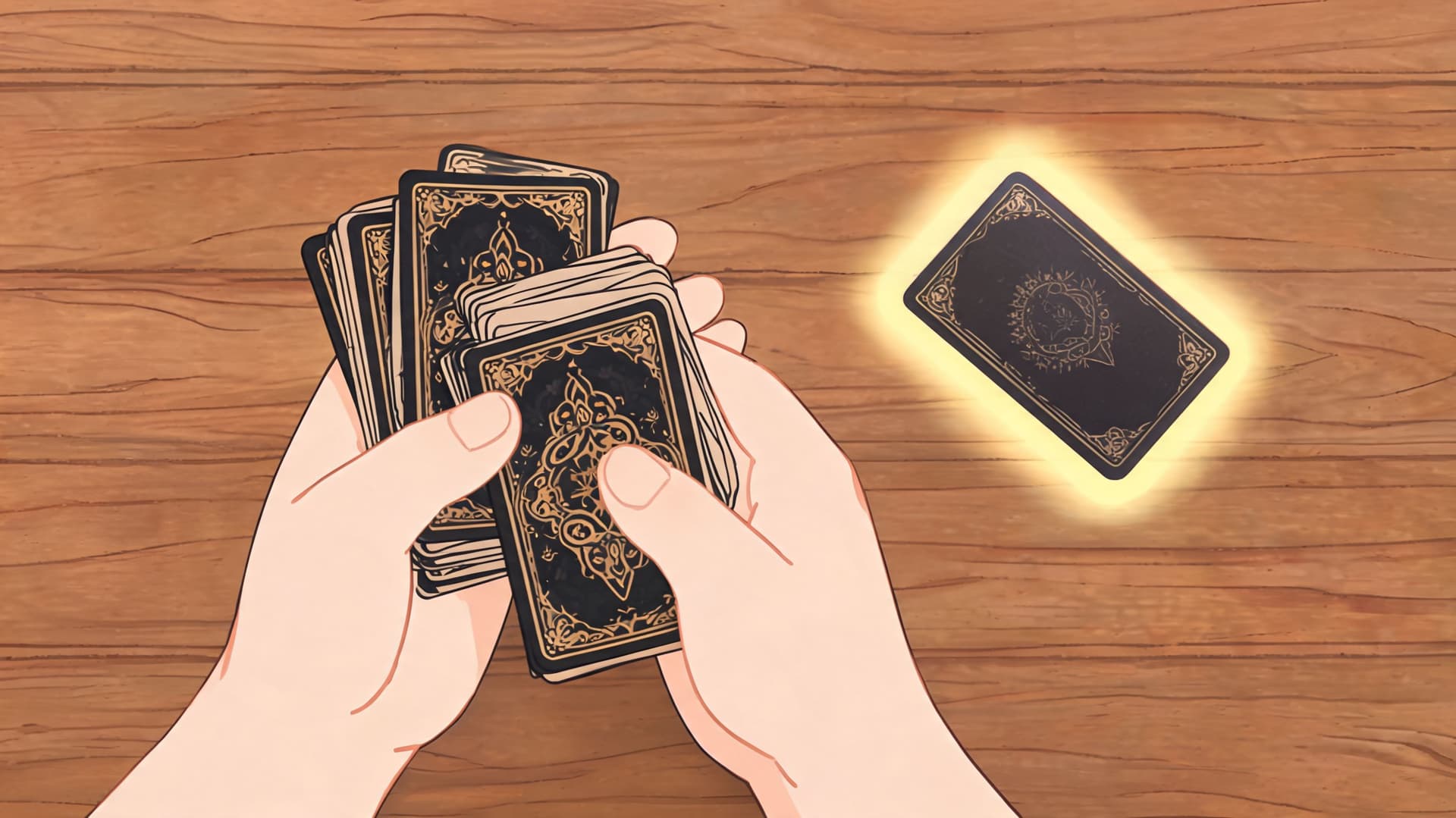
Start with one card if you feel tender, scattered, or skeptical. One card is often enough.
Use this sequence:
- Hold the deck and repeat your question in your mind.
- Shuffle until your body feels settled enough to stop.
- Draw one card from the top or the place your hand naturally reaches.
- Read the card title first.
- Pause before reaching for a grand meaning.
- Ask, “How does this show up in my real life right now?”
If the card says Writing, do not rush into a dramatic conclusion. A life purpose message usually works more like a seed than a command. It may point to journaling, honest communication, teaching, storytelling, or saying the thing you have been swallowing for months.
If you know your Life Path number from Dan Millman’s system or the Life Purpose App, add one more question: “How does this card support the main lessons of my path?” That question helps you connect intuition with a practical self-discovery map.
A beginner-friendly three-card spread
After a few one-card pulls, a three-card spread gives your reading shape. It works like arranging scattered thoughts into three labeled boxes so your mind can work with them.
You can use this simple layout:
| Card position | Meaning |
|---|---|
| Card 1 | What is active in me now |
| Card 2 | What helps me respond wisely |
| Card 3 | What grows if I practice that guidance |
This format keeps the reading participatory. The third card is not a fixed promise. It shows the likely direction that develops if you live the guidance of the second card.
A lot of beginners get confused here. They assume the cards are deciding for them. In practice, oracle cards are better at reflecting and clarifying than controlling outcomes. For a practical overview of simple oracle spread structure, see this guide on reading oracle cards2.
How to interpret without overcomplicating it
Interpretation gets easier when you read in layers.
-
Card meaning
What does the word or image suggest on its face? -
Inner reaction
What feeling, memory, resistance, or relief appears in you? -
Real-world step
What conversation, habit, boundary, or practice does this point toward?
That third layer matters because life purpose is not only a mystical idea. It is also expressed through behavior. A card about service may mean volunteering, listening better, or bringing more care into your current work. A card about leadership may mean taking responsibility for one overdue decision.
If the message feels unclear, write the card down and let it breathe for a day or two. Some readings land instantly. Others make sense only after you notice how they echo your Life Path themes, your repeated patterns, and the choices in front of you.
Sample spreads for deeper life purpose insight
Once you’ve done a few simple pulls, spreads become useful because they organize your thinking. A spread is really just a set of positions with a purpose. It helps you stop asking one giant, tangled question and start listening in smaller, clearer pieces.
The crossroads spread
Use this when you feel split between paths.
Lay out three cards in a row.
| Position | Ask this |
|---|---|
| Card 1 | What path am I currently walking? |
| Card 2 | What am I not seeing clearly? |
| Card 3 | What guidance helps me choose well? |
This spread works because it doesn’t demand a yes-or-no verdict. It reveals the energy underneath your indecision.
If Card 1 suggests comfort and Card 2 suggests fear, Card 3 may point toward courage, expression, or trust. The reading becomes less about “Which option wins?” and more about “Who do I need to become to choose cleanly?”
The gifts and blockages spread
This is one I return to often when someone feels called but stalled.
Place the cards in a triangle.
-
Top card
A core gift ready to be used -
Bottom left
A blockage, habit, or fear to release -
Bottom right
One integrating action
This spread is practical because it pairs inspiration with responsibility. If you draw a gift like teaching or healing, the second card keeps you from turning that into fantasy. It asks what must be faced so the gift can move into life.
“Some of the most helpful readings aren’t flattering. They’re clarifying.”
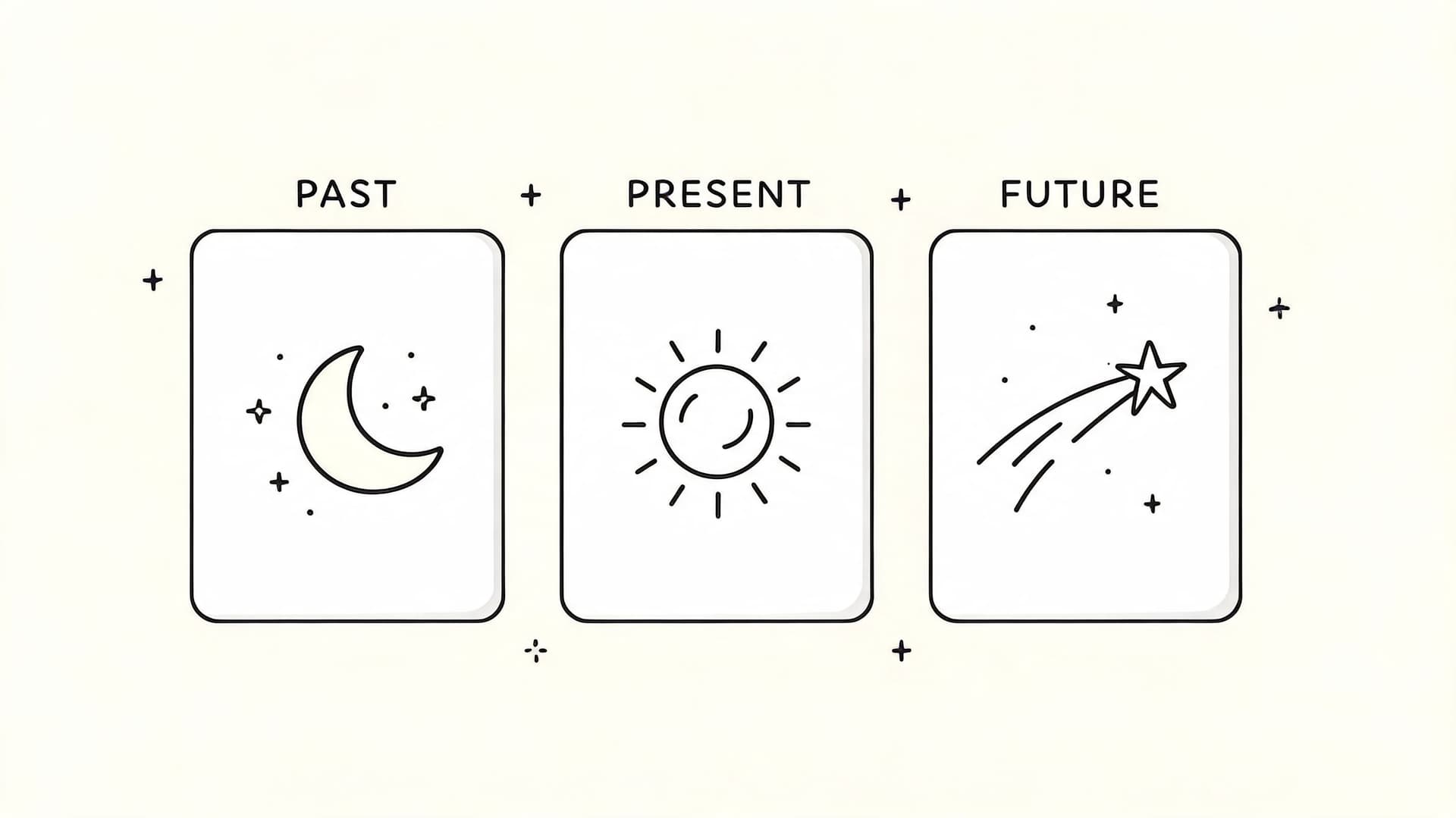
The past, present, future reflection
This spread is familiar for a reason. It’s simple, and it helps you see movement.
Arrange three cards from left to right:
-
Past
What has shaped the current issue -
Present
What the lesson is right now -
Future
Where this may lead if you follow the guidance
I like this spread when someone says, “I don’t know why this keeps repeating.” The first card often names the pattern. The second names the lesson. The third shows the direction that becomes available when the lesson is lived rather than merely understood.
You don’t need many spreads. You need a few trustworthy ones that help you tell the truth.
Connecting cards with your Life Path number
With oracle cards, intuitive reading becomes especially rich. Oracle cards can show what’s alive in the moment. Dan Millman’s book The Life You Were Born to Live offers a wider map of your lifelong curriculum, and the Life Purpose App helps people work with that same system in everyday life3.
When I speak about life path numbers, I’m referring to Dan Millman’s framework from The Life You Were Born to Live. In that system, your birth date points to one of 45 unique life paths, each with its own themes, gifts, and challenges3.
Two layers of guidance work better than one
An oracle reading can answer, “What’s asking for my attention right now?”
Dan Millman’s system asks a different question: “What larger lesson keeps shaping my life?”
Those are not competing tools. They complement each other.
If you haven’t worked with this framework before, learn how your number is derived, then return to your card reading with that larger context in mind.
A practical way to combine them
Here’s how I use the two together in a grounded way:
- Reflect on the themes of your life path as described in The Life You Were Born to Live.
- Draw a card around a current decision, tension, or opportunity.
- Ask how the card may be highlighting one part of that broader curriculum.
For example, someone may already know from Millman’s work that their path involves lessons around expression, responsibility, or leadership. If they then pull a direct card such as Teaching or Writing, the card acts like a spotlight. It says, “Pay attention here. This is not abstract. This is active now.”
That’s the power of the two-layered approach. The life path offers enduring structure. The card offers timing and texture.
Where readers get mixed up
Some people treat a life path number as a fixed identity and the card as a magical override. I don’t recommend that. Neither tool is there to trap you in a label.
Use both as mirrors:
- The life path reflects recurring themes in your soul’s curriculum.
- The card reflects the doorway that may be opening today.
When the two line up, the message often feels unmistakable. When they don’t, that’s not failure. It may mean you’re looking at a lesson from a different angle than you expected.
Reading ethically and trusting your inner wisdom
You pull a card when you feel uncertain, and for a moment it is tempting to let the message decide everything for you. I understand that impulse. When life feels foggy, any clear sentence can sound like a command. Life purpose oracle cards serve you best when you treat them as a reflective tool, not as a substitute for your own judgment.
The intended use of the deck is to support self-reflection around career and spiritual path through positive messages. Its value lies in prompting introspection rather than predicting concrete outcomes1. That distinction gives you a healthy boundary.
What these cards can do well
A good reading can bring quiet clarity. It can name something you already sense but have not yet said aloud. In my own practice, that is often the true gift of the cards. They bring the half-formed truth into focus.
They can help you:
- Name an inner truth you’ve been brushing aside.
- Spot a recurring theme in work, service, creativity, or calling.
- Journal with focus instead of staring at a blank page.
- Pause before acting and choose with more awareness.
They are especially useful as reflection prompts. A skeptical reader can still benefit from them in that way. The cards work a bit like a symbol-rich mirror. They reflect your attention back to you, and your response to the image or message often reveals as much as the card itself.
This is also where the two-layered approach helps. If a card highlights service, leadership, expression, or responsibility, you can compare that message with the structured themes you have already seen in Dan Millman’s The Life You Were Born to Live or the Life Purpose App. The card brings the immediate question. The life path system brings the larger map. Together, they make it easier to tell the difference between a passing mood and a lesson that keeps returning.
What they should not be asked to do
The cards should never become the final authority in your life.
Do not use them to replace practical judgment, therapy, medical care, legal advice, or honest conversation with the people involved. Do not keep drawing new cards until you get the answer you wanted the first time, either. That usually creates more anxiety, not more wisdom.
“Ultimately, your inner wisdom is the guide. The cards are a conversation partner.”
Ethical reading also means staying humble about what a message can and cannot say. If you read for someone else, avoid dramatic predictions, fear-based statements, or claims that trap them in a fixed identity. A healthy reading leaves a person with more room to reflect, choose, and act responsibly.
If a reading feels unsettling, write it down and give it some space. Real life often clarifies what symbolism cannot explain in one sitting. The healthiest readers I know are not the ones who pull cards most often. They are the ones who listen carefully, test insight against lived experience, and let intuition and structure work together.
Frequently asked questions
Q: How do I start if I’m skeptical?
A: Begin with one card and a simple question. Treat the card as a prompt for journaling or a short experiment, not a verdict.
Q: How often should I read?
A: Use the cards when you need clarity, not as a daily crutch. Weekly or situational readings usually offer balance.
Q: Can I combine these cards with tarot or other systems?
A: Yes. Many readers use oracle cards for quick prompts and tarot for deeper symbolic work. You can also integrate your Life Path number from Dan Millman’s system for longer-term context3.
1.
Product and deck details: Life Purpose Oracle Cards are described as a 44-card deck by Doreen Virtue. See product overview and guidebook information. https://www.amazon.com/Life-Purpose-Oracle-Cards-Doreen-Virtue/dp/0738706468
2.
Overview of oracle card practice and differences from tarot. See a practical guide to reading oracle cards. https://www.biddytarot.com/oracle-cards/
3.
Dan Millman’s Life Path framework and resources, including The Life You Were Born to Live and the Life Purpose App. https://www.danmillman.com/
4.
Research on meditation and decision making: Hafenbrack, J., Kinias, Z., & Barsade, S. (2014). Debiasing the mind through meditation: mindfulness reduces the sunk-cost bias. Psychological Science. https://journals.sagepub.com/doi/10.1177/0956797614524587
5.
Meditation and mindfulness resources and prevalence: National Center for Complementary and Integrative Health overview. https://www.nccih.nih.gov/health/meditation/overview
Discover your life path today
Enter your date of birth and see your life path, free.
Find your life path