Some days the search for purpose isn’t dramatic. This guided meditation and journaling toolkit helps you quiet the noise, notice what’s true now, and identify one practical next step.

May 15, 2026 (5mo ago) — last updated August 20, 2026 (2mo ago)
Life Purpose Meditation for Clarity & Direction
Use this guided meditation script and journaling prompts to connect with inner wisdom, clarify your life purpose, and choose one next step.
← Back to blog
Some days the search for purpose isn’t dramatic. This guided meditation and journaling toolkit helps you quiet the noise, notice what’s true now, and identify one practical next step.
Life Purpose Meditation for Clarity & Direction
Use this complete life purpose guided meditation script and journaling prompts to connect with your inner wisdom and find your unique direction.
Introduction
Some days the search for purpose isn’t dramatic. It looks like opening your laptop, closing it again, answering everyone else’s messages, and realizing you haven’t heard your own inner voice all day. You may be functioning well on the outside and still feel subtly off course. This guided meditation and accompanying journaling prompts help you quiet the noise, notice what’s true now, and identify one practical next step.

Finding your north star in a noisy world
Many people try to think their way into clarity. They make lists, read books, and ask friends for advice, but keep circling the same questions: What am I here to do? What fits me now? What am I ignoring?
Meditation changes the method. Instead of pushing harder, you listen better. Purpose rarely speaks over noise; it often arrives as a quieter signal—a felt sense, a repeated image, or a sentence that lands in the body before it lands in the intellect.
Why this search is more normal than you think
The urge to use meditation for meaning isn’t fringe. In a large U.S. health survey, spiritual meditation was practiced by about 3.7% of adults, showing that people turn to meditation for orientation and reflection as well as stress relief1. For many, the problem isn’t sincerity but overload; modern life produces constant input, and purpose usually becomes clear in pieces—first a direction, then a next step, then a wider pattern.
Practical rule: Purpose usually becomes clear in pieces. First a direction, then a next step, then a wider pattern.
Meditation for direction, not escape
A purpose meditation rarely hands you a grand revelation on command. What often emerges first is simpler and more useful: what drains you, a talent you’ve neglected, or a bodily response to a particular path. That’s real information. This work isn’t about leaving life behind; it’s about returning to life with better alignment.
Preparing your space and setting a single intention
Setup matters. A settled space helps the nervous system stop bracing so your attention can deepen. It doesn’t need to look sacred—just calm enough that you can be present. That might be a chair by a window, a cushion beside your bed, or the front seat of your parked car.

Build a container that supports attention
Beginners usually do better with guidance than with open silence. One comparison of guided and self-guided practice found higher adherence and fewer mind-wandering episodes among those who used guided sessions2. Practical setup suggestions:
- Silence digital pull: Put your phone on airplane mode or silence notifications.
- Choose a sustainable posture: Sit upright enough to stay awake, but relaxed enough to avoid tension.
- Lower the gaze or close the eyes.
- Use breath to arrive: A short breath practice (for example, three-part breath) can settle the body.
Set one clear intention
Enter the meditation with a single clean question. Not a full autobiography, but one focused intention, such as:
- Clarity: What wants my attention now?
- Discernment: Which direction feels alive, and which one only looks good on paper?
- Alignment: What is my next right action?
- Timing: What am I trying to force before it’s ready?
A clear intention gives the meditation somewhere to go without forcing the answer.
If you want a fuller reset, changing your environment can help. You don’t need perfect conditions though; a quiet corner and a sincere question are enough.
Guided meditation script to uncover your purpose
Use this script as written, read it aloud slowly, or record it in your own voice. Keep the pace unhurried. If you’re guiding someone else, leave more silence than feels natural—insight often arrives in the pauses.
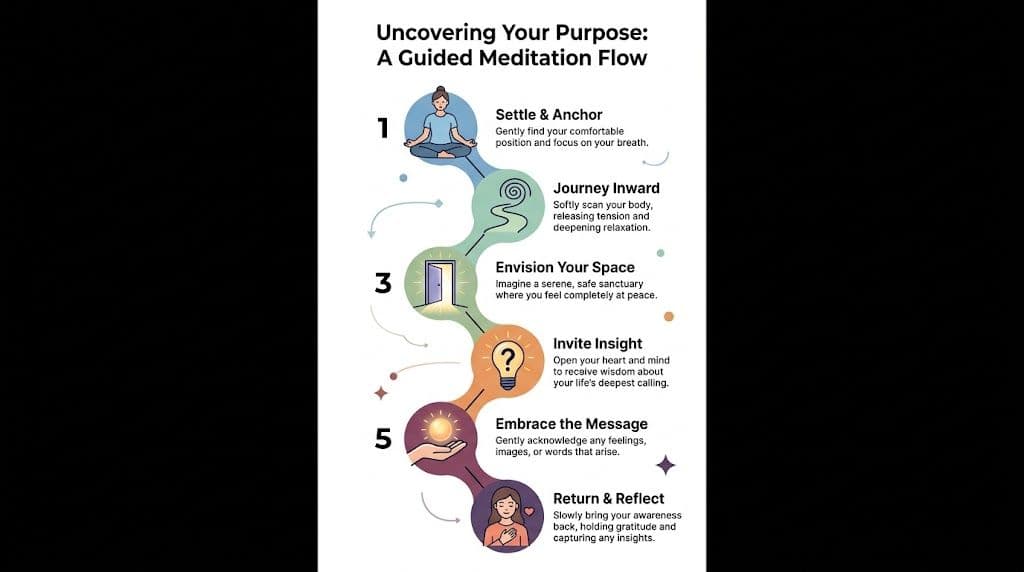
Before you begin
Choose one intention and say it inwardly. If you’re new to mindfulness, review a few beginner methods so you’re not second-guessing basics while you meditate. See /how-to-meditate for foundational practices.
The script
[SETTLE]
Take your seat. Let your hands rest where they can soften. Allow the spine to rise naturally. Let the jaw unclench. Relax the tongue. Loosen the muscles around the eyes.
[PAUSE]
Feel the contact points beneath you—the chair, the cushion, the floor. Let your body register that you are supported.
[BREATH]
Take a slow inhale through the nose. Exhale gently through the mouth. Repeat two more times. On the last exhale, let the body drop a little deeper.
Now allow the breath to return to its natural rhythm. Notice the rise and the fall. If the mind wanders, come back to the next breath without judgment.
[PAUSE]
Soften the body
Bring attention to the forehead; smooth it. Let the eyes rest back. Soften the cheeks. Unclench the jaw. Relax the throat. Let the shoulders drop away from the ears. Soften the arms, the hands, the chest, the belly. Relax the hips, thighs, knees, calves, and feet. Sense your whole body breathing—present, not perfect.
If you’re trying too hard to have an insight, return to the body. Pressure blocks the very thing you’re asking to receive.
Move from mental noise to inner listening
Bring attention to the center of the chest. Imagine a warm, steady light there. With each inhale, let that light grow a little clearer. With each exhale, let outer noise move farther away. Say to yourself:
“I am willing to listen. I am willing to see clearly. I do not need the whole path today. I only need to recognize what is true now.”
Enter your inner sanctuary
Imagine yourself at the entrance to a place that feels profoundly peaceful: a garden, a shoreline, a quiet room, or a forest path. Notice the light, temperature, colors, and sense of safety. Walk slowly into this space and sit where you feel held.
Invite the deeper question
Bring your intention into awareness and ask, slowly and sincerely:
- What is life asking of me now?
- What part of my purpose is ready to be lived?
- What gift wants expression through me?
- What am I being asked to release so I can move forward with sincerity?
Ask only one question if that feels cleaner. Don’t demand words. Purpose may appear as an image, a bodily sensation, a memory, a color, or a plain next step. If nothing comes, ask instead: What do I already know that I’ve been avoiding?
Receive without editing
If a word appears, let it be enough. If a memory surfaces, notice why it matters. If emotion moves through you, allow it without rushing to interpret. Repeat inwardly:
“I welcome insight in the form it comes. I don’t need to compare my path. I trust what rings true. I can take one faithful step.”
Notice whether your body leans toward any image or direction. The body often responds before the analytical mind agrees. You may sense a call toward service, building, healing, teaching, creating, repairing, leading, learning, or simplifying. Don’t turn insight into a plan yet; just notice the tone.
Ask for one next step
Bring the insight into daily life by asking: What is one action that would honor this message? Let the answer be small enough to do—one conversation, one page, one boundary, or one hour set aside. See yourself taking that step in ordinary life and notice how it feels to act in alignment.
Quiet test: A true next step usually feels clear and steady. It may still be uncomfortable, but it won’t feel inflated or theatrical.
Return slowly
Thank your inner sanctuary and whatever wisdom arose. Begin to feel the body: notice the breath, the weight of your hands, the surface beneath you. Take a deeper inhale, exhale fully, and gently wiggle fingers and toes. Open your eyes slowly and sit for a moment before moving on.
Why this script works
This structure anchors attention, settles the body, creates safety, and then invites reflection. That order matters; people struggle when they try to solve purpose from a busy, defended state. The script also asks for one next step instead of a total life map, keeping the practice honest and practical.
Personalize your journey with your unique life path
A universal meditation can open the door. Personalization helps you recognize what you find once you’re inside. Dan Millman’s The Life You Were Born to Live offers a framework for seeing recurring themes within your life path. It doesn’t replace meditation; it gives your reflection a language and context.
Why generic guidance often falls flat
Many meditation experiences stay broad. They offer soothing language but don’t help a person distinguish between their own core lessons and someone else’s ideals. That matters because many generic meditation offerings see high user drop-off when they lack personalization3. When practice stays generic, people often leave with a pleasant feeling but no usable self-understanding.
How to tailor the meditation
Use your life path from Millman’s system to refine the inquiry. If you use the Life Purpose App, bring that language into the meditation and ask more precise questions:
- Leadership: “Where am I being called to lead more cleanly, without control or performance?”
- Emotional openness: “What truth have I understood mentally but not yet allowed myself to feel?”
- Creativity: “What wants to be made, shared, or spoken through me now?”
- Service: “Where am I helping from alignment, and where am I helping from obligation?”
A personalized meditation doesn’t tell you who to become. It helps you recognize the lessons you’re already living.
Capturing wisdom after the meditation
The meditation itself is only half the practice. The other half begins in the first few minutes after you open your eyes. If you stand up too fast, check your phone, or move straight into chores, subtle material fades. Purpose insights are often delicate at first and need to be named before the world starts talking again.
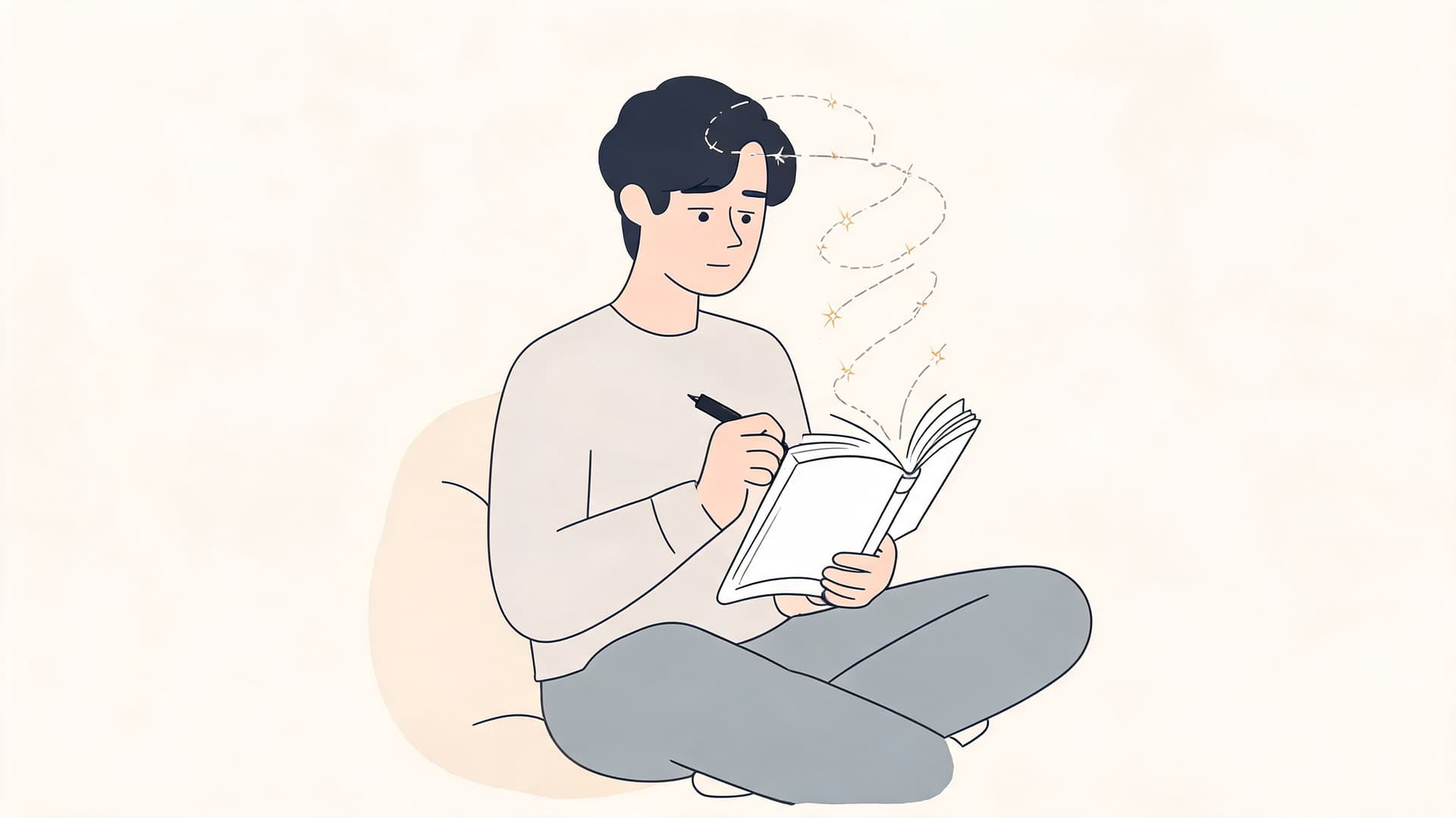
Turn the experience into usable language
Purpose works partly through behavioral activation, so reflection needs to connect to action4. Journaling helps convert a felt experience into a concrete step. A strong post-meditation journal entry doesn’t need to be long; it needs to be honest and specific. See /journaling-prompts for additional formats.
Prompts that reveal more than a summary:
- What stood out first: word, image, body sensation, memory, or emotion?
- What felt alive: which part brought energy, relief, warmth, or recognition?
- What felt resistant: where did I tense up, go blank, or want to skip ahead?
- What repeated: did any symbol, phrase, or theme return more than once?
- What feels true now: not forever, just now.
- What is the next visible action: what can I do within 24 hours that honors the message?
A simple integration format
Use this three-part closing note after each session:
| Focus | What to write |
|---|---|
| Insight | The clearest thing I noticed was... |
| Meaning | I think it matters because... |
| Action | In the next 24 hours, I will... |
That last line is the bridge. Without it, purpose stays inspirational. With it, purpose starts shaping a life.
Weaving purposeful threads into daily life
A life purpose meditation shouldn’t become one more beautiful experience that changes nothing by Tuesday. Its value shows up in choices: the email you send, the project you stop postponing, the conversation you finally have, the obligation you release because it no longer fits. Consistency matters more than intensity. One longitudinal look at meditators highlights that frequency of practice often predicts outcomes more than session length, and that cumulative practice matters for life satisfaction and emotional regulation5.
Make purpose visible in routines
Keep the practice close to daily life:
- Choose a recurring time: morning often works because the mind is less crowded, but any repeatable time is better than an ideal time you never keep.
- Link reflection to action: end each meditation by naming one task, boundary, or conversation that fits what you saw.
- Review patterns over time: purpose often becomes clearer across weeks of notes, not in a single dramatic sitting.
Millman’s nine-year cycles can remind you that not every season asks for the same action. Some periods ask for building, some for healing, and some for patience and deeper honesty. Purpose isn’t only discovered; it’s practiced.
If you want a practical way to explore your life path through Dan Millman’s The Life You Were Born to Live, track themes that keep repeating, and place your insights in the context of broader life cycles, the Life Purpose App offers a structured companion for that ongoing work. See /life-purpose-app for details.
Quick Q&A
Q: How long should I meditate to explore life purpose?
A: Start with 10–20 minutes focused on a single intention. Short, consistent sessions are more effective than occasional marathon sits.
Q: What if nothing appears during the meditation?
A: Don’t panic. Purpose often appears as fragments over time. Return to the body, stay consistent, and journal what subtle impressions you had.
Q: How do I turn insight into action?
A: Ask for one small, specific next step you can complete within 24 hours, then schedule it and treat it as an experiment.
1.
Kessler, Ronald C., et al., “National Health Interview Survey, spiritual meditation prevalence,” https://pmc.ncbi.nlm.nih.gov/articles/PMC5103185/
2.
Comparing self-guided with guided meditation: expert-led practices matter, https://www.martialjournal.com/comparing-self-guided-with-guided-meditation-why-expert-led-practices-matter/
3.
Discussion of life-purpose meditation and personalization, https://insighttimer.com/dominicbeeton/guided-meditations/guided-meditation-for-finding-your-life-purpose
4.
Behavioral activation and purpose in mindfulness, American Meditation Research Association summary, https://meditationresearch.org/
5.
Research on practice frequency and well-being summarized by meditation research organizations, for example see American Meditation Research Association materials, https://meditationresearch.org/
Discover your life path today
Enter your date of birth and see your life path, free.
Find your life path