Discover the core spiritual laws of life and how to apply them. This guide explains universal principles and connects them to your unique life path.
May 11, 2026 (4mo ago) — last updated July 13, 2026 (2mo ago)
Spiritual Laws of Life: Your Guide to Purpose & Clarity
Discover the core spiritual laws of life and how to apply them. This guide explains universal principles and connects them to your unique life path.
← Back to blog
One often starts looking for the spiritual laws of life at a moment when life feels noisy. You keep meeting the same kind of partner. The same money stress returns, even after a raise. You promise yourself you'll respond differently, but somehow the old pattern shows up again.
That kind of repetition can make life feel random. Or personal, in the worst way. As if something is wrong with you.
A gentler possibility is that life isn't random at all. It may be patterned. Not in a rigid, punishing sense, but in the way seasons are patterned. There are principles at work whether we notice them or not. Learning those principles can shift you from feeling pushed around by life to becoming a more conscious participant in it.
From Chaos to Clarity An Introduction to Life's Rules
Many people think of spiritual laws as abstract ideas meant for monasteries, mystics, or people with far more free time than they have. But the spiritual laws of life show up in ordinary places. In a tense family text thread. In the way your body reacts before your mind catches up. In the habits that shape your days.
A helpful way to think about them is this. Physical life has gravity. Inner life has patterns too. You don't need to believe in gravity for it to affect you. In the same spirit, some traditions describe spiritual laws as consistent principles that shape experience whether you're aware of them or not.
Interest in these ideas isn't fringe. A 2024 overview cited by mindbodygreen says 62% of adults in major markets believe in universal spiritual laws governing life outcomes, and 41% reported improved life satisfaction after applying them. That belief was reported to peak at 78% among adults ages 25 to 44.
Why people turn to spiritual laws
Usually, it isn't because they want more theories. It's because they want relief and direction.
- They want patterns to make sense. Why do similar conflicts keep repeating?
- They want better choices. How do you know when to act, wait, forgive, speak up, or leave?
- They want a path that feels personal. Generic advice often sounds nice but doesn't always fit a real life.
Spiritual laws become useful the moment they move from ideas in your head to signals you can notice in your day.
That personal dimension matters. Dan Millman's book The Life You Were Born to Live has helped many readers approach this question through a life-path lens. Instead of asking only what are the universal rules, it asks how do these principles meet my particular gifts, lessons, and timing?
If you're feeling scattered and need a simple way to slow down before diving deeper, SparkPod's curated meditation scripts can help you create a few quiet minutes for reflection. Sometimes clarity starts with a pause, not a breakthrough.
Understanding the Core Spiritual Laws
Different traditions organize these teachings in different ways. Some people work with the 12 Universal Laws. Others resonate with broader systems. Diana Cooper's overview of The 36 Spiritual Laws That Govern All Life presents categories related to life, creation, and higher awareness, which shows how deep and layered this wisdom can be.
Under the surface, a few laws appear again and again because they help explain daily experience in plain terms.
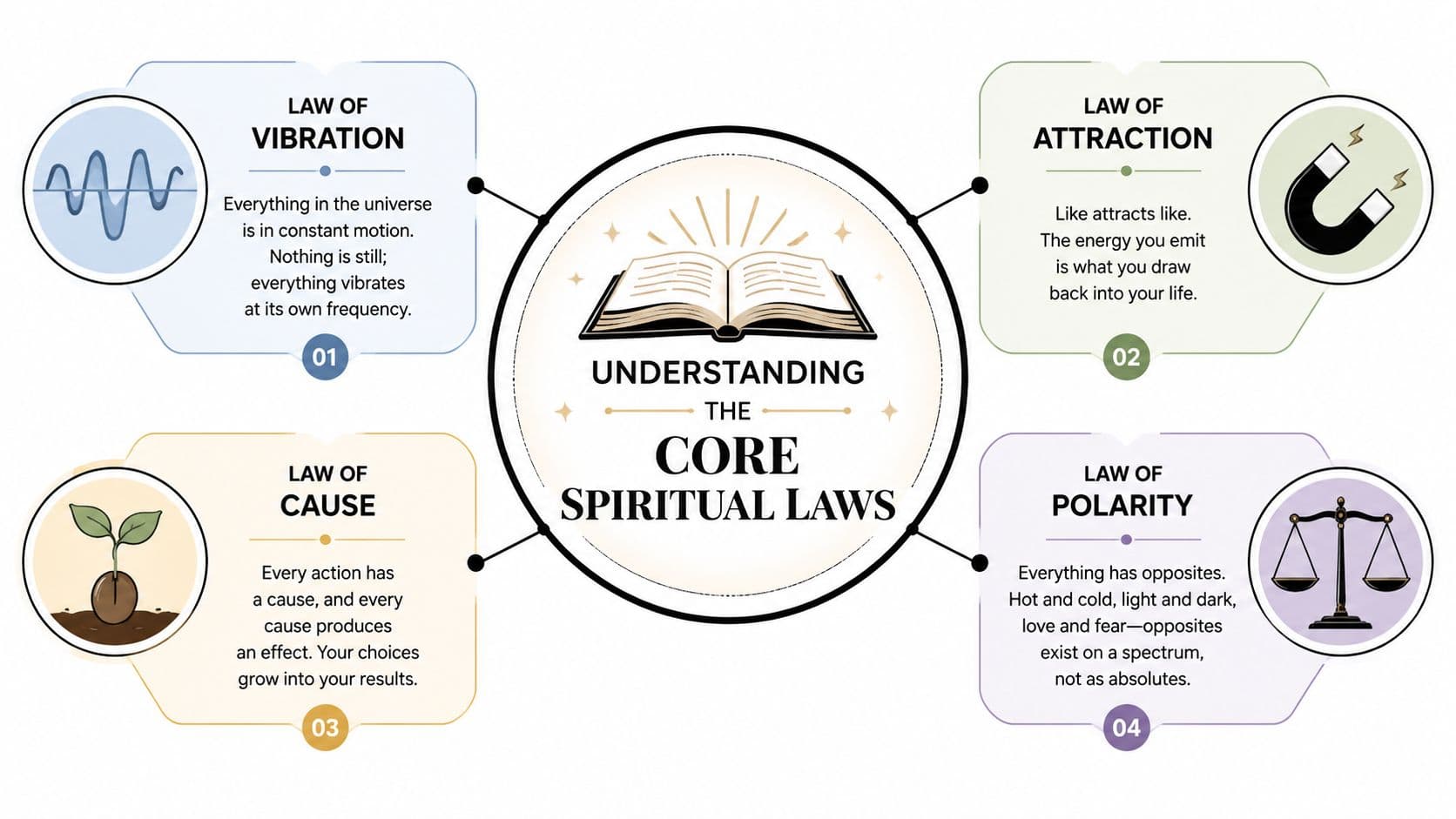
For a broader overview of the traditional framework, a useful companion is a guide to universal laws of life.
The Law of Divine Oneness
This law says life is interconnected. Your thoughts, words, and actions don't exist in isolation.
A forest is a good analogy. Each tree stands on its own, but none of them lives alone. Their roots share space. Their shade changes what grows nearby. Their health affects the whole ecosystem. Human life works similarly. Your mood enters a room before your words do. Your healing affects your family. Your bitterness does too.
This doesn't mean you're responsible for everything. It means you are connected to more than you think.
The Law of Cause and Effect
Cause and Effect is one of the most grounding spiritual laws of life because it cuts through magical thinking. Choices have consequences. Repeated choices create momentum. Inner patterns often become outer circumstances.
Think of planting. If you plant tomato seeds, you don't get lavender. If you plant nothing and then stare at the soil in frustration, you still don't get a harvest. Life may be more complex than gardening, but the principle holds. What you repeatedly feed tends to grow.
The Law of Compensation
People often confuse this with a transaction. If I'm nice, life should reward me immediately. That's not how most spiritual traditions frame it.
Compensation is closer to you reap what you sow. Energy, effort, care, and integrity aren't wasted, even when results don't arrive on your preferred schedule. This law invites steadiness. It asks, What kind of field are you cultivating with your everyday actions?
Practical rule: Stop asking only what do I want? Also ask, What am I consistently planting?
The Law of Polarity
Polarity helps people make peace with contrast. Joy and grief, confidence and doubt, rest and motion. Opposites don't cancel life out. They give it shape.
A battery needs two poles to generate current. In a similar way, human growth often happens through contrast. You may discover your values most clearly after a betrayal. You may understand peace more fully after a chaotic season.
When people resist polarity, they often suffer twice. First from the pain itself, and then from the belief that pain means they're doing life wrong.
The Unseen Engine How These Laws Actually Work
The spiritual laws of life aren't just ideas to admire. They're described as active principles. Always on. Always interacting. That's why understanding the mechanism matters.
Among these laws, Vibration is often treated as a key operating force. The simplest way to understand it is through a radio. If your dial is set to one station, you won't hear another. You don't argue with the radio. You tune it.
A diagram image. Then:
The law of resonance can be helpful to explore how energetic matching is often described in practice.
Why vibration matters
According to the explanation in this discussion of the 12 spiritual laws, the Law of Vibration operates on the principle that your energetic state must match the frequency of your desired outcome before it can manifest, and the Law of Perpetual Transmutation of Energy describes this as a continuous process where even small actions create measurable energetic shifts.
Your state matters. Not because you must be cheerful all the time, but because repeated emotional and mental patterns shape what you're available for, drawn toward, and willing to act on.
Small shifts count
People get tripped up here because they assume vibration means forced positivity. It doesn't. It means your inner state is not trivial.
Some examples are very ordinary:
| Moment | Low-alignment response | Higher-alignment response |
|---|---|---|
| You wake up anxious | Scroll, compare, tense up | Breathe, stretch, name what's real |
| You feel rejected | Shut down, retaliate | Pause, feel it, respond later |
| You feel stuck at work | Complain without direction | Take one honest action |
The point isn't perfection. It's direction.
A song can shift your body. A walk can soften mental fog. A few minutes of breathwork can interrupt a spiral. Those are not tiny in energetic terms. They are adjustments to the dial.
If your inner world is tuned to fear all day, you may still want peace, love, or abundance. But wanting and matching are not the same thing.
Why action still matters
Vibration without action becomes fantasy. Action without alignment becomes strain.
That's why people often feel confused when they say, Ive tried manifesting and nothing happened. Often what they tried was wishing. But spiritual laws of life point toward congruence. Thought, feeling, choice, and action begin moving in the same direction.
A practical test is simple:
- Check your body: Are you tense, braced, resentful, shut down?
- Check your thoughts: Are you rehearsing what you fear?
- Check your behavior: Are your actions supporting the life you say you want?
When those three are out of sync, progress feels heavy. When they begin to align, life often feels clearer, even before visible results arrive.
Common Misconceptions About Spiritual Laws
Some confusion around spiritual laws comes from oversimplified advice. A catchy quote travels faster than a nuanced teaching. The result is that people either expect too much from these laws, or dismiss them too quickly.
One of the biggest misunderstandings is the idea that spiritual law is one-size-fits-all. It isn't. The World Happiness Foundation discussion notes that spiritual guidance can be bespoke, and points to a real gap in mainstream content. People rarely get help navigating tensions such as forgiveness versus discernment.
Misreading the Law of Attraction
The pop version says think nice thoughts and you'll get nice things. That reading is too thin to be useful.
A healthier understanding is that attraction involves inner state, belief, and conduct. If you say you want a peaceful relationship but keep choosing emotionally unsafe people, another law is at work too. Cause and Effect hasn't been bypassed.
Treating spiritual laws like punishment
People sometimes hear you reap what you sow and translate it into shame. Then every hardship becomes evidence that they failed spiritually.
That approach usually harms more than it helps. Spiritual laws are better understood as principles than punishments. Fire cooks food and burns skin. Gravity supports walking and causes falls. The law itself isn't angry. It's consistent.
A painful experience is not always proof that you've done something wrong. Sometimes it reveals where healing, boundaries, grief, or deeper truth is needed.
Assuming one law cancels another
Many sincere people wrestle with a common quandary. They ask, Should I forgive, or should I protect myself? The answer may be both.
Forgiveness can release poison from your own system. Discernment can keep you from drinking more of it. One law heals the heart. Another protects the gate.
A useful way to work with tension is to ask:
- What brings me back into integrity?
- What protects what is sacred without closing my heart?
- What response fits this season of my growth?
That last question matters. The same advice doesn't fit every stage of life. A person learning courage may need to speak. A person ruled by reactivity may need silence first.
Why life can still feel unfair
This is the hardest part for many readers. If spiritual laws exist, why do generous people suffer? Why do selfish people sometimes prosper?
No simple formula can answer every human event. Life includes personal choices, other people's choices, timing, relationship dynamics, and larger conditions none of us fully control. Spiritual laws can guide response and meaning. They do not reduce life to blame.
That nuance is not a weakness in the teaching. It's part of what makes it humane.
Applying the Laws Through Your Personal Life Path
Universal principles apply to everyone. Personal application does not look the same for everyone.
Many readers experience relief. They don't need another list of laws to memorize. They need a way to understand which lesson is loudest in their life right now, and how to work with it in a grounded way.
Dan Millman's The Life You Were Born to Live offers that personal lens by interpreting the birth date as a blueprint of key lessons, gifts, and challenges. In parallel with that framework, the spiritual laws of money show how one life area can be examined through spiritual principles rather than only through strategy or stress.
Your blueprint changes the emphasis
A traditional statement from spiritual teaching is that these laws are constant and unchanging. The explanation on Life Hope & Truth's page about spiritual laws describes them as operating with no exceptions, whether you're aware of them or not. It also states that, in frameworks like Dan Millman's, your birth date encodes your personal blueprint of these laws, and that alignment creates harmony while ignoring that blueprint creates friction.
That idea helps explain why the same advice helps one person and frustrates another.
Consider these examples:
- A person with a creativity-centered lesson may need to apply the Law of Action by making something consistently, even imperfectly.
- A person whose path emphasizes healing may meet the Law of Cause and Effect through emotional honesty, repair, and forgiveness.
- A person learning boundaries may need the Law of Polarity more than the Law of pleasing others. They may be learning that compassion and firmness belong together.
The law is universal. The doorway is personal.
A simple way to apply spiritual laws in real life
When readers try to use spiritual laws of life, they often jump too quickly to conclusions. Slow works better.
Try this short process:
-
Name the repeating pattern Don't analyze everything at once. Pick one area. Relationships. Money. Work. Health. What keeps happening?
-
Identify the dominant law in play Is this about Cause and Effect? Vibration? Polarity? Compensation? You don't need perfect certainty. Start with the one that seems most obvious.
-
Look for your personal lesson Ask what this pattern is asking you to learn. Patience. Boundaries. Trust. Discipline. Honest communication.
-
Choose one aligned behavior Not ten. One. Send the difficult email. Stop chasing the unavailable person. Keep the promise you made to yourself.
Try this daily: At the end of the day, write down one moment when you acted from fear and one moment when you acted from alignment. Patterns become easier to see when you track them gently.
Personalization helps with conflicting laws
A birth-date-based framework can offer utility. In Dan Millman's The Life You Were Born to Live, life paths are not treated as labels. They're treated as learning patterns.
The Life Purpose App functions as a digital companion to that book. By entering a birth date, a reader can explore one of the 45 life paths described in Millman's system, along with key gifts, challenges, and life-cycle themes. That matters when two spiritual laws seem to clash. One person may need forgiveness to move forward. Another may need discernment first. Timing and life path can change the order.
A short comparison makes this easier to see:
| Situation | Universal law involved | Personal life-path question |
|---|---|---|
| Repeating conflict with a partner | Cause and Effect | What am I repeating, and why? |
| Feeling blocked despite effort | Vibration | What state am I working from each day? |
| Trouble saying no | Polarity | Where do love and boundary need to coexist? |
| Giving constantly and feeling drained | Compensation | Am I giving from wholeness or from fear? |
The goal isn't to become obsessed with analysis. It's to become more honest and more precise. Precision creates peace.
Living in Harmony with Universal Principles
Living by the spiritual laws of life doesn't mean becoming perfect, serene, or untouched by pain. It means becoming more aware of what you're participating in.
You start noticing that resentment has a cost. That gratitude changes your posture. That avoidance creates consequences, even when it feels easier in the moment. You also notice that one small aligned act can restore a surprising amount of inner order.
What harmony looks like in practice
Harmony is usually quieter than people expect. It looks like:
- Pausing before reacting
- Taking responsibility without shaming yourself
- Choosing relationships that match your values
- Acting in ways that support the life you say you want
This kind of living won't remove every hard season. But it can reduce unnecessary friction. You stop arguing with principles that are asking you to mature.
The more honestly you observe your life, the more these laws stop feeling abstract and start feeling recognizable.
Start smaller than you think
You don't need to master every framework at once. Start by watching one law for one week.
Maybe you observe Cause and Effect. Notice how a rushed morning changes your conversations. Or watch Vibration. Track what happens when you begin the day grounded instead of flooded. Or work with Polarity. When something difficult arises, ask what opposite quality might also be present.
If you enjoy deeper reflective study, this piece on wisdom for personal growth and self-discovery offers a grounded way to think about how inner understanding becomes lived judgment.
Many people first arrive here because life feels chaotic. Over time, a different picture emerges. Life may still be mysterious, but not meaningless. There are patterns. There are principles. There is also a personal path through them.
Dan Millman's The Life You Were Born to Live speaks to that personal path with unusual clarity. The more you understand both the universal laws and your own recurring lessons, the less life feels like something happening at you. It starts to feel like a conversation you can finally hear.
If you want to explore your own life path through Dan Millman's system, Life Purpose App (https://lifepurposeapp.com) offers a practical way to enter your birth date and review the life-path insights, cycles, and spiritual-law themes connected to The Life You Were Born to Live.
REQUIREMENTS:
- Remove each broken blog link completely (both the markdown link syntax and the descriptive text)
- Rewrite sentences naturally after removing references
- Preserve all other markdown formatting
- Only remove references to the specific broken blog links, don't change other content
- Process all broken URLs in a single pass
Example: Before: "...for your small business as described in the small business article." After: "...for your small business."
Please return your response in the following JSON format: { "updatedContent": "the full content with all broken links removed", "removals": [ { "brokenUrl": "the broken blog URL", "explanation": "brief explanation of what was removed and how the text was adjusted" } ] }
Discover Your Life Purpose Today!
Unlock your true potential and find your life’s purpose.
