Life can look fine from the outside while you feel flat, overworked, or off course inside. This guide explains how men’s spiritual retreats work, who benefits, how to choose and prepare, and how to integrate insights when you return. It also points to Life Purpose App tools to sharpen your questions before you go and keep the work alive afterward.
April 30, 2026 (3mo ago) — last updated July 15, 2026 (1mo ago)
Men’s Spiritual Retreats 2026: Find Purpose & Renewal
Discover men’s spiritual retreats—types, benefits, how to choose and integrate growth—plus practical Life Purpose App tools to prepare and follow up.
← Back to blog
Men’s Spiritual Retreats 2026: Find Purpose & Renewal
Summary: Explore men’s spiritual retreats—types, benefits, how to choose, prepare, and integrate growth. Includes Life Purpose App resources.
Introduction
Life can look fine from the outside while you feel flat, overworked, or off course inside. You don’t always need a crisis to know you need a reset. This guide explains how men’s spiritual retreats work, who benefits, how to choose and prepare, and how to integrate what you learn when you return. It also points to practical tools—like the Life Purpose App—to sharpen your questions before you go and keep the work alive afterward.
Why More Men Are Seeking Something Deeper
Monday starts before sunrise. You check your phone, handle what’s urgent, get everyone where they need to go, and keep the day moving. By evening you’ve performed what a capable man does. Still, something feels wrong.
Men are less likely than women to seek emotional support or professional help for mental health concerns, which leaves many coping alone with stress, numbness, or quiet dissatisfaction.1
I hear the same currents in different stories: the burned-out executive who cannot switch off, a father carrying everyone else’s needs and losing contact with his inner life, and the younger man whose ambition outruns meaning. Beneath those scenes is a shared tension: productivity can mask a loss of conviction, reverence, grief, joy, and honest self-knowledge.
Men often name that hunger in familiar ways:
- “I need to clear my head.” Often the problem is too much noise to hear what matters.
- “I need a break.” Sometimes rest is enough. Sometimes the deeper need is reflection, confession, and a reset of priorities.
- “I’m fine, just busy.” Busy can cover loneliness, resentment, doubt, and a slow drift away from a life that feels aligned.
Some men come to this need through faith; others through exhaustion, a breakup, a health scare, or the quiet realization that success didn’t answer deeper questions. If a Christian frame fits you, HolyJot’s study plan for young men can help you name the need for brotherhood, discipline, and spiritual grounding before you commit to a retreat.6
Another pattern shows up often: men don’t just want relief. They want orientation—where they are in their growth, what season they’re in, and what kind of work fits that season. The Life Purpose App gives a practical, personalized way to assess patterns, strengths, and friction points so you can arrive with sharper questions and clearer intention.
A good retreat doesn’t pull you out of life; it helps you return to it with more honesty.
What Is a Men’s Spiritual Retreat?
You arrive carrying more than a duffel bag. Your phone is hot from the last work message. Your jaw is tight. Part of you wants rest. Another part wants an honest answer to a question you’ve been avoiding.
A men’s spiritual retreat creates that room. At its best, it’s a bounded period away from your normal environment, intentionally structured for reflection, practice, and truthful contact with yourself, other men, and—for some—God. The point is not escape; the point is to interrupt habits that keep you defended, distracted, or numb long enough to see what’s going on.
That can include burnout, resentment, grief, stalled purpose, strained marriage, fatherhood pressure, loss of faith, or the uncomfortable sense that your outer life and inner life no longer match.
What it is—and what it isn’t
A retreat is structured time with intention. That’s what separates it from a weekend away. The schedule, setting, and facilitation support a specific kind of work.
Some retreats are explicitly Christian, Jewish, Buddhist, or rooted in another tradition. Some are non-denominational. Some focus on silence and prayer; others on breath, movement, nature, ritual, meditation, or group process. The common thread is design: to help a man examine how he’s living, what he’s avoiding, and what needs to change.
Good retreats also have limits. They can surface pain, but they’re not a substitute for trauma therapy, addiction treatment, or medical care. A skilled facilitator will be clear about that.
What a real retreat creates
Three conditions matter:
-
Separation from your usual inputs
Work demands, family roles, and constant stimulation drop in volume. That change alone can be confronting. -
A clear container for honest self-examination
Concrete practices—journaling prompts, silence, partner exercises, prayer, meditation, or guided inquiry—prevent the weekend from turning into private rumination. -
Contact that cuts through performance
A well-led men’s retreat creates enough safety for honesty and enough challenge to keep honesty from turning into storytelling.
Preparation changes the quality of the experience. Men often arrive with broad hopes but no language for the season they’re in. The Life Purpose App and Dan Millman’s life-path system can help narrow focus before you go and give you vocabulary for recurring themes and pressures.
What the atmosphere usually feels like
The best retreats feel steady, not theatrical. Meals are simple. The days have rhythm. There’s enough structure to make the space feel safe and enough openness for real insight to surface. You might spend hours in silence, sit in a circle and speak out loud what you’ve hidden for years, hike, pray, breathe, sweat, write, or sit by a fire after a hard conversation.
Some retreats are gentle; some are confrontational. Neither is automatically better. A man who is emotionally shut down may need challenge; a man who is raw may need steadiness and quiet. Matching the retreat to your actual condition matters more than choosing the one with the best branding.
Practical rule: If a retreat promises major transformation but cannot explain how the days are structured, who is facilitating, and how support is handled, be cautious.
A men’s spiritual retreat works like a reset for attention, values, and direction. It will not fix your life in three days. It can give you a cleaner look at what’s true and a stronger starting point for what comes next.
Formats and Modalities: Which One Fits You?
Not all retreats are built for the same work. Booking by branding, scenery, or urgency is a common mistake. Choose the format that matches your need.
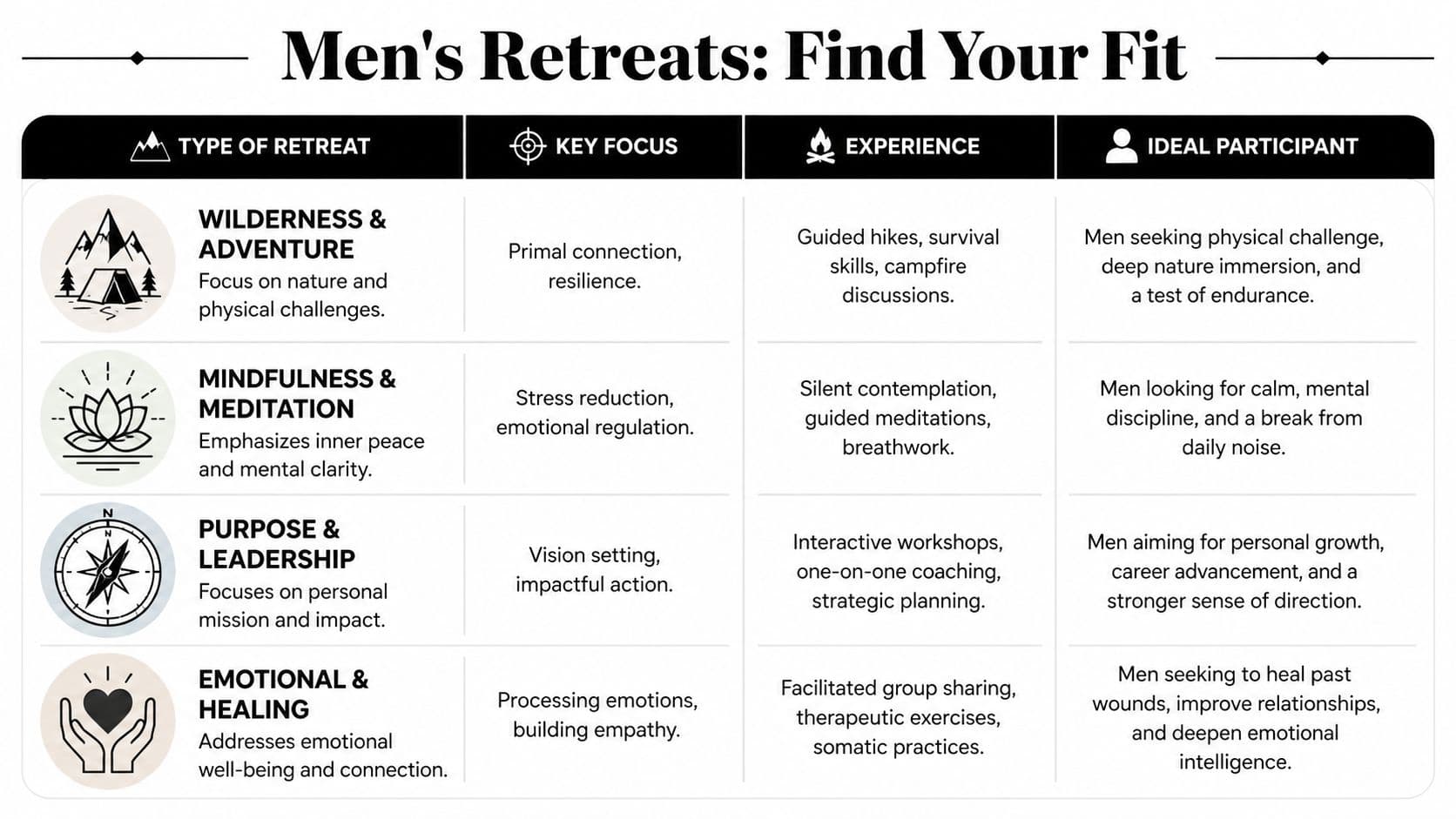
Quick comparison of common modalities
-
Silent and meditation retreats — Inner stillness and attention: seated meditation, silent meals, guided reflection. Best for men overloaded by noise and seeking clarity. Research shows meditation programs reduce symptoms of anxiety and depression for many participants.2
-
Wilderness and adventure retreats — Nature, resilience, simplicity: hiking, camping, campfire dialogue. Best for men who open up through movement and shared effort. Nature simplifies attention and creates non-performative bonding.
-
Men’s circles and vulnerability retreats — Emotional honesty and brotherhood: group sharing, facilitated dialogue, partner exercises. Best for men who feel isolated and need safe connection. Skilled pacing and consent are essential.
-
Yoga and movement retreats — Regulation through body awareness: yoga, breathwork, mindful movement. Best for men carrying stress physically who need to reconnect to the body.
-
Somatic and healing-arts retreats — Trauma-informed nervous-system work: breathwork, grounding, co-regulation. Best for men with chronic stress, shutdown, anger, or emotional numbness.
-
Archetypal and purpose-based retreats — Identity and masculine integration: guided visualization, shadow work, journaling. Best for men asking deeper questions about leadership, purpose, and integrity.5
Silent and meditation retreats
Silence removes stimulation so you can hear what your mind is doing. For some men that’s relief; for others it’s the first time they find out how noisy they are inside. Silence can expose fragmentation, but it may not provide enough relational processing if isolation or trust is a deeper wound.
Wilderness and adventure retreats
Nature simplifies attention and gives men a different, non-performative way to bond. Shared effort matters. The risk is mistaking hardship for depth—adrenaline without reflection isn’t spiritual work.
Men’s circles and vulnerability retreats
Done well, these create clear structure for speaking plainly, listening without fixing, and being witnessed without posturing. If a facilitator pressures disclosure before trust is built, the pacing is poor. For newcomers, pairing sharing with movement or ritual often helps.
Yoga, breathwork, and movement retreats
These use the body to lower mental overcontrol and restore presence. They’re less about flexibility and more about regulation—breathing fully, noticing tension before it becomes anger, and feeling grief or relief in the body instead of thinking around it.
Somatic and archetypal retreats
Somatic work targets the body’s stress patterns. Archetypal work offers language for parts of yourself that are underdeveloped or overused. These approaches can be powerful but require skillful facilitation—done poorly, they slip into performance or inflated language. For examples of archetypal frameworks and retreat overviews, see Embodied Masculine’s retreat materials.5
When facilitators explain the science and safety behind their practices, that’s a good sign. For more on why men’s healing retreats can work, see practitioner summaries and case studies from somatic coaches.3
Real Benefits You’ll Notice at Home
Retreat benefits aren’t mystical. They show up in ordinary life: calmer responses to pressure, less energy lost to internal conflict, and more honest presence with partners, children, friends, and teams. Retreats create conditions that are hard to reproduce at home and give your system time to reorganize.
The mental-health effects of meditation and structured retreat experiences have been documented in clinical and observational studies, showing reductions in anxiety and depression symptoms among participants and improved well-being for weeks to months afterward.2
Emotional regulation improves
Many men think they need better communication skills when what they really need is a calmer nervous system. If your body is braced, every conversation becomes harder than it needs to be. Retreat practices—breathing, grounding, somatic work—help regulate the nervous system so communication becomes easier and less reactive.
Relationships become less performative
Retreat work changes how men show up—not because they come home with perfect language, but because they’re less defended. They hear feedback without collapsing or counterattacking and can name what they feel sooner. Honest brotherhood in retreat settings often reveals how functional many everyday friendships have become.
Purpose becomes less abstract
A quieter relationship with yourself helps you distinguish between borrowed goals and your actual direction. Retreats support clearer decision-making, better boundaries, and more integrity because actions start matching what you know.
Practical skills transfer home
Useful retreats leave you with embodied tools—breathing practices, journaling, silence, movement, sleep rhythms, and simple routines—that can be practiced daily. The true test is whether the work changes your life thirty days after the retreat, not only whether day three felt profound.
How to Choose the Right Retreat
Discernment matters more than inspiration. Beautiful websites and scenic locations don’t guarantee good facilitation, safety, or fit. A good retreat meets your actual need, not your fantasy of breakthrough.
Ask the real question first
Before you compare programs, ask what problem you want to solve: exhaustion and the need for quiet? Emotional shutdown? Transition, grief, divorce, burnout, or spiritual dryness? Craving brotherhood? Wanting a faith-based container? Different needs call for different rooms.
- Choose silence if your mind is crowded and you can self-regulate.
- Choose brotherhood and facilitated sharing if isolation is the deeper wound.
- Choose somatic work if stress, anger, shutdown, or numbness live in your body.
- Choose faith-based retreats if your questions are inseparable from prayer and devotion.
Vet the facilitator, not just the concept
The facilitator shapes pacing, safety, tone, and what happens when real emotion enters the room. Look for maturity in experience, clear boundaries, trauma awareness, honesty about spiritual or ceremonial elements, and integration support such as follow-up or local community options.
Ask direct questions before you book. Good facilitators won’t be offended.
Practical details that affect the experience
Sleep setup, food, physical demands, schedule density, transport, and group size matter. Ask:
- How much downtime is there vs. programmed activity?
- What’s included in the price?
- Are accommodations private, shared, rustic, or hotel-style?
- What level of physical ability is expected?
- Is any sharing, fasting, or ceremonial participation required?
These aren’t minor details. They shape whether you can do the work.
Make sure the values fit
Read the language carefully. Does it sound sober, clear, and respectful? Or inflated, tribal, and emotionally careless? If you want ongoing inner work, favor programs that emphasize consistent practice and integration rather than peak experience.
Prepare Intentionally and Integrate with Discipline
The retreat itself is only part of the work. Men who get the most do two things well: prepare with intention, and integrate with discipline. Without preparation you arrive scattered. Without integration the experience fades into a good memory.
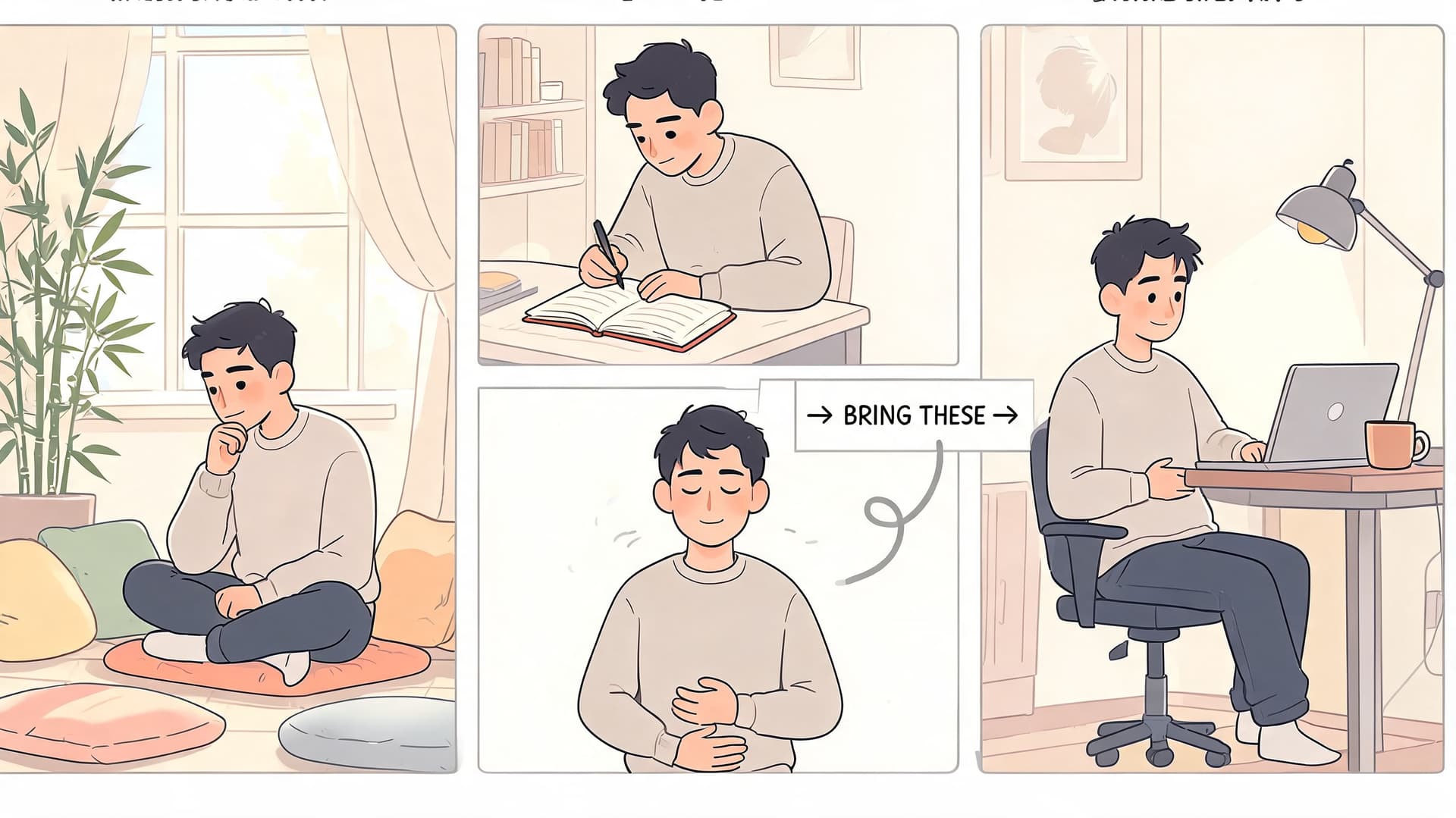
Prepare before you leave home
Arrive with questions—real ones, not polished talking points. Examples:
- Where am I lying to myself?
- What keeps repeating in my relationships?
- What part of my life has energy and what part feels dead?
- What am I avoiding because competence has become more important than honesty?
If you already use Dan Millman’s framework, the Life Purpose App can help you reflect on your life path, core lessons, and current cycle before you travel, which makes your intention sharper and your time at the retreat more useful.
Set a working intention, not a grand one
“I want transformation” is too vague. “I want to notice where I shut down when I feel vulnerable” is usable. Try this quick preparation practice:
- Name one pattern you want to understand.
- Name one relationship where that pattern shows up.
- Name one fear about attending.
- Write one honest sentence you’d be relieved to say out loud.
Bring any life-path notes as orientation, not dogma.
Integration is where the retreat becomes real
The days after a retreat are often messier than people expect. You may feel clear, tender, energized, emotional, spacious, or strangely exposed. That doesn’t mean the retreat failed; it means re-entry has begun.
Use structure right away:
- Journal within 24 hours of returning home to capture what landed.
- Choose one practice to continue. Not five—one.
- Tell one trusted person what you learned and what you’re changing.
- Protect some silence in the first few days back.
If you want a simple framework for follow-through, see meditation and journaling ideas on Life Purpose App resources.
Use a personal framework to keep the work alive
A retreat may surface themes around relationships, work, health, discipline, trust, or purpose. A personal life-path framework gives you a way to revisit those themes after the emotional intensity passes. Integration is less about holding a peak state and more about changing your next honest decision.
Common Questions
What if I’m not religious or spiritual?
You can still benefit. Many retreats focus on silence, self-examination, embodiment, nature, and honest connection without assuming religious beliefs. If you prefer faith-based work, choose a retreat that states that clearly; if you don’t, choose plain-language programs that respect different worldviews.
Will I be forced to share personal stories?
In a well-run retreat, no. You may be invited to speak, but pressure is a red flag. Skilled facilitators know trust cannot be extracted; men open up when the room is safe and participation has integrity.
Are these retreats only for one kind of man?
Not at all. The best groups include a mix—fathers, young professionals, creatives, business owners, men in transition, men in grief, and men who recognize they’ve been living on autopilot.
Quick Q&A
Q: How will a retreat help me day to day?
A: Retreats provide embodied tools—breathwork, journaling, silence, movement—and time to reorganize how you respond to pressure, so daily choices become clearer and less reactive.
Q: Which retreat format should I pick?
A: Start with the problem you want to solve. Silence for an overloaded mind, brotherhood for isolation, somatic work for chronic stress stored in the body, and faith-based retreats for questions tied to devotion.
Q: How do I keep the work after the weekend?
A: Prepare with a specific intention, pick one practice to continue, journal within 24 hours, tell a trusted person about your plan, and use a personal framework—like Dan Millman’s life-path tools in the Life Purpose App—to revisit themes consistently.
If you want a practical way to prepare for a retreat or make sense of what surfaced afterward, the Life Purpose App offers a structured companion to Dan Millman’s The Life You Were Born to Live. It helps you explore your life path, core themes, and cycles in ways that can clarify prayer, journaling, and integration after deep inner work.
\"1\".
American Psychological Association, “Men and Mental Health,” [https://www.apa.org/topics/mens-health/mental-health]
\"2\".
Goyal, M., Singh, S., Sibinga, E. M. S., et al., “Meditation programs for psychological stress and well‑being: a systematic review and meta‑analysis,” JAMA Internal Medicine, [https://jamanetwork.com/journals/jamainternalmedicine/fullarticle/1809754]
\"3\".
Mike Sagun, “The Science Behind Men’s Healing Retreats: Why They Work,” [https://www.mikesagun.com/somaticcoachingblog/the-science-behind-mens-healing-retreats-why-they-work]
\"5\".
Embodied Masculine, “Embodied Masculine retreat overview,” [https://embodiedmasculine.com/mens-spiritual-retreat/]
\"6\".
HolyJot, “Built for Brotherhood: Finding Godly Friendship as a Young Man,” [https://www.holyjot.com/blog/built-for-brotherhood-finding-godly-friendship-as-a-young-man-a-7-day-bible-study-plan]
Discover Your Life Purpose Today!
Unlock your true potential and find your life’s purpose.
