Feeling stuck? This guide gives clear, practical steps—awareness, compassionate inquiry, and deliberate action—to help you set boundaries, regulate emotions, and align work and money with your values.

December 19, 2025 (10mo ago) — last updated October 21, 2026 (2d ago)
Reclaim Your Power: Boundaries, Emotions, Career
Practical steps to reclaim control: set boundaries, manage emotions, and align work and finances with your values for lasting empowerment.
← Back to blog
Feeling stuck? This guide gives clear, practical steps—awareness, compassionate inquiry, and deliberate action—to help you set boundaries, regulate emotions, and align work and money with your values.
Reclaim Your Power: Boundaries, Emotions, Career
Summary: Practical steps to reclaim control: set boundaries, manage emotions, and align work and money with your values for lasting empowerment.
Introduction
Feeling stuck? You can reclaim control over your choices, time, and emotional life. This guide gives clear, actionable steps—awareness, compassionate inquiry, and deliberate action—to help you set boundaries, regulate emotions, and build a life that fits who you truly are.
What Taking Your Power Back Truly Means
Feeling powerless is a slow, quiet drain. It shows up when your voice isn’t heard, your needs come last, and you live by someone else’s script. Maybe you say you’re fine when you’re not, stay quiet in meetings when you have a strong idea, or let an inner critic run the show.
Taking your power back isn’t about aggression or dominating others. It’s an internal shift toward self-governance, a quiet confidence that comes from knowing you’re the ultimate authority in your life.
Pinpointing Your Power Drains
Start by noticing where your energy leaks. Common patterns include:
- In conversations: apologizing for things you didn’t do or letting others talk over you.
- At work: taking extra tasks to keep people happy at the expense of your workload.
- In relationships: bending your opinions or hiding your true desires to avoid conflict or gain approval.
This is your initial data collection. Awareness done with compassion gives you a place to begin changing habits.
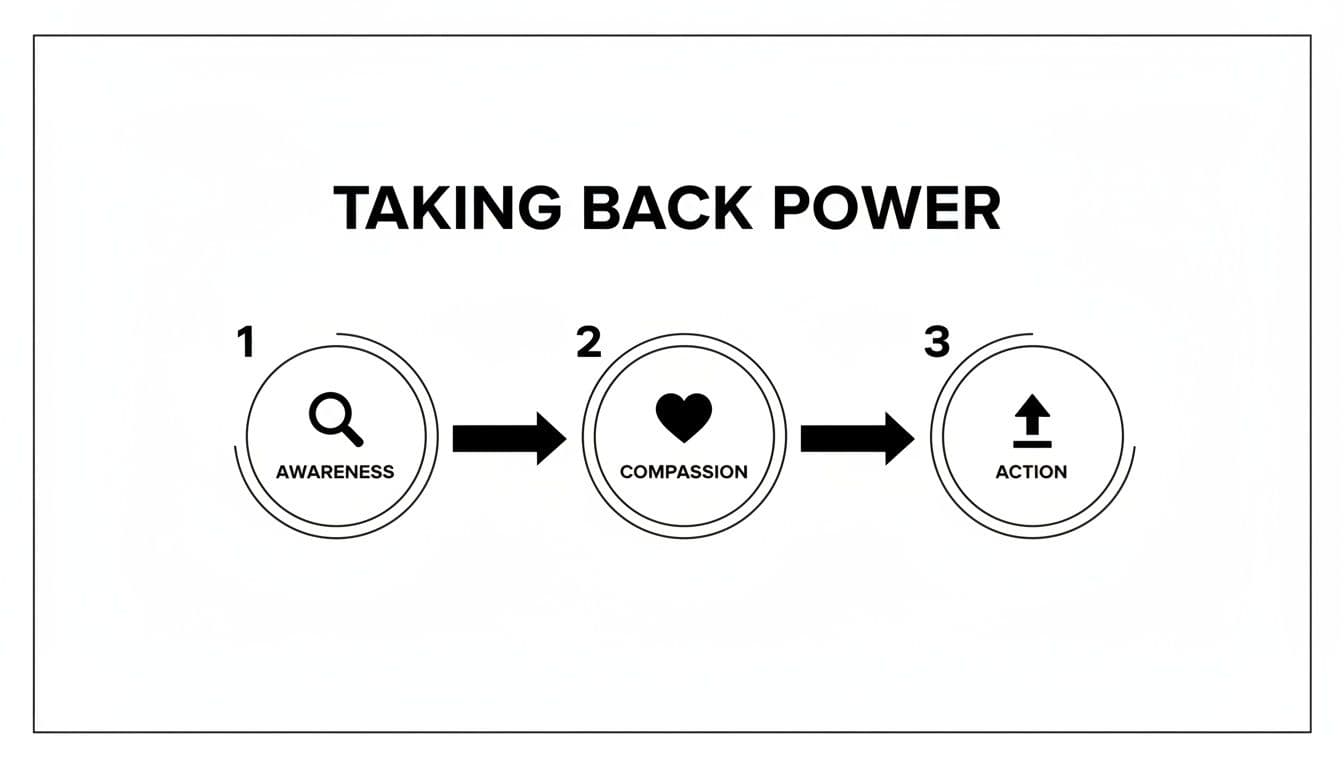
The flow—Awareness, Compassion, Action—reminds you that change begins with noticing, not punishing.
“The journey of taking your power back isn’t a battle to be won but an awareness to be cultivated. It begins the moment you decide your well-being is non-negotiable.”
Looking at these habits isn’t about blame; it’s about gathering intelligence. Noticing patterns is a win because it gives you tangible places to intervene.
Unlocking Your Personal Blueprint for Power
Generic advice often falls flat because it ignores who you are. A personal blueprint—insights into your natural strengths and recurring challenges—lets you choose strategies that feel authentic. Instead of forcing yourself into a mold, you work with your wiring.
Find Your Path with Dan Millman’s System
Dan Millman’s book, The Life You Were Born to Live, and the Life Purpose App use your birth date to generate a life number and outline strengths, challenges, and life themes1. Think of it as practical self-awareness rather than mystical prediction.
This kind of framework can explain why you thrive in creative chaos or why leadership feels natural but asking for help doesn’t. With clearer self-knowledge, you can stop fighting your nature and start directing your energy where it matters.
Turning Your Blueprint into Action
When you know your tendencies, choices become easier. If your blueprint highlights a challenge with speaking your truth, focus on small boundary practices. If it shows innovation as a strength, seek projects that let you lead creatively.
Use this insight to clarify core values and make concrete plans that align with them. For practical exercises to discover your core values, see our guide on discovering core values.
How to Set Boundaries That Actually Work
Boundaries protect your time, energy, and well-being. They’re not walls; they’re respectful fences that keep you available to the people and activities that matter most.
Different Boundaries for Different Situations
- Emotional boundaries: Protect your feelings so you can be empathetic without absorbing someone else’s drama.
- Physical boundaries: Guard your personal space and downtime—simple acts like declining a hug or asking for 30 minutes of quiet matter.
- Digital boundaries: Mute group chats at night, set an away message after hours, or unfollow accounts that drain you.
Simple Scripts for Common Scenarios
Having a few practiced lines removes the guesswork.
Scenario 1: The friend who keeps venting
“I’m so sorry you’re dealing with this, and I want to be here. I’ve got about 15 minutes before I need to run, but I’m fully with you until then.”
Scenario 2: The boss with after-hours “emergencies”
Respond the next morning: “Got it. I’ll make this a priority first thing today.”
Scenario 3: The relative with unsolicited advice
“Thanks for sharing. I’m really happy with how things are going. How was your trip last month?”
Use these lines to validate others while protecting your space. For more boundary strategies, see our boundary toolkit.
Taking Back the Reins of Your Career and Finances
Work and money strain can erode confidence. Getting clearer about your career and finances gives you the fuel to make bolder choices. Depression and anxiety cost the global economy an estimated US$1 trillion every year in lost productivity, which shows how mental health and financial stability are deeply connected2.
Building Your Professional Influence
Agency at work is built daily. Start small and collect evidence of your impact.
- Keep a “Wins” file of accomplishments and positive feedback.
- Protect your time—take your lunch break, stop checking email late at night.
- Speak with intention: replace “I think maybe we could” with “I recommend we…”
For insight into workplace advancement gaps, especially for women, see the McKinsey report on women in the workplace3.
Taking your power back professionally means trading the hope that you’ll be noticed for the strategy that ensures you’re heard.
Financial Empowerment Is an Act of Self-Respect
Financial clarity creates options. Know where your money goes, build emergency savings, and make a plan that supports your values. That safety net lets you walk away from misaligned roles and invest in what matters.
Mastering Your Inner World Through Emotional Regulation
Sustainable power comes from mastering yourself, not controlling others. Emotions are important signals. Your task is to build a gap between a trigger and your response so you can choose intentionally.
Getting Off the Emotional Autopilot
Learn your triggers—tones, phrases, or situations that reliably flip your switch. When you feel the reaction rising, notice the feeling without acting on it. That pause is a muscle; strengthen it with regular practice.
For deeper work on emotional intelligence, see our emotional intelligence resources.
Grounding Yourself With Simple Somatic Exercises
Somatic exercises use the body to reset the nervous system. Breathwork and grounding techniques are fast, practical tools you can use anywhere. Brief breathing practices can reduce the stress response and promote calm4.
Simple Somatic Exercises for Immediate Calm
| Exercise | How to Do It | When to Use It |
|---|---|---|
| The 4-7-8 Breath | Inhale through your nose for 4 counts. Hold for 7 counts. Exhale audibly for 8 counts. Repeat 3–4 times. | Before a tough conversation, when your heart races, or to fall asleep. |
| 5-4-3-2-1 Grounding | Name 5 things you see, 4 things you can touch, 3 things you hear, 2 things you smell, 1 thing you taste. | During panic, overwhelm, or dissociation. |
| Mindful Hand-Washing | Focus on water temperature, soap texture, scent, and the sound of water. | Quick mental reset at work or home. |
Regular use of these practices builds resilience so you respond with purpose rather than impulse. For guided exercises, visit our somatic exercises page.
Common Concerns When Reclaiming Your Power
Starting this work brings questions. Below are common concerns and practical responses.
What If People React Negatively When I Set Boundaries?
Pushback is normal because change disrupts old dynamics. Stay calm, consistent, and compassionate. Try: “I understand this feels different, but this is what I need for my well-being right now.” Their discomfort is about the change, not a verdict on you.
The right people will respect your growth; those who don’t reveal themselves through their reaction.
How Can the Life Purpose App Help If I Feel Lost?
If your work feels disconnected from who you are, a tool like the Life Purpose App can provide language and a framework to identify strengths and misalignments. It’s a compass that can spur concrete changes in how you structure work and relationships1.
I Keep Falling Back into People-Pleasing—Now What?
This is a practice, not a one-time fix. Use self-compassion and curiosity. When you slip, ask: What triggered that response? What was I trying to get or avoid? Each slip is data to improve future choices.
For additional resources on emotional regulation and boundaries, see our helpful resources index.
At Life Purpose App, we believe self-knowledge is the ultimate form of power. Understanding your blueprint helps you make choices with confidence. Discover your path and start aligning your life with who you are. Explore the Life Purpose App today.
Quick Q&A
Q: What does “taking your power back” mean? A: It means reclaiming control over your choices, time, and emotional responses so you live by your values rather than reacting to others.
Q: How do I start setting boundaries without feeling guilty? A: Start small with clear, kind scripts and protect short time blocks. Practice self-compassion and treat boundary-setting as self-care, not selfishness.
Q: Which techniques help when I feel overwhelmed right now? A: Use brief somatic tools—4-7-8 breathing, 5-4-3-2-1 grounding, or a mindful hand-wash—to reset your nervous system and create space to choose your response.
1.
Dan Millman, The Life You Were Born to Live; Life Purpose App, [https://lifepurposeapp.com](https://lifepurposeapp.com); Dan Millman, [https://danmillman.com/books/the-life-you-were-born-to-live/](https://danmillman.com/books/the-life-you-were-born-to-live/)
2.
World Health Organization, “Depression and anxiety cost the global economy US$ 1 trillion each year in lost productivity,” October 2019, https://www.who.int/news/item/23-10-2019-depression-and-anxiety-cost-the-global-economy-usd-1-trillion-each-year-in-lost-productivity
3.
McKinsey & Company, “Women in the Workplace,” https://www.mckinsey.com/capabilities/people-and-organizational-performance/our-insights/women-in-the-workplace
4.
Harvard Health Publishing, “Relaxation techniques: Breath control helps quell errant stress response,” https://www.health.harvard.edu/mind-and-mood/relaxation-techniques-breath-control-helps-quell-errant-stress-response
Discover your life path today
Enter your date of birth and see your life path, free.
Find your life path