March 31, 2026 (3d ago)

A Gentle Path Back to Yourself With Trauma Informed Yoga

Discover how trauma informed yoga can help you heal. This guide explains what it is, its benefits, and how to find a safe practice to reconnect with your body.

← Back to blog
Cover Image for A Gentle Path Back to Yourself With Trauma Informed Yoga

Discover how trauma informed yoga can help you heal. This guide explains what it is, its benefits, and how to find a safe practice to reconnect with your body.

Trauma-informed yoga is a specialized approach that helps people find safety and connection within their own bodies, especially after experiencing trauma. It’s less about achieving a perfect pose and entirely focused on how you feel in your body, moment to moment. The practice uses intentional language, predictable structures, and a deep respect for personal choice to help rebuild a sense of agency from the inside out.

A New Map for Inner Healing

Living with the aftershocks of trauma can feel like you've been given a faulty map to your own body. The internal landscape can feel unfamiliar, uncomfortable, or even dangerous. Your nervous system, the body's natural alarm, might be stuck in overdrive, leaving you feeling disconnected from your physical self and the world around you.

Trauma-informed yoga doesn't just hand you a new map; it teaches you how to draw your own. It's a gentle practice that builds a bridge between the mind and body, creating a safe pathway back to yourself. This isn't about getting a workout—it's about coming home.

To truly grasp this shift, it helps to see how this practice differs from what you might find in a typical yoga studio.

Traditional Yoga vs Trauma Informed Yoga

The table below highlights the fundamental differences in philosophy and application between a standard public yoga class and one specifically designed with trauma survivors in mind.

ElementTraditional Yoga ClassTrauma Informed Yoga Class
Primary GoalPhysical fitness, flexibility, mastering poses (asana).Creating internal safety, body awareness (interoception), and self-regulation.
LanguageOften uses direct commands ("Go to Downward Dog").Uses invitational language ("You might explore..." "When you're ready...").
Physical AdjustmentsHands-on assists from the instructor are common.Generally a hands-off approach to respect personal space and avoid triggers.
EnvironmentCan be fast-paced, with music, mirrors, and bright lights.Predictable, calm, often with dimmed lighting and no mirrors to keep focus internal.
Pacing & FlowTeacher sets the pace for the entire class.Participants are encouraged to move at their own pace and rest anytime.
EmphasisFocus on the external look of the pose (alignment).Focus on the internal feeling of the shape (sensation).

As you can see, the entire focus shifts from the instructor's authority to the participant's personal experience. It's about taking the power dynamic of a traditional class and handing it back to the individual.

Shifting Power Back to You

While well-intentioned, a standard yoga class can sometimes feel disempowering for someone with a history of trauma. The fast pace, hands-on corrections, and direct commands can unintentionally trigger a sense of being out of control. Trauma-informed yoga turns this entire dynamic around by putting you firmly in the driver's seat.

This approach is built on a few core ideas:

  • Invitational Language: Instead of hearing, "Do this pose," the teacher will offer an invitation. "You might explore..." or "If it feels right, you could try..." This simple change frames every movement as a choice, not a command.
  • Choice and Agency: You are always in control. You have the choice to participate, to change a pose, to skip it entirely, or to just rest. Reclaiming the power to choose is fundamental to healing. You are treated as the expert on your own body.
  • Creating Predictability: The class structure is often explained beforehand so there are no surprises. The physical space is also carefully managed—think softer lighting and more space between mats—to reduce potential overwhelm and help the nervous system relax.

Together, these elements create a container of safety where you can begin to listen to and trust your body's signals again. It's a practice in rediscovering your own inner wisdom, a skill that serves you long after you’ve rolled up your mat.

Why This Practice Matters

The powerful impact of this approach isn't just anecdotal; it's backed by solid research. A landmark 2014 study on women with chronic, treatment-resistant PTSD found trauma-informed yoga to be remarkably effective. After the program, an incredible 52% of participants in the yoga group no longer met the diagnostic criteria for PTSD, compared to only 21% in the control group.

These findings show how the practice can be a direct pathway to healing by fostering body awareness and self-regulation. The applications are both broad and profound. For example, it’s a key component in many programs focusing on yoga for addiction recovery, which often requires addressing deep-seated trauma. The themes of safety and reconnection are also central to other healing modalities, as explored in these inner child healing exercises.

Ultimately, trauma-informed yoga offers a tangible, physical framework for developing self-awareness. It's much like how tools such as Dan Millman's book, The Life You Were Born to Live, or the Life Purpose App can provide a mental blueprint for understanding your path. This practice gives you the means to physically embody that self-knowledge, allowing you to navigate your inner world with a newfound sense of confidence and safety.

How Trauma-Informed Yoga Resets Your Nervous System

Have you ever felt like your internal alarm system is just… stuck? For many who have experienced trauma, this feeling is a constant reality. The body remains locked in a high-alert state—ready for a fight, to flee, or frozen in place—long after any real danger has passed. It makes feeling truly safe in your own skin seem almost impossible.

This is where trauma-informed yoga comes in. It’s far more than just a sequence of postures; it's a way to gently press the reset button on your entire nervous system. It’s about using the body to send a clear, powerful message back to the brain: “You are safe now.”

So how does it work? When we experience trauma, our innate ability to self-regulate gets thrown off-kilter. Our sympathetic nervous system, the body’s “gas pedal,” can get stuck in the 'on' position, leaving us with a constant undercurrent of anxiety, hypervigilance, and a feeling of being perpetually on edge.

On the other hand, the body might slam on the brakes, pushing us into a shutdown or freeze state managed by the dorsal vagal part of our parasympathetic nervous system. This can lead to profound numbness, disconnection, and a deep sense of fatigue. Trauma-informed yoga works directly with these biological systems to help you find your way back to balance.

Awakening Your Inner Senses

One of the most profound ways this practice works is by helping you reclaim two crucial, and often silenced, inner senses: interoception and proprioception.

  • Interoception is your awareness of your internal world. Think of your heartbeat, the rhythm of your breath, or the subtle cues of hunger. Trauma often turns the volume down on these signals, making it difficult to know what your body is trying to tell you. This practice gently encourages you to start listening again.
  • Proprioception is your body’s sense of itself in space. It's the simple, grounding feeling of your feet on the floor or the stretch across your shoulders. By bringing mindful attention to these sensations, you strengthen the connection to your physical self, which is essential for feeling present and grounded.

As you focus on these internal experiences, you start to rebuild trust in your body’s own wisdom. It's a quiet but powerful shift from feeling disconnected from your body to feeling consciously at home within it.

The goal isn't what the pose looks like, but what it feels like. This supports a deeper reconnection with the body and empowers you to make choices in every movement.

From Survival Mode to a State of Calm

Every mindful breath and intentional movement sends calming feedback to your brain, directly impacting your nervous system. Gentle, slow stretches and deep, controlled breathing are especially effective at stimulating the vagus nerve.

Think of the vagus nerve as the main highway of your body's "brake pedal"—the parasympathetic nervous system. Activating it is key to shifting out of a high-stress, fight-or-flight state and into a "rest-and-digest" mode. This biological process helps lower the primary stress hormone, cortisol, allowing your body to finally get the signal that it's okay to relax and repair. You aren't just thinking your way into a calmer state; you are guiding your body there physically.

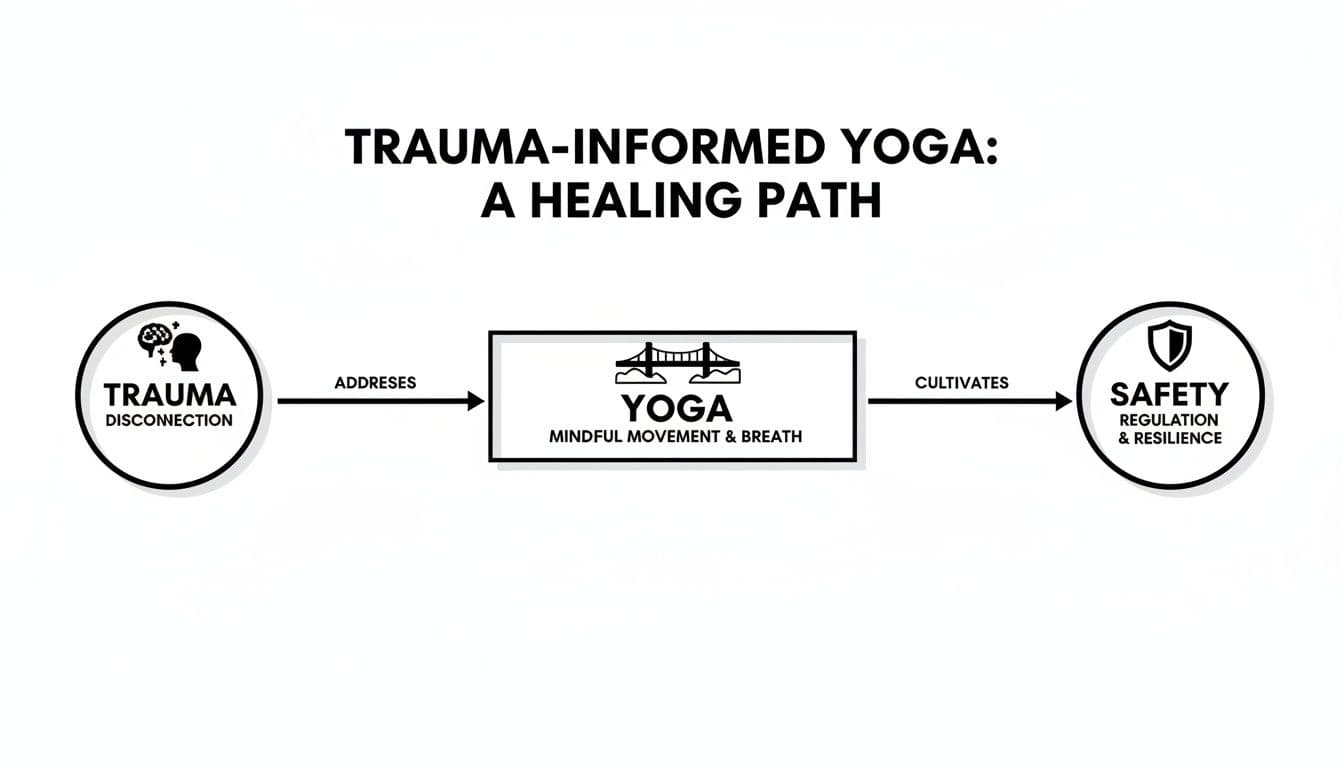
This path—from disconnection to safety—is a journey. It’s about using the practice as a bridge to come back to yourself.

Diagram showing trauma-informed yoga as a healing path, addressing trauma disconnection and cultivating safety.

The image captures it perfectly: yoga acts as a conduit, helping to mend the separation between mind and body and guide you from a state of fragmentation toward wholeness and security.

This conscious work helps you move beyond just surviving and start truly thriving. While the physical postures are important, the practice often works on much deeper levels to rebalance your internal systems. It shares this goal with complementary modalities like energy healing practices, which also focus on restoring inner balance.

Ultimately, trauma-informed yoga gives you the tools to become an active participant in your own healing. It teaches you how to anchor yourself in the present moment, offering a profound sense of control and proving that you have the power to feel grounded, centered, and safe within your own body once again.

The Core Principles of a Safe Yoga Practice

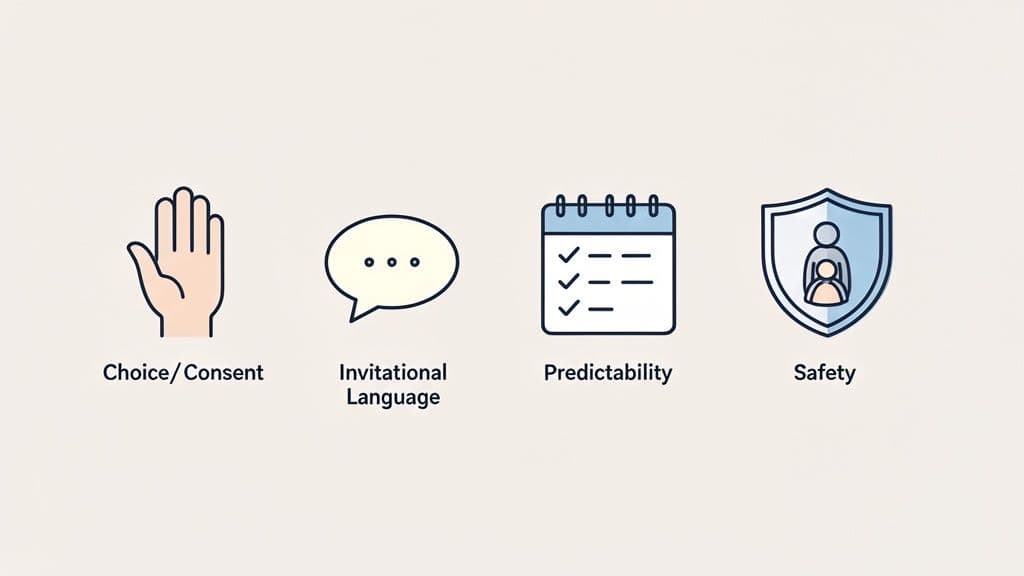
Four icons representing trauma-informed care principles: choice/consent, invitational language, predictability, and safety.

So, what’s the real difference between a standard yoga class and one that offers a space for deep safety and healing? It isn’t really about the poses. The magic lies in the core principles that shape every word, every silence, and every choice made in the room. A trauma-informed practice is built entirely on a framework designed to give power and control back to you.

These aren’t just items on a checklist; they represent a fundamental shift in philosophy. The focus moves away from the instructor as the expert and instead acknowledges that you are the ultimate authority on your own body and experience. Knowing what these pillars are helps you understand what to look for in a truly supportive practice.

Shifting from Commands to Invitations

The first thing you’ll probably notice is the language. In a typical class, you might hear direct commands like, "Lift your arms" or "Go to Downward Dog." In a trauma-informed class, that language softens into an invitation.

Instead, you’ll hear phrases like, “You might explore lifting your arms,” or “When you feel ready, an option is to find a comfortable stretch.” This small change makes a world of difference. It completely removes any pressure or sense of obligation, framing every movement as a choice, not a mandate. This is a vital step in rebuilding a sense of personal agency.

The Power of Choice and Agency

At its core, trauma can rob a person of their sense of control. A primary goal of trauma-informed yoga is to consciously hand that control back, one moment and one breath at a time. You are consistently reminded that you always have a choice.

This might look like:

  • Modifying a Pose: Choosing a version of a shape that feels better in your body, right now.
  • Opting Out: Deciding to skip a movement entirely, without any need for an explanation.
  • Taking Rest: Resting at any point during the class, for as long as you need.

This constant offering of choice is a practice in itself. It helps you reconnect with your innate ability to make decisions for your own well-being—a skill that will serve you long after you’ve rolled up your mat. This focus on self-knowledge and personal authority mirrors some of the core ethical guidelines of yoga, such as the Yamas and Niyamas, which guide how we relate to ourselves and the world around us.

Creating Predictability and Consistency

When the nervous system is stuck on high alert, surprises can feel like threats. Predictability, on the other hand, creates an environment of calm and safety. A trauma-informed teacher gets this and intentionally creates a consistent and predictable container for the practice.

This often means laying out the structure of the class right at the beginning, so you know exactly what to expect. Things like the room setup, the lighting, and even the teacher’s tone of voice are kept as consistent as possible. This stability minimizes potential triggers and allows your nervous system to finally settle, making it easier to turn your attention inward.

“Being trauma-informed is about creating an environment where people feel safe, respected, and free to explore movement at their own pace. The practice shifts the focus from how a pose looks to how it feels, supporting students in reconnecting with their bodies.”

In many yoga classes, it’s common for instructors to offer hands-on adjustments. In a trauma-informed setting, however, physical touch is handled with extreme care and is always, always based on explicit consent.

More often than not, teachers will simply adopt a completely hands-off policy to honor personal boundaries and eliminate any risk of triggering past trauma. If assists are offered at all, it's done with a clear, opt-in process that ensures you are in full control of your own space. This respect for your physical autonomy is non-negotiable.

These principles all work together to create an experience that feels empowering and restorative. The impact can be immediate; it helps build self-efficacy, which is the belief in your own ability to handle life's challenges. In fact, a 2023 study with survivors of domestic violence found that even a single session of trauma-informed yoga brought significant improvements in stress levels and overall well-being. This journey of reclaiming self-trust is similar to the clarity gained from tools like Dan Millman's book, The Life You Were Born to Live, and the Life Purpose App, which help you understand your unique path by making you the expert of your own life.

What to Expect in Your First Class

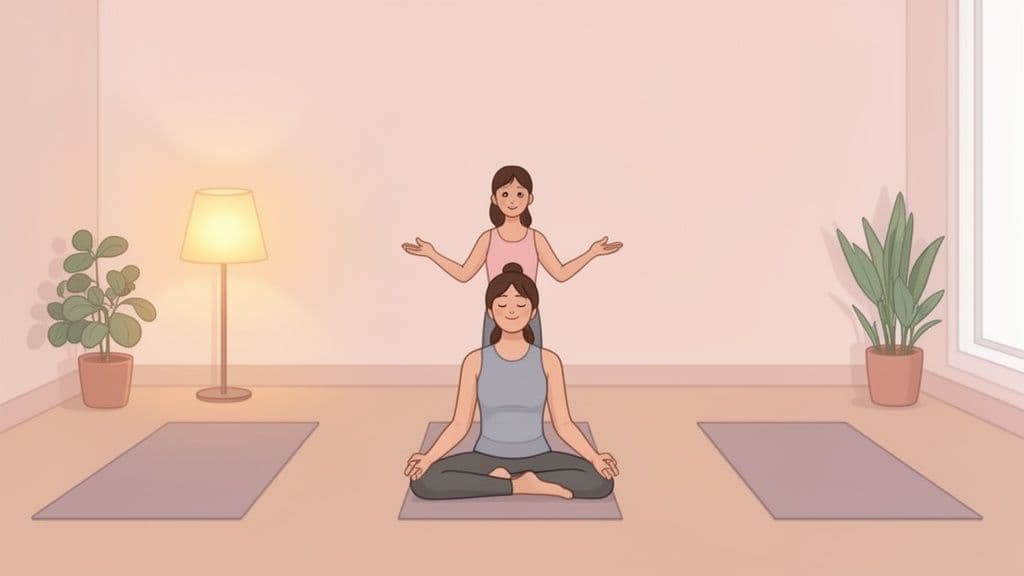
A yoga instructor gently guides a student in a meditative pose on a mat in a peaceful room.

It’s completely normal to feel a bit hesitant before trying something new, especially a practice as personal as trauma-informed yoga. Knowing what to expect can make all the difference, so let's walk through what a session typically looks and feels like.

One of the first things you might notice is the room itself. The environment is intentionally set up to be a calming, low-stimulation space. This often means softer lighting, a quiet atmosphere, and more generous spacing between mats than you'd find in a standard studio class, giving you a tangible sense of your own area.

A Focus on Gentle, Grounding Movement

If you’re worried about fast-paced flows or being bent into a pretzel, you can breathe a sigh of relief. The movements in a trauma-informed class are intentionally simple, slow, and grounding. The entire practice is less about what a pose looks like and more about what it feels like in your body.

You’ll be guided through shapes and movements designed to help you feel the support of the floor beneath you. The pace is deliberately unhurried, giving you ample time to breathe and notice sensations without any pressure to keep up. In fact, moving at your own pace is encouraged.

The instructor’s language is a huge part of this. Instead of commands, you’ll hear invitations that empower choice:

  • “If it feels okay in your body, you might explore a gentle stretch here.”
  • “An option is to place a hand on your belly and simply notice your breath.”
  • “Remember, you can rest at any time. Child’s pose is always available.”

This approach reinforces that you are the ultimate authority on your own experience. The goal isn’t a physical workout but a practice of building internal awareness and safety.

Predictability and Your Personal Space

A key element for creating a safe space is predictability. To avoid any surprises that might be jarring, the teacher will usually outline the class plan from the very beginning. Simply knowing what’s coming next can help the nervous system settle.

The practice isn't about pushing your limits; it's about honoring them. By offering choices and fostering a non-judgmental atmosphere, the class becomes a supportive space to rebuild trust in your own body.

You’ll also find that your personal space is deeply respected. Hands-on assists or adjustments are generally not used in this setting, ensuring you always feel secure within your own physical boundaries. Everything is structured to hand control back to you, reinforcing that your comfort is the top priority.

This mindful approach is part of a larger cultural shift toward mental health awareness. It's not surprising that as people seek out tools for stress management, yoga's popularity has soared. National Health Interview Survey data from 2002 to 2022 shows that by 2022, 55.78 million U.S. adults practiced yoga. You can read more about the trends fueling yoga's growth at the Global Wellness Institute.

How to Find a Qualified Teacher and Practice

Stepping into a trauma-informed yoga class can be a huge step, and finding the right guide for that journey is probably the most important decision you'll make. This is deeply personal work. You deserve a teacher who’s not just certified, but genuinely committed to creating a space where you feel truly safe.

Let's be clear: a standard 200-hour yoga teacher certification, while a great foundation, simply isn't enough for this kind of specialized practice. A properly qualified instructor has gone further, seeking out specific training that dives deep into the intersection of trauma, the nervous system, and movement. This isn't just about learning poses; it's about understanding how to hold space for someone else's nervous system.

When you’re looking into a new teacher or studio, please, ask questions. Your safety and comfort are the top priority, and any teacher worth their salt will welcome your diligence with open, transparent answers.

Key Questions to Ask a Potential Teacher

Think of this as a short, gentle interview to see if it’s a good fit. A confident and well-trained instructor will be happy you're taking such care. Here are a few things you might want to ask:

  • "What specific trauma-informed yoga training have you completed?" You're listening for the names of established, reputable programs, not just a weekend workshop. Solid training is often rooted in neuroscience and psychology, and the teacher should be able to speak to that.

  • "How do you create a choice-driven environment in your classes?" A good answer will revolve around concepts like using invitational language ("I invite you to..." instead of "Do this..."), constantly offering different options for a pose, and making it explicitly okay to rest or skip anything that doesn't feel right.

  • "What's your policy on hands-on assists?" For a trauma-informed class, the gold-standard answer is something like, "I have a hands-off policy," or "I only offer adjustments after getting clear, enthusiastic consent each and every time." This shows a profound respect for your personal space and boundaries.

  • "How do you handle it if a student has an emotional response during class?" A skilled teacher will talk about maintaining a non-judgmental container. Their job isn't to be a therapist or "fix" the feeling, but to ensure the space remains safe for that emotion to simply be, without intervention.

These questions help you find a teacher who truly gets the immense responsibility they hold.

Red Flags to Watch For

Just as you look for green flags, it's wise to know what to avoid. Sometimes, a class might be marketed as "trauma-sensitive" but the practice itself doesn't reflect the principles.

A critical ethical line for any trauma-informed yoga teacher is knowing this practice is a supportive tool, not a replacement for therapy. The teacher should never try to analyze your experience, offer psychological advice, or act like a clinical healer.

Be cautious if an instructor:

  • Uses commanding or demanding language ("Now, you will...") instead of offering invitations.
  • Fosters a competitive or performance-oriented vibe.
  • Is vague about their policies on physical touch and consent.
  • Presents themselves as a guru or an infallible expert.
  • Blurs the lines between being a yoga teacher and a therapist.

Ultimately, your intuition is your best guide. If a teacher or an environment just feels off, trust that feeling. Walking away to find a better fit is an act of self-care and empowerment—which is exactly what this practice is all about. This self-knowledge is a cornerstone of personal growth, much like the insights you can find using tools like Dan Millman's book, The Life You Were Born to Live, and the accompanying Life Purpose App, which help you become the expert of your own life's path.

Integrating Mindful Practice into Your Life's Path

The real power of trauma informed yoga isn't confined to what you do on your mat. The practice is really about learning to carry that sense of safety, choice, and awareness with you into every part of your life. It's a way to rebuild a relationship of trust with your own body, creating a foundation for resilience you can stand on no matter what comes your way.

Ultimately, the most important work happens when the class is over. The self-awareness you practice—noticing your breath when stress spikes, feeling your feet on the ground when you're overwhelmed—begins to show up everywhere. It becomes a lived, moment-to-moment experience.

From the Mat into Your World

Think of your yoga practice as a personal laboratory. It’s a dedicated space where you can safely experiment with new ways of inhabiting your body and listening to its signals. The skills you learn there don't stay behind; they are meant to come with you.

  • Honoring Your "No": Just like you learn to modify or skip a pose that doesn't serve you, you become more confident in setting boundaries in your life and relationships.
  • Finding Your Ground: The simple act of feeling your feet on the floor becomes a powerful tool you can use anytime to ground yourself during a tough conversation or a moment of panic.
  • Choosing Your Response: Mindfulness creates a crucial pocket of time between a trigger and your reaction. In that space, you find the freedom to choose how you want to respond instead of being pulled into old patterns.

This is where the real transformation takes root. You start to shift from a life dictated by past experiences to one where you are consciously and actively creating your present.

Trauma may not be your fault, but healing becomes your responsibility. This practice gives you the tools to take on that responsibility with deep compassion for yourself, rebuilding your life from a place of inner strength.

Aligning Body and Purpose

This journey of bringing your body and mind into alignment mirrors the work of discovering your life’s purpose. Many of us are looking for a map to make sense of our lives—to understand our natural gifts, our repeating challenges, and the unique path we're meant to walk.

Resources like Dan Millman’s book, The Life You Were Born to Live, and the Life Purpose App offer an incredible blueprint for this kind of self-discovery, helping you decode the numbers that shape your purpose. Trauma-informed yoga provides the physical practice to truly live that knowledge. For instance, if your life path points to a core lesson around self-worth, this practice offers a tangible way to build a felt sense of value and safety from the inside out. You can explore more on how these practices intertwine in our article on meditation for self-discovery.

It’s all about harmonizing your inner and outer worlds so you can show up more authentically. By gently working through the internal friction that holds you back, you clear the way to step fully and confidently into the life you were born to live. This practice is a profound act of coming home to yourself.

Your Questions Answered: What to Expect from Trauma-Informed Yoga

It’s completely normal to have questions as you think about trying trauma-informed yoga. Making the choice to step onto the mat in this way is deeply personal, and feeling prepared can make all the difference. Let’s walk through a few of the things people often wonder about.

Do I Need to Be Flexible or Have Any Yoga Experience?

Not at all. This is probably the biggest misconception we hear, and it couldn't be further from the truth. Trauma-informed yoga isn't about bending into pretzel shapes or even being able to touch your toes.

The entire practice is built around noticing what’s happening in your body in a gentle and curious way. Classes are intentionally designed for every body, regardless of fitness level or physical ability. You’ll be guided through simple, accessible movements, and the most important rule is to only do what feels right for you.

Is This a Replacement for Therapy?

No, and this is an incredibly important point. Any well-trained trauma-informed yoga teacher will be crystal clear about this boundary. This practice is a somatic (body-based) tool that can be a powerful partner to clinical therapy, but it is not therapy itself.

Your yoga teacher is there to guide you through physical shapes and help you cultivate a feeling of safety within your own skin. They are not a therapist. They won't analyze your past, offer psychological advice, or act in a clinical capacity.

Think of it as a collaboration. While a licensed mental health professional helps you process your experiences through talk therapy, this practice helps you work with the physical sensations and patterns that trauma can leave in the body. They support each other beautifully.

What if I Get Emotional During a Class?

First, know that this is completely normal and even expected. When you create a safe space for the body to be heard, emotions often come to the surface. Feeling something—anything at all—is a sign that you are beginning to reconnect with yourself.

You will always have complete control over how you respond. You might choose to pause and rest, shift into a different position, or simply allow the feeling to be present without judgment. A skilled teacher is trained to hold space for these moments quietly and respectfully, never drawing attention to you or trying to "fix" it. Your emotional safety and your right to choose are always the top priority.


At Life Purpose App, we believe in tools that empower your journey of self-discovery. Just as trauma-informed yoga helps you listen to your body’s wisdom, our app offers a structured way to understand your unique path in life. Find your blueprint by visiting us at lifepurposeapp.com.

← Back to blog

Discover Your Life Purpose Today!

Unlock your true potential and find your life’s purpose.