Karma Yoga is the practice of turning everyday duties into selfless, mindful action. This guide explains core principles and shows simple steps to reduce stress and find purpose in work, relationships, and chores.

February 26, 2026 (7mo ago) — last updated October 9, 2026 (15d ago)
Karma Yoga Guide: Selfless Action for Daily Life
Learn practical Karma Yoga: turn daily tasks into selfless practice to reduce stress, find purpose, and improve work and relationships.
← Back to blog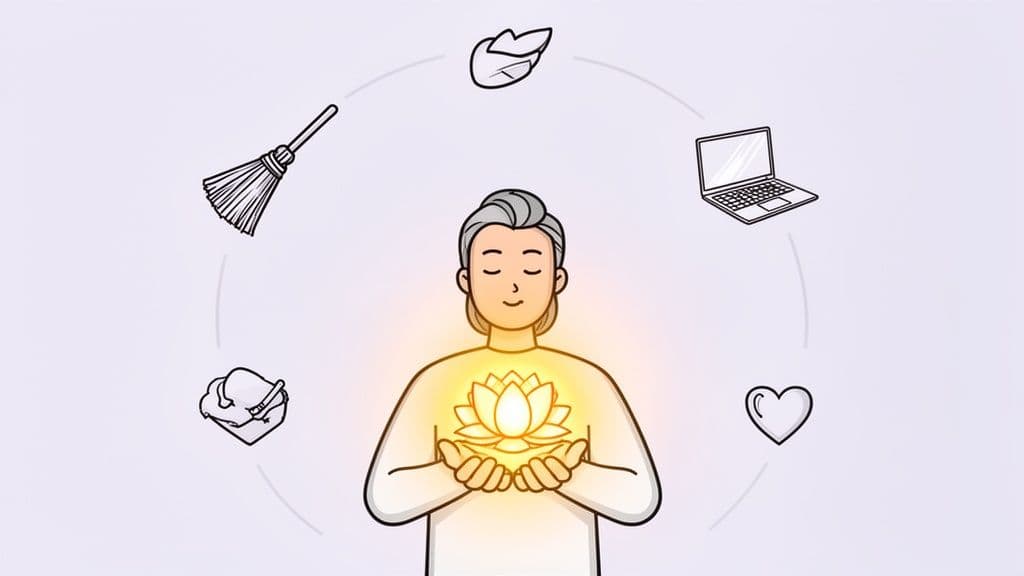
Karma Yoga is the practice of turning everyday duties into selfless, mindful action. This guide explains core principles and shows simple steps to reduce stress and find purpose in work, relationships, and chores.
Karma Yoga Guide: Selfless Action for Daily Life
Discover what Karma Yoga is and how selfless action can transform your daily life. A practical, actionable guide you can apply today.
So, what is Karma Yoga, really? Let’s get right to the heart of it.
At its core, Karma Yoga is the spiritual path of selfless action. It’s about pouring your full attention and dedication into your daily duties—whatever they may be—without getting hung up on the results. Think of it as finding profound meaning in the process, not just the prize at the end.
Unpacking the Path of Action

When most of us hear “yoga,” our minds jump to postures and breathing. Karma Yoga is different: it’s a way of living every moment with presence, whether you’re at your desk, washing dishes, or helping a neighbor move a couch.
This is the yoga of doing, designed for people woven into the fabric of daily life with all its demands and responsibilities.
The central idea is simple but powerful: any action, no matter how small or ordinary, can become a form of meditation. Shift your motivation from “What do I get out of this?” to “How can I do this well and with purpose?”
You don’t need to abandon ambition or responsibility. Karma Yoga invites you to show up for your duties with presence and dedication, finding fulfillment in the act itself.
Picture a potter lost in their work. Their focus isn’t the final sale or praise. They’re absorbed, finding joy in shaping the clay. That’s Karma Yoga in action.
The Inner Shift: From Reward to Purpose
A large part of daily stress comes from being chained to specific outcomes1. Karma Yoga teaches loosening that grip. “You simply learn to act for the sake of the action itself, as an offering to the world, rather than for what you might get back.”
This perspective turns routine tasks into chances for growth and helps you discover quiet purpose in the present moment.
To make this practical, let’s break down the practice’s key elements.
The Core Components of Karma Yoga at a Glance
| Component | Description | Everyday Example |
|---|---|---|
| Selfless Action | Performing your duty with full dedication, without expecting personal gain, praise, or recognition. | A software developer codes with focus on creating a high-quality, useful product, not just for a bonus. |
| Non-Attachment to Fruit | Letting go of the desire for a specific outcome. You control the action, but the result is not yours. | A chef cooks a meal with love and precision but remains emotionally neutral to whether it wins an award or not. |
| Duty (Dharma) | Fulfilling your responsibilities to family, work, and community with integrity and a sense of purpose. | A parent patiently helping their child with homework, seeing it as their role rather than a chore. |
| Offering to the Divine | Treating every action as a sacred offering to a higher power, the universe, or a greater good. | A street sweeper who does their job meticulously, seeing it as a way to create beauty and order for others. |
By integrating these components, Karma Yoga becomes less of a to-do list and more of a way of being.
What Karma Yoga Is Not
Clear up a few common misunderstandings:
- It’s not passive or submissive. Karma Yoga requires skillful, diligent, wholehearted action.
- It’s not about working for free. The practice changes your inner attitude toward work, whether you’re a CEO or a volunteer.
- It’s not indifference. Detachment doesn’t mean you stop caring; it means you care about the quality and integrity of your action rather than applause.
Acting without being chained to the fruits of your labor is central to Karma Yoga and connects with modern research on intrinsic motivation and well-being3.
Rooted in texts like the Bhagavad Gita, this philosophy offers a practical way for busy people to find spiritual meaning in everyday responsibilities4.
The Ancient Roots of Selfless Action
Karma Yoga isn’t a modern wellness trend. Its roots run deep in some of the world’s oldest spiritual texts. To grasp Karma Yoga, we return to a battlefield in ancient India where a profound dialogue unfolded.

The Bhagavad Gita frames the idea in a conversation between Arjuna, a warrior prince, and his guide Krishna. Arjuna is paralyzed by grief and moral confusion; Krishna advises him to act without attachment to results2.
“You have a right to perform your prescribed duty, but you are not entitled to the fruits of action. Never consider yourself the cause of the results of your activities, and never be attached to not doing your duty.” — Bhagavad Gita 2.47
Krishna’s counsel reframes spiritual practice as wholehearted engagement with life, not escape from it.
A Path for Everyone
Karma Yoga made spiritual practice accessible to householders—parents, workers, leaders—not only ascetics. Examples:
- For the householder: raise a family with love, without clinging to outcomes.
- For the worker: do your job with skill and integrity, not only for the paycheck.
- For the leader: make decisions for the greater good, free from personal gain.
By making life itself the practice, Karma Yoga offered a practical path to growth and insight that evolved across centuries of Hindu, Buddhist, and Jain thought4.
Three Core Principles for Everyday Practice
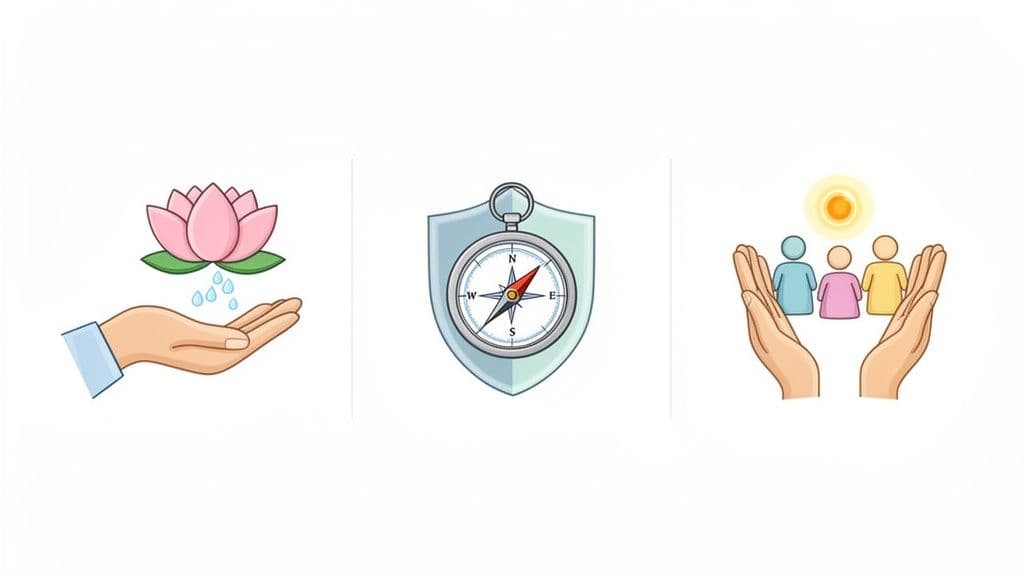
Boil Karma Yoga down to three practical mindsets you can bring to work, relationships, and chores.
Action Without Attachment
Nishkama Karma asks you to give your best and then let go of the result. Much of our stress comes from attachment to outcomes1. By focusing on the integrity of effort, you step off the emotional rollercoaster of success and failure.
Fulfilling Your Duty
Embrace your Dharma—your roles and responsibilities. This isn’t blind obedience; it’s recognizing where you are and showing up with integrity. At work, at home, and in community, performing your role well becomes spiritual practice.
Offering the Fruits of Your Action
Dedicate the results of your efforts to something larger than yourself: family well-being, team success, community good, or a higher ideal. This mental dedication shifts motivation from “What’s in it for me?” to “How can this action serve?”
Small changes in perspective can turn washing dishes into making a peaceful home.
How to Practice Karma Yoga in a Modern World
Ancient philosophy meets daily life. Karma Yoga doesn’t require giving up your career; it requires changing how you approach what you already do.
Karma Yoga at Your Job
Workplaces are fertile ground for this practice. Reframe your job as service and focus on delivering value rather than chasing titles.
- Focus on the task: lose yourself in the process and aim for excellence.
- Support colleagues: help a struggling teammate because the team matters.
- Handle feedback gracefully: see criticism as information to improve.
Work-related stress and burnout are common; recognizing work as practice can reduce anxiety and improve resilience—especially when paired with organizational support6.
Cultivating Selfless Action in Relationships
Relationships are full of opportunities to practice Karma Yoga. Much anxiety in connection comes from expectations. Flip that and focus on giving.
Offer presence without an agenda. Listen without planning your reply. Offer undivided attention for the other person’s sake. That kind of listening deepens bonds more than transactional reciprocity.
Transforming Mundane Chores into Mindful Moments
Even boring chores can become meditation. Instead of rushing, bring attention to sensations and actions. Steps:
- Be present: notice the warm water as you wash dishes.
- Act with intention: frame the chore as care for your home.
- Release the outcome: do the task well without needing recognition.
Mindful engagement with routine tasks reduces stress and improves well-being, according to systematic reviews of meditation and mindfulness programs5.
Volunteering is a direct form of Karma Yoga, but the deeper practice is transforming your mindset so every moment becomes an opportunity to act with purpose.
Finding Your Path: Karma Yoga and Other Spiritual Traditions
Karma Yoga is one of four primary paths of Yoga described in ancient texts. Each suits different temperaments, yet all aim for inner growth.
| Path of Yoga | Primary Focus | Core Practice | Best Suited For |
|---|---|---|---|
| Karma Yoga | Selfless action | Performing duties without attachment to results | Active, engaged, community-oriented people |
| Bhakti Yoga | Devotion and love | Prayer, chanting, ritual | Heart-centered, devotional people |
| Jnana Yoga | Wisdom and knowledge | Study, inquiry, contemplation | Intellectual, analytical minds |
| Raja Yoga | Meditation and mind control | Concentration, meditation, discipline | Introspective individuals with strong will |
Karma Yoga stands out as practical for modern life because it doesn’t ask you to retreat. It teaches you how to find spiritual meaning in everyday action.
These ideas appear across traditions and developed over centuries into the systems we recognize today4.
For related practices, see our Meditation guide and our article on developing purpose at work.
Common Misconceptions About Karma Yoga
Some myths make Karma Yoga seem impractical. Let’s clear up the biggest misunderstandings.
- Karma Yoga means being passive? No. It demands strength and full engagement.
- Is it only for religious people? No. The principles are psychological and human; benefits like reduced anxiety are available to everyone.
- Does detachment mean indifference? No. Detachment frees you to act with courage and clarity, not coldness.
Quick Q&A — Common Questions
How do I start practicing Karma Yoga right away?
Choose one routine task and give it your full attention. Do it well, then let go of the outcome.
Will Karma Yoga reduce my stress?
Yes. By shifting satisfaction from external results to the quality of effort, you reduce anxiety about outcomes and gain steadier calm1.
Can Karma Yoga fit into a busy life?
Absolutely. It’s designed for people living fully in the world; your daily duties become the practice.
Three Concise Q&A Summaries
Q1: What is Karma Yoga in one sentence?
A1: Karma Yoga is the practice of performing duties with full attention and selfless intent, while releasing attachment to outcomes.
Q2: How does Karma Yoga help with work and relationships?
A2: It reframes tasks as service, reduces stress tied to results, and deepens relationships through selfless presence.
Q3: Do I need to change my lifestyle to practice Karma Yoga?
A3: No. The practice is a mindset shift you apply to existing roles—parent, worker, friend—so daily life becomes the path.
Ready to uncover your unique purpose and bring more clarity to your actions? The Life Purpose App is a digital companion to Dan Millman’s bestselling book The Life You Were Born to Live. It offers access to an ancient system of self-knowledge and life-path insight based on your birth date. Discover your core strengths and challenges and start living a more harmonious, purpose-driven life today. Find out more at https://www.lifepurposeapp.com.
1.
American Psychological Association, “Stress in America,” 2019, https://www.apa.org/news/press/releases/stress/2019.
2.
Bhagavad Gita, 2.47, translation and commentary, https://vedabase.io/en/library/bg/2/47/.
3.
Edward L. Deci and Richard M. Ryan, “Self-Determination Theory: A Macrotheory of Human Motivation, Development, and Health,” Annual Review of Psychology 2017 (overview and foundational review available), https://selfdeterminationtheory.org/SDT/documents/2000_DeciRyan_ARP.pdf.
4.
“Vedas,” Encyclopaedia Britannica, overview of Vedic texts and chronology, https://www.britannica.com/topic/Vedas.
5.
H. Goyal et al., “Meditation Programs for Psychological Stress and Well-being: A Systematic Review and Meta-analysis,” JAMA Internal Medicine, 2014, https://www.ncbi.nlm.nih.gov/pmc/articles/PMC5771453/.
6.
World Health Organization, “Burn-out an ‘occupational phenomenon’: International Classification of Diseases,” 2019, https://www.who.int/news/item/28-05-2019-burn-out-an-occupational-phenomenon-international-classification-of-diseases.
Discover your life path today
Enter your date of birth and see your life path, free.
Find your life path