March 27, 2026 (Today)

A Complete Guide to Yoga Moon Salutations (Chandra Namaskar)

Discover Yoga Moon Salutations (Chandra Namaskar), a calming flow to honor lunar energy. Learn the poses, benefits, and how to start this restorative practice.

← Back to blog
Cover Image for A Complete Guide to Yoga Moon Salutations (Chandra Namaskar)

Discover Yoga Moon Salutations (Chandra Namaskar), a calming flow to honor lunar energy. Learn the poses, benefits, and how to start this restorative practice.

If Sun Salutations are your morning coffee, then Yoga Moon Salutations, or Chandra Namaskar, are your calming evening tea. This graceful, cooling sequence is designed to help you unwind, tune inward, and connect with the quiet, reflective energy of the moon. Unlike its solar counterpart, this practice emphasizes lateral side-bends and grounding postures that soothe your nervous system.

Why You Need a Calming Practice Like Moon Salutations

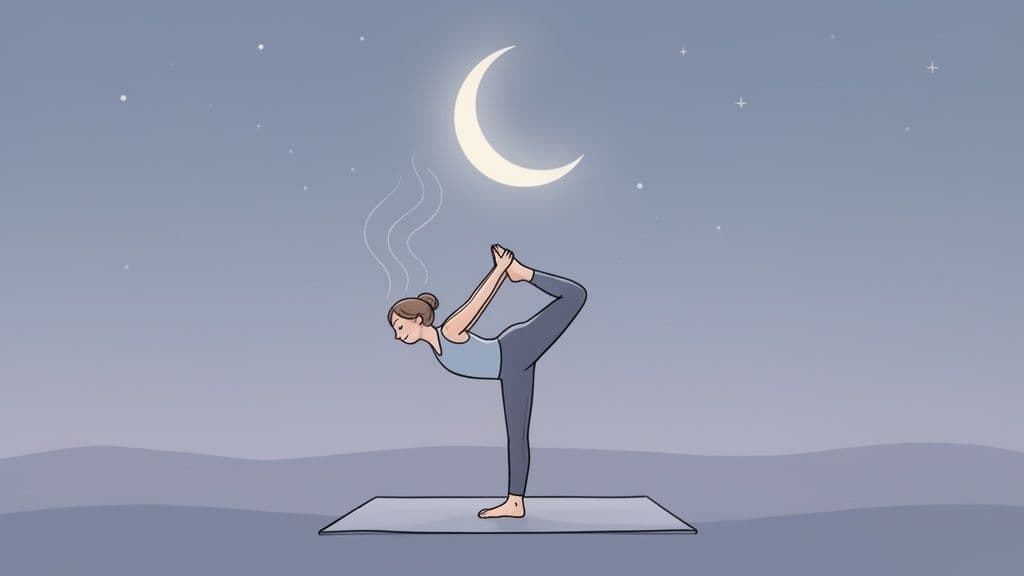
A woman performs a graceful Dancer's Pose on a yoga mat under a crescent moon and stars at night.

Do you ever feel like you're constantly running on empty? We live in a culture that celebrates hustle, but yoga moon salutations are a powerful antidote. They represent the "yin" to the "yang" of our demanding daily lives, creating a much-needed space for rest and renewal.

This practice is far more than just a physical workout. It’s a genuine invitation to slow down and listen to your body’s own quiet rhythms—something that’s all too easy to ignore when life gets loud.

The Origins of a Modern Ritual

You might be surprised to learn that while moon worship is ancient, the formal Chandra Namaskar sequence is a relatively recent creation. It came together in the late 1980s at the Kripalu Institute after teachers realized that 80-90% of yoga instruction was dominated by masculine, solar energy.

They developed this flow to specifically honor the feminine, receptive, and downward flow of energy, offering a beautiful counterbalance to more dynamic practices. You can learn more about this modern history and the philosophy behind it on their blog.

This concept of balancing our inner energies and understanding our personal life cycles is also a central theme in Dan Millman's work. His book, “The Life You Were Born to Live,“ and the companion Life Purpose App, offer incredible tools for decoding our own unique energetic blueprints.

Moon Salutations are a beautiful way to physically manifest the act of introspection. Just as the Life Purpose App helps you understand your inner blueprint, this practice helps you feel it in your body.

Finding Stillness in a Hectic World

Making time for a calming practice is non-negotiable for managing stress and staying centered. It's about discovering what truly helps you unwind, whether it's a flowing yoga sequence or a simple moment of quiet reflection. If you're looking for other ideas, there are plenty of simple yet powerful methods out there; you can explore these 5 different ways to relax.

Ultimately, the goal is to intentionally carve out moments of stillness in your day. This skill pairs perfectly with the gentle, meditative quality of Moon Salutations. If you're interested in going deeper, our guide on how to practice mindfulness is a great place to start.

The Modern Story and Deeper Meaning of Chandra Namaskar

You might think a practice called the Moon Salutation, or Chandra Namaskar, is thousands of years old, passed down from ancient sages. The truth is, its story is much more recent and, frankly, quite fascinating. While reverence for the moon is certainly an ancient concept in India, the specific sequence of poses we practice today was actually developed in the late 20th century.

It came about to fill a very real need in the yoga world. For a long time, the focus was heavily on heat-building, "solar" practices like the Sun Salutation. There was a desire for balance—for a practice that was more cooling, receptive, and feminine in its energy. The yoga moon salutations sequence was a direct answer to that call.

This infographic really puts into perspective how modern yoga sequences, including the Moon Salutation, evolved over time.

Flowchart showing modern yoga's evolution from the Vedic Era to Sun Salutation, then Moon Salutation.

It’s a great reminder that while yoga’s spiritual roots run incredibly deep, the structured asana flows we know and love are often more recent innovations.

Tuning Into Your Inner Tides

But this practice is so much more than just a collection of poses. In many spiritual traditions, the moon is seen as the governor of our emotions, intuition, and subconscious mind. It pulls the ocean's tides, and symbolically, it does the same for the emotional tides within us.

When you practice Moon Salutations, you're doing more than just moving your body. You're consciously aligning with these personal rhythms. It’s like having a physical conversation with your own inner world.

This connection to our personal cycles always reminds me of the energetic patterns explored in Dan Millman's incredible book, “The Life You Were Born to Live.“ The frameworks in the book and its companion Life Purpose App really highlight how our personal ebbs and flows often mirror these larger cosmic cycles.

Seeing your practice through this lens transforms it from simple stretching into a profound act of listening to the deepest parts of yourself.

A Modern Sequence with Ancient Roots

So, while ancient yogic texts definitely honored the sun and moon, the structured Moon Salutation is a modern creation. It was formalized in the late 1980s, which is quite different from the Sun Salutation, which was systemized around the 1920s.

Interestingly, references to Namaskaras (salutations) at sunrise and sunset do appear in the 3,500-year-old Rig Veda. But the formalization of these specific flows as a form of physical exercise is largely a 20th-century phenomenon, adapted to meet our modern wellness needs. You can dive deeper into this history and see how it contrasts with Sun Salutations at Winter Haven Yoga.

Knowing this context doesn't diminish the practice. If anything, it enriches it, showing how yoga is a living tradition that continually adapts to support us.

How to Flow Through the Moon Salutation Sequence

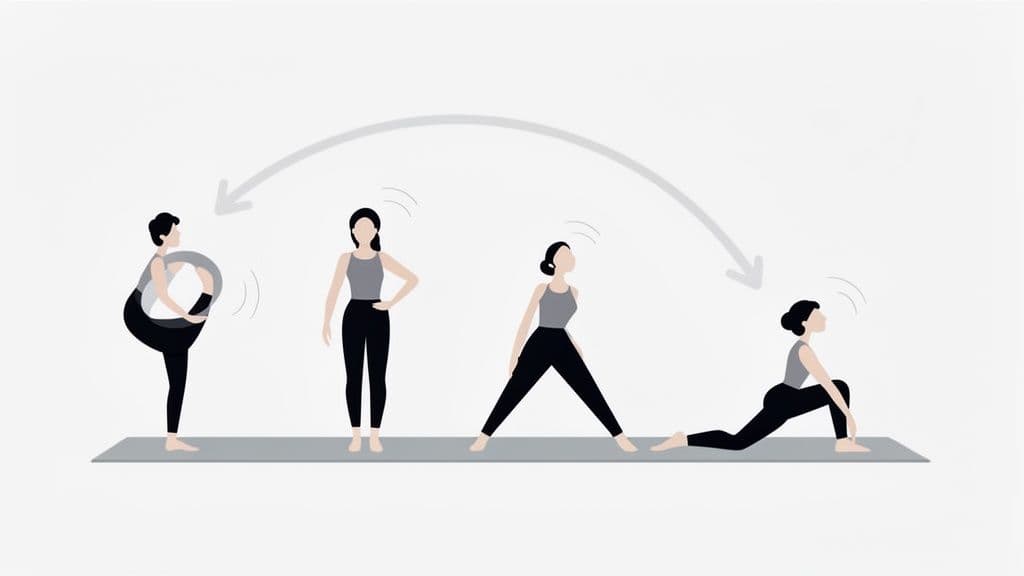
A woman demonstrates four distinct yoga poses in a sequential flow with an arrow.

Alright, this is where we bring the practice to life on the mat. Unlike the forward-and-back motion of Sun Salutations, the yoga moon salutations sequence is a beautiful, lateral journey across the width of your mat. Think of it as a dance from one side to the other and back again, almost like you’re mirroring the waxing and waning of the moon itself.

Let’s move through this graceful flow, really tuning into the sensation in your body and the rhythm of your breath. The secret is to move with intention, not speed. Inhale to find length and create space; exhale to sink deeper or transition into the next shape.

Opening Bends and Finding Your Ground

Begin by standing on the left side of your mat in Mountain Pose (Tadasana). Your feet are about hip-width apart, and your palms are gently pressed together at your heart. Take a full, grounding breath here. Feel the solid connection between the soles of your feet and the floor beneath you.

Standing Crescent Moon: On your next inhale, sweep your arms high overhead. Go ahead and interlace your fingers, but let your index fingers point straight up to the sky. As you exhale, press your left hip out to the side and gracefully bend your upper body to the right, feeling a delicious stretch along your entire left side. Keep both feet firmly grounded to get the most out of this. Inhale to return to the center, then exhale and take the bend to the other side.

Goddess Pose (Utkata Konasana): From the center, take a big step out with your right foot, landing with your feet wide and toes angled slightly outward. Exhale and bend your knees deeply, sinking your hips down as if sitting in a chair. Your knees should track directly over your ankles. Bend your arms to a 90-degree angle, creating cactus arms with your palms facing forward. This is a powerful pose; feel your strength and stability.

The flow of Chandra Namaskar is meant to be intuitive. Don't worry about perfect form at first. Instead, focus on coordinating your breath with the movement—inhale to extend, exhale to bend or ground. This simple act turns the sequence into a moving meditation.

Moving Into Deeper Stretches

From the strength of Goddess Pose, we’ll transition into postures that create length and release tension in the hips and hamstrings. This is where you’ll really start to feel that unique side-to-side flow.

Triangle Pose (Trikonasana): Inhale and straighten your legs. Turn your right foot to point toward the short edge of your mat and extend your arms so they’re parallel to the floor. As you exhale, hinge from your right hip, reaching forward as far as you can before letting your right hand come down to rest on your shin, ankle, or a block. Your left arm reaches for the sky, helping to peel your chest open.

Pyramid Pose (Parsvottanasana): Take an inhale to find length. On the exhale, lower your top hand and turn your hips to face your front foot. Fold your torso down over your front leg. It’s completely okay to keep a soft bend in that front knee, especially if your hamstrings are talking to you. The goal is a good stretch, not pain.

Low Lunge (Anjaneyasana): Inhale and generously bend your front knee, planting your fingertips on the mat on either side of your foot. Exhale and step your back foot even further back, gently lowering your back knee to the floor. Be sure to untuck your back toes. Check that your front knee is stacked right over your ankle—this protects the joint. To deepen the stretch, you can lift your chest and arms overhead.

The Heart of the Sequence and the Return Journey

Now we reach the lowest point of the sequence, a deep hip-opening squat, before we begin the journey back to where we started.

Side Lunge (Skandasana): From your Low Lunge, bring both hands to the inside of your front foot. On your next exhale, pivot on the ball of your back foot and start to shift your weight into a deep side lunge over your bent right leg. Your left leg extends out straight, with the foot flexed. This is a fantastic inner thigh and hip opener.

Garland Pose (Malasana): As you transition toward the center of your mat, you can flow through a low squat. Inhale and bring your feet a bit closer, sinking your tailbone down toward the earth. Bring your palms together at your heart and gently press your elbows against your inner knees. This is the turnaround point of our circular flow.

From here, you simply reverse the sequence on the other side. You'll move from Malasana into Skandasana on the left, then rise into a Low Lunge, Pyramid Pose, Triangle, Goddess, and finally back to a Standing Crescent Moon before returning to your starting Mountain Pose. This journey across the mat and back completes one full round.

The sequence is incredibly effective for improving flexibility and cultivating a deep sense of calm. If you enjoy its soothing qualities, you might also like to explore other cooling yoga poses that help balance your body’s energy.

Adapting the Practice for Your Body

The most beautiful yoga practice is one that truly honors your body exactly as it is today—not one that forces it into a "perfect" shape you saw online. The entire point of yoga moon salutations is to feel good, to turn your awareness inward, and to quiet your nervous system. Pushing through pain is the complete opposite of that goal.

This is where modifications and props become your greatest allies. Think of yoga blocks, blankets, and bolsters as wise extensions of your own body, not as crutches. They are simply tools to help you find that sweet spot of alignment and sensation in each posture. The most important skill you can cultivate is listening to your body's feedback. Some days you'll feel spacious and ready for more; on others, you might need a little extra support. Both are equally valid parts of the practice.

Making the Poses Work for You

Your Chandra Namaskar should feel like it was made just for you. Let's look at a few practical ways to adapt some of the key poses so they feel supportive and nourishing.

  • If you have tight hamstrings: When you arrive in Pyramid Pose (Parsvottanasana), don't think twice about placing yoga blocks under your hands. This simple act brings the floor up to meet you, so you can keep your spine long instead of rounding your back. A generous bend in your front knee is also a fantastic and always-available option.
  • If your balance feels wobbly: In a Low Lunge (Anjaneyasana), keeping your back knee on the mat creates a much more stable foundation. For added comfort, try placing a folded blanket under that knee—it can make a world of difference. Stability always comes before height.
  • If you have sensitive knees: For poses like Goddess Pose (Utkata Konasana) or the deep squat of Garland Pose (Malasana), don't feel pressured to go so low. Only sink your hips to a depth where your knees feel completely happy and supported.

The real yoga begins the moment you choose to honor your body's limits and work with them, not against them. A modification isn’t a step back; it’s a sign of advanced awareness and self-respect in your practice.

Deepening Your Moon Salutation

For those with a more established practice, adapting the sequence can mean going deeper rather than simply making it easier. It’s about adding new layers of awareness and intensity to the familiar shapes of the Moon Salutation.

You can bring a new dimension to your flow by:

  • Holding poses longer: Instead of flowing with every breath, experiment with holding poses like Triangle Pose or Goddess Pose for 3-5 full, deep breaths. This not only builds stamina but also gives you time to explore the subtle sensations that arise.
  • Engaging the bandhas: Bring a conscious engagement to your energetic locks—the root lock (Mula Bandha) and the abdominal lock (Uddiyana Bandha). This creates a powerful sense of internal lift and core stability, transforming the physical practice into a more energetic experience. These locks are deeply connected to the body’s energy centers, which you can learn more about in our guide to the chakras and their colors.

For a quick reference, I've put together a table with some common ways to adapt key poses, whether you’re just starting out or looking to explore a deeper variation.

Moon Salutation Pose Modifications

PoseBeginner ModificationDeeper Variation
Goddess PoseStay in a higher squat; don't sink as deeply.Lift your heels off the mat, balancing on the balls of your feet.
Pyramid PoseUse blocks under your hands and bend your front knee.Work toward bringing your forehead to your shin while keeping the spine long.
Side LungeKeep your hands on the floor for support and stay higher.Bring your hands to your heart and work on sinking your hips low.

Ultimately, these are just starting points. The more you practice, the more you'll learn your body's unique language and discover your own best ways to adapt each and every pose.

When to Practice Moon Salutations for Maximum Benefit

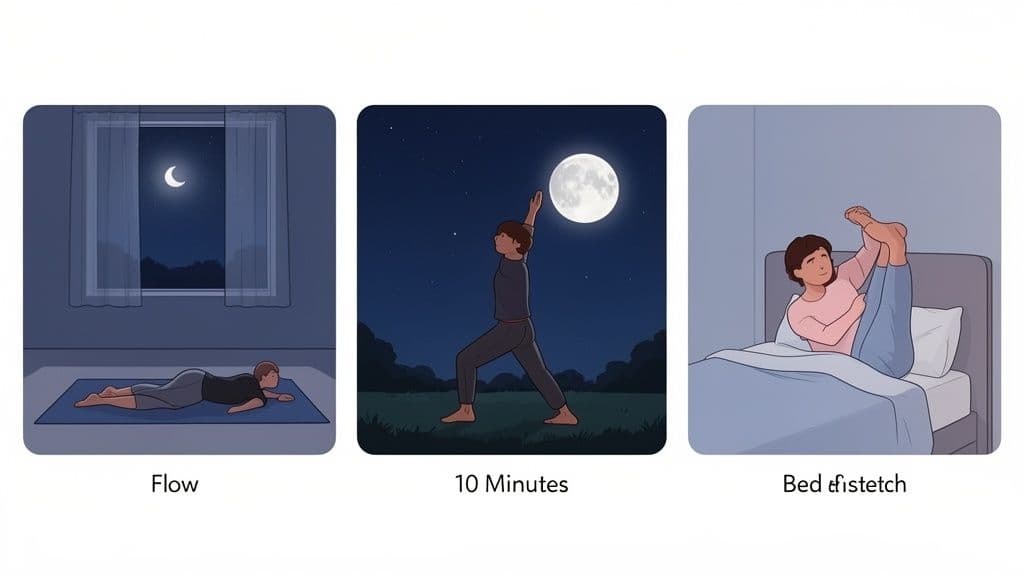
Three illustrations of people doing yoga and stretches at night, featuring a crescent and full moon.

You’ve learned the poses and felt the graceful, side-to-side rhythm of Chandra Namaskar. Now, the real art is knowing exactly when to bring this practice into your day. Unlike a fiery morning Vinyasa, the magic of yoga moon salutations is all about timing and intention.

For most people, the most natural time is in the evening. Think of it as a way to consciously close the chapter on your workday and open yourself up to rest. It’s an incredible tool for signaling to your mind and body that it's time to let go of the day's stress and prepare for a night of deep sleep.

Even a quick 10-minute flow can work wonders on a hectic night. It's just enough movement to wash away the mental clutter, leaving you feeling more grounded and ready for bed.

Syncing with Natural Cycles

Another powerful approach is to align your practice with the moon’s own cycle. For centuries, yogis have used the new and full moons as potent times for reflection, release, and setting intentions.

  • New Moon: This phase is all about new beginnings and planting seeds for the future. A gentle Moon Salutation can help you turn your focus inward and clarify what you hope to cultivate in the coming cycle.
  • Full Moon: A time of culmination and release. Practicing under the full moon can feel celebratory—a way to acknowledge your progress and consciously let go of anything that's holding you back.

Ultimately, the best time to practice is whenever you feel the call. If you're feeling stressed, emotionally drained, or just a little off-kilter, that's your body asking for a practice like this. It's less about a rigid schedule and more about an intuitive response to your own needs.

Honoring Your Personal Energy

This idea of aligning with cycles isn't just about the moon in the sky; it's also about our own unique energetic blueprints. This is a core idea in Dan Millman's book, The Life You Were Born to Live, which explores how our birth dates connect to specific spiritual laws and life paths.

The accompanying Life Purpose App offers a really accessible way to dig into these personal energetic patterns.

Three illustrations of people doing yoga and stretches at night, featuring a crescent and full moon.

When you start to recognize your own energetic highs and lows, you’ll instinctively know when a cooling, restorative practice like Chandra Namaskar is exactly what your system needs. On a high-energy day, you might opt for something more vigorous. But on days when you feel depleted or emotionally taxed, this sequence can become the most nourishing part of your entire day.

Common Questions About Moon Salutations

As you begin to explore yoga moon salutations, you'll probably have a few questions pop up. It's totally normal. Let's walk through some of the most common ones I hear from students so you can flow with confidence.

How Is a Moon Salutation Different From a Sun Salutation?

I like to think of them as balancing energies. Sun Salutations (Surya Namaskar) are all about building heat and energy. They’re very linear, moving you forward and back on your mat, which is why they feel so great in the morning to kickstart your day.

Moon Salutations (Chandra Namaskar), on the other hand, are designed to cool and calm the system. The movement is lateral, flowing from side to side across your mat. This unique flow helps you turn your focus inward, making it a perfect practice for the evening or any time you feel overwhelmed and need to ground yourself.

Can I Practice This If I'm a Beginner?

Absolutely! This sequence is wonderfully gentle and much more intuitive than it might look, which makes it very beginner-friendly. The most important thing is to move at your own pace and really listen to what your body is telling you.

The goal isn't to force your body into a "perfect" shape. The real magic is in how the practice makes you feel. Using a modification isn't a step back—it’s the mark of a smart, mindful practice.

Don't be shy about using props. Grab a couple of blocks to bring the floor closer to you in poses like Triangle or Side Angle. You can also always drop your back knee to the mat in a lunge to feel more stable.

How Often Should I Do Moon Salutations?

Honestly, the best guide here is your own intuition. There’s no strict rule you have to follow. Many people find that practicing a few times a week in the evening is a fantastic way to release the stress of the day.

It can also be a really beautiful ritual to align with the lunar cycle, especially during the new and full moons. Ultimately, turn to Chandra Namaskar whenever you feel the need. If you’re feeling scattered, anxious, or just want a moment of quiet reflection, this practice is always there for you.

This idea of honoring your own internal rhythms is a central theme in Dan Millman's book, “The Life You Were Born to Live,“ and is beautifully captured in its digital companion, the Life Purpose App. Both are incredible resources for understanding the personal energetic cycles that influence your life.


Understanding your unique life path can bring so much clarity and direction to your journey. The Life Purpose App gives you immediate access to the profound wisdom from Dan Millman’s bestseller, helping you uncover your core strengths, challenges, and purpose. Download the app and find your purpose today.

← Back to blog

Discover Your Life Purpose Today!

Unlock your true potential and find your life’s purpose.