Uncover the real powers of chi. This guide explains what chi energy is, how to cultivate it for health and focus, and its link to your spiritual life purpose.
May 3, 2026 (28d ago)
The Powers of Chi Explained: A Practical Guide
Uncover the real powers of chi. This guide explains what chi energy is, how to cultivate it for health and focus, and its link to your spiritual life purpose.
← Back to blog
You wake up tired even after a full night in bed. You eat reasonably well, you try to keep your stress in check, and yet by mid-afternoon you feel flat, scattered, or oddly disconnected from yourself. A lot of people describe that feeling as burnout, overload, or just life being life. Older traditions gave it another name. They called it a drop in chi.
That word can trigger eye rolls, and I understand why. It’s often used so loosely that it starts to mean everything and nothing. But if you treat it as a practical idea instead of a mystical slogan, chi becomes easier to work with. Think of it as your felt sense of vitality. Not just calories burned or hours slept, but the quality of aliveness behind your attention, mood, movement, and resilience.
Beyond the Buzzword What Is This Energy We Talk About
A reader once described her week to me in a way I hear often. She wasn’t sick. Her bloodwork was fine. She was getting through work, answering messages, taking care of other people, and crossing things off the list. But she said, “I feel like I’m running on fumes.”
That’s where talk of chi becomes useful. In many traditional systems, chi or qi names the life force behind animation, motivation, and steady presence. When people say their chi feels low, they usually don’t mean they’ve lost magic powers. They mean something more ordinary and more important. They feel depleted in a way sleep alone doesn’t fix.
A grounded way to think about chi
You don’t have to adopt a belief system to explore this idea. A simple approach is to ask: when do you feel more internally charged, and when do you feel drained?
Patterns often show up quickly:
- After conflict, the body feels tight, heavy, or jangly.
- After time in nature, there’s often more space inside.
- After doomscrolling late at night, attention gets fractured.
- After slow movement or steady breathing, the mind settles.
Those shifts are part of why mind-body practitioners talk about energy in the first place. They’re trying to describe the difference between merely functioning and feeling inwardly alive.
If you want a simple companion piece on the mind-body link, Ben's guide to total wellbeing does a nice job of framing health as more than symptom management.
Chi is often easiest to notice when it’s low. You feel it as drag, static, or a lack of inner coherence.
A practical entry point
Traditional Chinese Medicine uses the term chi. Yogic traditions use prana. Japanese traditions often use ki. The language changes, but the human observation is similar. People have long noticed that vitality can feel smooth and available, or blocked and scattered.
If you’re new to this, a useful primer is this explanation of what chi is. Read it the way you’d read a map legend. Not as a final answer, but as a way to orient yourself.
The Core Concept of Chi Across Traditions
The cleanest metaphor I know for chi is a river system.
A healthy river moves. It nourishes what it passes through. It doesn’t need drama to do its job. But if you clog it, dam it, or force it too hard, the whole environment changes. Some areas flood. Others dry out. Stagnation sets in.
Many traditional models describe the body in a similar way. Chi is said to move through pathways, often called meridians in Chinese medicine. You don’t need to picture literal tubes under the skin. It’s better to treat this as a functional map. The map says that vitality has patterns, and those patterns can become balanced or strained.
Flow matters more than force
Many people misunderstand this point. They hear “powers of chi” and assume the goal is to build a giant charge of energy. Usually that backfires.
Healthy chi isn’t about intensity. It’s about flow, regulation, and balance.
Consider a normal day:
- You sit for hours, shoulders lifted, jaw tight.
- You rush meals or skip them.
- You breathe shallowly while reading upsetting news.
- You sleep, but your nervous system never really unwinds.
From a chi perspective, those habits create congestion. From a modern wellness perspective, they create tension, stress load, and poor recovery. Different language. Similar observation.
Yin and yang in ordinary life
Chi is traditionally understood through the balance of yin and yang. That sounds abstract until you strip it down.
Yin has qualities like rest, receptivity, cooling, and inwardness.
Yang has qualities like action, warmth, expression, and outward movement.
Problems often show up when one side dominates for too long. Too much yang and you feel wired, reactive, overextended. Too much yin and you feel dull, collapsed, or stuck. Good practice doesn’t glorify one over the other. It helps them work together.
Practical rule: If a wellness practice leaves you more agitated, depleted, or disconnected, it may be stimulating you without regulating you.
Similar ideas in other traditions
This isn’t unique to one culture. In yogic language, people speak of prana moving through the system. In Japanese arts, ki points to living energy expressed through presence, breath, and coordinated action. The recurring idea is that a person’s state isn’t only mechanical. It’s also qualitative.
That matters because many people don’t need more motivation. They need better circulation of attention, breath, rest, and embodied awareness.
A useful way to test the river metaphor is simple. Ask yourself where life feels dammed up right now. In your chest. In your belly. In your schedule. In your relationships. The answer is often more revealing than any theory.
The Tangible Benefits of Cultivating Your Chi
The phrase powers of chi can sound theatrical, so let’s bring it back to the ground. In real life, the “powers” people care about are usually modest, concrete, and immensely valuable. More stable energy. A calmer mind. Better recovery. Less reactivity. More presence.
That may not sell movie tickets, but it can change a life.
Health and vitality
The first shift people usually notice is steadier fuel. Not a burst, not a buzz, but a more reliable baseline.
You might recognize it as:
- waking with less heaviness
- moving through the afternoon without crashing
- feeling less “fried” after ordinary tasks
- recovering better after a demanding day
This is why gentle practices often surprise hard-driving people. They expect only stretching or relaxation. Instead, they find that slowing down can give energy back.
Emotional balance
A lot of energy loss is emotional leakage. You replay a conversation, brace for a meeting, carry tension from one room into the next, and your system keeps paying for it.
Cultivating chi can help you become less porous to that drain. Not numb. Not detached. Just less easily knocked off center.
Some people describe this as having more “buffer.” The comment still stings, the deadline is still real, the family tension still exists. But it doesn’t hijack the whole body as quickly.
The clearest sign of stronger chi often isn’t feeling powerful. It’s needing less recovery time after stress.
Mental clarity
When chi is scattered, attention gets expensive. You reread the same paragraph. You open six tabs. You forget what you were doing halfway through doing it.
Practices that gather chi often improve your ability to stay with one thing long enough to finish it. That’s one reason slow movement and breath work can feel mentally refreshing even when they aren’t intellectually stimulating.
A simple analogy helps here. Think of sunlight. Diffused light brightens a room. Focused light can illuminate detail. Many people aren’t short on mental effort. They’re short on coherence.
Feeling less drained by people and places
One of the most relatable “powers of chi” is energetic protection, though I’d use that phrase carefully. I don’t mean an invisible shield in a fantasy sense. I mean having a system that doesn’t absorb every stressful environment as if it were your own.
You’ve probably met people who stay warm and open without becoming energetically scrambled. That quality often has less to do with personality than with regulation.
A few signs that this area is improving:
- Crowded spaces feel manageable instead of instantly exhausting.
- Other people’s moods register without taking over your body.
- You can end a difficult interaction and return to yourself sooner.
- Your yes and no become clearer because your internal signal is less noisy.
Why modest benefits matter
People dismiss these shifts because they sound ordinary. But ordinary capacities shape everything else. If your energy is unstable, purpose gets blurry. If your mind is noisy, intuition gets drowned out. If your emotions are constantly flooded, even good relationships feel harder than they should.
That’s why I treat chi cultivation less like a belief and more like hygiene. You don’t have to dramatize it. You just have to notice whether your daily choices increase vitality or leak it away.
Sensing and Cultivating Chi Practical Starting Points
If you want to explore chi without drifting into fantasy, start with direct experience. Don’t ask first, “Do I believe in energy?” Ask, “What changes when I breathe differently, move differently, and pay attention differently?”
That question keeps the whole practice honest.
Start with the easiest signal
The easiest place to sense chi is usually not in the hands or in some dramatic tingling sensation. It’s in your overall state.
Try this short sequence:
- Sit or stand comfortably.
- Let your jaw soften.
- Place one hand on the lower belly.
- Breathe slowly so the hand rises slightly on the inhale and settles on the exhale.
- Stay there for a few minutes.
Then ask three questions. Do you feel more settled, more present, or more connected to your body? If the answer is yes, even a little, you’ve already begun.
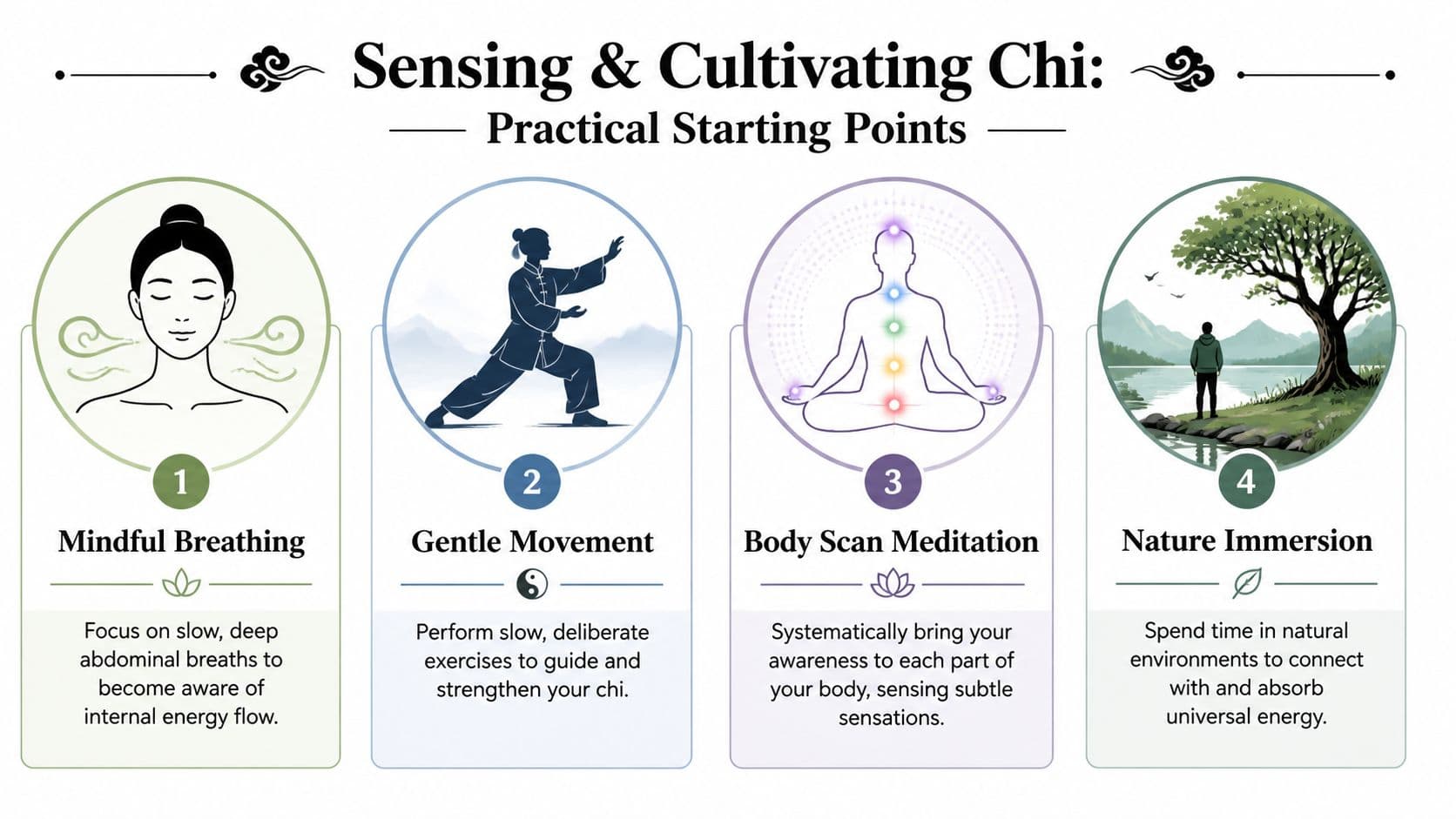
Four reliable entry points
Mindful breathing
Abdominal breathing is one of the simplest ways to gather scattered energy. It gives the nervous system a clearer rhythm and draws attention out of constant mental chatter.
This doesn’t need to be elaborate.
- Keep the breath gentle so you don’t create strain.
- Let the exhale lengthen naturally instead of forcing it.
- Notice the lower torso rather than breathing high into the chest.
Many people try too hard here. If you get lightheaded, tense, or self-conscious, ease off. Better to practice in private for a short time than to perform relaxation.
Gentle movement
Qigong and Tai Chi help many people because they combine posture, breath, intention, and slow coordinated motion. That combination makes internal states easier to feel.
If you want a beginner-friendly place to start, these chi gong exercises for beginners offer a practical on-ramp.
What matters most in the beginning isn’t precision. It’s quality of attention. Move as if you’re trying to reduce static, not impress anyone.
Body scan meditation
Stillness reveals things speed hides. A body scan helps you notice where energy feels open, numb, contracted, warm, restless, or heavy.
Work gradually from head to toe, or from feet to head. Don’t chase special sensations. Stay curious about ordinary ones.
Some days chi feels like warmth or flow. Other days it feels like simple contact with your own body. Both count.
Nature immersion
Natural settings often make chi easier to sense because they reduce competing signals. Trees don’t ask anything from you. Water doesn’t need your opinion. A quiet walk can settle an overstimulated system in a way indoor effort sometimes can’t.
Stand near moving water, sit under a tree, or walk without headphones. Pay attention to what happens to your breath and shoulders after a few unhurried minutes.
Choosing a practice that fits your life
| Practice | Primary Focus | Physical Intensity | Best For |
|---|---|---|---|
| Mindful breathing | Regulation and grounding | Low | Busy people who need a simple daily reset |
| Qigong | Energy flow and coordination | Low to moderate | Beginners who want structure without strain |
| Tai Chi | Moving meditation and balance | Low to moderate | People who enjoy learning sequences |
| Body scan meditation | Interoception and calm | Low | Those who feel disconnected from bodily signals |
| Nature immersion | Recovery and settling | Low | Anyone overstimulated by screens and noise |
Cautions that matter
A grounded practice includes limits.
- Start small. More isn’t always better with energy work.
- Stop if you feel worse in a sustained way. Agitation, dizziness, or emotional flooding means slow down.
- Look for qualified instruction if you want to go deeper, especially with advanced breath practices.
- Respect medical needs. Chi cultivation can support wellbeing, but it doesn’t replace proper care.
Some people like to pair reflective practices with other forms of intentional self-experimentation. If that’s your style, explore this microdosing protocol carefully and critically. Not because it’s part of chi practice, but because people often ask how different self-discovery methods compare. My advice is the same across all of them. Go slowly, know why you’re doing it, and don’t confuse intensity with insight.
Chi and the Lens of Science
The honest scientific position is straightforward. Science hasn’t settled the ancient concept of chi as a literal life force. What it can do is measure the effects of practices associated with chi cultivation.
That’s a meaningful distinction.
What researchers can actually measure
When people practice Qigong or Tai Chi, researchers can look at stress, sleep, and physiological regulation. Those are observable outcomes. They don’t prove every traditional explanation, but they do tell us whether a practice changes the body in reliable ways.
A 2023 meta-analysis in the Journal of Alternative and Complementary Medicine covering 25 RCTs with n=1,872 found that Qigong and Tai Chi significantly reduced chronic stress with effect size d=0.65, p<0.001, and improved heart rate variability by 12 to 18% compared to controls, according to the cited summary here. The same source also notes that 2025 wearable tech studies reported 22% better sleep scores after chi meditation, and because those findings are future-dated in the source, it’s best read as a reported projection rather than a settled present-day fact.
Why HRV gets so much attention
Heart rate variability, or HRV, matters because it gives a window into how flexibly the autonomic nervous system is functioning. In plain language, it reflects how well your system shifts between activation and recovery.
That’s one reason wearables have made this conversation more practical. People who would never use the language of chi may still notice patterns in sleep readiness, stress signals, and recovery trends. If ancient language feels too loaded, you can approach the same territory through measurable regulation.
For a broader reflection on that bridge between subtle experience and modern frameworks, this piece on energy, frequency, and vibration is worth reading with a critical but open mind.
A skeptical view can still be useful
You don’t need to claim more than the evidence supports. It’s enough to say this: certain breath, movement, and attention practices appear to produce measurable benefits in stress regulation and recovery. That’s already significant.
If someone calls that chi and another person calls it improved nervous system balance, they may be pointing to overlapping territory from different directions.
Important Note Chi Energy vs Chi-Square Statistic
A quick clarification will save some readers a lot of confusion. Chi energy and the chi-square statistic have nothing to do with each other.
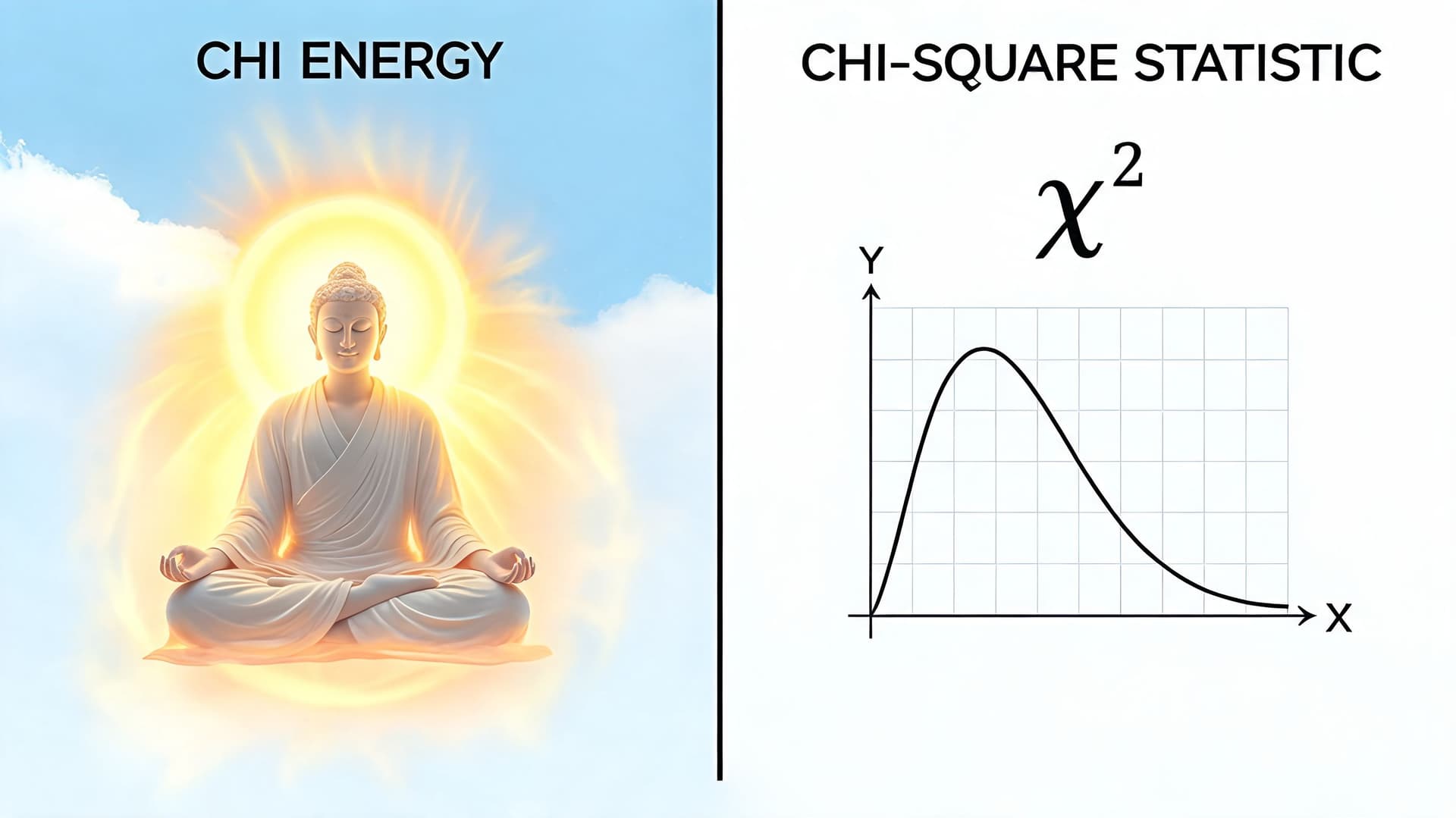
The chi-square statistic (χ²) was formulated by Karl Pearson in 1900 and is a tool in non-parametric statistics used to analyze categorical data independence, with a landmark example in genetics for checking Mendel’s 3:1 ratios, as described in this overview from PMC.
The phrase power of a chi-square test belongs to statistics too. It refers to the probability of correctly rejecting a false null hypothesis. In other words, it tells researchers how likely a test is to detect a real effect and avoid a Type II error.
If you searched “powers of chi” and landed in a statistics discussion, that’s why. Search engines often mix these topics because they share a word, not a meaning.
One term points to vitality in traditional wellness systems. The other points to a mathematical test. Same sound, different world.
Chi Life Purpose and Spiritual Growth
Once people start caring for their energy, a deeper question often follows. What is this energy for?
That’s where chi becomes more than a wellness concept. When your system is less scattered, you can hear your own life more clearly. Not as a booming cosmic message, but as steadier discernment. You notice what drains you, what strengthens you, what feels true, and what keeps pulling you off your path.
Energy is the fuel, not the map
Strong chi doesn’t automatically tell you your purpose. It gives you the steadiness to live the question with more honesty.
Structured self-reflection proves beneficial. If you’re exploring numerology, life paths, or life numbers, I’d point you to Dan Millman’s book, The Life You Were Born to Live, because it offers a framework people can engage with thoughtfully rather than vaguely. Used well, that kind of system can support self-observation, especially when paired with real-world practices that keep you grounded in your body.
Growth becomes more usable when you’re regulated
Many people chase insight while ignoring capacity. They want clarity about relationships, vocation, and spiritual direction, but they’re trying to do it from a fried nervous system and a drained body.
That rarely works well.

A better approach is simpler. Build energy. Protect it. Refine attention. Then let your larger questions meet a stronger container. Chi practice won’t hand you a finished identity, but it can help you become the kind of person who can listen, choose, and follow through with more integrity.
If you want a practical tool for self-discovery alongside Dan Millman’s The Life You Were Born to Live, the Life Purpose App offers a structured way to explore life paths, cycles, gifts, and challenges in everyday terms. It’s a useful next step if you’re ready to pair inner work with a clearer framework for direction.
Discover Your Life Purpose Today!
Unlock your true potential and find your life’s purpose.
