April 5, 2026 (Today)

What is the symbol of life: Symbol Of Life Meanings: Ankh, Tree Of Life & More

What is the symbol of life? Explore powerful meanings behind the Ankh, Tree of Life, & Flower of Life. Find the emblem that speaks to you.

← Back to blog
Cover Image for What is the symbol of life: Symbol Of Life Meanings: Ankh, Tree Of Life & More

What is the symbol of life? Explore powerful meanings behind the Ankh, Tree of Life, & Flower of Life. Find the emblem that speaks to you.

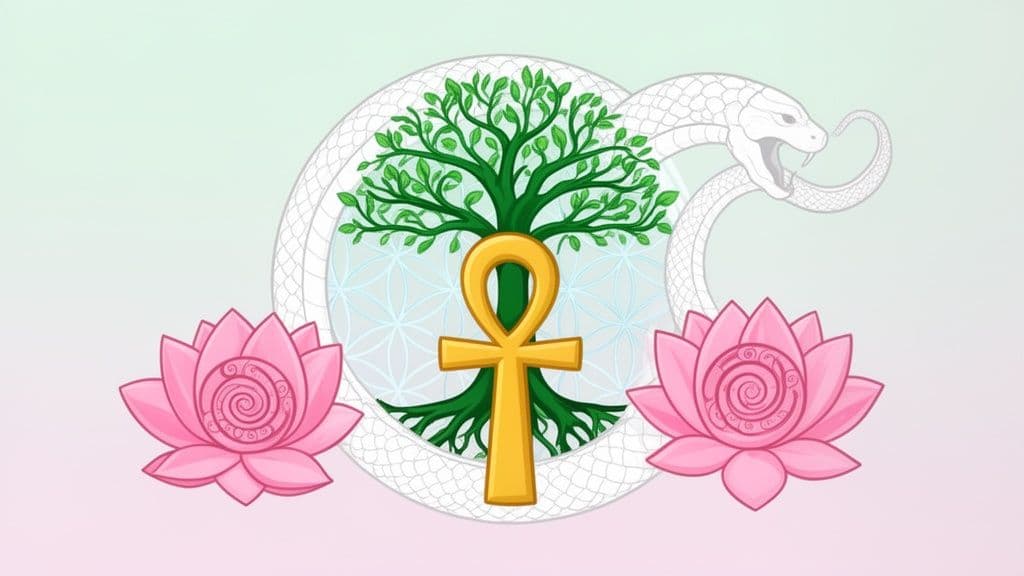
If you’ve ever wondered, “What is the symbol of life?” you’re not alone. It’s a question that has echoed through human history, and the answer isn't a single, neat image. Instead, it’s a rich tapestry of powerful emblems woven by cultures all over the world, each one capturing a different facet of what it means to be alive.

The Search for Life's Signature Symbol

Think about it—from the earliest cave paintings to modern art, we've always used visual language to grapple with life's big questions. These symbols are so much more than just ancient doodles. They're visual anchors that connect us to profound ideas like eternity, growth, creation, and the cyclical nature of everything.

As we dive in, we'll look at some of the most powerful and enduring symbols that different traditions have offered up as an answer to that big question: what is the symbol of life?

  • The Egyptian Ankh: Often called the "key of life," it represents eternal existence and the breath of life.
  • The Universal Tree of Life: This symbol maps the connection between the heavens, the earth, and the underworld.
  • The Sacred Flower of Life: A geometric pattern seen as the very blueprint for all creation.

Each one gives us a unique lens for seeing our own lives and our place in the grand scheme of things. Finding a symbol that truly clicks with you can be a deeply personal journey of self-discovery. In many ways, it’s like finding your unique life path in the system from Dan Millman's book, The Life You Were Born to Live, and its companion Life Purpose App. Both symbols and life paths can serve as powerful guides, helping you align with your innermost purpose and energy.

The real power of a symbol isn't just in its historical meaning but in how it speaks to your personal story. It becomes a visual reminder of what you value most—be it strength, growth, connection, or transformation.

For many, the most potent symbols are those that reflect change and renewal. The powerful meaning of a butterfly tattoo and its symbolism, for example, offers a beautiful meditation on transformation and new beginnings. Symbols from the natural world—the butterfly emerging from its chrysalis, the lotus flower blooming from the mud, the simple egg holding new life—all capture these cycles in a way that feels instantly familiar.

As we explore these ancient and modern designs, you'll start to see how they all point toward the same incredible, unfolding mystery that is life itself.

The Ankh: The Egyptian Key of Life

If you ask someone to picture a symbol of life, chances are the Ankh is one of the first images that comes to mind. This iconic emblem from ancient Egypt, often called the “key of life,” is instantly recognizable. With its distinct looped top and cross-like base, it's so much more than a relic from the past; it’s a powerful, enduring statement about the very nature of existence.

A radiant golden Ankh symbol, an ancient Egyptian hieroglyph representing life, on a textured background.

In the art and stories of ancient Egypt, you see the Ankh everywhere. Gods and goddesses like Isis, who wielded magic and healing, and Osiris, the lord of the afterlife, are almost always depicted holding one. For them, it wasn't just an accessory—it was the symbol of their divine authority over life and death and their power to grant immortality.

But the Ankh wasn't reserved for the gods alone. It was also a vital protective amulet for everyday Egyptians, believed to offer vitality and good health in this life and to ensure a safe passage into the next.

From Ancient Amulet to Modern Icon

The Ankh's incredible journey through time shows just how potent its meaning is. First appearing around 2700 BC, this "key of life" was often shown in the hands of gods like Ra and Isis, who used it to grant eternal life to pharaohs. Soon, people began wearing Ankh-shaped amulets for protection and placing them in tombs to secure a blessed afterlife. Centuries later, Coptic Christians in Egypt adapted the symbol into the crux ansata (the "handled cross") by 391 AD.

Fast forward to the 1960s, and the Ankh found a powerful new voice in Western culture. It was widely adopted as a symbol of African identity, reportedly used by 80% of Black Power movements, and also found a home in Neopagan and goth subcultures. You can dive deeper into the fascinating histories of symbols like this in our article on archetypes in mythology.

In modern holistic circles, the Ankh often stands for the eternal, cyclical nature of life. This idea of a continuous life force has an interesting parallel in modern purpose-finding systems. For example, the Life Purpose App, based on Dan Millman’s bestseller The Life You Were Born to Live, calculates your unique life path using your birth date. Just as the Ankh symbolizes a key to unlocking eternal life, understanding your life path can feel like finding the key to your personal purpose. Unlocking the full text from the book's 25th Anniversary Edition reveals deep insights into your core gifts, guiding you toward more purposeful living. For more on the Ankh's rich history, explore the National Park Service's research on this ancient symbol.

The Ankh represents the union of opposites—male and female, earth and sky, life and afterlife. The loop symbolizes the eternal soul, while the cross represents the material world, making it a complete picture of existence.

Today, its core message of life eternal continues to resonate with people all over the world. Whether you see it as jewelry, in spiritual practices, or as a piece of art, the Ankh remains a timeless and profound answer to the question, "what is the symbol of life?"

The Tree of Life: A Universal Symbol of Connection

If the Ankh is a key to life, then the Tree of Life is its roadmap. You'll find this ancient symbol woven into the fabric of countless cultures, from Norse sagas to the mystical teachings of Kabbalah. It feels less like something someone invented and more like a truth we all collectively discovered. Its real power comes from its beautiful, intuitive visual for life itself.

It tells a complete story, one that mirrors our own journey perfectly.

Think of the roots, digging deep into the earth. They are our foundation—our ancestry, our history, and the things that ground us. They’re the unseen strength that keeps us stable through any storm. From that foundation rises the trunk, solid and strong. This is you, right now: your personal strength, your core self, bridging the gap between your inner world and the life you live.

And then, there are the branches. They reach, stretch, and twist towards the sky, representing our hopes, our dreams, and our connection to something bigger than ourselves. The branches are all about our potential and the future we’re working to create. This isn’t just an old drawing; it's a living framework for seeing how our past grounds us, our present defines us, and our future calls to us.

A Symbol of Growth and Interconnection

The Tree of Life isn't static. It breathes with the seasons, losing its leaves only to grow them back again. This powerful cycle of death and rebirth speaks to a deep truth about resilience. It’s a constant reminder that sometimes we have to let go of the old to make room for the new—a theme we all know well from our own lives.

Its sprawling canopy also speaks to the profound interconnectedness of everything. Just as every single root, branch, and leaf is part of one unified tree, each of us is connected to our families, our communities, and the world at large.

This idea of a tree embodying a life's journey is captured beautifully in a specific living art form: the Bonsai. A miniature tree is far more than just a plant; it's a testament to patience, balance, and harmony. You can explore the rich world of Bonsai Tree Symbolism to see another powerful take on life's journey and resilience.

The Tree of Life teaches a fundamental truth: to grow tall, you must have deep roots. It’s a reminder that personal and spiritual growth requires a strong, grounded foundation.

This notion of having a unique blueprint for growth shows up in modern tools for self-discovery, too. Take Dan Millman’s work in The Life You Were Born to Live, which suggests everyone has a distinct life path outlining their purpose and challenges. The companion Life Purpose App helps you find yours. In the same way the Tree of Life maps the connections between earth and sky, understanding your life path can help you map your own journey, tying your daily experiences to a much bigger purpose.

The Flower Of Life: A Geometric Blueprint For The Universe

Not all symbols of life are drawn from the living world of plants and animals. Some of the most profound are found in the pure, elegant language of geometry. The Flower of Life is a stunning example—a complex pattern of 19 overlapping circles that has captivated philosophers, artists, and spiritual seekers for millennia.

This isn't just a pretty design. It's a core piece of what's known as sacred geometry, where shapes and patterns are believed to reveal the hidden order of the universe. Many see the Flower of Life as nothing less than the visual blueprint for existence itself.

An Ancient, Global Mystery

The symbol’s roots run deep and spread wide across the ancient world. You'll find some of the oldest known examples, etched into stone at least 6,000 years ago, at the Temple of Osiris in Abydos, Egypt. But its journey doesn't stop there.

The pattern appears in ancient synagogues in Israel, carved into the Forbidden City in China, and woven into the art of Buddhist temples from India to Japan. In the mystical tradition of Kabbalah, it's even seen as the source from which the more familiar Tree of Life grows. It’s a truly global symbol, and you can dig deeper into its ancient secrets to see just how widespread its influence was.

The Building Blocks Of Creation

The beauty of the Flower of Life is how it unfolds from such a simple beginning. It starts with just one circle. A second circle is drawn over the first, creating an almond-shaped overlap called the Vesica Piscis. As more circles are added, new forms emerge.

The first seven circles create a pattern known as the Seed of Life, often seen as a symbol for the seven days of creation. The completed 19-circle pattern is thought to contain every fundamental shape and pattern, forming a kind of universal template for everything from atoms to galaxies. It’s a powerful visual reminder that everything is connected, originating from a single source.

The Flower of Life shows us that from one simple start, infinite complexity and beauty can emerge. It’s a deep truth: everything in existence, from the smallest particle to the vastness of space, shares a common origin and is part of a single, unified whole.

This idea of an underlying pattern in the cosmos has a fascinating parallel in understanding our own lives. Think of the work of Dan Millman in The Life You Were Born to Live, which inspired the Life Purpose App. The app uses your birth date to map out your unique life path—one of 45 distinct possibilities—and even charts your personal 9-year cycles.

Just as the Flower of Life reveals a grand cosmic design, this system helps you see the elegant structure within your own personal journey. It’s a powerful way to see that your life isn’t random but follows a pattern that’s waiting to be discovered.

The image below uses the Tree of Life to illustrate a similar concept of life's interconnected and structured journey.

A diagram illustrating the Tree of Life concept with branches, trunk, and roots connected to ancestors and descendants.

While the Flower of Life uses geometry to show a universal blueprint, the Tree of Life model here breaks a personal journey into its essential parts: grounding roots, a strong trunk for the present, and branches reaching toward the future.

The Star of Life: A Modern Emblem of Hope

Not all symbols of life are thousands of years old. Some of the most powerful ones were created right in our own time, designed to meet urgent, real-world needs. Think about the last time you saw an ambulance speeding by. That bold, blue, six-pointed star you saw is the Star of Life, and it’s one of the most recognized symbols of survival in the world today.

Unlike the ancient mysteries we've explored, this symbol wasn't born from spiritual contemplation. It was forged out of necessity, a modern emblem of hope representing immediate, life-saving action.

The Six Points of Survival

The Star of Life is a surprisingly recent invention. It was created in 1973 by Leo R. Schwartz, who was then the Chief of the EMS Branch for the National Highway Traffic Safety Administration (NHTSA). His goal was to create a single, universal symbol for emergency medical services—and he succeeded. You can get the full story on its creation from the city of Albuquerque's detailed history of this vital emblem.

Each of its six points represents one link in the critical chain of survival. It’s a complete system for saving a life.

  • Detection: The first people at the scene notice the incident and realize there's a problem.
  • Reporting: A call for professional help is made.
  • Response: Emergency responders are sent out and head to the scene.
  • On-Scene Care: Medical teams arrive and begin providing immediate care.
  • Care in Transit: The patient receives ongoing medical care while being transported.
  • Transfer to Definitive Care: The patient is safely handed off to the specialized staff at a hospital.

This action-oriented design feels a world away from the cosmic, spiritual meanings of the Ankh or the Tree of Life. Yet, at their core, they all serve the same purpose: to place immense value on life and to represent hope.

At the heart of the Star of Life is the Rod of Asclepius—the classic symbol of medicine showing a serpent wrapped around a staff. This ancient Greek emblem grounds the modern star in a long, continuous history of healing, reminding us how we’re always building on the wisdom of those who came before.

This modern drive to create systems for clarity and purpose isn't limited to emergencies. Tools like the Life Purpose App, which is based on Dan Millman’s work in The Life You Were Born to Live, provide a similar kind of roadmap for our personal journeys. By using your birth date, the app helps you uncover one of 45 different life paths, highlighting your own strengths, challenges, and purpose.

In a way, it’s just like the Star of Life. One gives you a clear system for saving a life, and the other can give you clarity and direction for living yours.

How To Choose Your Personal Symbol for Life

We've walked through a gallery of history's most powerful symbols of life, seeing what they meant to entire civilizations. But now, let's bring it back home. The most meaningful symbol isn't one from a history book; it's the one that speaks directly to you and anchors your own unique journey.

Hands balancing various symbols of life, nature, and spirituality, including an Ankh and Tree of Life.

Think of this less as a test and more as an act of self-discovery. There are no wrong answers here, only what feels true in your gut. The best way to start is simply by asking yourself a few quiet questions.

Reflect on Your Core Values

Right now, in this chapter of your life, what does "life" really feel like? Is it about resilience and inner strength? Maybe it's about connecting more deeply with family and friends, or perhaps it’s a season of profound personal growth.

Think about the qualities you want to invite into your life.

  • For strength: You might feel a pull toward the unshakeable image of a mountain, the deep-rooted power of an oak tree, or even the quiet courage of a lion.
  • For growth: Does a spiral, endlessly expanding outward, feel right? Or maybe the image of a lotus flower blooming from the mud, or a tiny seed just beginning to sprout.
  • For connection: Perhaps the interconnected branches of the Tree of Life resonate, or the simple, unbreakable loop of a Celtic knot.
  • For transformation: Consider the butterfly emerging from its chrysalis, the snake-like Ouroboros shedding its skin, or the ever-changing phases of the moon.

This is all about listening to your intuition. Don't force it. Just notice what images pop into your head when you think about your path. The idea is to find a visual that feels like coming home. This process is really at the heart of learning how to connect with yourself on a deeper level.

Your personal symbol doesn’t have to be ancient or famous. It can be something you create yourself—a simple doodle that captures a feeling, a combination of shapes, or a modern image that tells your story.

Finding a personal symbol is a lot like the clarity you gain from understanding your life path. As Dan Millman explains in his book, The Life You Were Born to Live, and its companion Life Purpose App, your life path number provides a blueprint for your journey. Your symbol then becomes the visual touchstone for that blueprint—a small, daily reminder of your purpose, your strengths, and the incredible life you are building.

Frequently Asked Questions About Life Symbols

It's natural to have questions as you dive into the rich world of life symbols. After all, we're talking about concepts that have captivated humanity for thousands of years! Let's clear up some of the most common points of curiosity.

Is There One Correct Symbol of Life?

Not at all. There is no single, universally "right" symbol of life. The beauty of these emblems lies in their diversity. Cultures across the globe developed symbols like the Ankh, the Tree of Life, and the Ouroboros to express their own unique understanding of the world.

The most meaningful symbol is simply the one that feels true to you. It's about personal resonance, not a popularity contest.

The most powerful symbol of life is the one that speaks your personal truth. It doesn't need to be ancient or famous; it just needs to feel like an authentic reflection of your path and your spirit.

Can I Use These Symbols Even If I'm Not from That Culture?

Yes, you absolutely can. Many of these ancient symbols have grown beyond their original roots to become global icons, representing universal ideas like growth, eternity, and our shared human experience.

The key is to approach them with respect. Taking a moment to learn about a symbol's history and original meaning enriches your connection to it and ensures you're honoring its legacy, even as you make it your own.

How Does Knowing My Life Path Relate to These Symbols?

Think of your life path as the specific map of your personal journey, and these ancient symbols as the universal landmarks along the way. When you understand your core purpose—say, through a system like the one in Dan Millman's book The Life You Were Born to Live and the Life Purpose App—you gain a blueprint of your inherent strengths and challenges.

This self-knowledge acts like a magnet. You might find that certain symbols naturally align with your path. For example, someone whose purpose involves nurturing connections might feel a strong pull toward the Tree of Life, while someone on a quest for higher truth might resonate deeply with the Ankh. The symbol becomes a powerful, personal touchstone for your unique journey.


Ready to discover your own life blueprint? The Life Purpose App offers instant access to the wisdom system from Dan Millman’s bestselling book. Uncover your unique life path and gain clarity on your purpose. Find out more at the Life Purpose App website.

← Back to blog

Discover Your Life Purpose Today!

Unlock your true potential and find your life’s purpose.